placeholder image to represent content

Earth History (SI)

Quiz by Norman Mitchell

Our brand new solo games combine with your quiz, on the same screen

Correct quiz answers unlock more play!

New Quizalize solo game modes
14 questions
Show answers
  • Q1
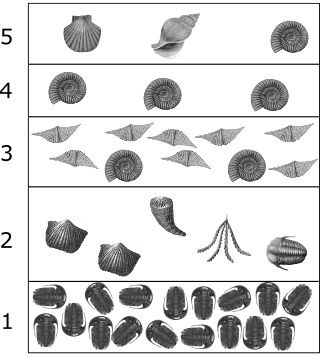
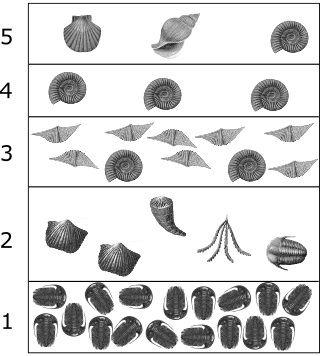
    The diagram represents a stack of rock layers. What do these layers and their fossils suggest about Earth's history?
    Question Image
    No lifeforms were present when these layers formed.
    Lifeforms on Earth have been the same over time.
    Only one kind of lifeform lived where these layers formed.
    There have been changes in Earth's lifeforms over time.
    30s
  • Q2
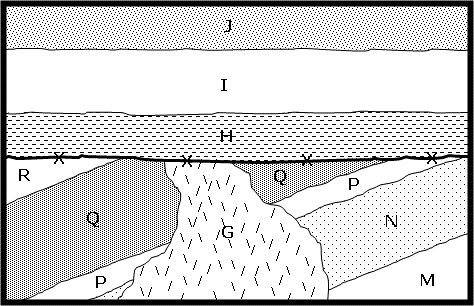
    The diagram shows several rock layers and other geologic features. Using the principles of original horizontality, superposition, and cross-cutting relationships, determine which of the following features is the youngest.
    Question Image
    H
    N
    G
    R
    30s
  • Q3
    The image shows a diagram of a reverse fault. What formation will be created on the side of the fault labeled A if the land shifts in the direction of the arrow?
    Question Image
    mountain ridge
    valley
    flood plain
    cave
    30s
  • Q4
    The diagram shows a cross section of a hillside. Four rock units are shown in the cross section. Which of these units is the youngest?
    Question Image
    limestone unit
    igneous unit
    shale unit
    sandstone unit
    30s
  • Q5
    The image shows a stack of rock layers exposed in a cliffside. These layers have a fault running through them. A fault is a crack along which rocks move. When these layers first formed long ago, there was no fault present. At some time later, tectonic forces cracked the layers, forming the fault. Then, the rocks on either side of the fault moved. Using the layer marked a as a guide, determine how the rocks moved along the fault.
    Question Image
    The rocks on the left side moved up, and the rocks on the right side moved down.
    The rocks on the right side moved up, and the rocks on the left side moved down.
    The rocks on both sides of the fault moved down the same distance.
    The rocks on both sides of the fault moved up the same distance.
    30s
  • Q6
    A geologist finds ripples preserved in ancient sedimentary rock that look just like ripples made by water in mud. He concludes that there was once water in that location that created the ripples. Why is this conclusion reasonable?
    because water and mud behaved very differently in the past than they do today
    because sedimentary rock never forms from mud
    because sedimentary rock always forms under water
    because water and mud behaved in a similar way in the past as they do today
    30s
  • Q7
    Which statement about the movement of Earth's crust along a fault line is true?
    Only vertical, up-and-down movement occurs along faults.
    Only horizontal, side-to-side movement occurs along faults.
    Crustal movement does not occur along fault lines.
    Different types of movement occur along different types of faults.
    30s
  • Q8
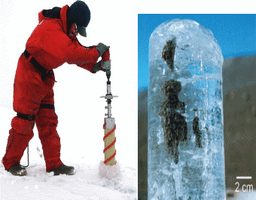
    When looking for supportive evidence of global warming over time, how might you learn the most about climate change in a tundra region?
    radiometric data
    water cycle
    rock layers
    ice coring
    30s
  • Q9
    One method that scientists use to study the Earth's climate history is to dig deep into glaciers and compare the composition of the fallen snow and ice from previous time periods to the snow and ice that falls today. They also compare the composition of tiny air bubbles in the ice to air today. Scientific information that is gathered in this manner is known as _______.
    ice flow data
    ice core data
    snow gauge data
    rain gauge data
    30s
  • Q10
    If scientists find an ice core from 30,000 years ago that contains chemicals radically different than the chemicals that are around today, they would likely conclude that _______.
    the number of layers they counted was incorrect.
    the atmosphere never changes its composition.
    these chemicals are abundant today.
    the atmosphere 30,000 years ago was different than our atmosphere today.
    30s
  • Q11
    Faults are
    cracks where pieces of the Earth's crust move past each other due to tectonic forces.
    found only in the center of the Earth's continents.
    cracks that prevent tectonic forces from moving pieces of the Earth's crust.
    found only in the center of the Earth's oceans.
    30s
  • Q12
    According to the law of superposition, younger layers of rock are generally found above older layers of rock. However, there are locations where older layers are found above younger layers. Which of the following can cause this to happen?
    all of these
    Older rock layers can slide above younger rock layers along faults.
    Rock layers can overturn as they are folded.
    During uplift, rock layers can tilt enough to overturn.
    30s
  • Q13
    A geologist is studying an ancient stack of rock layers. Most of the layers contain fossils of shallow marine creatures (clams, corals, etc.), suggesting the layers formed in a shallow ocean environment. But at the top of the stack, there is a layer that could only have been deposited by a river. What does this change in rock layers tell the geologist about Earth's history in the area where these layers formed? (Assume the layers have not changed position since they formed.)
    The environment changed suddenly from a shallow ocean setting to a river system.
    A mass extinction caused a river system to form where there used to be a shallow ocean setting.
    The environment changed suddenly from a river system to a shallow ocean setting.
    A volcanic eruption must have occurred nearby, which scared the sea creatures away.
    30s
  • Q14
    Fossils of a primitive whale called Basilosaurus have been found in many parts of the southeastern U.S., including the Gulf states of Mississippi, Alabama, and Louisiana. This creature lived in the sea during the Eocene epoch, which lasted from about 55 million to 34 million years ago. What do these fossils suggest about the areas of land in which they are found?
    The areas were deserts in the past.
    The areas were once covered by the sea.
    Humans and Basilosaurus lived in the areas together.
    Humans lived in the areas before Basilosaurus.
    30s

Teachers give this quiz to your class