


Ecology Pre-test
Quiz by POLANCO
Feel free to use or edit a copy
includes Teacher and Student dashboards
Measure skillsfrom any curriculum
Measure skills
from any curriculum
Tag the questions with any skills you have. Your dashboard will track each student's mastery of each skill.
With a free account, teachers can
- edit the questions
- save a copy for later
- start a class game
- automatically assign follow-up activities based on students’ scores
- assign as homework
- share a link with colleagues
- print as a bubble sheet
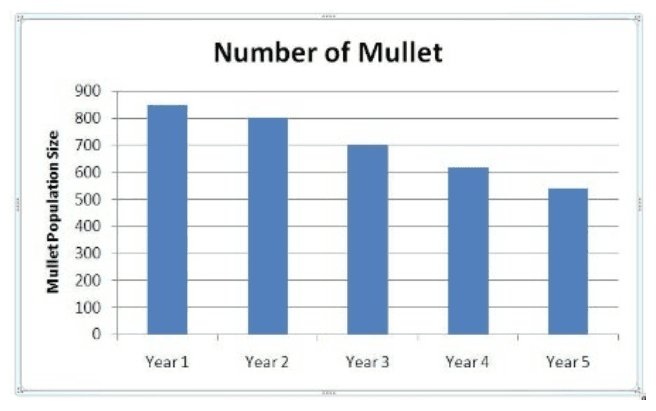
- Q 1/20Score 0Mullet are local estuarine fish that move in schools and feed on plankton and plant matter. Natural predators of the mullet include spotted sea trout, sharks, pelicans and dolphins. The graph below shows how the number of mullet in an area has changed over time. Based on the data, one student concludes that a new predator was introduced into the area during this time period. Which of the following is a likely alternate explanation for the change in the mullet population?29mullet prey increased in the areathe temperature of the area increasedthe amount of aquatic plants in the area decreasedmullet parasites decreased in the area


20 questions
Show answers
- Q1Mullet are local estuarine fish that move in schools and feed on plankton and plant matter. Natural predators of the mullet include spotted sea trout, sharks, pelicans and dolphins. The graph below shows how the number of mullet in an area has changed over time. Based on the data, one student concludes that a new predator was introduced into the area during this time period. Which of the following is a likely alternate explanation for the change in the mullet population?mullet prey increased in the areathe temperature of the area increasedthe amount of aquatic plants in the area decreasedmullet parasites decreased in the area30s
- Q2How does the predator-prey relationship affect a population?The predators and prey are in competition with each other.The relationship controls the population size of both species.Usually either the predator or the prey will become extinct.The predator species usually has exponential growth.30s
- Q3Data on the immigration and emigration of a fish species would be most helpful in determining which of the following?predator-prey relationshipsinterspecies competitionbiological magnificationpopulation of the species30s
- Q4When an environment has reached its carrying capacity for a certain population, which of the following is true?Growth and immigration rate is less than death and emigration rate.Growth and immigration rate is equal to death and emigration rate.Growth rate is exponential.Growth and immigration rate is greater than death and emigration rate.30s
- Q5The pH of the water in several lakes in Norway and Sweden had decreased to below 5.0 due to an increase in acid rain. Which of the following is most likely to happen in these lakes?an increase in the amount of primary producersthe decline of several fish populations.an increase in numbers of fishincreased predator-prey relationships30s
- Q6Which of the following is a limiting factor in a population of organisms.availability of foodlife spans of the membersfluctuations in atmospheric temperaturereproductive replacement30s
- Q7Which of the following are abiotic factors that shape ecosystems?sunlight, mushrooms, and windwind, precipitation, and soil typeniches, trees, and bacteriaworms, plants and temperature30s
- Q8The common brushtail possum is a marsupial native to Australia. This possum was introduced to New Zealand where it had no natural predators and had an abundant food supply. Which of these likely occurred a few years after the introduction of this possum to New Zealand?The possum population grew to a larger size.The possum population evolved into a different species.The possums developed shorter life spans.The possums became extinct.30s
- Q9The number of pythons found throughout Everglades National Park has increased in recent years. These huge snakes are not native to Florida and are believed to have been released into the wild by pet owners. Wildlife biologists have initiated attempts to capture and remove these pythons. Which statement best explains the biologists' reasons for removing these pythons from the Everglades?The pythons could adapt to overcome diseases common to native snakes.The pythons could upset the territorial boundaries of native organisms.The pythons could prey on native organisms and cause native population to decline.The pythons could begin to interbreed with native snakes and produce a more successful species.30s
- Q10Why are there so few aquatic plants and phytoplankton that live at the bottom zones in the ocean?Most sunlight is absorbed before reaching these levels.The temperature in these zones is extremely low.Water is a limiting factor.The ocean floor contains many decomposers.30s
- Q11A team of ecologists observed feeding patterns of several populations in the desert. The energy pyramid shown below depicts the feeding patterns the ecologist observed. Which of the following best explains the difference in the amount of available energy in the trophic levels of the desert ecosystem?There is more energy available in the second trophic level because less energy is needed for hunting compared to the higher trophic levels.There is more available energy in the birds of prey because they have greater muscle mass for storing energy than organisms in lower trophic levels have.There is less available energy in the fourth trophic level because of the loss of energy through metabolism in each of the lower trophic levels.There is less energy available in the producers because their tissues are less dense than those at higher trophic levels.30s
- Q12A diagram of a food web is shown below. Which organism receives the least amount of energy from the producers?HawkGrasshopperMouseRabbit30s
- Q13The diagram below shows the cycling of nutrients in an ecosystem. The removal of which of the following groups would cause an immediate decrease in the amount of energy flowing through the system?Inorganic nutrientsProducersConsumersDecomposers30s
- Q14Complete burning of plant material returns carbon primarily to theherbivoresatmospherevegetationwater30s
- Q15Which of these organisms would most likely be found at the top of an energy pyramid?sharks - a secondary consumersardines - a primary consumerclams - a primary consumerkelp - a primary producer30s


