Feel free to use or edit a copy
includes Teacher and Student dashboards
Measures 1 skill from
Track each student's skills and progress in your Mastery dashboards
- edit the questions
- save a copy for later
- start a class game
- automatically assign follow-up activities based on students’ scores
- assign as homework
- share a link with colleagues
- print as a bubble sheet
- Q1
What would most likely happen to the populations of organisms in the forest ecosystem if there were no rain for a very long time?
A. The grass and tree populations would increase because they only need sunlight and soil to get nutrients.
D. The populations of all the forest organisms would decrease because producers would not be able to survive to supply nutrients to the consumers.
B. The populations of all the forest organisms would remain the same because water only affects other nonliving factors.
C. The hawk and rabbit populations would increase because they would not have to compete with grass and tree populations for water.
300sS4L1 - Q2
Developers cleared a small forest to build an apartment complex near Marie's house. As a result, the amount of habitat for hawks decreased significantly. Since hawks eat mice, what is most likely to happen to the population of mice now that the hawks have fewer places to live?
C. The population of mice will increase.
D. The population of mice will decrease.
B. The population of mice will remain the same.
A. The population of mice will move to another area.
300sS4L1 - Q3
How would a prey species most likely be affected if disease killed most of the predator species?
B. The prey population would need to find other food.
D. The prey population would increase.
A. The prey population would decrease.
C. The prey population would start hunting the predators.
300sS4L1 - Q4
In a forest ecosystem, a disease killed many of the rodents. Which of the following is most likely to occur after this happens?
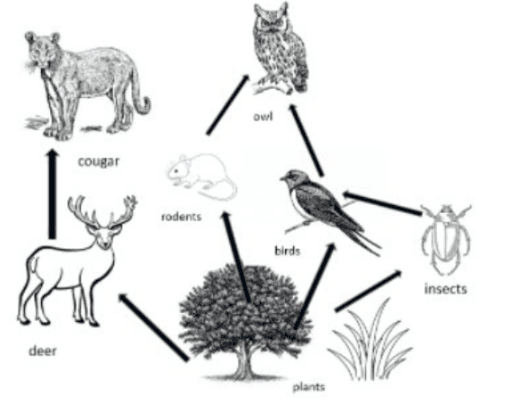
B. The plant population will decrease.
C. The insect population will decrease.
A. The numbers of owls will decrease.
D. The number of deer will decrease.
300sS4L1 - Q5
Use the photograph below to help you answer the question.
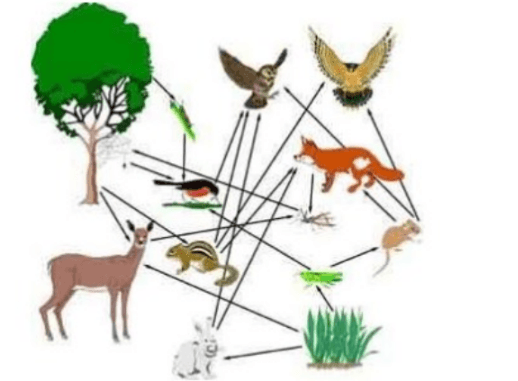
A. Parts of the community would have less shade.
B. The consumers in the community that depends on trees will have to find another producer that will meet their needs.
D. The consumers in the community would decrease as they would not have anything to eat.
C. The consumers in the community that depends on trees will begin depending on other decomposers to fill the void of the smallest trees.
300sS4L1 - Q6
A student made a model of a food web in Australia.
A widespread forest fire burned down most of the eucalyptus trees. How would this affect the community?
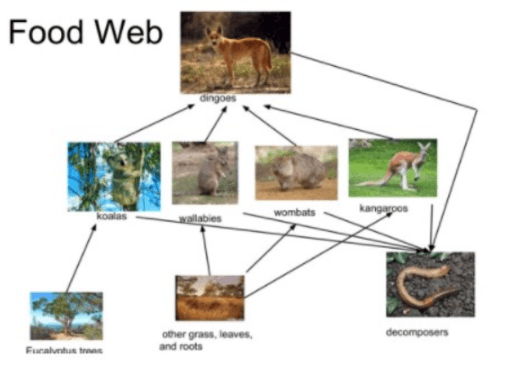
C. The koala population would also go down because they would have no food to eat, therefore, also decreasing the dingo population since they would have less koalas to eat.
D. The kangaroo population would also go down because they would not have any food to eat, therefore, also decreasing the dingo population since they would have less kangaroos to eat.
A. The community would remain unaffected. There is still another producer that the consumers can all eat.
B. The koala population would also go down because they would have no food to eat, but the rest of the ecosystem will be unaffected.
300sS4L1 - Q7
The table shows the basic needs of a robin.
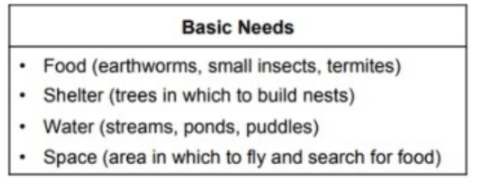
B. Beavers building a dam to create a pond.
C. Humans cutting down trees to build houses.
D. Ants building large anthills in a schoolyard.
A. Prairie dogs digging tunnels in the ground.
300sS4L1 - Q8
The graph shows the sizes of two populations. The hare is the prey, and the lynx is the predator.
Using the graph, which statement describes the changes in the ecosystem between 1910-1913?
C. When the population of the hair became scarce, the population of the lynx increased.
B. When the population of the hare became over-abundant, the population of the lynx decreased.
D. When the population of the hare became scarce, the population of the lynx stayed stable.
A. When the population of the hare became over-abundant, the population of the lynx also increased.
300sS4L1 - Q9
If a species of predator is removed from an environment, the population of prey animals
B. will decrease.
C. will be the same.
D. will disappear.
A. will increase.
300sS4L1 - Q10
The table shows organisms in an ecosystem and what they eat, which transfers energy between them.
Which organisms would receive less energy if rabbits were removed from the ecosystem?
C. hawks and wolves
D. snakes and hawks
B. wolves and mice
A. mice and snakes
300sS4L1
