Tag the questions with any skills you have. Your dashboard will track each student's mastery of each skill.
Give this quiz to my class
Q 1/18
Score 0
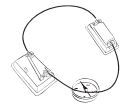
A student set up the circuit you see in the picture. There was a compass sitting on
the table next to the circuit. When the student connected the plastic-coated copper
wire to the battery, the compass needle moved.
Why did the compass needle move?
120
Magnetic force was flowing from the battery to the compass.
Electricity was flowing through the wire to the compass.
The energy flowing through the wire caused the compass to vibrate.
Magnetism was created when electricity flowed through the wire.
Q 2/18
Score 0
A student placed two horseshoe magnets near each other on a table. What will happen when she lets go of the two magnets?
120
One side of the magnet will repel and the other side will attract
The force will be cancelled between the magnets.
The two magnets will repel and push apart.
The two magnets will attract and stick together.
18 questions
Q.
A student set up the circuit you see in the picture. There was a compass sitting on
the table next to the circuit. When the student connected the plastic-coated copper
wire to the battery, the compass needle moved.
Why did the compass needle move?
1
120 sec
Q.
A student placed two horseshoe magnets near each other on a table. What will happen when she lets go of the two magnets?
2
120 sec
Q.
When black sand and iron filings are mixed together, they look like a black powder. Which of the following would be the easiest way to separate the sand and the filings?
3
120 sec
Q.
The Acme Recycling Company recycles cans. Some of the cans are made of
aluminum and some are made of iron. Which of the following would be the best way to separate the two types of cans?
4
120 sec
Q.
Mandy set up an experiment. She recorded her findings in a chart. Which question was Mandy testing?
5
120 sec
Q.
Robbie made an electromagnet by winding a coil of insulated wire around a nail.
What kind of energy was changed into magnetic energy?
6
120 sec
Q.
The graph shows the results of an investigation with an electromagnet. If 22-gauge wire is used, how many nails will it pick up?
7
120 sec
Q.
What can you use to make an electromagnet?
8
120 sec
Q.
What force does a magnetic field apply without actually touching the object?
9
120 sec
Q.
What happens to the strength of an electromagnet as you add more coils around it?
10
120 sec
Q.
In order for an electromagnet to be formed, an __________ current must pass through a coil of __________ wrapped around an ________ core.
11
120 sec
Q.
Why does a compass needle move when it is near a wire with an electric current?
12
120 sec
Q.
What is the interaction between electricity and magnetism?
13
120 sec
Q.
What must happen for an electromagnet to have a magnetic field?
14
120 sec
Q.
What is one difference between electromagnets and bar magnets?
15
120 sec
Q.
A group of students removed the plastic insulation around a wire. They wrapped the uninsulated wire around a steel rivet 50 times in order to make an electromagnet. They connected the wires to a battery to make a complete circuit. They tried to pick up some steel washers, but nothing happened. Below is the advice they received from other groups in the class. What advice should they take to get their electromagnet to pick something up?
16
120 sec
Q.
Which action would make an electromagnet stronger (able to pick up more paper clips)?