Loading...


ELECTROSTATICS 1
Quiz by Joythsna Joythsna
Tag the questions with any skills you have. Your dashboard will track each student's mastery of each skill.
1

B
D
A
C
2
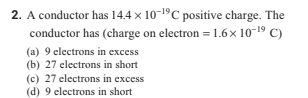
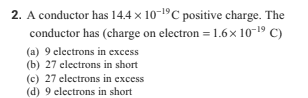
A
D
B
C
1

2
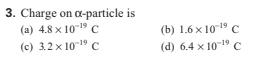
3
4. When a glass rod is rubbed with silk, it
(a) gains electrons from silk (b) gives electrons to silk
(c) gains protons from silk (d) gives protons to silk
5. When a body is earth connected, electrons from the earth flow into the body. This means the body is
(a) uncharged (b) charged positively
(c) charged negatively (d) an insulator
6. There are two charges +1 μC and +5 μC. The ratio of the forces acting on them will be
(a) 1: 5 (b) 1 :1 (c) 5 :1 (d) 1: 25
7
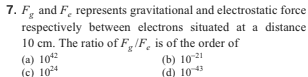
8. Two similar small spheres having +q and −q charge are kept at a certain distance. F force acts between the two. If in the middle of two spheres, another similar small sphere having +q charge is kept, then it will experience a force in magnitude and direction as
(a) zero having no direction (b) 8F towards +q charge
(c) 8F towards −q charge (d) 4F towards +q charge
9. The force between two charges 0.06 m apart is 5 N. If each charge is moved towards the other by 0.01 m, then the force between them will become
(a) 7.20 N (b) 11.25 N (c) 22.50 N (d) 45.00 N
10. Two charged spheres separated at a distance d exert a force F on each other. If they are immersed in a liquid of dielectric constant 2, then what is the force? (if all conditions are same) (a) F/ 2 (b) F (c) 2F (d) 4F
11. Electric charges of 1 1 μ μ C C , − and 2μCare placed in air at the corners A, B and C respectively of an equilateral triangle ABC having length of each side 10 cm. The resultant force on the charge at C is
(a) 0.9 N (b) 1.8 N (c) 2.7 N (d) 3.6 N
12. Two small conducting spheres of equal radius have charges +10μC and −20μC respectively and placed at a distance R from each other. They experience force F1 . If they are brought in contact and separated to the same distance, they experience force F2 .The ratio of F1 to F2 is (a) 1 : 8 (b) −8 :1 (c) 1 : 2 (d) −2 :1
13
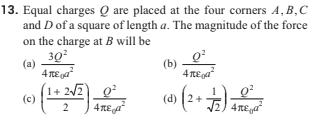
14. Two equally charged, identical metal spheres A and B repel each other with a force F. The spheres are kept fixed with a distance r between them. A third identical, but uncharged sphere C is brought in contact with A and then placed at the mid-point of the line joining A and B. The magnitude of the net electric force on C is
(a) F (b) F/4 (c) F/2 (d) 4F
15. Two charges +4e and +e are at a distance x apart. At what distance, a charge q must be placed from charge +e, so that it is in equilibrium?
(a) x/ 2 (b) 2 x/3 (c) x/ 3 (d) x/ 4
16
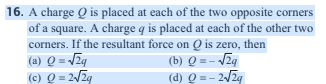
17. A charge q is lying at mid-point of the line joining the two similar charges Q. The system will be in equilibrium if the value of q is
(a) Q/2 (b) – Q/ 2 (c) Q/4 (d) – Q/ 4
18. Two point charges +2 C and +6 C repel each other with a force of 12 N. If a charge of – 4 C is given to each of these charges, the force now is
(a) 4 N (repulsive) (b) 4 N (attractive)
(c) 12 N (attractive) (d) 8 N (repulsive)
19
20
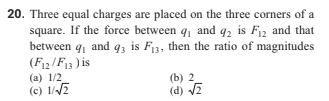
21. The centres of two identical small conducting spheres are 1mapart. They carry charges of opposite kind and attract each other with a force F. When they are connected by a conducting thin wire they repel each other with a force F/3. What is the ratio of magnitude of charges carried by the spheres initially?
(a) 1 : 1 (b) 2 : 1 (c) 3 : 1 (d) 4 : 1
22. A metallic sphere having no net charge is placed near a finite metal plate carrying a positive charge. The electric force on the sphere will be
(a) towards the plate (b) away from the plate
(c) parallel to the plate (d) zero
23
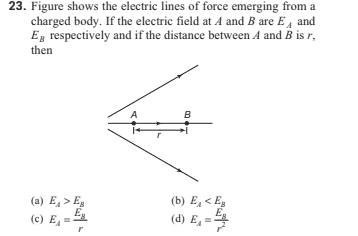
24
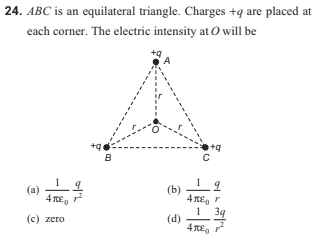
25

26. The distance between the two charges 25μCand 36μCis 11cm. At what point on the line joining the two, the intensity will be zero?
(a) At a distance of 5 cm from 25 μC
(b) At a distance of 5 cm from 36 μC
(c) At a distance of 4 cm from 25 μC
(d) At a distance of 4 cm from 36 μC
27
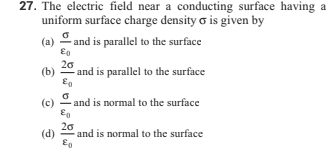
28. The unit of electric field is not equivalent to
(a) N/C (b) J/C (c) V/m (d) J/C-m
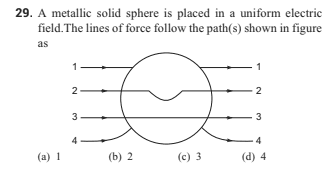
29.
30. The unit of intensity of electric field is
(a) Newton/coulomb (b) Joule/coulomb
(c) Volt-metre (d) Newton/metre
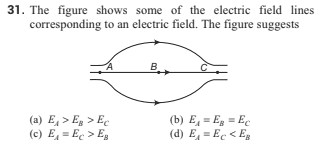
31.
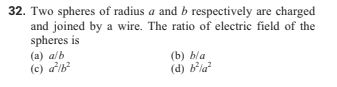
32.
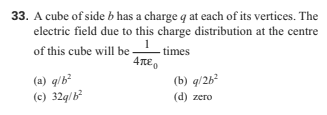
33.
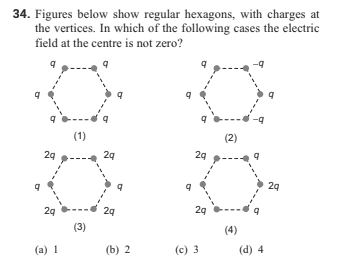
34.
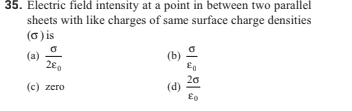
35.
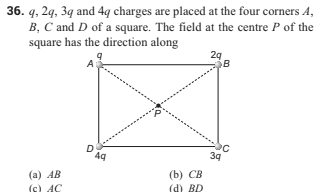
36.
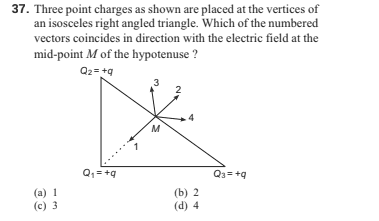
37.
38.
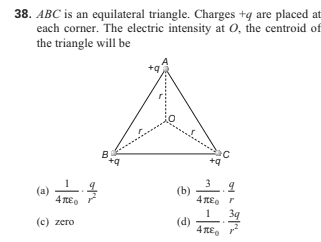
39.

40. Two point charges q and 2q are placed some distance apart. If the electric field at the location of q be E, then that at the location of 2q will be
(a) 3E (b) E/2
(c) E (d) None of these
41.
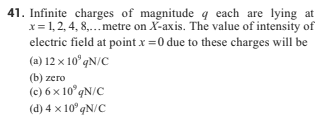
42. Angle between equipotential surface and lines of force is
(a) zero (b) 180° (c) 90° (d) 45°
43. If a charged spherical conductor of radius 10 cm has potential V at a point distant 5 cm from its centre, then the potential at a point distant 15 cm from the centre will be
(a) 1 / 3 V (b) 2/ 3 V
(c) 3/ 2 V (d) 3 V
44.
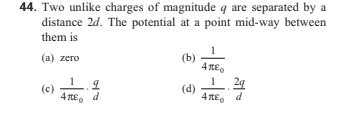
45.
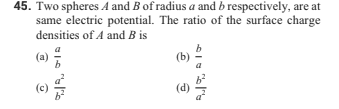
46. Point charge q1 = μ2 Cand q2 = − μ1 Care kept at points x = 0 and x = 6, respectively. Electrical potential will be zero at points
(a) x = 2 and x = 9
(b) x = 1and x = 5
(c) x = 4 and x = 12
(d) x = – 2 and x = 2
47. Eight small drops, each of radius r and having same charge q are combined to form a big drop. The ratio between the potentials of the bigger drop and the smaller drop is
(a) 8:1 (b) 4:1 (c) 2 :1 (d) 1:8
48. Eight oil drops of same size are charged to a potential of 50 V each. These oil drops are merged into one single large drop. What will be the potential of the large drop?
(a) 50 V (b) 100 V (c) 200 V (d) 400 V
49.

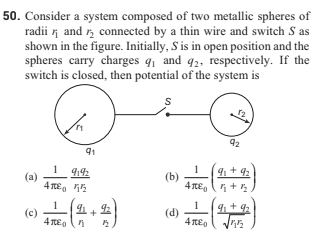
50.