Loading...


Environmental Science Quiz
Quiz by Dejie Mae Saumat
Tag the questions with any skills you have. Your dashboard will track each student's mastery of each skill.
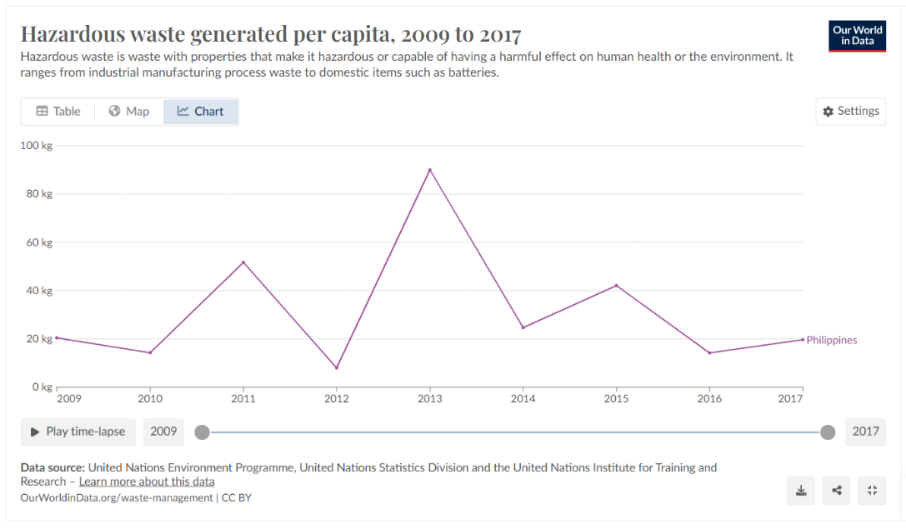
On February 15, 2001, the Philippines implemented Republic Act 9003, also known as the Ecological Solid Waste Management Act of 2000. Despite this, the country experienced a rise in hazardous waste in 2013. In the same year, Typhoon Yolanda (Haiyan) struck the Philippines.
Which of the following was the most direct and immediate contributor to the significant rise in hazardous waste in the Philippines in 2013?
Below is the waste production activity in the Philippines from year 2009-2017, refer to this in answering the question:
Systemic challenges in implementing Republic Act 9003, leading to long-term waste management issues.
Weak enforcement of environmental regulations, allowing improper disposal of hazardous materials.
The large-scale destruction caused by Typhoon Yolanda (Haiyan), which generated massive amounts of hazardous debris.
The rapid increase in industrial and medical waste due to economic and population growth.
The Evolution of Recycling and Waste Management
Recycling is a common practice today, but the idea of reusing materials has existed for centuries. As early as 1031 A.D. in Japan, discarded documents were shredded and transformed into new sheets of paper for resale. Long before modern recycling systems, societies found innovative ways to extend the usefulness of materials. Containers were reused, fabrics were repurposed into rags, and broken pottery was often remade into new objects.
Before industrialization, waste was mostly organic, including wood, ash, textiles, and food scraps. Unlike today, people repaired and reused household items as much as possible. Objects were rarely discarded unless they were completely unusable. Waste disposal methods were simple—non-compostable waste was either thrown into the streets, dumped into pits covered with soil, or burned.
As societies expanded and production increased, so did waste generation. The growing demand for raw materials led to the development of the modern recycling industry, where discarded materials were collected, processed, and sold for reuse. This shift marked the beginning of structured waste management, shaping the way materials are recycled today.
The evolution of recycling highlights how human societies have adapted waste management strategies over time, balancing resource conservation, economic opportunities, and environmental sustainability.
Why has waste burning become less common compared to the past?
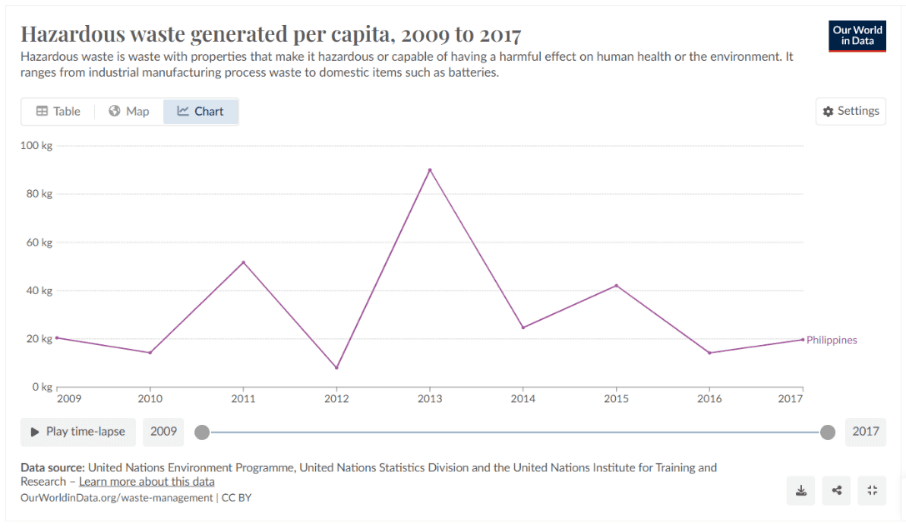
On February 15, 2001, the Philippines implemented Republic Act 9003, also known as the Ecological Solid Waste Management Act of 2000. Despite this, the country experienced a rise in hazardous waste in 2013. In the same year, Typhoon Yolanda (Haiyan) struck the Philippines.
Which of the following was the most direct and immediate contributor to the significant rise in hazardous waste in the Philippines in 2013?
Below is the waste production activity in the Philippines from year 2009-2017, refer to this in answering the question:
Study the pie graph presented below by the World Bank about the trends in Solid Waste Management. The pie chart illustrates the global waste composition, represented in percentage terms.
Based on the waste composition data presented in the pie graph, which of the following environmental policies would likely have the most significant impact on reducing global waste?

WEATHER VS. CLIMATE
It’s a sunny afternoon in July, and Mia is at the park with her friends. The temperature is a scorching 95°F (35°C), and everyone is seeking shade under the trees. As they fan themselves with magazines, one of Mia’s friends, Jake, groans, "This heat is unbearable! I thought the weather was supposed to be cooler this summer. Isn’t that what the news said?"
Mia, who’s been studying environmental science, replies, "Actually, the news was talking about the climate trend for this region, not the daily weather. Over the past few decades, summers here have been getting slightly cooler on average due to changes in wind patterns. But that doesn’t mean we won’t have hot days like today. Weather is what’s happening right now, while climate is the average over many years."
Jake looks confused. "So, what’s the difference? Isn’t it all just about temperature?"
Mia shakes her head. "Not exactly. Weather is short-term—like today’s heat, tomorrow’s thunderstorm, or next week’s cool breeze. Climate is the big picture—like how this region typically has mild summers and snowy winters over a 30-year period. Even if today is hot, the overall trend might still show cooler summers compared to the past."
Jake nods slowly, starting to understand. "So, weather is like a single chapter in a book, and climate is the whole story?"
"Exactly!" Mia says with a smile. "You’re getting it."
Based on the conversation of Mia and Jake, how did Mia differentiate weather and climate?

WEATHER VS. CLIMATE
It’s a sunny afternoon in July, and Mia is at the park with her friends. The temperature is a scorching 95°F (35°C), and everyone is seeking shade under the trees. As they fan themselves with magazines, one of Mia’s friends, Jake, groans, "This heat is unbearable! I thought the weather was supposed to be cooler this summer. Isn’t that what the news said?"
Mia, who’s been studying environmental science, replies, "Actually, the news was talking about the climate trend for this region, not the daily weather. Over the past few decades, summers here have been getting slightly cooler on average due to changes in wind patterns. But that doesn’t mean we won’t have hot days like today. Weather is what’s happening right now, while climate is the average over many years."
Jake looks confused. "So, what’s the difference? Isn’t it all just about temperature?"
Mia shakes her head. "Not exactly. Weather is short-term—like today’s heat, tomorrow’s thunderstorm, or next week’s cool breeze. Climate is the big picture—like how this region typically has mild summers and snowy winters over a 30-year period. Even if today is hot, the overall trend might still show cooler summers compared to the past."
Jake nods slowly, starting to understand. "So, weather is like a single chapter in a book, and climate is the whole story?"
"Exactly!" Mia says with a smile. "You’re getting it."
Based on her explanation, which of the following would be the best way for scientists to determine if summers in the region are truly becoming cooler over time?

The Growing Challenge of Waste Management
In many cities around the world, waste generation has reached critical levels, leading to serious environmental and health problems. One of the most effective ways to manage waste is through segregation at the source, ensuring that recyclables, biodegradable waste, and hazardous materials are properly sorted. However, despite awareness campaigns, improper disposal remains a major issue.
This data highlights the need for better waste management strategies, such as composting for organic waste, recycling for plastics and paper, and proper disposal methods for hazardous materials. Some cities have implemented strict waste segregation policies, while others struggle with inadequate infrastructure and public participation.
What is the main reason for implementing waste segregation in cities?

The Growing Challenge of Waste Management
In many cities around the world, waste generation has reached critical levels, leading to serious environmental and health problems. One of the most effective ways to manage waste is through segregation at the source, ensuring that recyclables, biodegradable waste, and hazardous materials are properly sorted. However, despite awareness campaigns, improper disposal remains a major issue.
This data highlights the need for better waste management strategies, such as composting for organic waste, recycling for plastics and paper, and proper disposal methods for hazardous materials. Some cities have implemented strict waste segregation policies, while others struggle with inadequate infrastructure and public participation.
Based on the graph, which type of waste should be prioritized for composting programs?
The Growing Challenge of Waste Management
In many cities around the world, waste generation has reached critical levels, leading to serious environmental and health problems. One of the most effective ways to manage waste is through segregation at the source, ensuring that recyclables, biodegradable waste, and hazardous materials are properly sorted. However, despite awareness campaigns, improper disposal remains a major issue.
This data highlights the need for better waste management strategies, such as composting for organic waste, recycling for plastics and paper, and proper disposal methods for hazardous materials. Some cities have implemented strict waste segregation policies, while others struggle with inadequate infrastructure and public participation.
Which of the following is NOT an effectivestrategy for improving global waste management?

The Global Impact of Climate Change
Over the past century, Earth's climate has been changing at an alarming rate. One of the main causes is the excessive release of greenhouse gases (such as carbon dioxide and methane) from human activities like burning fossil fuels, deforestation, and industrial production. These gases trap heat in the atmosphere, leading to a phenomenon called global warming.
The effects of climate change are visible worldwide. Rising temperatures cause glaciers to melt, leading to higher sea levels that threaten coastal cities. Unpredictable weather patterns result in stronger storms, longer droughts, and extreme heatwaves. Additionally, many animal species struggle to survive as their habitats change rapidly.
Scientists warn that if humans do not take action—such as reducing carbon emissions, protecting forests, and using renewable energy—climate change will continue to worsen, affecting future generations.
The graph below shows the increase in average global temperature over the past 100 years.
What is the main reason for the increase in Earth's temperature?

The Global Impact of Climate Change
Over the past century, Earth's climate has been changing at an alarming rate. One of the main causes is the excessive release of greenhouse gases (such as carbon dioxide and methane) from human activities like burning fossil fuels, deforestation, and industrial production. These gases trap heat in the atmosphere, leading to a phenomenon called global warming.
The effects of climate change are visible worldwide. Rising temperatures cause glaciers to melt, leading to higher sea levels that threaten coastal cities. Unpredictable weather patterns result in stronger storms, longer droughts, and extreme heatwaves. Additionally, many animal species struggle to survive as their habitats change rapidly.
Scientists warn that if humans do not take action—such as reducing carbon emissions, protecting forests, and using renewable energy—climate change will continue to worsen, affecting future generations.
The graph below shows the increase in average global temperature over the past 100 years.
Based on the graph, what can you conclude about global temperature trends?
