EOC Review - Environmental Change Impact on Ecosystem B.12E
Quiz by Biology - Texas Education Agency
High School
Biology(2017)(ARCHIVED)
Texas Essential Knowledge and Skills (TEKS)
Feel free to use or edit a copy
includes Teacher and Student dashboards
Measures 1 skill from
Measures 1 skill from
Track each student's skills and progress in your Mastery dashboards
With a free account, teachers can
- edit the questions
- save a copy for later
- start a class game
- automatically assign follow-up activities based on students’ scores
- assign as homework
- share a link with colleagues
- print as a bubble sheet


12 questions
Show answers
- Q1The overgrowth of algae poses a major problem for coral reefs. Intensive fishing is one factor that contributes to algae overgrowth because it does which of the following?Reduces the number of organisms that feed on algaeInhibits the spread of pathogens in algae coloniesIncreases the competition between different algae speciesAllows more sunlight to be available to algae60sBIOL.12e
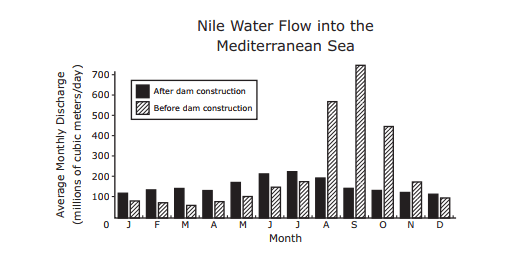
- Q2The Nile River flows into the Mediterranean Sea. The Aswan High Dam contains the flow of water from the river and reduces the annual fall flooding. The floodwater is trapped behind the huge dam, allowing irrigation for agriculture. Sediments that would be washed away by the annual floods are also trapped behind the dam. The graph shows the water flow from the Nile that enters the Mediterranean Sea. How has this dam most likely affected the Mediterranean Sea ecosystem?Reduced nutrients from the land support fewer producers in the seaThe flooding in August through November causes marine life to be destroyedThe water temperature of the sea has increasedWater trapped behind the dam causes the marine ecosystem to move inland60sBIOL.12e
- Q3Dead zones are low-oxygen areas that develop on the seafloor. Scientists hypothesize that phytoplankton blooms cause these dead zones. Phytoplankton blooms occur when excess nutrients are introduced by pollution from fertilizers, sewage plants, and the burning of fossil fuels. Which of the following would most likely cause an increase in these contributors to dead zones?Rainfall patterns that increase freshwater runoff from terrestrial ecosystemsConstructing efficient water-recovery and treatment plantsReplacing coal-fired power plants with windmillsFarming practices that reduce nitrate and phosphate applications60sBIOL.12e
- Q4Amphibians are dying in large numbers after being infected by an aquatic fungus called Batrachochytrium dendrobatidis. The origin of this fungus is unknown, but scientists suspect that humans are helping spread it. More than 350 amphibian species have been affected, and at least 200 species of frogs have suffered serious reductions in population or become extinct. The map below shows the worldwide distribution of B. dendrobatidis. What will be the most likely impact of the decline in frog populations resulting from the fungal infection?The fungus will move on land and destroy reptile and mammal populations in tropical ecosystemsNew species of frogs that feed on both the fungus and the infected species of frogs will evolvePlants will no longer grow in the waters of the affected ecosystems, and fish species will increasePopulations of algae and mosquitoes will increase, leading to fish die-offs and potential increases in human malaria cases60sBIOL.12e
- Q5On March 24, 1989, an oil tanker ran aground on Bligh Reef in Prince William Sound, Alaska, and spilled millions of liters of crude oil. The graph shows pink salmon populations in Prince William Sound from 1970 to 1999. What do these data suggest about the effect the oil spill had on pink salmon?Pink salmon were nearly eliminated after the oil spill.Pink salmon populations steadily declined in the 10 years following the spill.Pink salmon populations seemed to be minimally affected.Pink salmon populations declined and never fully recovered.60sBIOL.12e
- Q6In dry desert areas poor drainage can lead to a buildup of salt in water supplies. A student performed an investigation to study the effects of salinity on the germination rates of seeds. The student placed seeds in several solutions containing 0% to 3% salt. The length of the radicle, which is the root of the germinating seed, ranged from 49 mm in the 0% salt solution to 0 mm in the 3% salt solution. The data from this investigation suggest that increased salinity in more areas may lead to a decrease in which of the following?Oceanic evaporationAir pollutionNonrenewable resourcesFood production60sBIOL.12e
- Q7Food webs such as the one shown were first used in 1927 by the animal ecologist Charles Elton. The food web below represents the feeding relationships among organisms in an Alaskan ecosystem. An environmental change that removed which of these organisms from the ecosystem would cause the most instability in the ecosystem?FoxesAukletsSalmonZooplankton60sBIOL.12e
- Q8Which of the following is most likely to cause the greatest disruption to an ecosystem?Cleaning the windshield of a car with an alcohol-based glass cleanerMowing the lawn in a city parkCutting down a small cedar tree to make holiday decorationsEmptying an aquarium containing non-native species into a local waterway60sBIOL.12e
- Q9The picture shows a pika, a small mammal found in grassland ecosystems. The vast grasslands of the Tibetan plateau are home to the plateau pika. The numerous pikas are prey for many predators of the grasslands, which serve as a major watershed for much of the area. The watershed drains large quantities of groundwater during the rainy season, or the monsoon season. Pikas have extensive burrows that help drain groundwater rapidly and are used as nesting sites by many bird species. However, many people advocate the eradication of the plateau pikas because they compete with livestock for grass. Which of these will most likely happen if the plateau pikas are completely removed from the Tibetan plateau grasslands?The ecosystem will become more stable because the pika will no longer be there to eat the grasses, the birds will migrate to other ecosystems during nesting season, and the soils will be able to absorb more of the monsoon rains without the pika burrows.The ecosystem will become more stable because the pika will be replaced by other species of small mammals that can fill the niche, bird species will adapt to nesting aboveground, and the soils will become compacted without the burrows.The ecosystem will become unstable because predators will have fewer prey, the birds will have fewer nesting sites, and the area downriver will become vulnerable to flooding without the burrows to aerate the soil and provide drainage for monsoon rains.The ecosystem will become unstable because the predators will migrate to nearby ecosystems, the birds will nest in nearby trees, and the soils will be aerated by other small mammals.60sBIOL.12e
- Q10Roads are often built through forests for industrial purposes or as land is developed for residential and commercial needs. How would road construction through a forest most likely affect the ecosystem?All producers would be eliminated from the communityThe natural succession of vegetation would changeThe number of primary consumers would increaseNon-native species would replace native species60sBIOL.12e
- Q11In the mid-1980s an aggressive strain of algae known as Caulerpa was accidentally introduced into the Mediterranean Sea when a seaside aquarium cleaned out its tanks. The algae contains a toxin that prevents native herbivores from consuming it. Caulerpa quickly spread over the sea floor, crowding out many species including sponges, corals, sea fans, and lobsters. Which statement explains the most likely impact Caulerpa has had on the biodiversity in the Mediterranean Sea?The spread of Caulerpa improved the habitat for many species of sea grasses, and increased the biodiversity.Caulerpa interbred with native species with the same adaptations within the ecosystem.The presence of Caulerpa within an ecosystem is an indicator of the ecosystem's health.Caulerpa became dominant within the ecosystem and reduced the biodiversity60sBIOL.12e
- Q12Scientists have observed many types of tropical fish moving beyond their traditional ocean ranges into waters that have historically been more temperate. These fish compete for food with native fish, consuming much from the kelp forests and beds of sea grass. The expansion of the ranges of tropical fish was most likely caused by -the rising temperatures of ocean watersglobal droughts that raise the salt concentration of ocean watersagricultural runoff that contributes to dead zones in the oceanacid rain pollution that lowers the pH of ocean waters60sBIOL.12e