Loading...


European Colonization of the Americas
Quiz by Samantha Jordan
Customize this quiz to suit your class
Instantly translate to 100+ languages
Tag the questions with any skills you have. Your dashboard will track each student's mastery of each skill.
Give this quiz to my class
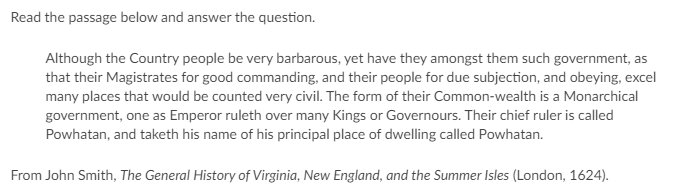

 Colonial Period Early colonial settlements were similar in that each developed near the coastline. EX) Jamestown (1607) Plymouth (1620) New England Colonies- the New England Colonies developed initially as religious outposts by various subjugated groups. Influenced by good harbors, abundant forests, rocky soil, and a short growing season. Geographic factors influenced the economy of New England by promoting the growth of trade and manufacturing. Developed villages with town-hall meetings. Had small farms and commercial fishing. American Indians were viewed by the Puritans as needing to be saved from their sinful ways since they were not Christians. In the early years of English colonization, Puritans did not openly embrace the American Indians but relied on them for help in the difficult early years for survival. As the English population increased, so did the conflict with natives of the area. A series of bloody wars (King Philip’s War and the Pequot Wars) during the colonial period between the Puritans and the American Indians of New England Southern Colonies- The climate (long growing season), rich soil, and deep rivers of the southeastern U.S. had a major impact on the history of the U.S. before 1860 because the region provided agricultural products that were processed in the North and in Europe. Developed plantations (large farms that used slave labor) because of fertile land and a long growing season. Relations with American Indians in the Southern Colonies began somewhat as a peaceful coexistence. As more English colonists began to arrive and encroach further into native lands, the relationship became more violent. Mid Atlantic (Middle Colonies)- were created from the previous Dutch New Netherland colony and had good harbors and river systems that shaped their development. The Hudson and Delaware Rivers provided highways to the interior of North America. Furs acquired from American Indians through trade for European goods were transported toward the coast along swift rivers. Later, the region’s farmers were able to use the rivers to ship wheat and other agricultural goods to markets in other colonies and Europe. The rivers also provided colonists access to manufactured goods imported from European markets. Harbors in cities such as Philadelphia and New York City allowed the Mid-Atlantic Colonies to grow into major commercial hubs for all of England’s American colonies. Ship building was common in the mid Atlantic colonies. The natives (American Indians) who resided there were typically relied upon for trade with the English and not the target of war, as was often the case in the other English colonial regions. Pennsylvania, in particular, treated the American Indians with more respect as evidenced by William Penn’s insistence on compensating the natives for their lanSS 3/4/25 “A Wave of Colonization” and “Europeans Encounter Native Peoples in the Americas,” pages 18–21 SS 3/5/25 “A Wave of Colonization” and “Europeans Encounter Native Peoples in the Americas,” pages 18–21 SS HW/EC 3/5/25 “A Wave of Colonization” and “Europeans Encounter Native Peoples in the Americas,” pages 18–21 Economy of Southeast Asia Even prior to the penetration of European interests, Southeast Asia was a critical part of the world trading system. A wide range of commodities originated in the region, but especially important were such spices as pepper, ginger, cloves, and nutmeg. The spice trade initially was developed by Indian and Arab merchants, but it also brought Europeans to the region. First the Portuguese, then the Dutch, and finally the British and French became involved in this enterprise in various countries. The penetration of European commercial interests gradually evolved into annexation of territories, as traders lobbied for an extension of control to protect and expand their activities. As a result, the Dutch moved into Indonesia, the British into Malaya, and the French into Indochina. Europe’s interest and activity in the region was further enhanced by the opening of the Suez Canal, the development of telegraphic communications, the adoption of steam shipping, and the prospects for trade with China. In the case of Malaya, the gradual diffusion of British administration provided systems of law and order and of taxation and allowed for the gradual development of infrastructure, principally reliable transport systems. This environment attracted Chinese immigrants, and the growth of the tin mining industry soon followed. Later rubber plantations were established, which brought about still further immigration. Similar developments took place in Burma (Myanmar), Vietnam, and Indonesia. In Siam (Thailand) during the second half of the 19th century, a rapid expansion of Western enterprise occurred, though not by colonization. Both British and American firms began trading in the region. The impact of the Western activity was essentially to remove trade from what had been a Chinese monopoly and to emphasize the export of a single commodity, rice. Established indigenous textile and sugar-processing industries were replaced by imports, and the economy slowly became dependent on rice exports. The Philippines gradually developed a plantation farming system under Spanish and later American influence, although rice, sugar, and tobacco continued to be produced by small-scale growers and processed by Chinese enterprises until the mid-19th century. The incorporation of Southeast Asia into the world economy had a major impact on the distribution of the region’s economic development, and it created more uneven patterns of population growth and economic activity. It also brought about a stronger sense of class distinction and resulted in a larger discrepancy between the wealthy and poor. The worldwide economic depression of the 1930s severely affected the commercialized areas most dependent on the world economy. Unemployment rose, and the period produced the seeds of political change and activism that culminated in the independence of most of the region’s countries after World War II. Since the 1950s the economic development strategies of virtually all the capitalist Southeast Asian states have emphasized urban industrialization, while agricultural development generally has been viewed as subsidiary to industrial growth. These strategies have met with mixed success. Indeed, the trading pattern of the region by and large has continued to be one of producing and exporting raw materials and importing manufactured goods. Only Singapore has reached an advanced level of industrialization, in the process becoming one of the world’s great centers of industry and commerce. There is great disparity in development rates within the region, especially between the member and nonmember countries of the Association of Southeast Asian Nations (ASEAN). Those belonging to this grouping—Brunei, Indonesia, Malaysia, the Philippines, Singapore, and Thailand—generally have experienced significant economic development since the mid-1960s; the exception has been the Philippines, the economy of which has grown at a much slower rate. Development has been extremely slow or nonexistent in the non-ASEAN countries of Cambodia, Laos, Myanmar, and Vietnam, and these are among the poorest nations in the world.The Role of Christian, union and labour groups in the movement for First Nations Australians' rights and freedoms, including the foundation of the National Day of Mourning. Christian organisations, trade unions, and labour groups played a significant role in advocating for the rights and freedoms of First Nations Australians, including the establishment of the National Day of Mourning. 1. Christian organisations: - Many Christian churches and missionary groups, such as the Aborigines' Protection Society and the Australian Board of Missions, campaigned for better treatment and rights for Aboriginal Australians. - Christian leaders like William Cooper and Daniel Deacon worked towards raising awareness about the injustices faced by Aboriginal people and advocating for their rights. 2. Trade unions and labour groups: - Trade unions, particularly the Australian Workers' Union (AWU) and the Waterside Workers' Federation, supported the Aboriginal rights movement and advocated for their inclusion in the workforce. - Unions provided a platform for Aboriginal workers to voice their concerns and demand equal treatment and opportunities. - The labour movement played a crucial role in campaigning for the rights of Aboriginal people, including the right to vote and equal wages. 3. The foundation of the National Day of Mourning: - The National Day of Mourning, also known as the Day of Mourning and Protest, was initiated by the Australian Aborigines' League and other Aboriginal rights groups in 1938. - It was a protest held on January 26, 1938, which marked the 150th anniversary of the British colonisation of Australia. - The Day of Mourning aimed to raise awareness about the dispossession, discrimination, and injustices experienced by Aboriginal people since the arrival of European settlers. - The event received support from various Christian organisations, trade unions, and labour groups, who recognized the significance of the Aboriginal rights movement and the need for change. While the Aboriginal rights movement was primarily led by Aboriginal activists and organisations, the support and solidarity from Christian groups, trade unions, and labour organisations played a crucial role in amplifying their voices, advocating for their rights, and bringing attention to the unjust treatment of First Nations Australians.European Colonization of AmericaTEKS Social Studies Grade 8 - 8.2.A: Identify Reasons For European Exploration & Colonization Of North America