Tag the questions with any skills you have. Your dashboard will track each student's mastery of each skill.
Give this quiz to my class
Q 1/4
Score 0
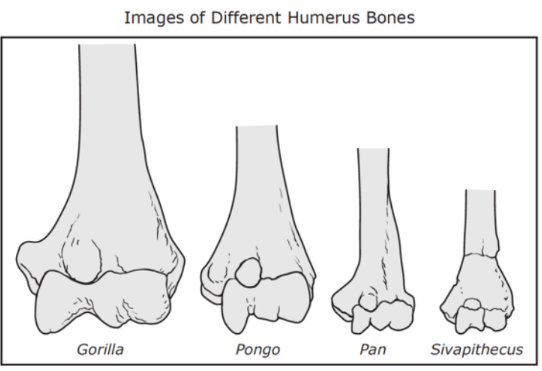
Which statement is best supported by the observable structures of the different humerus bones?
60
The primates had diets that consisted of similar types of food.
The primates shared a common ancestor.
The primates lived in similar environments.
The primates interbreed with similar organisms in a population.
Q 2/4
Score 0
A new predator of rabbits has been introduced within an ecosystem. This new predator runs faster than the native predators of rabbits.
Which statements describes what will most likely occur in the rabbit population due to the introduction of the predator.
60
The rabbits will mutate their genes and express genes that increase their speed.
Slower rabbits will develop stronger legs and pass this trait to their offspring.
Faster rabbits will survive and reproduce increasing the average speed of the rabbit population.
Rabbits will make and produce offspring with a different species that has faster runners.
4 questions
Q.
Which statement is best supported by the observable structures of the different humerus bones?
1
60 sec
Q.
A new predator of rabbits has been introduced within an ecosystem. This new predator runs faster than the native predators of rabbits.
Which statements describes what will most likely occur in the rabbit population due to the introduction of the predator.
2
60 sec
Q.
Common baboons live on the savanna in breeding groups called troops. While females tend to stay with the troop younger or less dominant males may leave to join a neighboring troop. Which of these is a likely outcome of movement by young males?
3
60 sec
Q.
The diagram shows data on the evolution of horses.
The data in the diagram is evidence that -