Tag the questions with any skills you have. Your dashboard will track each student's mastery of each skill.
Give this quiz to my class
Q 1/83
Score 0
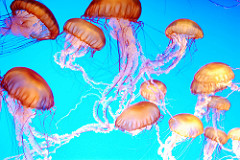
Soft-bodied, carnivorous animals that have stinging tentacles arranged in circles around their mouths. They are the "simplest" animals to have body symmetry and specialized tissues.
30
Cnidarians
Q 2/83
Score 0
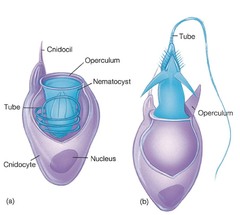
Stinging cells
30
Nematocysts
Cnidocytes
83 questions
Q.
Soft-bodied, carnivorous animals that have stinging tentacles arranged in circles around their mouths. They are the "simplest" animals to have body symmetry and specialized tissues.
1
30 sec
Q.
Stinging cells
2
30 sec
Q.
A poison-filled, stinging structure that contains a tightly coiled dart
3
30 sec
Q.
A cylindrical body with armlike (waving) tentacles that look like little feet
4
30 sec
Q.
A motile, bell-shaped body with the mouth on the bottom (dangling tentacles)
5
30 sec
Q.
A digestive chamber with one opening
6
30 sec
Q.
A loosely organized network of nerve cells that together allow cnidarians to detect stimuli such as the touch of a foreign object
7
30 sec
Q.
Consists of a layer of circular muscles and a layer of longitudinal muscles that, together with the water in the gastrovascular cavity, enable the cnidarian to move
8
30 sec
Q.
Takes place outside the female's body; the sexes are often separate---each individual is either male or female; The female releases eggs into the water, and the male releases sperm.
9
30 sec
Q.
Contains jellyfish; "cup animals"; live their lives primarily as medusa(adult); size varies; some may be deadly
10
30 sec
Q.
Contains hydras and other related animals; microscopic; polyp body form; can move by summersaulting
11
30 sec
Q.
Contains sea anemones and corals, animals that have a polyp stage in their life cycle; "flower animals"; all live as polyps
12
30 sec
Q.
Hydra, anemone, jellyfish...
13
30 sec
Q.
Animals that do not have a backbone, or vertebral column: microscopic dust mites, giant squids
14
30 sec
Q.
Animals that have a backbone: fishes, amphibians, reptiles, birds, mammals
15
30 sec
Q.
Eat plants
16
30 sec
Q.
Eats other animals
17
30 sec
Q.
Aquatic animal that strains tiny floating organisms from water
18
30 sec
Q.
Two species live in close (good) association with each other
19
30 sec
Q.
What does 'motile' mean?
20
30 sec
Q.
asexually (budding) sexually (egg and sperm)
21
30 sec
Q.
carnivores, tentacles grab food
22
30 sec
Q.
diffusion
23
30 sec
Q.
eliminate waste through mouth
24
30 sec
Q.
Two forms (medusae/polyp) they swim
25
30 sec
Q.
radial
26
30 sec
Q.
Boneless, brainless, eyeless, headless, footless
27
30 sec
Q.
A group of mollusks. The name means head foot. The octopus, squid, nautilus and cuttlefish are in this group.
28
30 sec
Q.
Cells with pigments that can be manipulated to change the color of cephalopod's skin, allowing it to blend into its surroundings
29
30 sec
Q.
The cephalopod's ability to allow water inside its body, then quickly squeeze it out, sending a jet stream out of its body and propelling it backward.
30
30 sec
Q.
The tube which the stream of water goes out of in jet propulsion.
31
30 sec
Q.
A graceful animal that lives on the bottom of the ocean. It can quickly change its color and even its texture to match its surroundings. It has a shell on the inside of its body.
32
30 sec
Q.
The internal shell of a cuttlefish
33
30 sec
Q.
A cephalopod with ten arms and a beak
34
30 sec
Q.
A group of squids
35
30 sec
Q.
A nocturnal cephalopod with eight arms and a beak. It lives in shallow waters, spending most of its time on the sea floor.
36
30 sec
Q.
The parts that detect light in the human or animal eye
37
30 sec
Q.
A cephalopod that rises and sinks due to gas-filled chambers in its shell. It can have anywhere between 38 and 90 arms.
38
30 sec
Q.
A large, cream-colored cephalopod with brown, wavy lines and many arms. It is the only cephalopod that creates an external shell.
39
30 sec
Q.
The thickened area over the head of a nautilus.
40
30 sec
Q.
A creature in the class polyplacophora. Eight plates make up its shell, and it has neither eyes nor arms.
41
30 sec
Q.
The protruding portion of the chiton's mantle.
42
30 sec
Q.
Soft, slimy creatures with squishy bodies that belong to phylum Mollusca
43
30 sec
Q.
Phylum of mollusks
44
30 sec
Q.
Either crustaceans or mollusks
45
30 sec
Q.
Organ inside the body of a mollusk with special chemical properties that converts calcium and other minerals into a shell
46
30 sec
Q.
Octopuses and squids are examples of this group of mollusks
47
30 sec
Q.
This group of mollusks has two shell halves shaped like a fan , oysters, mussels, and clams
48
30 sec
Q.
A tube that is extended when a bivalve is underwater
49
30 sec
Q.
The siphon tube that takes in water on a bivalve
50
30 sec
Q.
The siphon tube on a bivalve that expels wastes
51
30 sec
Q.
The most common predator of bivalves; drills hole in bivalve shell and sucks out bivalve
52
30 sec
Q.
The extended, soft part of the bivalve that is used to crawl along the sea floor
53
30 sec
Q.
This mollusk can clap its shell open and closed to move short distances in little bursts
54
30 sec
Q.
Some of these can burrow into coral, rock, ships or piers by secreting a substance that weakens the material and using the edge of their shell to dig and form a hole
55
30 sec
Q.
By counting these you can estimate the age of a bivalve; each one represents one year of its life.
56
30 sec
Q.
Spends its entire adult life in one spot, clinging to rocks, piers, or other structures in the water even when powerful waves slam against them
57
30 sec
Q.
Attaches itself to one spot, but will move from time to time, usually smooth black, bluish or gray, growing from 1-9 inches
58
30 sec
Q.
Acts like natural "super glue" to attach mussels to a surface
59
30 sec
Q.
A mussel in its larval form. It will grow and mature until it becomes an adult
60
30 sec
Q.
Created by oysters, mussels and clams when something like a bacteria or parasite gets inside the bivalve between the mantle and the shell
61
30 sec
Q.
The largest pearl in the world which weighed 14 pounds and was the size of a basketball
62
30 sec
Q.
Fan-shaped mollusk that is the fastest mover of all the bivalves, tiny eyes that form rings around the animal
63
30 sec
Q.
Means "stomach foot". Their body is a mass of organs (the stomach) sitting on top of one large foot.
64
30 sec
Q.
They are scavengers that can smell dead fish in the water and will even catch waves to get to the dead animal faster...within minutes
65
30 sec
Q.
An organ in gastropods with many denticles or tooth-like spikes allowing them to scrape algae off rocks and into their mouth
66
30 sec
Q.
Clings to starfish and cuts into them with their radula, eating the soft insides.
67
30 sec
Q.
The door that seals off a snail's shell
68
30 sec
Q.
The study of shells; the name is taken from the "conch"
69
30 sec
Q.
One of the greatest dangers to the conch. Can crush a conch shell with their powerful jaws.
70
30 sec
Q.
A shell that has been used as a horn for many thousands of years by removing the small tip of the shell
71
30 sec
Q.
A whelk's radula with a long stalk. Used to probe into other gastropod shells or to pry open bivalve shells.
72
30 sec
Q.
Papery, spongy masses used to contain the egg of a whelk
73
30 sec
Q.
A shell that is commonly found on the shore shaped like an ice cream cone, spiraling around and around the tip.
74
30 sec
Q.
Stalks its victim and crawls up on top of it and covers the prey with its expanded foot causing its prey to suffocate
75
30 sec
Q.
The inside lining of an abalone and other shells used to make jewelry
76
30 sec
Q.
Means "naked gills", are disgusting to eat and use bright colors to advertise their bad taste
77
30 sec
Q.
A living creature that glows in the dark.
78
30 sec
Q.
Animals without backbones and represent 95% of the animal kingdom
79
30 sec
Q.
Have soft bodies and long, stinging body parts. Not really fish.
80
30 sec
Q.
An invertebrate species that can live for over 100 years.
81
30 sec
Q.
What is the world's largest and heaviest creature without a backbone?
82
30 sec
Q.
A cehpalopod so smart it sometimes uses tools to hunt.