Loading...


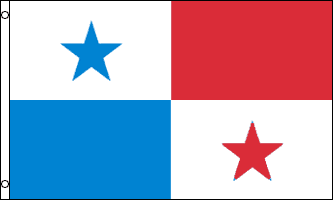
Flags of Spanish speaking countries
Quiz by Shanaz MOHAMDALLY
Customize this quiz to suit your class
Instantly translate to 100+ languages
Tag the questions with any skills you have. Your dashboard will track each student's mastery of each skill.
Give this quiz to my class
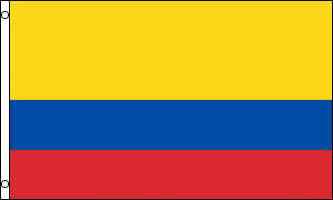
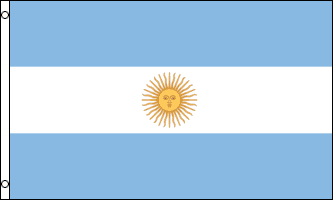
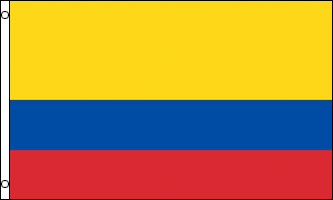
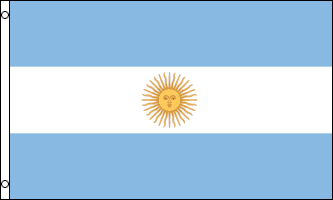


 Can you create a quiz on all 21 of the the flags of spanish speaking countries with pictures with 21 questionsThe Philippine Flag Our country is officially identified through our flag. The Philippine flag has three colors: white, blue, and red. White signifies purity; blue means hope and peace; and red denotes bravery. The three stars symbolize the three big groups of islands of our country-the Luzon, Visayas, and Mindanao. The eight rays of the sun signify the eight provinces that first revolted against the Spaniards. These are Bulacan, Pampanga, Tarlac, Nueva Ecija, Laguna, Batangas, Manila, and Cavite. We respect our flag to show that we respect our country. We should not treat it like an ordinary cloth because it symbolizes our country. An old flag should be burned and not be used as a rag. Title: National Hero Body text: Dr. Jose Rizal was from a middle-class family from Calamba, Laguna. He is regarded as a genius who fought the Spaniards through his writings, especially the novels "Noli Me Tangere" and "El Filibusterismo." The two novels exposed the anomalies and wrongdoings of the Spanish government against the Filipino people. He wrote the poem "Mi Ultimo Adios" the eve before his execution in Bagumbayan (now known as Rizal Park). National Fruit A mango is sour when it is green, but very sweet when it is ripe. This heart-shaped fruit symbolizes the kindness of the Filipinos. It has a big tree that bears fruits abundantly during summer. National Animal A carabao is a model of hard work and industry. It is the best companion of farmers in the field. It is black and looks like a tamaraw. A carabao is a very strong animal in terms of work. It symbolizes the Filipinos as hardworking and patient. National Bird The Philippine eagle, also known as haribon, stands over 5 feet (1.6 m) tall. It has a large, sharp, and aggressive beak and has powerful talons. Philippine eagles are excellent hunters, and live in tropical rainforests. These eagles lay just one or two eggs each year. National Tree The narra is a hardy tree that grows big and is found mainly in the Bicol Region, Mindanao, and Cagayan Valley forests. Most of the desks and tables in schools are made of narra. It signifies the strong personality of Filipinos in facing trials in life. National Flower The sampaguita has white, star-shaped petals with a sweet fragrance. It is made into garlands, which are given to visitors and special persons on occasions. It signifies purity and among Filipino women. National Fish Bangus or milkfish is our national fish. It grows in ponds or freshwater and tastes delicious. Its white, shiny scales signify our beautiful country. National Dance Cariñosa is a dance of love using a handkerchief and a fan. It symbolizes the true love expressed by Filipinos. National House A nipa hut is a small but beautiful house made from bamboo and sawali or cogon leaves. Filipinos used this kind of house during the olden times. At present, there are still people using this as a dwelling place, but most of the time, they use it as a rest place or cottage. National Costume Barong Tagalog is the national costume for Filipino men. It is made from pineapple fiber or other native materials. Filipinos wear this on special occasions such as formal events or weddings. Baro at Saya is the national dress for Filipino women. Most of them are made from jusi or pineapple fiber and other native materials. This dress shows the gracefulness of Filipino women. National Leaf Our national leaf is a palm tree. It is wide and narrow like an open fan. Farmers use this to protect their crops from the harsh sunlight and rain. It grows like a tree with thorns in its body. National Language Our national language is Filipino, which is based in Tagalog. Through the efforts of former President Manuel L. Quezon (known as the "Father of the National Language"), Filipino was widely disseminated and is now used in all parts of the country. With this, Filipinos in different cultures and native tongues can still communicate with each other. National Food Lechon (litson) is an important dish served at many occasions, especially on fiestas. Lechon is a suckling pig, slowly roasted over live coals to make it crispy and tasty. National Footwear Bakya is the national footwear of the Philippines. It was most popular from the 1950s to the 1970s before the introduction of rubber slippers. There are several colors and designs of bakya that suit the taste of most Filipinos. Valuing Our National Symbols Symbols represent a country and its people. We have to respect and value these symbols because they tell something about our country and of who we are as Filipinos. Here are some ways of valuing our national symbols: When singing the national anthem, stand straight and place your right hand on your left chest. Remove your cap or close your umbrella. Ask the people walking to stop while the flag is being raised. Tell other children to stop chatting while singing the national anthem. Most importantly, sing the national anthem wholeheartedly. Retirement of a Flag: A worn-out flag should be disposed of respectfully. It should be burned in a dignified ceremony, not thrown away or used for other purposes. Help in saving and conserving our forests. They serve as habitat of our national bird and other animals. You may also help organizations that promote reforestation, clean and green programs, and tree planting activities. Do not pick flowers when visiting parks. Instead, help in keeping these places clean and beautiful. Avoid throwing thrash in their surroundings. Patronize products that are made here in our country and made by Filipinos. Tell your family and friends to buy products of the Philippines especially those of which are our national symbol. Aside from patronizing our own products, let us use and love our national language. It is good to learn foreign languages, but do not forget to use our own language correctly and proudly.By the late 1800s, the Spanish were losing control of Cuba. Concerned about insurrection in the countryside, they moved rural Cubans to “reconcentration” camps where the Spanish claimed they would be better able to protect them. U.S. Consul-General Fitzhugh Lee forwarded the following account of the conditions of the camps to the U.S. Assistant Secretary of State on November 27, 1897. Lee said the author of the note was “a man of integrity and character.” “[W]e will relate to you what we saw with our own eyes: “Four hundred and sixty women and children thrown on the ground, heaped pellet-mell as animals, some in a dying condition, others sick and others dead. . . . “There is still alive the only living witness, a young girl of 18 years, whom we found seemingly lifeless on the ground; on her right-hand side was the body of a young mother, cold and rigid, but with her young child still alive clinging to her dead body; on her left-hand side was also the corpse of a dead woman holding her son in a dead embrace. . . . “The circumstances are the following: complete accumulation of bodies dead and alive, so that it was impossible to take one step without walking over them; the greatest want of cleanliness, want of light, air, and water; the food lacking in quality and quantity what was necessary to sustain life. . . . From all this we deduct that the number of deaths among the reconcentrados has amounted to 77 per cent.” Source: Unsigned note that was included in a telegram sent by Fitzhugh Lee, U.S. Consul-General in Cuba, to the U.S. Assistant Secretary of State November 27, 1897. consul-general: a government official living in a foreign country charged with overseeing the protection of U.S. citizens and promoting trade pell-mell: state of disorder accumulation: pile want: lack reconcentrados: the reconcentration camp prisoners; The following is an excerpt from Albert J. Beveridge’s speech, delivered September 16, 1898. Beveridge gave this speech while he was campaigning to become a senator for Indiana. The speech helped him win the election and made him one of the leading advocates of American expansion. “Fellow citizens, it is a noble land that God has given us; a land that can feed and clothe the world;. . . . It is a mighty people that he has planted on this soil . . . It is a glorious history our God has bestowed upon his chosen people; . . .a history of soldiers who carried the flag across the blazing deserts and through the ranks of hostile mountains, even to the gates of sunset. . . . “The Opposition tells us that we ought not to govern a people without their consent. I answer: The rule of liberty that all just government derives its authority from the consent of the governed, applies only to those who are capable of self-government. I answer, We govern the Indians without their consent, we govern our territories without their consent, we govern our children without their consent. “They ask us how we will govern these new possessions. I answer: If England can govern foreign lands, so can America. If Germany can govern foreign lands, so can America. . . . “What does all this mean for every one of us? It means opportunity for all the glorious young manhood of the republic, the most virile, ambitious, impatient, militant manhood the world has ever seen. It means that the resources and the commerce of these immensely rich dominions will be increased. . . . “In Cuba, alone, there are 15,000,000 acres of forest unacquainted with the axe. There are exhaustless mines of iron. . . . There are millions of acres yet unexplored. . . . It means new employment and better wages for every laboring man in the Union. . . . Flags of the World Part IFlags of the WorldFlags of the World (G-J)Flags of the World (C's)Flags of the wold