General Regents Review
Quiz by Elizabeth Cooper
Feel free to use or edit a copy
includes Teacher and Student dashboards
Measures 17 skills from
- edit the questions
- save a copy for later
- start a class game
- automatically assign follow-up activities based on students’ scores
- assign as homework
- share a link with colleagues
- print as a bubble sheet


- Q1
When you cut your finger, new skin quickly grows that repairs and replaces the damaged skin cells. Information directing this process is located in the
DNA of neighboring cells, which divide by mitotic cell division
mitochondria in neighboring skin cells, which provide the energy needed for meiotic cell division
DNA of neighboring cells, which divide by meiotic cell division
mitochondria in neighboring skin cells, which provide the energy needed for mitotic cell division
30sS4-K2.2.1 - Q2
ATP is produced in the
vacuoles
ribosomes
nuclei
mitochondria
30sS4-K5.5.1 - Q3
Some trees release toxins into the soil that can kill the plants nearby. This ability can best be described as
an evolutionary advantage, reducing competition for water, nutrients, and sunlight
a means of establishing a consistent soil pH
a trait acquired by the species to eliminate the consumers that feed on them
a benefit to the ecosystem, since it results in increased biodiversity
30sS4-K6.6.1 - Q4
When the frequency of a gene in a population changes, the most likely result would be
biological evolution
ecological succession
species extinction
genetic mutation
30sS4-K3.3.1 - Q5
During the 1880s, in an attempt to control the rat population, the Asian mongoose was brought to the Hawaiian Islands. However, there was a flaw in the plan. Rats are active at night, while mongooses feed on birds and eggs during the day. They had little effect on the rat population. The mongoose population rapidly increased and caused the extinction of many bird species native to the islands.
Bringing mongooses to the Hawaiian Islands is an example of
developing a research plan to study unintended outcomes
an imported species solving an ecological problem
a technological fix to solve problems caused by population growth
humans altering ecosystems, resulting in unintended consequences
30sS4-K7.7.3 - Q6
Many companies today are looking for ways to reduce the use of finite resources. They are working to recycle, reuse, and repair more products to reduce dumping and pollution. Which statement best describes a positive result of these changes?
Fossil fuels will be renewed for future generations to utilize.
Destruction of ecosystems will result in a loss of biodiversity.
Finite resources will not be depleted as quickly.
These activities can result in unstable ecosystems.
30sS4-K7.7.3 - Q7
Which characteristic would give one species the greatest advantage over other species?
lower adaptation to the environment
lower number of matings
higher rate of disease
higher number of surviving offspring
30sS4-K3.3.1 - Q8
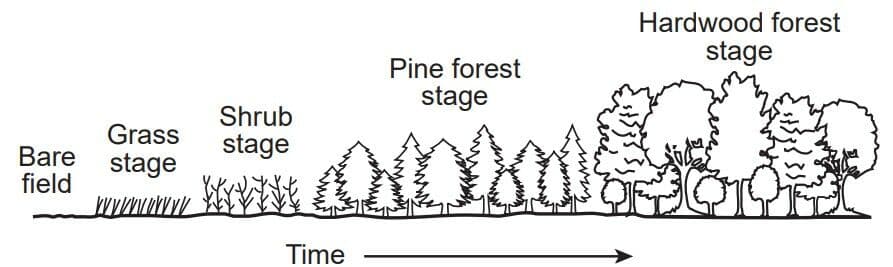
The diagram below represents the same location over a period of many years.
As a result of these changes,
the community becomes less stable
biodiversity in the area decreases
the community becomes more stable
biodiversity is not affected
30sS4-K6.6.3 - Q930sS4-K7.7.1
- Q10
Two different species of animal prefer the same plant for food. One eats the leaves of the plant, the other prefers the fruit. By eating different parts of the same plant these species can successfully coexist because they do not
compete for limited resources
interact in a predator-prey relationship
live in the same area
reproduce at the same time of year
30sS4-K6.6.1 - Q11
Different techniques are used to study cells. Fluorescent (glowing) tags allow scientists to visualize specific proteins as they are synthesized inside cells. Which part of a cell would be studied when using this technology to visualize protein synthesis?
cell membrane
nucleus
ribosome
cell wall
30sS4-K1.1.2 - Q12
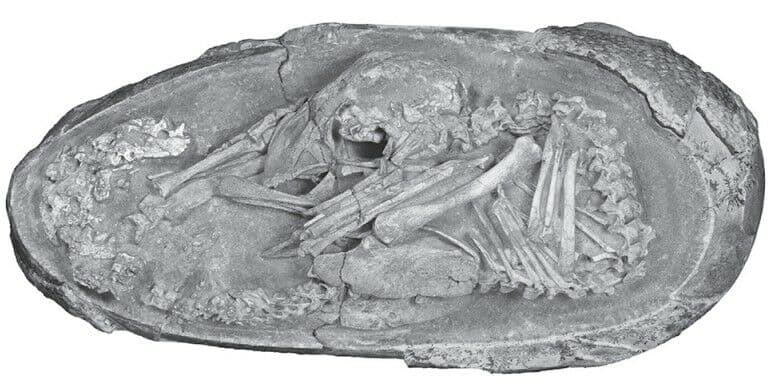
The image below shows a recently discovered fossil of an unhatched egg of a theropod dinosaur. The dinosaur is in a prehatching position similar to bird embryos in unhatched eggs today. Prior to finding the fossil, this behavior was never seen in animals other than birds. The fact that both theropod dinosaurs and birds share this behavior is evidence that
behaviors like this must be learned from parents
this behavior decreases reproductive success
animals that develop in eggs must use this behavior to survive
birds and theropod dinosaurs are related and share a common ancestor
30sS4-K3.3.1 - Q13
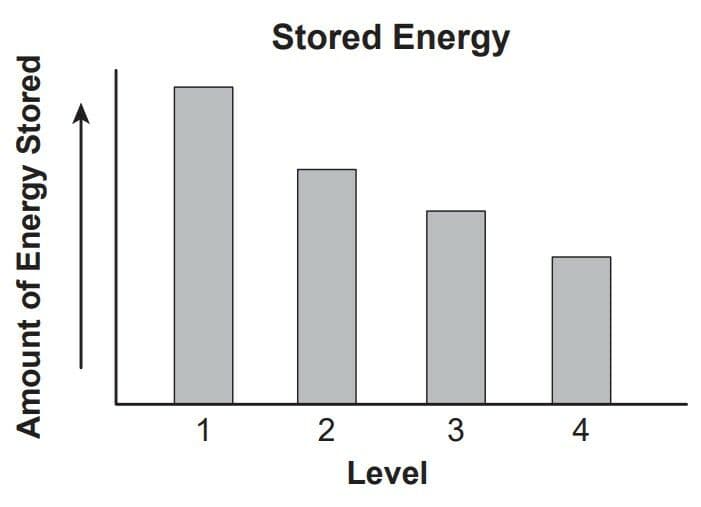
The graph below represents the amount of stored energy in each level of an energy pyramid.
The amount of stored energy between level 1 and level 4 decreases because
there are more producers at each level
there are more organisms at level 4
level 1 has more consumers
at each level some energy is released as heat
30sS4-K6.6.1 - Q14
In a sexually reproducing species of plant, which change could occur that would have an effect on the species in the future?
a change in the DNA sequence caused by ultraviolet radiation in the cells of the plants’ stems
variations that occur in the root cells of the plants in a field
changes in the egg cells in the ovaries of the plants’ flowers
differences in leaf cells that are exposed to solar radiation
30sS4-K3.3.1 - Q15
Many factors go into producing goods that are used by people in their everyday lives. In manufacturing, the production of goods and use of energy
is always positive because it is the only way for goods to be produced
can only be negative because it generates a lot of pollution
can have both positive and negative effects
is neither positive nor negative because the energy is necessary
30sS4-K7.7.1