Loading...


GEOLOGY FOR ENGINEERS!!!(UPPERCASE TOL HA)
Quiz by camille nonescan
Tag the questions with any skills you have. Your dashboard will track each student's mastery of each skill.
The most common rock forming minerals are
It describes the breaking down or dissolving of rocks and minerals on the surface of the Earth. Water, ice, acids, salts, plants, animals, and changes in temperature are all agents.
Two types of crust
This is the amount of energy released by an Earthquake.
It is one of the important minerals that is also known as iron sulfide.
The color of a mineral when it is ground to powder is its
Which principle states that geologic processes have operated similarly over time
The Pinatubo Eruption happened back in year _____ ?
What is the other name of Muscovite?
Which among the following is generated as a result of the breakdown of ancient plant life that existed millions of years ago. The dead plant materials began to build up, eventually producing a substance known as peat.
Which period is also known as the Age of the Fishes due to the abundance of fish fossils in rocks.
Minerals satisfy five conditions, except:
Minerals are always solid.
Minerals are rarely formed in nature.
Minerals are always solid.
It is a high-pressure condition exist in _______, which occur when one tectonic plate is driven beneath another. These settings can also stimulate the development of garnets
The era containing the Triassic, Jurassic, and Cretaceous Periods.
Conchoidal is the type of fracture when minerals fracture in curved surfaces, it is sometimes seen in quartz but more common in non-crystalline substances.
One of the properties of crystalline solids are highly compressible
CONVERGENT PLATE BOUNDARIES is a type of tectonic Plate boundary is associated with subduction and explosive volcanic eruption.
Which of the following is not among the types of volcanic eruption?
When you say a mineral is metallic, you are taking about its
TWO TYPES OF BODY WAVES
Which event marked the beginning of the Mesozoic era
This is the measure of size of an Earthquake.
Where do over 80 percent of large earthquakes occur
The tendency of a crystalized mineral to break along certain directions yielding smooth, plane surface.
What mineral has CACO3 as its chemical equation?
Also known as “Fools Gold” because of the crystal resemble gold in color.
This refers to any solid materials whose atoms are arranged in a definite pattern or in a highly ordered structure, called a crystal lattice.
Three types of plate boundary.
Type of volcano in which most of it is symmetrical and steep.
Rock forming minerals contain elements that are common in Earth’s
One of two types of Igneous Rocks.
The best way to tell a pyrite sample from a gold sample of similar size is to compare their
It is the opalescent variety of orthoclase, with a blue or white sheen like the glow of the moon and it is composed of two feldspar species, orthoclase and albite; the two species are intermingled.
Two types of Surface Waves.
This type of volcano is also known as Stratovolcano.
the hardness scale of DIAMOND
the hardness scale of CALCITE
the hardness scale of GYPSUM
the hardness scale of CORUNDUM
the hardness scale of TOPAZ
FLUORITE
the hardness scale of APATITE
the hardness scale of TALC
the hardness scale of ORTHOCLASE
the hardness scale of QUARTZ
FOSSIL
QUARTZ
GRANITE
ROCK SALT
WOOD
ICE
ORTHOCLASE
TALC
GOLD
WATER
BONE
COAL
DOLOMITE
DIAMOND
FLUORITE
YOUNGEST (1) TO OLDEST (10) THIS 1-6
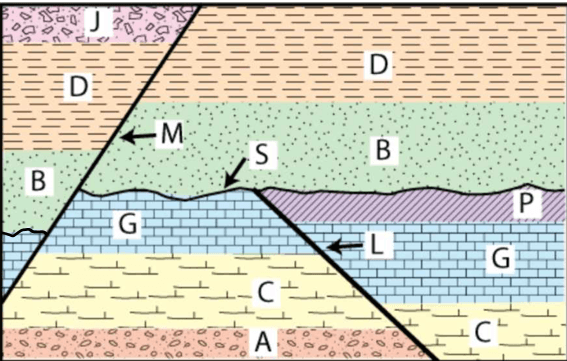
7-10
People who study about tremors (earthquake) are known as?
It involves the transfer of heat by the physical movement of the material.
Which of the following is NOT a type of plate boundary?
The part of Earth that lies just beneath the crust is the
Earth's continents were once joined as a single massive supercontinent. What do geologists call it?
The theory stating that the Earth’s outer mechanical layer, the lithosphere, is divided into large continent-sized plates that are constantly moving.
A sudden and violent shaking of the ground, sometimes causing great destruction, as a result of movements within the earth's crust or volcanic action.
A theory that suggests continents shift position on Earth’s surface and have moved over geologic time relative to each other, thus appearing to have "drifted" across the ocean bed.
Point on the fault where the rupture occurs and the location from which seismic waves are released.
A geological process in which one edge of a crustal plate is forced downward into the mantle below another plate and melted.
developed the Continental Drift Theory in 1912 and said that continents move around on Earth’s surface and that they were once joined together as a single supercontinent.
the study of earth’s material.
When plates move toward each other, it is called
When plates move away from each other, it is called
a framework that organizes Earth's history into distinct divisions based on significant geological and biological events.
can lead to the formation of new landmasses.
A period that characterized by the emergence of Homo sapiens
states that a sedimentary rock layer in a tectonically undisturbed sequence is younger than the one beneath it and older than the one above it.
states that the geologic processes observed in operation that modify the earth's crust at present have worked in much the same way over geologic time.
the result of a sudden release of stored energy in the Earth's crust that creates seismic waves
Three (3) Types of Plate Boundary
Two (2) types of body wave
Two (2) types of surface waves
SIX Type of Volcanic Eruption
GEOLOGIST WHO STUDIES FOSSILS IS KNOWN AS
THE TENDENCY OF A CRYSTALIZED MINERAL TO BREAK ALONG A CERTAIN DIRECTIONS YIELDING MORE OR LESS SMOOTH, PLANE SURFACE IS
MINERALOGY DEALS WITH
A PROPERTY OF MINERALS THAT DESCRIBES THE RATION OF THE WEIGHT OF THE MINERAL BY THE WEIGHT OF AN EQUAL VOLUME OF WATER
THE TERM IN GEOLOGY AS NATURALLY OCCURING AND COHERENT AGGREGATE OF ONE OR MORE MINERALS
FOUR SYMMETRY ELEMENTS OF CRYSTALS
FOUR PHYSICAL PROPERTIES OF MINERALS
FIVE AMONG SEVERAL MOST COMMON ROCK FORMING MINERAL
SOMETIMES CALLED VITREOUS TEXTURE
STUDY OF MINERALS, THEIR CRYSTALLINE AND CHEMICAL STRUCTURES, AND THEIR PROPERTIES
A NATURALLY OCCURING, INORGANIC, SOLID, CRYSTALLINE SUBSTANCE
REFERS TO THE EXPERIMENTAL SCIENCE OF DETRERMINING THE ARRANGEMENT OF ATOMS IN CRYSTALLINE SOLIDS
What are the three primary categories of rocks studied in petrology?
What does the term "petrology" mean in Greek?
What causes metamorphism in rocks?
Explain how weathering and erosion contribute to the formation of sedimentary rocks
What is the difference between magma and lava?
How would you classify a rock that has a fine-grained texture and is composed of quartz and feldspar?
How are sedimentary rocks formed?
The most abundant sedimentary rock found in the Earth’s crust is
Foliated rocks have a layered or banded texture, while nonfoliated rocks have a random orequidimensional texture.
Dikes are dome-shaped intrusive bodies, while sills are vertical or near vertical intrusive rock bodies
Dikes cut across rock beds, while sills run parallel to the existing rock bed
Two (2) types of Igneous Rocks are Extrusive Igneous Rock and Intrusive Igneous Rock
types of Metamorphism
common sedimentary rocks
common minerals found in igneous rocks
type of rock and its classification GNEISS
type of rock and its classification BRECCIA
It can be measured as the distance from crest to crest or from through to trough. It is inversely proportional to frequency.
It depends upon the nature of the medium used.
It is the measure of the number of waves passing through a point in a unit time.
A condition that affects the speed of sound
It describes the ability of a substance to undergo deformation and then return to its initial form in response to outside forces.
a process to improve the load bearing capacity of a structure by filling wet or dry materials into cavities or cracks of a rock mass, concrete, and other types of materials that can bear loads.
the material that was injected into the structure in the process of grouting.
the ability of a material to resist a distorting influence and to return to its original size and shape when that influence or force is removed.
a measure of the internal forces that particles of a material exert on each other when an external force is applied. It is calculated as force per unit area and is expressed in pascals (Pa) or newtons per square meter (N/m²).
the measure of deformation of the material as a result of stress. It is the ratio of the change in dimension to the original dimension and is dimensionless.
Wave is a propagational disturbance from place to place in a regular and organized way.
Love Waves is a combination of P-wave and S-wave, also a type of waves that we feel during Earthquake.
Rayleigh waves Is a combination of P-wave and S-wave, also a type of waves that we feel during Earthquake.
Rock mechanics is important in Mining, Geotechnical Engineering, Petroleum Engineering, and Environmental Engineering.
Geology is a branch of biology that focuses on the behavior and physical properties of rocks.
Seismology is the study of seismic waves and earthquakes that move around the Earth's surface.
4 types of Joints
5 types of Folded Structures
the 3 elements of Geological structure
3 types of geological map
4 types of faults
This explains the movement of the earth that caused some parts either to rise or sink. This happens with the folding, faulting, and wrapping of the earth.
Located at the West of the islands of Luzon and Mindoro in the Philippines.
This is also known as “East Luzon Trough”.
It is a tectonic boundary where two lithospheric plates converge, and one plate is forced beneath the other into the Earth's mantle.
These are curved chains of volcanoes that form above subduction zones. These arcs result from the melting of the subducted oceanic plate as it descends into the Earth's mantle.
The arc is a result of the subduction of the Philippine Sea Plate beneath the Eurasian Plate along the Cotabato Trench, giving rise to a chain of active volcanoes across the region.
The Philippine Fault is believed to be comparable to the San Andreas Fault where the faults are locked, transitional, and creeping segments.
Guinayangan Fault can generate high-intensity quakes and was the cause of the magnitude 7 Ragay Gulf quake.
The fault covers 4 segments: Santa-Sinait; San Juan-Vitar; Bacarra-Burgos; and Pagudpud -Ilocos Region
These are a linear or curved sequence of mountains that are connected by high ground.
It is considered as Luzon’s backbone.
The Cagayan River is known throughout the Philippines as the __________.
It refers to natural landscape that is largely the result of chemical weathering by water, resulting in caves, sinkholes, cliffs, and steep-sided hills.
This mineral is mainly found in the provinces of Zambales and Dinagat.
Major deposits of gold are found in Baguio, Paracale, Masbate, Surigao, and Masara.
Three main geographical divisions of the Philippine Archipelago.
Volcanic arcs in the Philippines associated with the subdivision.
Give 5 (Five) Philippine’s Major Fault Lines.
4 (Four) Types of Karst landscape.
5 (Five) Importance of Regional Geology in Engineering.
GOD IS ALWAYS THERE TO GUIDE YOU.
an earth science comprising the study of solid Earth, the rocks of which it is composed, and the processes by which they change
An explosion of life populated the seas, but land areas remained barren
Multiple collisions between the Earth's crustal plates gave rise to the first supercontinent, known as
The predecessor of today's Atlantic Ocean began to shrink as the continents of that time drifted closer together. Trilobites were still abundant; important groups making their first appearance included the corals, crinoids, bryozoans, and pelecypods
Life ventured on to land in the form of simple plants called psilophytes, with a vascular system for circulating water, and scorpion-like animals akin to now extinct marine arthropods called eurypterids
This period is also known as the age of fishes, because of their abundant fossils in Devonian rocks. Fishes had also become adapted to fresh water as well as to salt water.
The Earth's land areas became welded into a single land mass that geologists call Pangaea, and in the North American region the Appalachians were formed.
known as the age of reptiles.
was marked by the reappearance of Gondwanaland, as Pangaea split apart into northern (Laurasia) and southern (Gondwanaland) supercontinents.
The beginning of the Mesozoic era
As Gondwanaland rifted apart, the North Atlantic Ocean widened and the South Atlantic was born. Giant dinosaurs ruled on land, while marine reptiles such as ichthyosaurs and plesiosaurs increased in number
Dinosaurs flourished and evolved into highly specialized forms, but they abruptly disappeared at the end of the period, along with many other kinds of life.
North America's land link to Europe was broken, but its ties to South America were forged towards the end of the period.
Intermittent continental ice sheets covered much of the northern hemisphere. Fossil remains show that many primitive pre-human types existed in south-central Africa, China, and Java by Lower and middle Pleistocene times; but modern humans (Homo sapiens) did not appear until the later Pleistocene.
concerns crosscutting intrusions. In geology, when an igneous intrusion cuts across a formation of sedimentary rock, it can be determined that the igneous intrusion is younger than the sedimentary rock.
states that, with sedimentary rocks, if inclusions (or clasts) are found in a formation, then the inclusions must be older than the formation that contains them.
- states that the deposition of sedimentsoccurs as essentially horizontal beds.
states that a sedimentary rock layer in a tectonically undisturbed sequence is younger than the one beneath it and older than the one above it.
based on the appearance of fossils in sedimentary rocks. As organisms exist at the same time period throughout the world, their presence or (sometimes) absence may be used to provide a relative age of the formations in which they are found.
The core is divided into two layers: a solid inner core and a liquid outer core.
made of minerals rich in the elements iron, magnesium, silicon, and oxygen.
rich in the elements oxygen and silicon with lesser amounts of aluminum, iron, magnesium, calcium, potassium, and sodium.
made of relatively dense rock called basalt
made of lower density rocks, such as andesite and granite.
the rigid outermost layer made of crust and uppermost mantle.
part of the mantle that flows, a characteristic called plastic behavior.
The flow of the asthenosphere is part of mantle convection, which plays an important role in moving lithospheric plates.
originally proposed by Alfred Wegener, a German meteorologist, in 1912.
proposed that the Earth's surface consists of 12 rigid plates that move relative to each other
This belt is known as the "Ring of Fire" because it is the site of frequent volcanic eruptions.
plate boundary, plates slide past each other.
accordingly measured with a seismometer, commonly known as a seismograph.
s formed of several layers that have very different physical and chemical properties.
is the depth from the Earth's surface to the region where an earthquake's energy originates (the focus)
is the point on the Earth's surface directly above the focus.
commonly described by the geographic position of its epicenter and by its focal depth.
The vibrations produced by earthquakes are detected, recorded, and measured by instruments called??
travel along the Earth's surface,
travel through the Earth.
a wave usually have the strongest vibrations and probably cause most of the damage done by earthquakes
waves travel through the Earth's molten core.
push tiny particles of Earth material directly ahead of them or displace the particles directly behind their line of travel.
Shear waves do not travel as rapidly through the Earth's crust and mantle as do compressional waves, and because they ordinarily reach the surface later, they are called "secondary" or?
designated the primary preliminary wave because it is the first to arrive at a seismic station after an earthquake.
The simplest method of locating an earthquake on a globe is to find the time interval between the P- and S-wave arrivals at several seismograph stations.
drawn on the globe using the distance of the earthquake to the station as a radius.
measurements of the severity of an earthquake.
a measure of the amount of energy released
usually expressed by the Richter Scale, is a measure of the amplitude of the seismic waves.
named after Dr. Charles F. Richter of the California Institute of Technology, is the best known scale for measuring the magnitude of earthquakes.
A quake of magnitude 2 is the smallest quake normally felt by people
expressed by the Modified Mercalli Scale, is a subjective measure that describes how strong a shock was felt at a particular location.
the main effects created by earthquakes, principally resulting in more or less severe damage to buildings or other rigidstructures
which happens when loosely packed, water-logged sediments lose their strength in response to strong shaking, causes major damage during earthquakes.
comes from the little island of Vulcano in the Mediterranean Sea off Sicily. Centuries ago, the people living in this area believed that Vulcano was the chimney of the forge of Vulcan--the blacksmith of the Roman gods.
mountains but they are very different from other mountains; they are not formed by folding and crumpling or by uplift and erosion.
a basalt with a rough, blocky appearance, much like furnace slag.
a more fluid variety with a smooth, satiny and sometimes glassy appearance.
the simplest type of volcano.
a bowl-shaped crater at the summit and rarely rise more than a thousand feet or so above their surroundings
They are typically steep-sided, symmetrical cones of large dimension built of alternating layers of lava flows, volcanic ash, cinders, blocks, and bombs and may rise as much as 8,000 feet above their bases.
have a crater at the summit which contains a central vent or a clustered group of vents.
type of volcano, are built almost entirely of fluid lava flows
are formed by relatively small, bulbous masses of lava too viscous to flow any great distance; consequently, on extrusion, the lava piles over and around its vent.
Huge clots of molten lava burst from the summit crater to form luminous arcs through the sky.
Dense cloud of ash-laden gas explodes from the crater and rises high above the peak.
Great quantities of ash-laden gas are violently discharged to form cauliflower-shaped cloud high above the volcano.
Large quantity of gas, dust, ash, and incandescent lava fragments are blown out of a central crater, fall back, and form tongue-like, glowing avalanches that move downslope at velocities as great as 100 miles per hour.
In fissure-type eruptions, molten, incandescent lava spurts from a fissure on the volcano's rift zone and feeds lava streams that flow downslope.
The most powerful eruptions and involve the explosive ejection of relatively viscous lava.
– gives a substance the appearance of being made of metal.
gives a substance a glazed appearance, like glass or porcelain.
resembles the surface of unglazed pottery; it is a common characteristic of various clay minerals. Minerals with an earthy luster look as though they are covered with dirt or dust
looks like the mineral is covered with grease, the mineral definitely shines.
- describes the “scratchability” of minerals.
is the easiest of the properties to see, but it is not always the best way to identify a mineral. Many minerals have more than one color because of impurities that were present during the formation of the mineral.
a test used by a geologist to see the color of the mineral under the top layer or coating on the mineral. T
is the mineral’s tendency to split apart along certain preferred directions.Some minerals have a tendency to split or crack along parallel or flat planes
is a mineral property related to cleavage. Fracture occurs when a mineral breaks at random lines instead of at consistent cleavage planes. Many minerals that have no cleavage or poor cleavage fracture easily.
when minerals fracture in curved surfaces. These look rather like the inside of a clam shell.
was used by ancient sailors for compasses.
a mineral that has perfect cleavage and a greasy or soapy feel. It is given the distinction of being number 1 on Mohs hardness scale.
pure calcium carbonate (CaCO3). It is found in limestone and marble. It is the cementing agent that binds sediments together into sedimentary rocks. Marble is metamorphosed (changed by heat and pressure) limestone
the most important source of iron ore in the world.
an important source of lead.
has a hardness of about 2.5 on Mohs hardness scale which is about as hard as your finger nail.
common mineral that is found in many different types of rocks.
is also known as iron sulfide. It is one of the most common minerals on the Earth's surface.
is a mineral that can be split into very thin sheets.
very similar chemically to a diamond.
a hot liquid made of melted minerals. These minerals form crystals when they cool.
can form underground, where the magma cools slowly.
can form above ground, where the magma cools quickly.
can occur in rock when they are heated to 300 to 700 degrees Celsius.
also cooling and thus hardening into igneous rocks deep under the surface of the Earth.
usually take a few thousand years to cool
dark colored, fine-grained extrusive rock. The mineral grains are so fine that they are impossible to distinguish with the naked eye or even a magnifying glass.
very closely related to granite and has much finer crystals
an extrusive igneous rock having cooled much more rapidly than granite, giving it a glassy appearance.
- are those extrusive igneous rocks with chemical content between that of a felsic and mafic.
is volcanic glass. It is one of the few rocks that is not composed of minerals.
formed from lava that is full of gas and a very light colored, frothy volcanic rock.
Igneous rocks that are formed at great depth.
an igneous body that crystallized at a considerable depth.
a small discordant pluton with an outcrop area of less than 100 sq. kilometers
a large discordant pluton, with an outcrop area of more than 100 sq. kilometers.
a vertical or near vertical intrusive igneous rock body that cuts across rock beds.
a dome shaped intrusive body that has intruded between layers of sedimentary rock. The rising magma forces the overlying layers to rise up into a dome.
similar to a dike with the exception that sills run parallel to the existing rock bed instead of cutting through it
mafic, dark-colored, coarse-grained intrusive igneous rocks. They are very similar to basalts in their mineral composition.
composed mostly of the mineral plagioclase feldspar with smaller amounts of pyroxene and olivine
A felsic, coarse – grained igneous rock composed mainly of potassium and sodium – rich feldspar and quartz, is the most abundant intrusive rock
A coarse – grained, igneous rock of intermediate composition. It is composed of approximately equal amounts of plagioclase feldspar and ferromagnesian minerals.
are formed by deposition of either detrital or organic matter, or chemical precipitates (evaporites), followed by compaction of the particulate matter and cementation.
is the grinding away of sharp corners of rock fragments during transportation
a process in which sediment grains are selected and separated according to grain size (or grain shape or specific gravity)
Formed from cemented sediment grains that are fragments of preexisting rocks.
a clastic sedimentary rock that forms from the cementing of rounded cobble and pebble sized rock fragments
formed by river movement or ocean wave action.The cementing agents that fill the spaces to form the solid rock conglomerate are silica, calcite, or iron oxides.
a clastic sedimentary rock that forms from the cementing together of sand sized grains forming a solid rock.
a fine – grained sedimentary rock notable for its splitting capability, or fissility.Most shales contain both silt and clay and are so fined – grained that the surface of the rock feels very smooth.T
a rock consisting mostly of silt grains.It lacks the fissility of and laminations of shale because it is much more coarse-grained than shale
a rock that contains both silt and clay, has the same grain size and is almost as smooth as shale but lacks that of shale’s fissility and lamination
the most abundant of the non-clastic sedimentary rocks. Limestone is produced from the mineral calcite (calcium carbonate) and sediment.
– the solid – state transformation of preexisting rocks into texturally or mineralogically distinct new rock as a result of high temperature, high pressure, or both.
the parallel alignment of textural and structural features of a rock.
metamorphism in which high temperature is the dominant factor.
metamorphism caused by relatively high temperature and pressure
metamorphosed limestone or dolomite. Both limestone and dolomite have a large concentration of calcium carbonate (CaCO3)
a fine-grained metamorphic rock with perfect cleavage that allows it to split into thin sheets.
a medium grade metamorphic rock, which means that it has been subjected to more heat and pressure than slate, which is a low grade metamorphic rock.
a high grade metamorphic rock, which means that gneiss has been subjected to more heat and pressure than schist.
composed of sandstone that has been metamorphosed.
a branch of geology that deals with the shapes, arrangement, and interrelationships of bedrock units and the forces that causes them.
are produced when rocks break or bend due to the applied stresses within the earth. Due to these applied stresses, rocks/ rock formations deform. Deformation of rocks are brought about by plate tectonics processes and burial of sediments.
are attitudes in the rocks produced by geologic forces and present after the rocks are folded (bent) or faulted (cracked and moved along the crack).
an imaginary line with compass direction constructed on the surface of a sedimentary bed or fault in which all points on that line are of equal elevation--the compass direction is usually expressed as a bearing
- is an imaginary line constructed down-slope on a sedimentary bed or fault--the dip direction is perpendicular to the strike direction and usually expressed in bearing and an angle of tilt (dip) measured from the horizontal plane to the top of a bed or fault--a dip angle may not exceed 90 degrees
are warps in rock layers and occur bended upwards, downwards, or sideways--compressional forces are the prime causes of folds.
a series of up-arched strata with side portions (limbs) dipping in opposite directions away from the central portion of fold split by a plane called the axial plane and observed in the top (plan) view as the fold axis--an eroded surface indicates the rocks become progressively younger away from the fold axis
- is a series of down-arched strata with limbs dipping inwards in opposite directions towards the fold axis--an eroded surface indicates the rocks become progressively older away from the fold axis
an up-arched series of strata with beds on all sides dipping away from the center throughout 360 degrees--an eroded surface indicates the rocks become progressively younger away from the center of the structure
a down-arched series of strata with beds on all sides dipping in towards the center throughout 360 degrees--an eroded surface indicates the rocks become progressively older away from the center of the structure.
a bend in the strata resulting in a local steepening in dip of the strata which is almost flat lying on both sides away from the bend-- there is only one direction of dip in the monocline.
is a structure with major displacement of rock material along a crack in a rock
that type with movement along the dip of the fault--the concepts of hanging wall and footwall are important in defining the different types of vertical faults.
hanging wall moves down in respect to footwall
-hanging wall moves up in respect to footwall--a low angled reverse fault is called a thrust fault
a low angle reverse fault
Movement along strike-slip faults is horizontal. It is that type with horizontal movement along the cracked rock--movement can be left lateral or right lateral
the intermediate stress is vertical. The largest and smallest stresses are horizontal
the two blocks move either to the left (sinistral ) or to the right (dextral) relative to one another
