
placeholder image to represent content

GRADE 10-SCIENCE

Quiz by Theresa Mariz

Our brand new solo games combine with your quiz, on the same screen

Correct quiz answers unlock more play!

New Quizalize solo game modes
15 questions
Show answers
  • Q1

    Oceanographers mapped the ocean floor and discovered "magnetic stripes" on either side of the Mid-Atlantic Ridge. The stripes show alternating bands of normal and reversed polarity that are symmetrical.

    Figure: [Ridge] ⇦Normal | Reverse | Normal ⇨ [Ridge] ⇦ Normal | Reverse | Normal ⇨

    How does this magnetic data scientifically support the theory of Seafloor Spreading?

    The stripes appear because the Earth's magnetic field flips back and forth every few years.

    New rock forms at the ridge, recording Earth's magnetic field as it cools and spreads outward.

    The ocean floor is made of magnetic iron that rusts over time, changing colors in bands.

    The magnetic rocks are pulled by the North Pole, causing the continents to drift apart.

    300s
  • Q2

    The Himalayas are a tall mountain range formed where the Indian Plate collides with the Eurasian Plate. Unlike the Andes mountains, there are no volcanoes in the Himalayas. Scientifically, why are volcanoes absent in this specific collision zone?

    The weather is too cold in the Himalayas, which freezes the magma before it erupts.

    The mountains are too high for the lava to reach the very top peaks.

    It is a continental-continental collision, so neither plate subducts deep enough to melt.

    The collision is pushing rocks up, while volcanoes only form where rocks fall down.

    300s
  • Q3

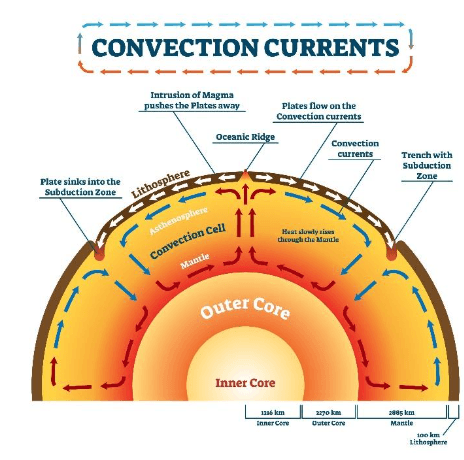
    Scientists believe that the movement of tectonic plates is driven by processes within the Earth's mantle.

    Explain the mechanism driving this movement.
    Question Image

    Heat from the core causes convection currents; hot material rises, drags plates, cools, and sinks.

    Gravity pulls the heavy continents down, making them slide across the slippery mantle.

    The core acts like a magnet that pushes the crustal plates around the surface.

    The mantle is boiling liquid, and the bubbles push the continents apart.

    300s
  • Q4

    Comparing two types of waves:

    Wave X: Used in night vision goggles; feels like heat.

    Wave Y: Used to treat cancer; can damage cells.

    Data: Wave Y has a much higher frequency than Wave X.

    Why is Wave Y more dangerous to living tissue than Wave X?

    Wave Y has a longer wavelength, allowing it to wrap around and squeeze cells.

    Wave X is natural, while Wave Y is artificial and therefore toxic.

    Wave Y is faster than Wave X, so it hits the cells harder.

    Wave Y carries more energy per photon due to its higher frequency, causing ionization.

    300s
  • Q5

    A student has Myopia (nearsightedness). Light from distant objects focuses in front of their retina rather than on it.

    Why does a concave lens correct this vision problem?

    Question Image

    It diverges light rays before they enter the eye, pushing the focal point back onto the retina.

    It magnifies the image so the retina can catch the light more easily.

    It makes the object look smaller so it fits inside the eye.

    It reflects the extra light away so the eye is not overwhelmed.

    300s
  • Q6

    In a simple electric motor, a coil of wire spins when placed in a magnetic field and connected to a battery.

     What fundamental interaction causes the coil to spin?

    The magnetic field creates a force on the moving charges in the current-carrying wire.

    The battery pushes air against the coil to make it turn.

    The magnet attracts the metal wire and pulls it in a circle.

    The electricity warms up the wire, causing it to expand and rotate.

    300s
  • Q7

    A student moves a bar magnet quickly in and out of a coil of wire connected to a galvanometer. The needle moves. When the magnet is held still inside the coil, the needle returns to zero.

    Scientifically, why is movement required to produce current?

    The magnet needs to catch air friction to generate static electricity.

    The electrons in the wire are sleeping and need the magnet to wake them up.

    Moving the magnet shakes the electrons loose from the copper atoms.

    A changing magnetic field is required to induce an electromotive force (voltage).

    300s
  • Q8

    After a meal, blood glucose levels rise. The pancreas releases Insulin. As a result, glucose levels drop. How does this process demonstrate negative feedback?

    Insulin destroys the glucose to stop the blood from becoming too sweet.

    The rise in glucose triggers a response (insulin) that reverses the change, restoring balance.

    The body reacts negatively to food by removing the sugar.

    The pancreas works harder when you eat, which is a negative strain on the organ.

    300s
  • Q9

    A DNA sequence TAC is transcribed into mRNA AUG and translated into the amino acid Methionine. A mutation changes the DNA to ATC.

    Why might this change affect the organism's traits?

    Changing the letter makes the gene read backwards.

    The mutation makes the DNA disappear, so the cell dies.

    The DNA change alters the mRNA, potentially changing the protein's shape and function.

    The organism will grow a new limb because the code is different.

    300s
  • Q10

    A population of bacteria is treated with an antibiotic. Most die, but a few survive. The next generation of bacteria is entirely resistant to the antibiotic. Which explanation best fits Darwinian Natural Selection?

    The bacteria with random mutations for resistance survived and reproduced.

    The bacteria realized the antibiotic was bad and learned to fight it.

    The antibiotic made the bacteria stronger by exercising their immune systems.

    The bacteria needed to change to survive, so they mutated on purpose.

    300s
  • Q11

    Graph A shows a forest with 50 species of trees. Graph B shows a plantation with 1 species of tree. A disease strikes both areas.

    Why is the forest in Graph A more likely to survive the disease outbreak?

    Graph A has more trees, so it takes longer for them all to die.

    The disease will get confused by too many different types of trees.

    Genetic diversity increases the chance that some species will be naturally resistant.

    The trees in Graph A are older and stronger than the plantation trees.

    300s
  • Q12

    A scuba diver releases an air bubble deep underwater. As the bubble rises to the surface, its volume increases significantly.

    Based on the Kinetic Molecular Theory, why does the volume increase?

    The water pressure decreases, so gas particles hit the container walls less often, allowing expansion.

    The bubble sucks in more water as it goes up, making it bigger.

    Gases naturally want to be free, so they expand when they get closer to the air.

    The gas particles get excited by the sunlight at the surface and run away from each other.

    300s
  • Q13

    A balloon is placed in a freezer. After 1 hour, the balloon appears shrunken and wrinkled.

     Explain this change in terms of particle movement.

    The balloon material tightened up because of the cold.

    The air escaped through the holes in the balloon because of the cold.

    The cold air made the gas particles heavy, so they fell to the bottom.

    Low temperature decreased the kinetic energy of particles, reducing the force of collisions.

    300s
  • Q14

    Two experiments are conducted using magnesium and hydrochloric acid.

    Exp 1: Whole Magnesium ribbon + Acid ----> Slow bubbling.

    Exp 2: Crushed Magnesium powder + Acid ----> Fast bubbling.

     How does collision theory explain the result in Experiment 2?

    Crushing the magnesium releases the energy stored inside the metal.

    The powder is lighter than the ribbon, so it floats and reacts faster.

    Increased surface area exposes more particles, increasing the frequency of effective collisions.

    The powder heats up the acid, making the reaction go faster.

    300s
  • Q15

    Enzymes are proteins that speed up chemical reactions. If an enzyme is boiled, it stops working.

    Scientifically, why does heating the enzyme destroy its function?

    High temperature alters the protein's 3D shape (denaturation), destroying the active site.

    The heat melts the enzyme into a liquid so it flows away.

    The heat kills the enzyme because it is a living thing.

    The enzyme gets used up by the heat and has no energy left.

    300s

Teachers give this quiz to your class