Determine the meaning of words and phrases as they are used in a text, including figurative, connotative, and technical meanings; analyze the impact of a specific word choice on meaning and tone.
Analyze the interactions between individuals, events, and ideas in a text (e.g., how ideas influence individuals or events, or how individuals influence ideas or events).
Trace and evaluate the argument and specific claims in a text, assessing whether the reasoning is sound and the evidence is relevant and sufficient to support the claims.
Compare and contrast a text to an audio, video, or multimedia version of the text, analyzing each medium's portrayal of the subject (e.g., how the delivery of a speech affects the impact of the words).
Analyze how two or more authors writing about the same topic shape their presentations of key information by emphasizing different evidence or advancing different interpretations of facts.
Track each student's skills and progress in your Mastery dashboards
Give this quiz to my class
Q 1/21
Score 0
Part A: What is the best definition of anecdotal as the word is used in paragraph 15 of Text 1, “High Schools Starting Later to Help Sleepy Teens?”
45
Evidence that is unrelated to the author’s claims
Evidence based on personal experiences
Evidence based on unlikely theories
Evidence that comes from many years of research
Q 2/21
Score 0
Part B: Which detail from Text 1 helps the reader determine the meaning of anecdotal?
45
“…teachers especially wanted…”
“…Wolak adds…”
“…supports Wolak’s observations…”
“…overwhelmingly endorsed…”
21 questions
Q.
Part A: What is the best definition of anecdotal as the word is used in paragraph 15 of Text 1, “High Schools Starting Later to Help Sleepy Teens?”
1
45 sec
RI.7.4
Q.
Part B: Which detail from Text 1 helps the reader determine the meaning of anecdotal?
2
45 sec
RI.7.4
Q.
Part A: Based on information in Text 1, which sentence states the author’s primary claim?
3
45 sec
RI.7.6
Q.
Part B: How does the author of Text 1 most effectively develop her primary claim?
4
45 sec
RI.7.6
Q.
How does the author structure her argument regarding the possibility of adjusting start times for high school students?
5
45 sec
RI.7.5
Q.
Part A: Based on the information in Text 1, which sentence explains how the sleep habits of teenagers are impacted by school start times?
6
45 sec
RI.7.3
Q.
Part B: Which sentence from Text 1 supports the correct answer to Part A?
7
45 sec
RI.7.3
Q.
In Text 1, the author describes some concerns related to changing high school start times. Which “Real-Life Solution” does the author uses to contradict the following concern about changing start times?
1. Having high schools start later is expensive because it requires schools to run more busses each day.
8
45 sec
RI.7.8
Q.
In Text 1, the author describes some concerns related to changing high school start times. Which “Real-Life Solution” does the author uses to contradict the following concern about changing start times?
2. Having high schools start later results in students getting home from school and activities too late in the evening.
9
45 sec
RI.7.8
Q.
Part A: Which word best defines economics as the author uses the word in paragraph 4 of Text 2: “High schools will keep starting too early. Here’s why.”?
10
45 sec
RI.7.4
Q.
Part B: Which groups of words from paragraphs 3-5 of Text 2 best help the reader understand the meaning of the word economics as it is used in this passage?
11
45 sec
RI.7.4
Q.
Which sentence provides the best summary of Text 2?
12
45 sec
RI.7.2
Q.
Part A: Based on information from Text 2, which sentence best states the author’s perspective regarding high school start times?
13
45 sec
RI.7.6
Q.
Part B: Which sentence explains the most effective ways the author develops his perspective?
14
45 sec
RI.7.6
Q.
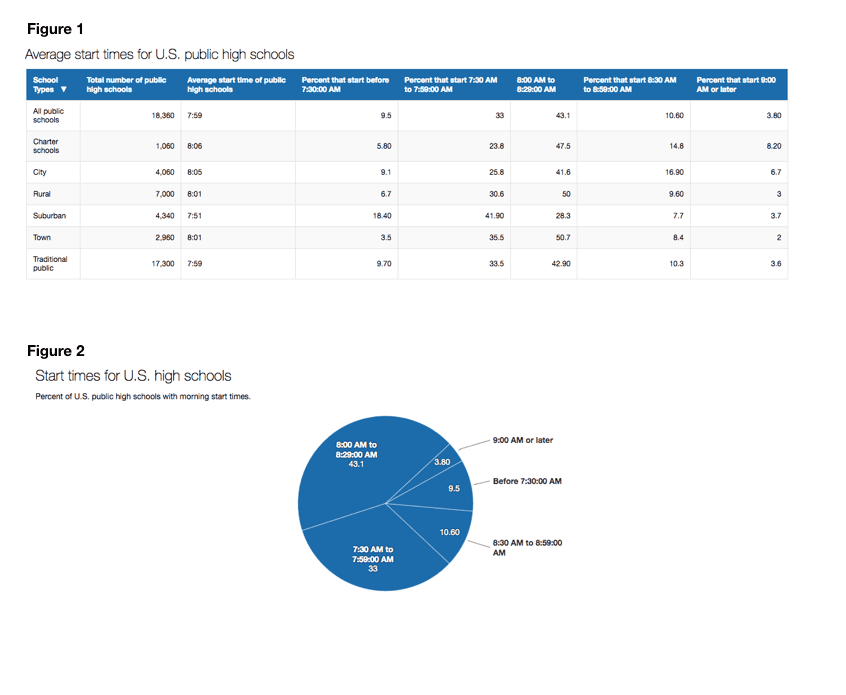
How do Figures 1 and 2 contribute to the meaning of Text 2?
15
45 sec
RI.7.7
Q.
Which sentence best explains how the recording clarifies the information provided in Text 2?
16
45 sec
RI.7.7
Q.
The school district is considering various schedules. Parents may try to convince the district to adopt a specific schedule for the good of the students. Which quote from Text 1 supports the proposed start time of 8:00AM at Elementary School?
17
45 sec
RI.7.9
Q.
The school district is considering various schedules. Parents may try to convince the district to adopt a specific schedule for the good of the students. Which quote from Text 2 supports the proposed start time of 8:00AM at Elementary School?
18
45 sec
RI.7.9
Q.
The school district is considering various schedules. Parents may try to convince the district to adopt a specific schedule for the good of the students. Which quote from Text 1 supports the proposed start time of 9:00AM at High School?
19
45 sec
RI.7.9
Q.
The school district is considering various schedules. Parents may try to convince the district to adopt a specific schedule for the good of the students. Which quote from Text 2 supports the proposed start time of 9:00AM at High School?
20
45 sec
RI.7.9
Q.
In Text 2, the author notes that Kristine Amundson believes “…late start times probably work better for smaller districts, with fewer buses to run.” Which sentence from Text 1 best contradicts this claim?