
GRADE 8-SCIENCE
Quiz by Theresa Mariz
Feel free to use or edit a copy
includes Teacher and Student dashboards
Measure skillsfrom any curriculum
Tag the questions with any skills you have. Your dashboard will track each student's mastery of each skill.
- edit the questions
- save a copy for later
- start a class game
- automatically assign follow-up activities based on students’ scores
- assign as homework
- share a link with colleagues
- print as a bubble sheet
- Q1
A student performs an experiment using two carts. Cart A has a mass of 1 kg, and Cart B has a mass of 3 kg. The student pushes both carts with the same amount of force (10 N) across a frictionless surface.
Table 1: Acceleration Data
| Cart | Mass (kg) | Force (N) | Acceleration (m/s2) |
| :--- | :--- | :--- | :--- |
| A | 1 | 10 | 10 |
| B | 3 | 10 | 3.33 |
Based on the data, which alternative best explains the difference in acceleration between the two carts?
Cart B is heavier, so it naturally resists moving more than Cart A does.
Cart B has more mass, requiring more force to achieve the same speed as Cart A.
Cart A moves faster because it is smaller and lighter than Cart B.
Cart B has greater inertia due to higher mass, resulting in lower acceleration for the same force.
300s - Q2
A construction worker lifts a 50 kg bag of cement 1 meter vertically. Another worker holds a 50 kg bag of cement on his shoulder while standing still for 5 minutes.
Scientifically, how does the work done differ between the two workers?
The worker holding the bag does no work because energy is not being transferred to the object.
Both workers do the same amount of work because the bags weigh the same.
The worker holding the bag does more work because he is tired after 5 minutes.
The worker lifting the bag does work because he applies force over a vertical distance.
300s - Q3
A group of students measured the speed of sound in air at different temperatures.
Figure 1: Speed of Sound vs. Temperature
At 0°C, Speed = 331 m/s
At 20°C, Speed = 343 m/s
At 30°C, Speed = 349 m/s
Explain the trend observed in the data.
Sound travels faster when the air is hot because it carries more heat energy.
The data shows that sound speed is directly proportional to the temperature of the medium.
Higher temperatures cause air particles to move faster, transmitting vibrations more quickly.
The speed increases with temperature because hot air rises, pushing the sound.
300s - Q4
A student places a pencil in a glass of water. From the side, the pencil appears broken at the water line.
Which statement provides the most accurate scientific explanation for this observation?
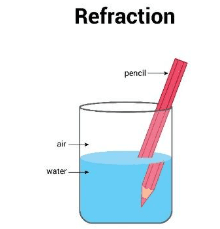
Light changes speed and bends as it travels from water to air, shifting the image's position
The water breaks the image of the pencil because water is denser than air.
The pencil looks bent because water magnifies objects differently than air.
Light rays reflect off the surface of the water, creating an illusion of a break.
300s - Q5
An experiment tested the rate of starch breakdown by the enzyme amylase at different temperatures.
Why does the reaction rate drop to zero at 60°C?
Table 2: Amylase Activity
The high temperature changes the enzyme's shape, destroying its function.
The heat kills the starch molecules so they cannot react.
The enzyme slows down because it is tired from the heat.
The enzyme becomes too hot and evaporates.
300s - Q6
A scientist observes skin cells from a patient under a microscope. She notices that as the wound heals, the number of cells increases rapidly.
How does this process ensure the new skin is identical to the old skin?
The chromosomes replicate and divide equally, producing genetically identical daughter cells.
The cells split in half to double the number of chromosomes.
The cells simply grow larger to fill the gap in the wound.
The cells mix genetic material to create stronger skin cells.
300s - Q7
Two farms are studied. Farm A plants only corn. Farm B plants corn, beans, squash, and maintains a small forest patch. A pest infestation hits both farms. Farm A loses all crops; Farm B only loses the corn.
Explain the difference in the impact of the pest infestation.
Farm A has weak soil because it only grows one crop.
Farm B was lucky that the pests only liked corn.
Farm B has higher biodiversity, making the ecosystem more resilient to disturbances.
Farm A is a monoculture, which attracts more pests than a mixed farm.
300s - Q8
Consider the following food chain: ----> Grass ----> Grasshopper ----> Frog ----> Snake.
Data shows the Grass contains 10,000 J of energy. The Snake receives only 10 J.
What happens to the missing energy?
Energy is lost as heat during metabolism at each trophic level.
The energy disappears as it moves up the chain.
The organisms at the top eat less food than the ones at the bottom.
The grasshopper and frog store most of the energy in their bodies.
300s - Q9
A beaker of water is heated. A thermometer shows the temperature rising until it hits 100°C. Despite continued heating, the temperature stays at 100°C while the water boils. Scientifically, where is the heat energy going during boiling?
The energy is used to make the water bubble and move around faster.
The thermometer is broken because the heat is still on.
The water has reached its maximum heat limit and cannot get hotter.
The energy is used to overcome the attraction between particles to change phase.
300s - Q10
An atom of Sodium (Na) has 11 protons and 11 electrons. It reacts with Chlorine to form salt (NaCl). In the process, Sodium becomes a positive ion (Na).
Explain why the Sodium atom becomes positively charged.
It gained a proton from the Chlorine atom.
It mixed with the positive charge of the salt crystal.
It became positive because it is a metal and metals are always positive.
It lost a negatively charged electron, leaving an imbalance of protons.
300s - Q11
A student drops Lithium, Sodium, and Potassium into water.
Lithium: Bubbles slowly.
Sodium: Bubbles vigorously.
Potassium: Bursts into purple flame.
How does the atomic structure explain this trend in reactivity?
Potassium is hotter than Lithium, causing a fire.
Potassium has more electrons, which makes it more unstable.
Potassium is heavier, so it hits the water harder than Lithium.
Potassium's valence electron is further from the nucleus, making it easier to lose.
300s - Q12
A liquid is heated. It starts boiling at 85°C, but the temperature continues to rise to 90°C as it boils.
What does this data suggest about the identity of the liquid?
The liquid is water but the thermometer is calibrated incorrectly.
The liquid is turning into a gas, which is why the temperature changes.
The liquid is a mixture because it boils over a temperature range.
The liquid is a pure substance because it boils.
300s - Q13
Geological data shows that a "Reverse Fault" occurred underwater in the Pacific Ocean, pushing a large slab of crust upward by 5 meters.
Why is this specific type of movement dangerous to coastal communities?
The vertical displacement of the water column generates a tsunami.
It heats the water, causing marine life to die and wash ashore.
It shakes the ground, causing buildings on the coast to collapse.
The fault creates a gap in the ocean floor that drains the water.
300s - Q14
A typhoon is tracking across the Pacific Ocean. As it enters the Philippine Area of Responsibility (PAR), it hits the Sierra Madre mountain range.
Data:
Wind speed before landfall: 180 kph
Wind speed after crossing mountains: 140 kph
Scientifically, what caused the decrease in wind speed?
Friction with land and lack of warm water supply weakened the storm.
The trees on the mountain blocked the wind physically.
The typhoon used up all its energy traveling across the ocean.
The mountains absorbed the water from the typhoon clouds.
300s - Q15
Observers notice a bright streak of light in the sky that lasts for a few seconds and disappears. This is identified as a meteor.
What causes the light phenomenon?
The rock is burning because it is made of fire.
The rock reflects sunlight as it passes near the Earth.
Friction between the rock and atmospheric particles generates intense heat.
The rock explodes upon entering the Earth's magnetic field.
300s