Grade 9 - “A Big Surprise from the Edge of the Solar System”
Quiz by Common Core - ELA - Grade 9
Grades 9-10
English Language Arts
Common Core
Feel free to use or edit a copy
includes Teacher and Student dashboards
Measures 12 skills from
Track each student's skills and progress in your Mastery dashboards
With a free account, teachers can
- edit the questions
- save a copy for later
- start a class game
- automatically assign follow-up activities based on students’ scores
- assign as homework
- share a link with colleagues
- print as a bubble sheet
13 questions
Show answers
- Q1As used in paragraph 11 of “A Big Surprise from the Edge of the Solar System,” which meaning of the word acute best applies?intensedirecrucialclear45sRST.9-10.1
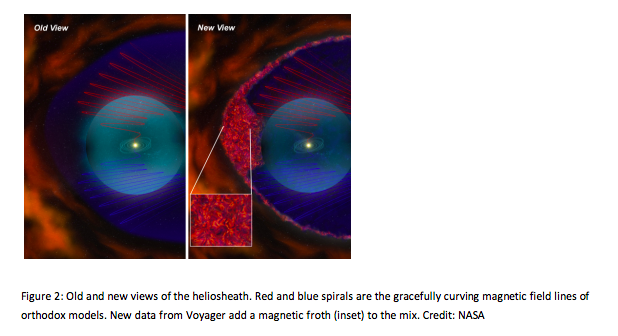
- Q2Part A: Read the caption under Figure 2 in the text. What is the meaning of the word orthodox as used in the caption?conservativeofficiallegitimatetraditional45sRI.9-10.1
- Q3Part B: Which word in the caption under Figure 2 provides the strongest clue to the meaning of the word orthodox?modelsmixoldviews45sRI.9-10.4
- Q4What is the relationship between the terms magnetic reconnection and magnetic bubbles as they are used in the article?Magnetic reconnection is what causes the magnetic bubbles to form.Magnetic reconnection is what solar flares use to create magnetic bubbles.Magnetic reconnection occurs when magnetic bubbles rejoin the sun.Magnetic reconnection is what allows magnetic bubbles to create solar flares.45sRST.9-10.5
- Q5Part A: Why does the author provide an explanation of the graceful-arc theory of the sun’s magnetic field?to demonstrate the relationship between the Sun’s magnetic field and the rate at which Voyager can send information back to Earthto introduce the beliefs about our solar system that the Voyager mission was designed to disproveto show what the Voyager is attempting to find as it reaches the outer edge of the Sun’s magnetic fieldto establish the idea that current data from Voyager probes seems to contradict previously held theories45sRST.9-10.6
- Q6Part B: How does this explanation contribute to the author’s purpose in the article?It gives an example that explains one of the Voyager’s primary goals.It provides support for the claim that the Voyager is NASA’s primary tool for making discoveries in space.It provides support for the idea that scientific theories change as new information becomes available.It gives an example of one way that scientists can learn new things from oldm experiments.45sRI.9-10.6
- Q7In the article, the author reveals Opher’s claim that “The magnetic bubbles appear to be our first line of defense against cosmic rays . . .” Which sentences from the article is most helpful to develop this claim?“Lots of things try to get across—interstellar clouds, knots of galactic magnetism, cosmic rays, and so on.”“When these microscopic cannonballs try to enter the solar system, they have to fight through the sun’s magnetic field to reach the inner planets.”“The crowded folds of the skirt reorganize themselves, sometimes explosively, into foamy magnetic bubbles.”“The actual bubbles appear to be self-contained and substantially disconnected from the broader solar magnetic field.”45sRI.9-10.5
- Q8Which of these possible ideas could be used to introduce a summary of the article?The border between the Milky Way and the Solar System is known as “the heliosheath.”Cosmic rays are subatomic particles that travel at nearlight speed.A new theory of magnetic foam is based on information gathered by the Voyager spacecraft.Scientists expect to make further discoveries based on data recorded by the Voyager craft.45sRST.9-10.2
- Q9Which of these possible ideas could be used to conclude a summary of the article?Scientists believe the foam-like magnetic fields are caused by the spinning of the sun.Cosmic rays are subatomic particles that travel at nearlight speed.The border between the Milky Way and the Solar System is known as “the heliosheath.”Scientists expect to make further discoveries based on data recorded by the Voyager craft.45sRI.9-10.2
- Q10Which excerpt from the video best demonstrates the central idea?“When they arrive at the bubble region, they slowly move from bubble to bubble until they can reach smooth magnetic field lines, and follow them toward the sun.” (1:31-1:38)“The sun’s magnetic field spins on opposite directions on the North and South Poles, creating a sheet where the two spins meet.” (0:46-0:52)“The two Voyager spacecraft have been travelling away from earth for more than thirty-three years, and they are finally in the outer edge of the solar system.” (0:14-0:20)“The smooth, streamlined look is gone, replaced with a bubbly, frothy outer layer.” (1:20-1:23)Video45sRST.9-10.2
- Q11Part A: Why does the author of the article compare cosmic rays to cannonballs?to describe the shape and trajectory of cosmic raysto clarify the role dangerous cosmic rays play in spaceto explain the technical topic of cosmic rays using a familiar objectto illustrate the explosive nature of the process of forming cosmic rays45sRST.9-10.7
- Q12Part B: Which excerpt from the video demonstrates a technique similar to the answer to Part A?“When this sheet reaches the termination shock, it starts to compress, like water hitting a wall.” (0:59 – 1:04)“This sheet gently ripples as it travels outward, and the ripples get bigger as they go.” (0:53 – 0:57)“As the solar wind travels out from the sun, it pushes against the galactic medium and abruptly slows down.” (0:29 – 0:33)“This new layer also changes our understanding of how extremely fast-moving particles, called cosmic rays, enter our solar system.” (1:24 – 1:31)Video45sSL.9-10.3
- Q13In paragraph 9 of the article, the author claims that “Energetic particle sensor readings suggest that the Voyagers are occasionally dipping in and out of the foam—so there might be regions where the old ideas still hold.” Which image from the video best supports this claim?45sRI.9-10.7