Loading...


Great Depression and WWII Review
Quiz by Adrienne Alloway
Tag the questions with any skills you have. Your dashboard will track each student's mastery of each skill.
What BEST explains Duke Ellington's considerable cultural impact in the United States in the 1930s?
Which of the following does NOT correctly illustrate one of the "three Rs" of Franklin D. Roosevelt's New Deal programs?
What major turning point in the Great Depression gave many people hope that the United States would recover?
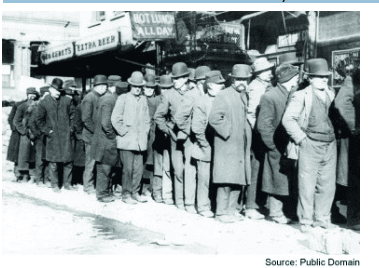
Look at the picture of a bread line outside of a bakery in New York City in the first half of the twentieth century and answer the question.
What is the MOST LIKELY reason that these men were waiting in line for bread?
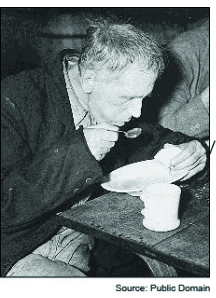
Look at the 1936 picture of a man eating at a Volunteers of America Soup Kitchen in Washington, DC. Then answer the question that follows.
Why did soup kitchens such as this one open during the 1930s?
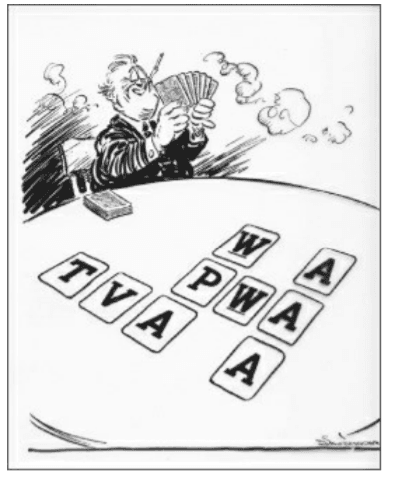
Use the 1935 political cartoon of President Franklin D. Roosevelt to answer the question.
What do the letters in this cartoon represent?
Read the text and answer the question.
George was an unemployed painter in 1936. He lived in Georgia and used to paint murals for local shops, but they could not afford to pay him anymore. He wanted to find a job that would let him use his artistic talent to support himself.
Based on his wants and needs, George should have looked for a job with?
Why did some US citizens oppose the New Deal?
Which of the following was NOT a purpose of the Tennessee Valley Authority Act?
Use the picture to answer the following question
Elora is making a timeline with pictures of the Great Depression. She lost her notes showing when this photograph was taken. Based on the scene, it was MOST LIKELY taken in

Margaret Mitchell won the 1937 Pulitzer Prize for Gone with the Wind, a book about
How did Jesse Owens contribute to US culture?
Why did farmers who did manage to grow crops during the Dust Bowl struggle to make enough money to survive?
Which set of factors helped cause the Dust Bowl in the 1930s?
Which of these regions suffered the MOST from the effects of the Dust Bowl?
How did many farmers react to the effects of the Dust Bowl in the 1930s?
In what way were the Civilian Conservation Corps and the Works Progress Administration similar?
How was the Civilian Conservation Corps (CCC) different from the Tennessee Valley Authority (TVA)?
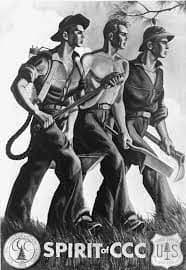
Use the image to answer the following question.
Which New Deal program is BEST represented in this image?
Why did the economy start to decline at the end of the 1920's ?
What did NOT happen once too many people tried to sell their stocks all at once which caused the market to crash?
Homeless Camps were nicknamed what during the Great Depression?
What was Germany's economy recovering from after World War I?
How did Adolf Hitler rise to power?
Benito Mussolini is the dictator from what country?
Hitler was able to carry out a lot of his aggression thanks to other European countries doing what?
Imperialism means to
What did Japan rely on other nations for?
What did President Franklin Roosevelt want to practice since Americans remember the horrors of WWI?
What lead the United Stated to Enter WWII?
Why did Japan bomb Pearl Harbor, Hawaii?
Why was rationing important during World War II?
Why were women's roles expanding during World War II?
Why was Rosie the Riveter symbol for women working during the war?
All of the following are true about the Tuskegee Airmen EXCPET
Why was Iwo Jima important during WWII?
Why did President Truman decide to drop the bomb on Hiroshima and Nagasaki
Why was Elanor Roosevelt important during this time?
What was the main goal of the United Nations?