Loading...


Hand fractures & dislocations
Quiz by Ariel
Customize this quiz to suit your class
Instantly translate to 100+ languages
Tag the questions with any skills you have. Your dashboard will track each student's mastery of each skill.
Give this quiz to my class
A 22-year-old man comes to the emergency department after falling onto his outstretched left hand. An x-ray study and a clinical photograph are shown. Attempted reduction is unsuccessful. Reduction is most likely blocked by which of the following anatomical structures?
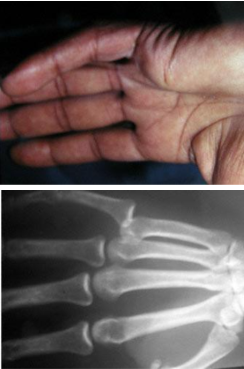
Lateral bands
Flexor tendons and intrinsic muscles
Dorsal capsule and collateral ligaments
Sagittal bands
Central slip
A 22-year-old man who has consumed alcoholic beverages punches a concrete wall with both hands and sustains multiple metacarpal fractures. Which of the following will cause the most significant long-term hand impairment in this patient?
Third metacarpal shaft fracture with 0-degree angulation
Fifth metacarpal neck fracture with 40-degree angulation
Fourth metacarpal shaft fracture with 10-degree angulation
Fourth metacarpal neck fracture with 35-degree angulation
Third metacarpal neck fracture with 25-degree angulation
A 22-year-old man comes to the emergency department after falling onto his outstretched left hand. An x-ray study and a clinical photograph are shown. Attempted reduction is unsuccessful. Reduction is most likely blocked by which of the following anatomical structures?
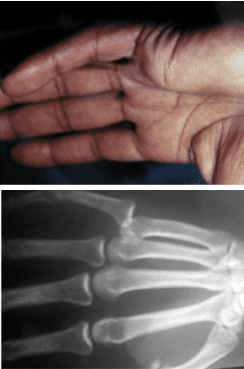
A 22-year-old man who has consumed alcoholic beverages punches a concrete wall with both hands and sustains multiple metacarpal fractures. Which of the following will cause the most significant long-term hand impairment in this patient?
A 60-year-old woman is evaluated in the emergency department after she fell on her outstretched hand while playing tennis. Examination shows tenderness in the dorsal and volar aspects of the wrist. Which of the following bones was most likely fractured in this patient?
A 38-year-old right-hand–dominant man is evaluated in the emergency department 4 hours after amputating the left thumb and index finger with a circular saw. Microvascular replantation surgery is planned. Which of the following is first in the sequence of repair?
A 3-year-old boy sustains a crushing injury to the tip of the right index finger in a door. Physical examination shows a stellate laceration of the nail bed; eponychial fold and proximal nail bed are intact. Which of the following is the most appropriate counsel when advising the patient’s parents about what they can expect with regard to fingertip injury and nail growth in their son?
The metacarpophalangeal (MCP) joint of the thumb is which of the following types of joint?
A 30-year-old man is evaluated for a hand injury after punching a wall. X-ray study shows a fracture of the fifth metacarpal neck. Which of the following findings is most likely to require surgical intervention?
An 11-year-old boy is brought to the office with an acute injury of the left small finger. A lateral x-ray study is shown. Which of the following is the most appropriate description of this patient's injury?
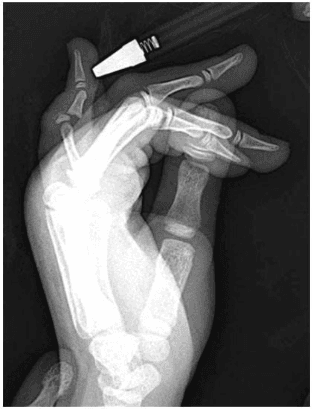
A 6-year-old boy presents with a supracondylar fracture sustained during a fall on an outstretched hand. A splint with the elbow flexed less than 90 degrees is placed. The patient is screaming in pain. Examination shows the affected hand has a 3-second capillary refill. Which of the following is the most appropriate next step in management?
A 26-year-old man sustained a crush injury to the tip of the left middle finger with an associated fracture at the dorsal base of the distal phalanx with nail bed injury 6 months ago. No treatment was provided. Examination shows non-union of the distal phalanx. Which of the following is the most likely secondary deformity in this patient?
Weekly Quiz 20 - Hand FracturesIdentify key structural elements, e.g.: • Exposition - Statement of position, • Arguments, • Restatement of Positions and language features of an argumentative text, e.g.: • modal verbs: should, must, might, and modal adverbs: usually, probably, etc.; • attitudes expressed through evaluative language; • conjunctions or connectives to link ideas: because, therefore, on the other hand, etc.; • declarative statements; • rhetorical questions; passive voicePretend that you are a secondary teacher. Make me 10 HOTS-SOLO or PISA-like assessment test items or multiple choice test questions with answers and stimuli for grade 10 students. Start your questions with why, how, what, and which, align with this learning competency - Identify key structural elements, e.g.: • Exposition - Statement of position, • Arguments, • Restatement of Positions and language features of an argumentative text, e.g.: • modal verbs: should, must, might, and modal adverbs: usually, probably, etc.; • attitudes expressed through evaluative language; • conjunctions or connectives to link ideas: because, therefore, on the other hand, etc.; • declarative statements; • rhetorical questions; passive voiceChapter 8: The Worlds of North and South Geography Geography refers to the seasons, climate, soil, and physical features of a region (mountains, rivers, etc.) The differences in geography b/t the N and S is one of the major reasons slavery b/c entrenched in the S while it died out in the N. Geography of the North The N has diverse geography and experiences four distinct seasons including long, harsh winters. The Great Plains region has some of the best farmland in the country. New England has rocky, hilly wilderness, not well suited for farming. It has hundreds of bays and harbors along its coastline. States farther S had rich soil and coastal access through rivers. The N also experienced mass deforestation b/c of the need for lumber and to make room for farms. Geography of the South Climate: the S had mild winters, and a long, hot, humid growing season. It has fertile lowlands, marshes and swamps. It's ideal for growing tobacco, sugar, rice, indigo, and cotton (cash crops). B/c of the geography of the S, their whole way of life was based on agriculture and geography is one of the major reasons why slavery took off in the S. Economies Economy basically refers to the way people make and spend money. The Northern economy was far more diversified than the Southern. Economy of the North The North experienced the Industrial Revolution—the shift from handmade goods to machine-made goods. This resulted in new jobs, increased production, and improved efficiency in agriculture. IOW, you can make things faster, easier, and cheaper. More ppl get more stuff. Factories were almost always located next to rivers. The Reaper The Indust. Rev. changed northern agriculture with Cyrus McCormick’s reaper. It could cut 28xs more grain than a single man. The Sewing Machine Elias Howe's sewing machine; At 250 stitches a minute, Howe's lockstitch mechanism out-stitched the output of five hand seamstresses with a reputation for speed, completing in one hour what took the sewers 14.5 hours. The Textile Mill Francis Cabot Lowell's textile mill: essentially the first factory in the US, Lowell set the model for all future factories. Interchangeable Parts Eli Whitney's interchangeable parts; considered the "dawning of a new age" of machinery. This concept was applied to pretty much all manufacturing. Economy of the South The South's economy was based on AGRICULTURE. Most southerners were agrarians. Most had small farms, some owned plantations. Slavery beginning to decline in late 1700s; prices went down (tobacco, indigo) and cotton was difficult. King Cotton Cotton was South’s most important crop. Earned more money than all other exports combined. The S would go on to supply 75% of the world's cotton demand. Cotton Gin Eli Whitney invented the cotton gin in 1794 and forever changed the US. The gin made cotton incredibly profitable. We start to see the effects of the cotton gin around 1820. Slavery and Cotton Southerners put all their money into slaves and land, and almost none into building factories. With the spread of cotton, demand for slaves increased. 1790 to 1850, number of slaves rose 600%. Transportation Again, the N was far more inventive in their approach to transportation than the S. Transportation in the North National Road National Road stretched from the East (the Potomac), over the Appalachians, to the West (Illinois), over 620 miles. Steamboat In 1807, Robert Fulton invented the steamboat. It traveled 150 miles UP the Hudson River at a speed of 5 mph. Erie Canal Built b/t 1817 and 1825, the canal spanned 363 miles and connected Lake Erie to the Hudson River. This connected farms in the W to cities in the E and the Atlantic Ocean. Clipper Ship Clippers were narrow w massive sails that were built for speed. They cut the time it took to cross the Atlantic in half. Locomotive The fastest and cheapest way to move goods was by steam-powered trains. The first RR was the B&O which was built in 1827. Transportation in the South Most people and goods in the South traveled by rivers in steamboats. The South had trains, but less than half the amount of railroad track than the North had. Society (The People) The people who made up the N and S could not have been more different. The S was primarily agrarian while the N was b/c urbanized. The S was holding on to the past, while the N was embracing change. Society in the South Society was organized into 3 distinct classes of people: rich plantation owners at the top; then white farmers and workers; slaves on the bottom. This rigid social class system was the result of a slave-based agricultural system. Power Structure Only 1 in 4 whites owned a slave. Plantation owners, who owned more than 20 slaves, dominated politics and the economy. Society in the North 7 of 10 Northerners still lived on farms by the 1840s (6 of 10 by 1860), but urbanization was growing fast in the N. The N relied on wage labor as opposed to slave labor, so most blacks in the N were free. N blacks were not treated equally and the N was about as racist as the S. Immigration Compared to the S, the N population was exploding, in large part bc of immigration. Between 1845 and 1860, 4 million immigrants came to the North. Most were German and Irish. Irish--a potato famine; German--a failed revolution. Ethnic neighborhoods developed as a result.Oral Manifestations of Viral Infections Viral infections can lead to a variety of oral manifestations, which may vary depending on the type of virus involved. Below are the key viral infections and their associated oral symptoms. --- 1. Herpes Simplex Virus (HSV) Infections Type: HSV-1 and HSV-2 Common Oral Manifestations: Primary Herpetic Gingivostomatitis: In children, presents as painful swelling and redness of the gums, with vesicular lesions on the lips, tongue, and hard palate. Recurrent Herpes Simplex: Cold sores (herpes labialis) often appear on the lips or around the mouth, and are painful and fluid-filled. Herpetic Whitlow: Infection of the fingers, often seen in healthcare workers. Clinical Features: Vesicular lesions that break to form ulcers Painful and burning sensations in affected areas Swollen lymph nodes Fever (during primary infection) Diagnosis: Direct immunofluorescence, PCR, or viral culture. --- 2. Varicella-Zoster Virus (VZV) Infections Type: Varicella (chickenpox) and Herpes Zoster (shingles) Common Oral Manifestations: Varicella: Enanthem (oral lesions) such as vesicular lesions on the hard palate, tongue, and lips, in conjunction with the characteristic skin rash. Herpes Zoster (Shingles): Unilateral painful oral lesions, often involving the hard and soft palate, and can extend to the tongue or buccal mucosa along the distribution of the trigeminal nerve. Clinical Features: Vesicular lesions that ulcerate Pain and discomfort in affected areas Fever, malaise, and headache (for chickenpox) Diagnosis: PCR, direct fluorescence antibody test, and clinical signs. --- 3. Human Papillomavirus (HPV) Infections Type: Multiple strains, including HPV types 16 and 18 Common Oral Manifestations: Oral Warts: Benign, non-painful growths typically found on the lips, palate, tongue, and floor of the mouth. Condyloma Acuminatum: Wart-like lesions in the mouth, often associated with genital HPV. Oropharyngeal Cancer: Certain high-risk HPV strains (e.g., HPV-16) are linked to cancers of the oropharynx, including tonsils and base of tongue. Clinical Features: Raised, fleshy, or cauliflower-like growths Rarely associated with pain or discomfort Diagnosis: Biopsy and PCR testing for HPV. --- 4. Coxsackievirus Infections Type: Hand, Foot, and Mouth Disease (HFMD) Common Oral Manifestations: Oral Ulcers: Painful, shallow ulcers typically seen on the soft palate, tonsils, tongue, and buccal mucosa. Vesicular Lesions: Small vesicles that ulcerate to form painful sores. Clinical Features: Red spots or vesicles that turn into ulcers Fever, sore throat, and malaise Rash and lesions on hands and feet Diagnosis: Clinical presentation and PCR. --- 5. Measles (Rubeola) Type: Paramyxovirus Common Oral Manifestations: Koplik Spots: Small, white or bluish-white spots seen on the buccal mucosa opposite the molars before the rash appears. Generalized Oral Ulceration: Following the appearance of Koplik spots, mucosal lesions may develop. Clinical Features: High fever, cough, and rash (starts on the face and spreads) Conjunctivitis Koplik spots as early indicators Diagnosis: Clinical signs and serology for measles antibodies. --- 6. HIV/AIDS Type: Human Immunodeficiency Virus Common Oral Manifestations: Oral Candidiasis: Fungal overgrowth in the mouth due to immunosuppression. Kaposi's Sarcoma: A form of cancer that appears as purple or brown lesions in the mouth, especially in the palate or gingiva. Oral Hairy Leukoplakia: White, hairy lesions on the lateral borders of the tongue, often associated with Epstein-Barr virus. Herpes Simplex and Zoster: Recurrent infections in the oral cavity. Clinical Features: Candidiasis: White plaques that can be scraped off Kaposi’s Sarcoma: Purple, macular lesions Hairy Leukoplakia: White, corrugated patches on the tongue Recurrent infections and oral ulcers Diagnosis: HIV testing, biopsy for Kaposi's sarcoma, and culture for candidiasis. --- 7. Influenza Virus Type: Influenza A and B Common Oral Manifestations: Pharyngitis: Sore throat and erythema of the oropharyngeal mucosa. Dry Mouth: Often secondary to fever and dehydration. Mucosal Erosions: Rare, but may occur in severe cases. Clinical Features: Fever, cough, sore throat, muscle aches, and headache Red or swollen tonsils and oral mucosa Diagnosis: Rapid influenza tests and PCR. --- 8. Epstein-Barr Virus (EBV) Type: Epstein-Barr virus Common Oral Manifestations: Oral Hairy Leukoplakia: White, asymptomatic, corrugated patches on the lateral borders of the tongue. Pharyngitis: Sore throat with swelling of tonsils. Oral Ulcers: Occasionally seen in association with infectious mononucleosis. Clinical Features: Fever, sore throat, and swollen lymph nodes (mononucleosis) Fatigue and malaise Diagnosis: EBV serology and PCR. --- 9. Rabies Virus Type: Rabies virus Common Oral Manifestations: Hydrophobia: Difficulty swallowing and fear of water. Increased Salivation: Resulting from dysfunction in the throat and jaw muscles. Clinical Features: Progressive neurological symptoms Paroxysms of pain or spasms in the throat and mouth Diagnosis: Clinical signs, rabies testing (saliva, CSF, or tissue biopsy). --- 10. Human Immunodeficiency Virus (HIV) Common Oral Manifestations: Oral Candidiasis: White, creamy lesions in the mouth, especially in immunocompromised individuals. Kaposi’s Sarcoma: Purple or red lesions on the palate and gingiva. Herpes Simplex: Recurrent oral lesions. Oral Hairy Leukoplakia: A condition linked with Epstein-Barr virus, presenting as white patches on the lateral borders of the tongue. --- Conclusion Oral manifestations of viral infections are varied and can provide valuable clues for diagnosing systemic viral diseases. Clinicians must consider the specific features and patterns of lesions in combination with other clinical signs for an accurate diagnosis. Some infections may also have long-term oral health implications, requiring management and prevention strategies.Seafloor spreading is a geologic process in which tectonic plates—large slabs of Earth's lithosphere—split apart from each other. Seafloor spreading and other tectonic activity processes are the result of mantle convection. Mantle convection is the slow, churning motion of Earth’s mantle. Convection currents carry heat from the lower mantle and core to the lithosphere. Convection currents also “recycle” lithospheric materials back to the mantle. Seafloor spreading occurs at divergent plate boundaries. As tectonic plates slowly move away from each other, heat from the mantle’s convection currents makes the crust more plastic and less dense. The less-dense material rises, often forming a mountain or elevated area of the seafloor. Eventually, the crust cracks. Hot magma fueled by mantle convection bubbles up to fill these fractures and spills onto the crust. This bubbled-up magma is cooled by frigid seawater to form igneous rock. This rock (basalt) becomes a new part of Earth’s crust. Mid-Ocean Ridges Seafloor spreading occurs along mid-ocean ridges—large mountain ranges rising from the ocean floor. The Mid-Atlantic Ridge, for instance, separates the North American plate from the Eurasian plate, and the South American plate from the African plate. The East Pacific Rise is a mid-ocean ridge that runs through the eastern Pacific Ocean and separates the Pacific plate from the North American plate, the Cocos plate, the Nazca plate, and the Antarctic plate. The Southeast Indian Ridge marks where the southern Indo-Australian plate forms a divergent boundary with the Antarctic plate. Seafloor spreading is not consistent at all mid-ocean ridges. Slowly spreading ridges are the sites of tall, narrow underwater cliffs and mountains. Rapidly spreading ridges have a much more gentle slopes. The Mid-Atlantic Ridge, for instance, is a slow spreading center. It spreads 2-5 centimeters (.8-2 inches) every year and forms an ocean trench about the size of the Grand Canyon. The East Pacific Rise, on the other hand, is a fast spreading center. It spreads about 6-16 centimeters (3-6 inches) every year. There is not an ocean trench at the East Pacific Rise, because the seafloor spreading is too rapid for one to develop! The newest, thinnest crust on Earth is located near the center of mid-ocean ridge—the actual site of seafloor spreading. The age, density, and thickness of oceanic crust increases with distance from the mid-ocean ridge. Geomagnetic Reversals The magnetism of mid-ocean ridges helped scientists first identify the process of seafloor spreading in the early 20th century. Basalt, the once-molten rock that makes up most new oceanic crust, is a fairly magnetic substance, and scientists began using magnetometers to measure the magnetism of the ocean floor in the 1950s. What they discovered was that the magnetism of the ocean floor around mid-ocean ridges was divided into matching “stripes” on either side of the ridge. The specific magnetism of basalt rock is determined by the Earth’s magnetic field when the magma is cooling. Scientists determined that the same process formed the perfectly symmetrical stripes on both side of a mid-ocean ridge. The continual process of seafloor spreading separated the stripes in an orderly pattern. Geographic Features Oceanic crust slowly moves away from mid-ocean ridges and sites of seafloor spreading. As it moves, it becomes cooler, denser, and thicker. Eventually, older oceanic crust encounters a tectonic boundary with continental crust. Keeping Earth in Shape Seafloor spreading is just one part of plate tectonics. Subduction is another. Subduction happens where tectonic plates crash into each other instead of spreading apart. At subduction zones, the edge of the denser plate subducts, or slides, beneath the less-dense one. The denser lithospheric material then melts back into the Earth's mantle. Seafloor spreading creates new crust. Subduction destroys old crust. The two forces roughly balance each other, so the shape and diameter of the Earth remain constant.Key Word Definition
Aid Assistance in the form of grants or loans at below market rates. For example, the UK provided aid to Nepal after the 2015 earthquake to help with reconstruction efforts.
Barriers to Trade Government constraints on the flow of international goods and services, such as tariffs and quotas. For example, the European Union imposes tariffs on certain agricultural products to protect its farmers.
BRICS An acronym for an association of five major emerging nations: Brazil, Russia, India, China, and South Africa. For example, BRICS nations often meet to discuss economic cooperation and development strategies.
Demographic Aging The rise in the median age of a population. For example, Japan is experiencing demographic aging, with a significant increase in the elderly population.
Economic Core Region The most highly developed region(s) in a country. For example, London is considered an economic core region in the UK due to its high level of development and economic activity.
GNP (Gross National Product) GDP plus overseas earnings, also known as GNI (Gross National Income). For example, the GNP of the United States includes the value of goods and services produced domestically and the income earned by its citizens abroad.
HIC (Higher Income Country) A country with a high level of income and development. For example, Germany is classified as a higher income country due to its high GDP per capita and advanced infrastructure.
NEE (Newly Emerging Economy) A country that is experiencing rapid economic growth and industrialisation. For example, China is an example of a newly emerging economy, having rapidly industrialised and grown economically over the past few decades.
LIC (Lower Income Country) A country with a low level of income and development. For example, Malawi is considered a lower income country, with a low GDP per capita and limited access to healthcare and education.
GDHI (Gross Disposable Household Income) The amount of money that households have available for spending and saving after taxes and social contributions. For example, in the UK, the GDHI varies significantly between regions, with London having one of the highest levels.
Gini Coefficient A measure of income inequality within a population, ranging from 0 (perfect equality) to 100 (perfect inequality). For example, South Africa has a high Gini coefficient, indicating significant income inequality within the country.
Trade Unions Organisations that promote trade between member countries, such as the East African Community (EAC). For example, the East African Community (EAC) works to promote economic integration and trade among its member states.
Fair Trade A movement aimed at helping producers in developing countries achieve better trading conditions and promote sustainability. For example, Fairtrade coffee ensures that farmers receive a fair price for their product and work under safe conditions.
FDI (Foreign Direct Investment) Investment made by a company or individual in one country in business interests in another country. For example, Toyota's investment in manufacturing plants in the UK is an example of foreign direct investment.
Debt Relief The partial or total remission of debts, especially those owed by developing countries to external creditors. For example, the Heavily Indebted Poor Countries (HIPC) initiative provides debt relief to eligible countries to help them achieve sustainable development.
International Aid Voluntary transfer of resources from one country to another, often in the form of financial assistance, goods, or services. For example, the UK provides international aid to various countries through its Department for International Development (DFID).
Top-Down Development Large-scale development projects led by national governments or international organisations. For example, the construction of the Three Gorges Dam in China is an example of a top-down development project.
Bottom-Up Development Small-scale development projects led by local communities or NGOs, focusing on the needs of the poorest and most vulnerable. For example, WaterAid's installation of hand pumps in rural villages in Africa is an example of a bottom-up development project.
Urbanisation The increase in the proportion of people living in urban areas compared to rural areas. For example, rapid urbanisation in India has led to the growth of megacities like Mumbai and Delhi.
Geopolitics The study of the effects of geography (human and physical) on international politics and relations. For example, the geopolitics of the Arctic region involves disputes over territorial claims and access to natural resources.
Quality of Life The general well-being of individuals and societies, outlining negative and positive features of life. For example, Scandinavian countries are often ranked high in quality of life due to their strong social welfare systems and high levels of happiness.
Poverty Cycle A set of factors or events by which poverty, once started, is likely to continue unless there is outside intervention. For example, lack of education and healthcare can trap families in a poverty cycle, making it difficult for future generations to improve their living standards.
Sustainable Development Economic development that is conducted without depletion of natural resources. For example, the use of renewable energy sources like wind and solar power is a key aspect of sustainable development.
Humanitarian Aid Material or logistical assistance provided for humanitarian purposes, typically in response to crises including natural disasters and man-made disaster. For example, humanitarian aid was provided to Haiti after the devastating earthquake in 2010 to help with immediate relief efforts.
Economic Growth An increase in the production of goods and services in an economy over a period of time. For example, China's economic growth over the past few decades has lifted millions of people out of poverty.
Social Indicators Measures that describe the well-being of individuals or communities, such as health, education, and income. For example, life expectancy and literacy rates are common social indicators used to assess development.
Environmental Sustainability Responsible interaction with the environment to avoid depletion or degradation of natural resources and allow for long-term environmental quality. For example, practices like recycling and conservation of natural habitats contribute to environmental sustainability.
Infrastructure The basic physical and organisational structures and facilities needed for the operation of a society or enterprise. For example, good infrastructure, such as roads, bridges, and schools, is essential for economic development.
Globalisation The process by which businesses or other organisations develop international influence or start operating on an international scale. For example, the globalisation of technology companies like Apple and Google has led to their products being available worldwide.
Microfinance Financial services provided to low-income individuals or groups who are typically excluded from traditional banking. For example, microfinance institutions like Grameen Bank provide small loans to entrepreneurs in developing countries to help them start or expand their businesses.
Commas Directions: Correct the sentences by adding commas where needed. 1. After the sound of the bell we realized it was a false alarm. 2. Mr. Yoshino the head of the department resigned yesterday. 3. The gentleman with the black umbrella who is an ambassador to the United States said hello to us as we were entering the hotel. 4. Even though we won the game the players unfortunately did not play their best. 5. Heather walked quickly up to the door and knocked hoping that someone would answer. Author’s Purpose 6. An author writes a story about a boy who saves his town from a flood by using his quick thinking. The author includes exciting descriptions of the boy's bravery. What is the author’s most likely purpose for writing this story? A. To inform readers about the dangers of floods B. To entertain readers with a heroic tale C. To explain how to prevent floods D. To persuade readers to prepare for emergencies 7. Which of the following is an example of an author writing to persuade? A. A science textbook chapter explaining the water cycle B. A commercial encouraging people to adopt shelter pets C. A short story about a girl who finds a magical necklace D. A recipe for making chocolate chip cookies 8. Read the following sentence: "Studies show that students who read for 20 minutes a day score higher on tests. Reading is one of the best habits you can develop for success in school and life." What is the author’s purpose in this passage? A. To entertain readers with a fun story B. To persuade readers to read more often C. To inform readers about how books are written D. To explain how to find books to read 9. An author writes a how-to guide titled 10 Easy Steps to Plant a Garden. What is the author’s primary purpose? A. To persuade readers to grow their own vegetables B. To inform readers how to plant a garden C. To entertain readers with funny garden tips 10. Read the excerpt: "Long ago, in a village surrounded by mountains, the people discovered a secret about their water well. Every full moon, the well water turned to gold for just one night. But no one knew why. This mystery brought travelers from far and wide, hoping to uncover the truth." What is the author’s purpose in this excerpt? A. To persuade readers to visit the village B. To inform readers about a historical event C. To entertain readers with a mysterious tale D. To explain the science behind the water Main Idea When I stepped out into the bright sunlight from the darkness of the movie house, I had only two things on my mind: Paul Newman and a ride home. I was wishing I looked like Paul Newman--- he looks tough and I don't--- but I guess my own looks aren't so bad. I have light-brown, almost-red hair and greenish-gray eyes. I wish they were more gray because I hate most guys that have green eyes, but I have to be content with what I have. My hair is longer than a lot of boys wear theirs, squared off in back and long at the front and sides, but I am a greaser and most of my neighborhood rarely bothers to get a haircut. Besides, I look better with long hair. 11. What is the main idea? The narrator likes movies. The narrator wishes he was Paul Newman. The narrator is content with his appearance. The narrator looks better with long hair. 12. The narrator believes. . . looks are important. he should get a haircut. green eyes are bad. that he has red hair. Once there were four girls who shared a pair of pants. The girls were all different sizes and shapes, and yet the pants fit each of them. You may think this is a suburban myth. But I know it's true, because I am one of them, one of the sisters of the Traveling Pants. We discovered their magic last summer, purely by accident. The four of us were splitting up for the first time in our lives. Carmen had gotten them from a secondhand place without even bothering to try them on. She was going to throw them away, but by chance, Tibby spotted them. First Tibby tried them; then me, Lena; then Bridget; then Carmen. By the time Carmen pulled them on, we knew something extraordinary was happening. If the same pants fit and I mean really fit the four of us, they aren't ordinary. They don't belong completely to the world of things you can see and touch. My sister, Effie, claims I don't believe in magic, and maybe I didn't then. But after the first summer of the Traveling Pants, I do. 13. What is the main idea? Four friends were connected through a special pair of pants. A pair of pants called the Traveling Pants. Carmen finding a pair of pants from a second-hand shop. The girls believing in magic. 14. The narrator included that the pants fit all of them to emphasize how the girls become friends. the girls are different sizes. why the pants are special. where the pants came from. If you are interested in stories with happy endings, you would be better off reading some other book. In this book, not only is there no happy ending, there is no happy beginning and very few happy things in the middle. This is because not very many happy things happened in the lives of the three Baudelaire youngsters. Violet, Klaus, and Sunny Baudelaire were intelligent children, and they were charming, and resourceful, and had pleasant facial features, but they were extremely unlucky, and most everything that happened to them was rife with misfortune, misery, and despair. I'm sorry to tell you this, but that is how the story goes. 15. What is the main idea? description about the story to come. A warning about the story and its sad content. A declaration about the Baudelaire family. A beginning for the end of the story. 16. The narrator believes the reader does not like sad stories. likes stories with happy endings. can’t enjoy the story. will find the story unhappy. 17. Read the following sentence: Of course you can exaggerate your story, but what you say must be based on truth. Which word means the same as exaggerate? repeat reveal overstate increase 18. What is the meaning of the word inaugurated, used in the following sentence: Less than two months after Abraham Lincoln was inaugurated President in 1861, he encountered one of the most difficult tasks ever experienced by a United States leader: civil war. elected by a vote brought into office identified by name viewed as an authority 19. What does the phrase “practice your presentation so much that you could do it in your sleep” suggest in the following sentence: The best advice is to practice your presentation so much that you could do it in your sleep. get plenty of sleep the night before giving a presentation give their presentations in front of a small audience first take advice from their teachers on how to write a presentation memorize their presentations before they give them 20. Read the following sentence: The Phoenix Mars Lander is a NASA spacecraft that landed on the Red Planet in May 2009 to study the history of water and potential for life on the planet. What is another word for potential? existence situation possibility qualification