Track each student's skills and progress in your Mastery dashboards
Give this quiz to my class
Q 1/9
Score 0
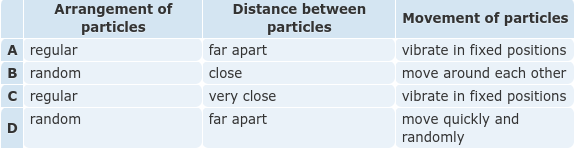
The table shows some properties of the particles in a solid, liquid, and gas. Which row shows the properties of particles in a liquid?
60
A
D
B
C
Q 2/9
Score 0
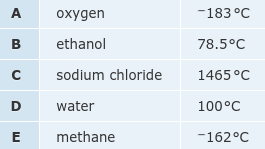
The table shows a list of different substances with their boiling points. Which sequence shows the order of boiling points from lowest to highest?
60
AEBDC
CDBEA
EABDC
EACDB
9 questions
Q.
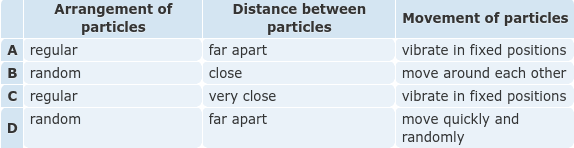
The table shows some properties of the particles in a solid, liquid, and gas. Which row shows the properties of particles in a liquid?
1
60 sec
5.2.2.1
Q.
The table shows a list of different substances with their boiling points. Which sequence shows the order of boiling points from lowest to highest?
2
60 sec
5.2.2.1
Q.
Name the process that turns a gas into a liquid.
3
60 sec
5.2.2.1
Q.
4
60 sec
5.2.1.4
Q.
Ethene is a useful substance that can form polymers. It has a melting point of 169°C and a boiling point of 104°C. At which temperature
would ethene be a liquid?
5
60 sec
5.2.2.1
Q.
Which sentence describing different types of bonding is correct?
6
60 sec
5.2.1.2
Q.
7
60 sec
5.2.1.3
Q.
Which sentence explains why metals can form alloys with different properties?
8
60 sec
5.2.1.5
Q.
Which one of these would have a giant covalent structure?