Loading...

Hurricanes: A Closer Look
Quiz by Zzish User
Customize this quiz to suit your class
Instantly translate to 100+ languages
Tag the questions with any skills you have. Your dashboard will track each student's mastery of each skill.
Give this quiz to my class
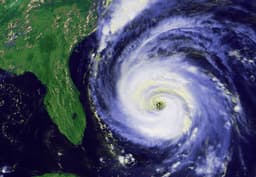
 What is a Hurricane, Typhoon, or Tropical Cyclone? The terms "hurricane" and "typhoon" are regionally specific names for a strong "tropical cyclone". A tropical cyclone is the generic term for a non-frontal synoptic scale low-pressure system over tropical or sub-tropical waters with organized convection (i.e. thunderstorm activity) and definite cyclonic surface wind circulation (Holland 1993). Tropical cyclones with maximum sustained surface winds of less than 17 m/s (34 kt, 39 mph) are usually called "tropical depressions" (This is not to be confused with the condition mid-latitude people get during a long, cold and grey winter wishing they could be closer to the equator). Once the tropical cyclone reaches winds of at least 17 m/s (34 kt, 39 mph) they are typically called a "tropical storm" or in Australia a Category 1 cyclone and are assigned a name. If winds reach 33 m/s (64 kt, 74 mph), then they are called: "hurricane" (the North Atlantic Ocean, the Northeast Pacific Ocean east of the dateline, or the South Pacific Ocean east of 160E) "typhoon" (the Northwest Pacific Ocean west of the dateline) "severe tropical cyclone" or "Category 3 cyclone" and above (the Southwest Pacific Ocean west of 160°E or Southeast Indian Ocean east of 90°E) "very severe cyclonic storm" (the North Indian Ocean) "tropical cyclone" (the Southwest Indian Ocean) Coriolis Effect The Coriolis Effect—the deflection of an object moving on or near the surface caused by the planet’s spin—is important to fields, such as meteorology and oceanography. Storm Approaching Southeast Asia Because of the Coriolis Effect, hurricanes spin counterclockwise in the Northern Hemisphere, while these types of storms spin clockwise in the Southern Hemisphere. This Northern Hemisphere storm, approaching Southeast Asia, is spinning counterclockwise. Earth is a spinning planet, and its rotation affects climate, weather, and the ocean through the Coriolis Effect. Named after the French mathematician Gaspard Gustave de Coriolis (born in 1792), the Coriolis Effect refers to the curved path that objects moving on Earth’s surface appear to follow because of the spinning of the planet. As Earth turns, points near the equator—countries like Ecuador and Kenya—are moving much faster than places near the planet’s poles. This is because Earth is shaped like a marble: Its circumference is larger near its middle (the equator) than near its top and bottom. All places on Earth experience a day that is about 24 hours long, but points near the equator have to travel longer distances in the same period of time, which means that those places move faster. Scientists say these points have more “angular momentum.” This is why rockets are usually launched from places near the equator, like Cape Canaveral, Florida, United States. Such locations give rockets a large initial speed, which helps them get into orbit using the least possible amount of fuel. The Coriolis Effect influences wind patterns, which in turn dictate how ocean currents move. Imagine wind near the equator flowing to the north. That wind starts with a certain speed due to Earth’s rotation (near the equator, Earth rotates at a speed of roughly 1,600 kilometers per hour (1,000 miles per hour) from west to east). As the wind travels north toward the North Pole, it moves over parts of Earth that are rotating progressively more slowly. Since the wind retains its angular momentum, it keeps moving from west to east, overtaking the part of Earth turning more slowly below it. As a result, the wind appears to bend to the east (that is, to the right). This is the Coriolis Effect in action. Wind flowing south from the equator would likewise bend to the east. This effect is responsible for many meteorological and oceanographic phenomena. For instance, due to the Coriolis Effect, hurricanes in the Northern Hemisphere spin in a counterclockwise direction, while hurricanes in the Southern Hemisphere (known as cyclones) spin in a clockwise direction. Ocean-circling currents known as “gyres” also spin in spiral patterns thanks to the Coriolis Effect. There is an urban legend that water in toilets spins in opposite directions in the Northern and Southern Hemispheres because of the Coriolis Effect. But that isn't true—a toilet bowl is too small for the effect to be observed. Instead, other factors like the shape of the toilet bowl and the direction that the water enters are largely responsible for how the flushing water moves.Create a quiz with the following questions and answersConvection is… The rising motion of warm air A large volume of air A boundary between two different air masses The weight of the Earth’s atmosphere over an area What are isobars? Storms with strong winds, heavy rains, lightning, and thunder Lines on a map to show high and low pressure The study of elevation This front is associated with thunderstorms, heavy rain, snow, and cooler temperatures. Warm front Stationary front Cold front Occluded front What is a barometer? A tool used to measure temperature An instrument used to measure wind speed An instrument used to measure humidity An instrument used to measure air pressure What is a tornado? Storms with strong winds, heavy rains, lightning, and thunder Large, rotating tropical weather systems A rapidly spinning column of air that has touched the ground What is topography? The study of elevation Lines on a map to show high and low pressure The condition of the atmosphere at a given place and time What are air masses? Large, rotating tropical weather systems The study of elevation A large volume of air with the same temperature What is transpiration? The process of a liquid’s surface changing into a gas The process of a gas changing into a liquid The movement of water through the soil The process of water vapor being released by plants. What is nitrification? The process bacteria use to convert nitrogen gas into ammonium ions The process of turning ammonium ions into nitrites and nitrates. The uptake of nitrates in the soil by the roots of plants. The process of turning nitrates into nitrogen gas Fun Fact: Carbon makes up ___ of your mass. 30% 18% 50% 6% What are the reactants of photosynthesis? Carbon dioxide and water Glucose and oxygen What are the reactants of cellular respiration? Carbon dioxide and water Glucose and oxygen What is a storm surge? Flooding caused by hurricanes Region of air where the air pressure is low Any product of the condensation of water vapor High pressure is… A region of air where the air pressure is greater than that of the surrounding area A region of air where the air pressure is lower than that of the surrounding area. Low pressure is… A region of air where the air pressure is greater than that of the surrounding area A region of air where the air pressure is lower than that of the surrounding area. What causes global winds? Photosynthesis The process carbon goes through Uneven heating of the Earth What can humans do to reduce carbon emissions? We can use renewable energy (ex. solar power) We can use non-renewable energy (ex. fossil fuels) Carbon can form stable bonds with many elements and and makes up the backbone of major macromolecules: carbohydrates, proteins, lipids, and ___ Nucliec acids Glucose Oxygen Nitrogen What weather is associated with low-pressure systems? Bad weather (ex. Cloudy weather) Good weather (ex. Sunny weather) What is fossilization? The burning of fossil fuels The process where fungi and bacteria decompose dead organisms Dead organisms form fossil fuels over thousands and millions of years What is the first step in the formation of tornadoes? Rising air from the ground pushes up on the swirling air and tips it over A large thunderstorm occurs in a cumulonimbus cloud The funnel grows longer and stretches towards the ground The funnel of swirling air begins to suck up more warm air from the ground What is the difference between thunderstorms and regular storms? Thunderstorms have thunder while regular storms don’t Regular storms have thunder while thunderstorms don’t There is no difference What are hurricanes? Rapidly spinning columns of air touch the ground Large, rotating tropical weather systems Storms with strong winds, heavy rains, lightning, and thunderstorms What is not a hurricane fact? They are the most powerful storms on earth They have an average wind speed of 120-180 km/h They lose their power when they travel over cooler waters or land Storm surges cause the most damages What is the difference between weather and climate? Weather is long-term while climate is short-term Climate is long-term while weather is short-term There is no difference Ect weather data. Trackingthe The forecasters have a lot of help! Meteorologists, or scientists who study weather, collect data from all over the world. They use automated systems at sea, on land, in the air, and in space to help track the weather. At sea, weather buoys collect data on coastal weather conditions. These data help keep people in coastal cities safe. On land, weather-monitoring stations track weather conditions in remote locations. They can send advance notice about incoming weather. Scientists also use Doppler radar towers to observe how storm clouds are moving. Weather balloons and weather satellites collect data from high above Earth’s surface. Weather satellites can track the weather over very large areas. They also help relay data from land-based tools to meteorologists around the world. Scientists launch weather balloons that carry tools, called radiosondes, into the atmosphere. A typical radiosonde measures air temperature, air pressure, and humidity. Weather satellites orbit Earth. They collect weather data, such as cloud cover, and track storms, such as hurricanes. These satellites use radio signals to transmit data back to Earth. Packets of air move across Earth’s surface. An air mass is a large body of air with the same temperature and humidity throughout. An air mass reflects the conditions of the place where it forms. Air masses that form over land are dry. Air masses that form over water are moist. Cold air masses form near the poles, and warm air masses form near the tropics. As air masses move across an area, they can collide. The boundary between two air masses is called a front. Weather changes take place at fronts. For example, as a warm front passes over an area, warm air replaces cooler air and the temperature rises. The movement of air masses and fronts explains why you might be chilly one day and warm the next. At a front, stormy conditions are common. Air masses may form over land or water. The masses that form over land near the poles will be cold and dry. The masses that form over water near the poles will be cold and moist. Which types of air masses will form near the tropics? A cold front forms where a cold air mass bumps into a warmer air mass. The denser cold air pushes the warm air up. Water vapor in the air cools, and large clouds form. Thunderstorms and heavy rain often take place. Cooler temperatures follow a cold front. A warm front forms where a warm air mass moves over a cold air mass. A warm front forms a wider area of clouds and rain than a cold front. Steady rain or snow may fall. Warmer temperatures follow a warm front. The Blue Planet Earth is called the Blue Planet. Do you know why? The Earth looks blue from space because there is water on 70% of our planet. Sometimes there are storms over warm ocean water. These are hurricanes. The wind is very strong, and it blows in a circle. North of the equator, hurricane winds blow counterclockwise. South of the equator, the winds blow clockwise. Hurricanes form at the equator. It is very rainy and moist there. There are many different animals and beautiful plants.1. Settlements Importance of Rivers Fertile Land: The soil near rivers was great for farming, thanks to regular flooding that added nutrients. Trade and Travel: Rivers made moving things and people easy, which helped trade and communication. Protection: Rivers could act as natural barriers, making it harder for enemies to attack. Food: Rivers were full of fish and other food, adding to what people could eat. Energy: People used the river's flow to power machines, for example, grinding grain. Cleanliness: Rivers were used to wash away waste, keeping settlements cleaner. Culture: Rivers often had spiritual importance, and ceremonies and stories revolved around them. Common Geographic Features of Ancient Civilizations Mesopotamia: the Tigris and Euphrates Rivers in central Iraq Indus River Valley: the river runs in the northwestern part of India Nile River Valley: the major river of Egypt Yellow River Valley: a major river flowing through the southern part of China Rivers provided water, food, transportation, and shaped the way of life and development of these ancient civilizations. Impact of Mountains on Settlements Mountains served as barriers to early settlement due to the lack of technology to cross them. The Himalayan Mountains isolated much of India and China during their early development. Impact of Deserts on Migration Deserts posed significant challenges to people who wanted to migrate due to their harsh and unforgiving conditions. Notable deserts include the Empty Quarter in Saudi Arabia and the Sahara Desert in Africa. Changes in Migration and Cultural Blending Advancements in transportation technology post-Industrial Revolution increased cultural blending. Transportation advancements enabled global migration. Before, cultures were isolated, focusing on beliefs and local adaptations. The Industrial Revolution transformed migration and cultural blending. 2. How Humans Modify and Adapt to Their Environment Ways Humans Modify Their Environment Mining: Removing the earth's surface for precious metals. Irrigation: Diverting water for farming. Transportation: Moving goods with trains, cars, airplanes, and boats. Mining Strip mining removes large layers of the earth. Can impact the environment by removing plants and polluting water sources. Irrigation Diverting water for farming and urban development. Transportation Moving goods using trains, cars, airplanes, and boats. Human Adaptation to the Environment Adjusting to environmental conditions by changing behavior. Examples: Wearing specific clothing, using specific building materials. Human Modification of the Environment Changing the earth to meet human needs by physically altering the environment. Examples: Dams, canals, roads, bridges. Impact of Weather and Geological Events on Humans Events like earthquakes, hurricanes, and cold weather affect human settlements. Examples: Building earthquake-resistant buildings, creating levees, using ice for tourism. 3. Understanding Culture Introduction to Culture Culture refers to the way of life of a group of people who live in a particular place. It includes traditions, beliefs, values, and the way they do things. Cultural Characteristics Religious traditions Language Family values Laws Cultural characteristics make each culture unique. Cultural Representations Art Architecture Music Literature Cultural representations express a culture's creativity and show their beliefs and history to the world. Government and Culture Types of government reflect cultural beliefs and traditions. Examples: democratic republic, communist state. The way a country is governed tells a lot about its culture. Economic Systems and Cultures Economic systems reflect cultural values. Examples: bartering, modern economies (e.g., United States, China). How people earn and spend money also reflects their culture. Spread of Cultural Ideas Trade: Spreading ideas through interactions during trade. Travel: Visitors bringing new ideas. War: Conquering armies imposing beliefs. Cultural ideas spread through trade, travel, and war. Multicultural Societies Blending of multiple cultural and ethnic groups. Common in advanced societies with immigration. Multicultural societies create something new by bringing together different cultures. Cultural Adaptation Cultures can change and adapt by taking new ideas and blending them with their own traditions. Example: 'Tex-Mex' food, which blends Mexican and Texan traditions.The Columbian Exchange was the widespread exchange of animals, plants, culture, disease, people, and ideas that began between European countries and their colonies in North and South America. The Spanish came to the Americas in search of gold and other riches. The Europeans wanted to convert the Native Americans to Christianity/Roman Catholicism. Spain had the greatest impact on the culture of Latin America. Sugarcane was a crop that was grown in the Caribbean that required a lot of land and labor. Native populations died out largely due to diseases that they had no natural immunity to before the arrival of Europeans. When the Native populations died out, African slaves were brought over to work. Two cultural elements in Latin America that resulted from the Columbian Exchange were language - Spanish, and religion - Roman Catholicism/Christianity. Environmental Issues Deforestation is the clearing of forests for human demands such as farmland, timber, and mining. The Amazon Rainforest in Brazil is one area experiencing major deforestation. Hurricanes can damage the economies in the Caribbean and Central America by keeping tourists away. Economy The three economic indicators used to determine the Human Development Index (HDI) are: life expectancy, literacy rate, and GDP per capita. Higher literacy rates, GDP per capita, and life expectancy are associated with more developed countries, while lower literacy rates, GDP per capita, and life expectancy are associated with less developed countries. The three sectors of the economy are primary/agriculture (e.g. rancher), secondary/manufacturing (e.g. table factory), and tertiary/services (e.g. teacher). A single product economy is when a country depends on just one product for almost all of its jobs, like the Caribbean Islands depend on tourism. Three disadvantages of a single product economy are: having to import other goods/resources, facing competition from other countries for the same product, and if the product fails, the economy is ruined which could restrict access to goods/resources. A free enterprise/market economy is when individual people and businesses make all economic decisions. A command/communist economy is when the government makes all basic economic decisions. Cuba has a communist economy where the government controls all aspects of the economy.Chore a household task, such as washing dishes; often assigned to children by their parents livestock farm animals rasp to make a rough, grating sound hope a wish for something to happen the way you want it to lard soft fat from a pig that is used for cooking neigh a soft, low sound made by a horse ribs the bones that protect your heart and lungs wheat the grain from grass that is used to make bread point of view the perspective from which a story is told first, second, third person the type of perspective (1st - I, me; 2nd - you; 3rd - he, she, they) narrator the person telling a story hurricane a large, powerful storm that starts over the ocean and brings in heavy rain and high winds to the land last resort a final chance to go for help levee a long wall built along a river to stop flooding; can be made of soil, rocks or concrete shelter a place where people can get food and a place to sleep when a storm threatens their home frond a large, long leaf Chinatown a part of a city that was historically home to Chinese immigrants conflict a serious disagreement society people living together in a community chaos a state of complete confusion; actions and events are out of control deport to force someone to leave a country because the person is not a citizen mass a large number of people resident someone who lives in a place status the position of a person according to the law informative a text that gives facts about something opinion a view of something based on feelings, not facts chart a visual that gives information about a topic aloft in the air plains a large area of flat land without trees researcher a person who gathers facts about a topic scale a range of numbers used as a system to measure or compare things twister another name for a tornado; a storm in which wind forms a tube that moves along the ground at high speeds and often causes damageThe Path of a Hurricane