Loading...


If a person shocked electrically, the person must be removed from the supply by using a:
Quiz by ahmed_shaker_68@yahoo.com
Customize this quiz to suit your class
Instantly translate to 100+ languages
Tag the questions with any skills you have. Your dashboard will track each student's mastery of each skill.
Give this quiz to my class
If a person shocked electrically, the person must be removed from the supply by using a:
Metal trunk
Copper conduit
Wet hands
PVC coduit
An electric washing machine connected to 230 v supply; the machine resistance is 40 Ω. Find the current used in the circuit
5.75 A
4.75 A
2.75 A
3.75 A
If a person shocked electrically, the person must be removed from the supply by using a:
An electric washing machine connected to 230 v supply; the machine resistance is 40 Ω. Find the current used in the circuit
An electric iron connected to 230 v source, the current flowing by the device is 4 A. Calculate the energy consumed by this device when it works for 2 hours
In series circuits
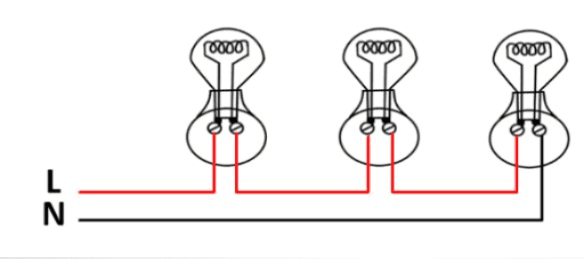
The figure shown represents the circuit of
Two resistors are connected in parallel. First resistor value is 50 ohms, and the second resistor value is 50 ohms. Find the total resistance
In three lamps parallel circuit, if one lamp burned out, the current will:
In the figure shown, what is the name of this personal protective equipment?

In the figure shown, what is the name of this tool?

What is the next step in the power transmission grid after electricity is generated at power plants?
The figure shows the power supply system feeding houses. Choose the correct name for part number (2).
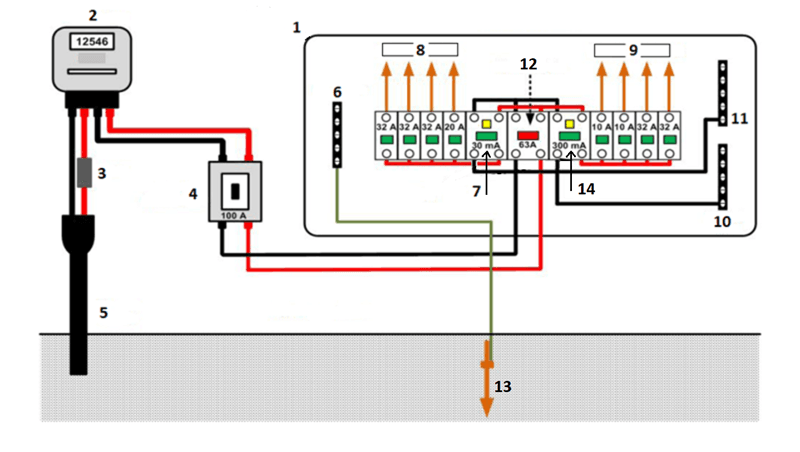
It’s a device used to switch “ON” or “OFF” all the circuits in the DB
For non-flexible cables, choose the correct color code for line conductor.
The figure shown represents the circuit of

Which of the following is considered as cable electrical protection?
The tripping current rate of RCD in power circuit is
The minimum size of wire used for lighting circuit is:
In the figure shown, what is the type of the switch used to control this circuit?

Which type of switch is used to change light level or fan speed?
What type of switch is used for controlling water heater?

The symbol shown in the figure represents:

What is the name of the device shown in the figure?

In insulation resistance test, the reading resistance should be greater than:
What is the function of polarity test?
In earthing test, if the ohmmeter reading is 0.5 Ω, then the test result is:
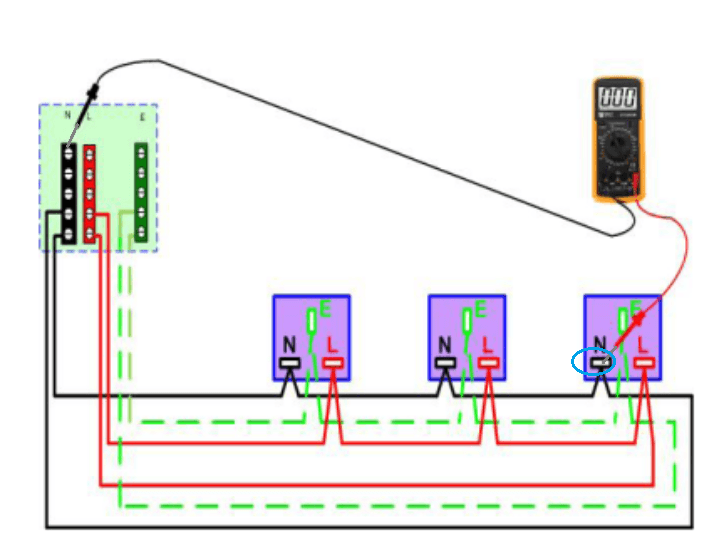
In the circuit shown, what is the name of the test carried out?

In the circuit shown, what is the name of the test carried out?
What will happen due to the fault current passing in washing machine metal body?
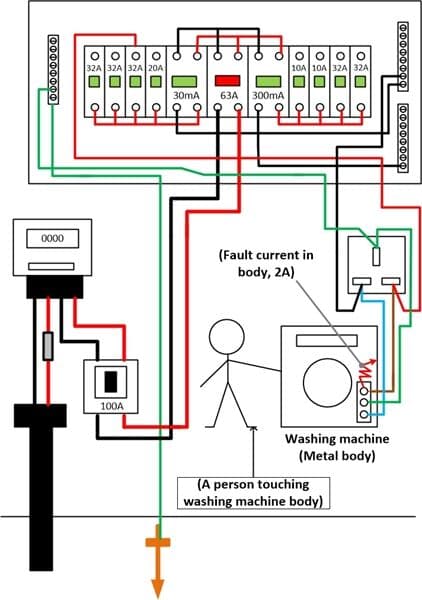
Study the circuit shown then identify the mistake in the connection
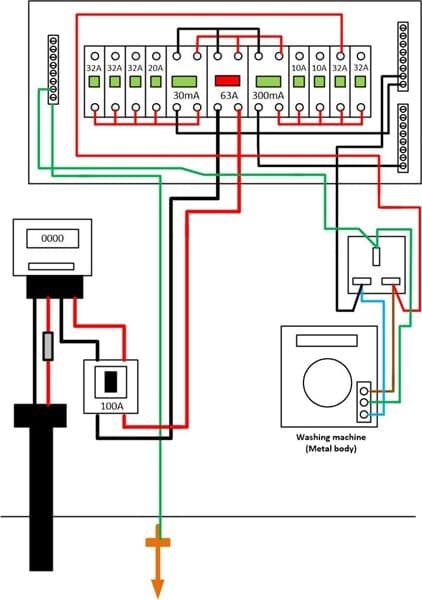
In the circuit shown, what is the name of the test carried out?
 The story of The Resurrection of Jesus is very amazing. Resurrection: meaning Jesus rising from the dead. Jesus is alive again. Jesus proved to the people that He is the “Son of God”. Would you like to know the amazing story? Let’s read on! Jesus is Alive! After Jesus died a man named Joseph from Arimathea put Jesus in His tomb. Before Joseph left, he and some men rolled a large heavy stone in front of the tomb. Mary and Mary Magdalene made spices and oils as a sign of respect to Jesus, and went very early to the tomb on the third day to go see Jesus' body. As they were just about at the tomb the earth suddenly shook and an angel came down from heaven. He easily rolled away the stone at the entrance of the tomb and sat on top of it. The women looked at each other and rubbed their eyes, they couldn't believe what they had seen. The angel was so bright, almost as bright as lightning. His clothes were as white as snow. There had been guards watching the tomb so no one would steal Jesus' body. When they saw the angel they fell over and they couldn't move or speak because they were so afraid. Christian Living Education 2 SEIBO COLLEGE 5 Then the angel said to the women, "Do not be afraid. I know you are looking for Jesus who has died. But He isn't here; He has risen just as He said He would! Come and see for yourself, the tomb is empty." The women were confused. How could this happen? They were sure Jesus had died, and now He was alive? They looked in the tomb and the cloths Jesus was wrapped in were lying on the ground, and the tomb was empty. Then the angel spoke again, "If you want to find Jesus He's on his way to Galilee." So the women hurried away. They had been so sad that Jesus was dead and now they were so excited He was alive! They just knew they had to find Jesus, and they had to tell the disciples the good news. As they were running down the path they turned a corner, and there was Jesus. "Greetings," He said. The ladies fell at His feet and worshiped him. Then Jesus said to them, "Do not be afraid. Go and tell my disciples to come to Galilee, which is where they will see me." The disciples came to Galilee, and had heard by this time that Jesus was alive. They were sitting around talking about it, when Jesus walked into the room and said to them, "Peace be with you." The disciples immediately stopped talking. Even though they had heard Christian Living Education 2 SEIBO COLLEGE 6 He was alive, they were shocked to see Him standing there with them. Jesus said to them, "Why do you look at me like you've just seen a ghost? Why don't you believe what you're seeing? Look at the scars in my hands and feet. It is really me! Touch me and see, I am not a ghost but a real person." The disciples’ mouths were open in amazement because they still didn't know what to think. They were so full of joy, and yet it was so impossible. Jesus understood what they were thinking, so He said, "This is what I told you would happen, that everything must happen that has already been written in the Bible." Then Jesus told them, "You have seen these things that have happened, so stay in the city and soon I am going to give you what God has promised you, the Holy Spirit. Jesus had one more person to see. His name was Thomas, and he was one of the disciples that weren’t there when Jesus met with them. Thomas had also heard that Jesus was alive, but would not believe until he saw Jesus with his own eyes. A week later when Thomas finally saw Jesus, Jesus said to him, "Put your finger here; see my hands. Stop doubting and believe." But Jesus continued, "Because you have seen me, you have believed; but it is more amazing for those who don't see me, and believe anyway." Christian Living Education 2 SEIBO COLLEGE 7 Jesus is actually talking to us when He said this. If you believe in Him, without seeing Him He thinks you're very special! That is exactly what faith is, believing in God even though you can't see Him. When we become Christians Jesus automatically gives us the Holy Spirit to live inside of us. The Holy Spirit makes us know when we have done something wrong. We might feel sick to our stomach, or just get a bad feeling, that is the Holy Spirit reminding us that we are doing something wrong, or that we need to stop and say sorry and ask for forgiveness for what we've done. Do you know what we celebrate during Easter Sunday? We celebrate the rising of Jesus from the dead. We celebrate because Jesus shared His new life with us. Through His rising from the dead, we are saved. We also have new life. What do you think we should do with our new life? How can we thank Jesus for sharing His new life with us? Of course, we should do good deeds. When we say good deeds, it is anything that we do that is good. It doesn’t matter how big or small as long as it is good. It would make Jesus very happy if we stop our bad ways and change for the betterAlright, Isti — here’s a longer and more detailed English version of the Isaac Newton text, still written at a level that’s accessible for Grade 4 students, but rich enough in information to meet PISA literacy expectations and EF A2-level vocabulary. I’ve kept sentences short, clear, and with explanations for new concepts so it’s easier for young learners to follow, while still including both famous facts and lesser-known stories. ⸻ Isaac Newton: The Man Who Changed the Way We See the World A Boy from a Small Village Isaac Newton was born on January 4, 1643, in Woolsthorpe, a small village in England. His life was not easy. His father died before he was born. When he was just a few months old, his mother remarried and left him to live with his grandmother. Isaac missed his parents, but he kept himself busy by making things and exploring the world around him. As a child, Isaac liked to build models and machines. He made a small windmill that could turn with the wind. He built a water clock that told the time by dripping water into a container. He even made a sundial — a clock that tells the time by using the shadow of the sun. 💡 Did you know? The sundial marks that Isaac carved as a boy can still be seen today on the wall of his old house. ⸻ School and Curiosity When Newton first went to school, he was not the top student. At first, he did not pay much attention in class. But one day, another boy teased him for not being smart. Newton decided to study hard to prove him wrong. Soon, he became the best in his class. Isaac loved asking questions. He wanted to know how and why things happened. He enjoyed watching the stars at night and thinking about how the world worked. ⸻ The Falling Apple and Gravity One of the most famous stories about Newton is the falling apple. One afternoon, Isaac sat in his mother’s garden and saw an apple drop from a tree. This made him think: “Why does the apple fall straight down? Why doesn’t it fly up into the sky?” From this question, Newton began to think about gravity — an invisible force that pulls objects toward each other. Gravity is what keeps our feet on the ground. It’s also what keeps the Moon moving around the Earth and the planets moving around the Sun. 💡 Fun fact: The apple did not hit Newton’s head. That’s just a story people made up later to make the tale more exciting. ⸻ Newton’s Three Laws of Motion Newton studied movement and wrote three important rules: 1. Objects stay still or keep moving unless something makes them change. • Example: A ball will not roll unless you push it. 2. The bigger the push, the bigger the movement. • Example: If you kick a ball harder, it will go faster and farther. 3. Every action has an equal and opposite reaction. • Example: When you jump off a boat, the boat moves backward as you move forward. These three laws are still used today to understand how cars, rockets, and even roller coasters work. ⸻ Discoveries in Light and Color Newton also studied light. He found that white light is not just one color — it is made of many colors. He used a glass prism to split sunlight into a rainbow. This helped scientists understand how colors work. ⸻ Inventions and New Ideas Newton made a special telescope that used mirrors instead of lenses. This type of telescope made images of planets and stars much clearer. It is still called the Newtonian telescope today. He also worked in mathematics and helped create a new type of math called calculus, which is used to study changes and movement. ⸻ Strange Experiments Newton was so curious that he sometimes tested ideas on himself. Once, he put a thin needle, called a bodkin, beside his eye to see how it would change his vision. It was very dangerous, but luckily he did not go blind. 💡 Did you know? Newton also studied alchemy — an old kind of science where people tried to turn metal into gold. He never succeeded, but it showed how wide his interests were. ⸻ Later Life and Work At the age of 27, Newton became a professor at Cambridge University. He later worked for the Royal Mint, making sure coins were made safely and stopping people from making fake money. He was very strict, and some criminals were sent to prison because of his work. Newton never married. He spent most of his life reading, writing, and doing experiments. ⸻ The End of His Life Isaac Newton died in 1727 at the age of 84. He was buried in Westminster Abbey, a famous place in London where great people of Britain are honored. His work changed the world forever. Even today, scientists, engineers, and students still use Newton’s laws and ideas. 💬 Newton once said: “If I have seen further, it is by standing on the shoulders of giants.” This means we can make new discoveries by learning from the work of others who came before us. give 10 questions to each passage with PISA literacy standard for kid 10 years, 1. Nikola Tesla: The Man Who Dreamed of Lightning Born: July 10, 1856 Died: January 7, 1943 When Nikola Tesla was a boy in Croatia, he saw a flash of lightning and asked his mother, “Can we catch the light?” That question never left him. As he grew older, Tesla became a brilliant inventor, especially fascinated by electricity. He believed in a future where energy could be sent wirelessly through the air—like music through the radio! Tesla invented the alternating current (AC) system, which became the foundation of modern electricity. At the time, Thomas Edison promoted direct current (DC), and the two men had a fierce competition. Many laughed at Tesla's bold ideas, but he never gave up. He dreamed of wireless communication, flying machines, and even free energy for everyone. Though he died alone and poor, today the world honors his vision. Think About It: Why do you think people didn’t believe Tesla at first? What can we learn from Tesla’s courage to dream big? 2. Charles Darwin: The Man Who Studied the World’s Weirdest Creatures Born: February 12, 1809 Died: April 19, 1882 When young Charles Darwin got on a ship called HMS Beagle, he didn’t know he would change science forever. He sailed around the world for five years, collecting plants, animals, and fossils. On the Galápagos Islands, he noticed something curious: finches had different beaks depending on their island. Why? Darwin’s observations led him to write the theory of evolution by natural selection. It explained how animals adapt and survive. But his ideas shocked many people because they seemed to challenge religious beliefs. Despite the controversy, Darwin continued his work. His book On the Origin of Species changed how we see life on Earth. Think About It: Should scientists share their ideas even if they go against what others believe? How did traveling help Darwin make new discoveries? 3. Marie Curie: The Woman Who Glowed in the Dark Born: November 7, 1867 Died: July 4, 1934 Marie Curie was born in Poland at a time when girls were not allowed to study science. But that didn’t stop her. She moved to France, worked day and night, and discovered radioactivity, a powerful energy hidden inside atoms. She and her husband, Pierre Curie, found two new elements: polonium and radium. She became the first woman to win a Nobel Prize, and the only person to win in two different sciences: physics and chemistry. Even when Pierre died in an accident, Marie continued their work. Her discoveries helped doctors treat cancer—but working with radioactive materials also harmed her health. She died from radiation exposure, but her legacy lives on. Think About It: What challenges did Marie Curie face as a woman in science? Why is it important to balance discovery with safety? 4. Galileo Galilei: The Star Watcher Who Defied the Church Born: February 15, 1564 Died: January 8, 1642 Galileo loved looking at the stars. He built one of the first powerful telescopes and made stunning discoveries: mountains on the Moon, moons around Jupiter, and that the Earth orbits the Sun—not the other way around. This idea, called heliocentrism, went against the teachings of the Church. He was put on trial and forced to say he was wrong. But he wasn’t. He spent his last years under house arrest, quietly writing. Today, Galileo is called the father of modern science for daring to question what others blindly believed. Think About It: Why do you think Galileo was punished for telling the truth? Should science always follow evidence, even if it goes against powerful beliefs? 5. Isaac Newton: The Man Who Asked “Why?” When an Apple Fell Born: January 4, 1643 Died: March 31, 1727 One day, an apple fell from a tree, and Isaac Newton began to wonder: Why did it fall down, not sideways or up? This simple question led to his theory of gravity. Newton also invented calculus, described the laws of motion, and changed physics forever. But Newton wasn’t just a genius—he was curious, quiet, and often worked alone. He believed everything in nature followed rules, and it was our job to discover them. Thanks to him, we understand how planets move, how rockets launch, and why you fall when you trip. Think About It: How did Newton’s curiosity lead to great discoveries? Do you think working alone helped or hurt Newton? 6. Ada Lovelace: The First Computer Programmer Before Computers Existed Born: December 10, 1815 Died: November 27, 1852 Ada Lovelace was the daughter of the famous poet Lord Byron, but she didn’t love poetry—she loved numbers! At a time when girls were expected to sew, Ada studied mathematics. She met Charles Babbage, who designed an early computer called the Analytical Engine. Ada imagined the machine could do more than just math—it could create music, art, and even write! She wrote what is now considered the first computer program, long before real computers were built. Think About It: How did Ada imagine something that didn’t exist yet? Why do we call her a pioneer in technology? 7. Albert Einstein: The Man Who Brought Time and Space Together Born: March 14, 1879 Died: April 18, 1955 Albert Einstein wasn’t always a good student. In fact, his teachers thought he was slow. But Einstein thought deeply. He asked big questions like, “What if you could ride a beam of light?” His theories of relativity changed how we see space, time, and gravity. He also warned the world about the dangers of nuclear weapons, even though his ideas helped create them. Einstein believed science should help people, not harm them. With his messy hair, kind smile, and brilliant mind, he remains a symbol of genius. Think About It: Can someone be bad in school but still be brilliant? Should scientists be responsible for how their inventions are used? 8. Pythagoras: The Musician Who Loved Math Born: Around 570 BC Died: Around 495 BC Long ago in ancient Greece, Pythagoras believed the universe followed numbers. He discovered the Pythagorean Theorem, a rule about triangles that helps us build houses, design computers, and navigate space. He also believed that music had math inside it—that certain notes made perfect harmony because of mathematical ratios. Pythagoras started a secret school and taught his students to search for truth through numbers, shapes, and sound. Think About It: Why do you think Pythagoras saw math in everything? How does music relate to math? 9. Rosalind Franklin: The Woman Behind the DNA Discovery Born: July 25, 1920 Died: April 16, 1958 Rosalind Franklin loved looking closely at things. She used a special machine called X-ray crystallography to photograph molecules. One of her greatest photos, called Photo 51, showed the shape of DNA, the molecule that carries life’s instructions. But her work was taken without credit. Two men, Watson and Crick, used her photo to build their famous model of DNA and won the Nobel Prize. Rosalind died young and never knew how important her work became. Think About It: Why is it important to give credit in science? What can we learn from Rosalind’s quiet strength? 10. Carl Linnaeus: The Man Who Gave Names to Everything Born: May 23, 1707 Died: January 10, 1778 Have you ever wondered why a tiger is called Panthera tigris? That’s thanks to Carl Linnaeus, a Swedish scientist who created a way to name and organize every living thing. His system is still used today in biology. Linnaeus loved nature and spent his life collecting plants, animals, and even rocks. He believed that by organizing life, we could better understand it. Thanks to him, we now have a global “dictionary of nature.” Think About It: Why is it important to name and organize living things? How does order help us understand the world? *BRITISH EDUCATION SCHOOL* *Grade 9 - English Language - Literature* *Chapter 5: The Young Tulip-grower - "The Black Tulip"* * *Section A: Reading Comprehension [12 Marks]* Answer in complete sentences. 2 marks each. 1. Describe Cornelius’s feelings and exact words when he looked at the 3 bulbs. What do they show about his character? 2. Why did Cornelius choose to save the bulbs before reading Craeke’s letter? What does this tell us about his priorities? 3. Explain how Cornelius hid the bulbs from the soldiers. Why was this action risky? 4. Why was Isaac Boxtel watching Cornelius’s house? Was he happy or sad about Cornelius’s arrest? Give evidence. 5. What important information did Isaac learn from Cornelius’s notebook? How did this change his plan? 6. Compare Cornelius and Isaac. Who loves the tulips more? Give one reason for each character. *Section B: Vocabulary in Context [8 Marks]* Choose the best meaning of the underlined word. 1 mark each. 1. Cornelius was *surprised* when Craeke ran in. a) happy b) shocked c) angry d) sleepy 2. He picked up the bulbs *carefully*. a) quickly b) with attention c) loudly d) angrily 3. The judge said Cornelius had papers of a *traitor*. a) hero b) friend c) person who betrays his country d) servant 4. The house was *empty* when Isaac entered. a) full of people b) with no one inside c) very big d) very clean 5. Cornelius thanked God the bulbs were not *damaged*. a) broken b) painted c) lost d) old 6. Isaac looked through his *telescope*. a) book b) tool for seeing far c) gun d) letter 7. Cornelius was not *frightened* of the soldiers. a) afraid b) excited c) hungry d) tired 8. Isaac was *jealous* of Cornelius. a) loved him b) wanted what he had c) helped him d) ignored him *Section C: Grammar - Past Continuous vs Past Simple [6 Marks]* Fill in with correct verb form. 1 mark each. 1. While Cornelius ............at the bulbs, Craeke ran into the room. 2. The servant .........that soldiers were coming to arrest him. 3. Isaac ............Cornelius’s house with his telescope all day. 4. When the judge arrived, Cornelius ....... the bulbs in his pocket. 5. The soldiers .........into the room while Cornelius was talking. 6. Isaac .......... the notebook after he searched all the drawers.[look][say][watch][put][run][find] *D* Who Said, write the speaker 1. "Next year, these bulbs will be black tulips. I am the happiest man!" 2. "Please, read this letter immediately, sir!" 3. "You must give that package to me. It is not yours!" 4. "Good! The soldiers will take Cornelius to The Hague. Then they will kill him." 5. "I cannot wait! He has come from The Hague." 6. "None of these was a black tulip!" *E* write your own answer according to your understanding to the current chapter. 1. If you were Cornelius, would you save the bulbs or read the letter first? Give 2 reasons for your choice. [2 marks] 2. Do you think Isaac is a villain or just ambitious? Explain your opinion with evidence from the chapter. [2 marks] *F* Complete the quotes from the chapter. 1. "I must put these bulbs safely in a ........... 2. "The bulbs are not ............I thank God for that." 3. "Last January, Cornelius De Witt left a package of papers in this ............ 4. "Today I have three small tulip from one large bulb. These bulbs will have flowers in the spring ..................Hi, I'm John Green, this is Crash Course U.S. History, and today, we're going to talk about slavery, which is not funny. 0:06 Yeah, so we put a lei on the eagle to try and cheer you up, but let's face it, this is going to be depressing. 0:10 With slavery, every time you think, like, "Aw, it couldn't have been that bad," it turns out to have been much worse. 0:14 Mr. Green, Mr. Green! But what about – 0:15 Yeah, Me from the Past, I'm going to stop you right there, because you're going to embarrass yourself. Slavery was hugely important to America. 0:20 I mean, it led to a civil war and it also lasted what, at least in U.S. history, counts as a long-ass time, from 1619 to 1865. 0:29 And yes, I know there's a 1200-year-old church in your neighborhood in Denmark, but we're not talking about Denmark! 0:35 But slavery is most important because we still struggle with its legacy. 0:38 So, yes, today's episode will probably not be funny, but it will be important. 0:42 [Theme Music] North & South economic ties 0:51 So the slave-based economy in the South is sometimes characterized as having been separate from the Market Revolution, but that's not really the case. 0:57 Without southern cotton, the North wouldn't have been able to industrialize, at least not as quickly, because cotton textiles were one of the first industrially products. 1:04 And the most important commodity in world trade by the nineteenth century, and 3/4 of the world's cotton came from the American South. 1:11 And speaking of cotton, why has no one mentioned to me that my collar has been half popped this entire episode, like I'm trying to recreate the Flying Nun's hat. 1:18 And although there were increasingly fewer slaves in the North as northern states outlawed slavery, cotton shipments overseas made northern merchants rich. 1:26 Northern bankers financed the purchase of land for plantations. 1:29 Northern insurance companies insured slaves who were, after all, considered property, and very valuable property. 1:35 And in addition to turning cotton into cloth for sale overseas, northern manufacturers sold cloth back to the South, where it was used to clothe the very slaves who had cultivated it. 1:45 But certainly the most prominent effects of the slave-based economy were seen in the South. Slave-based agriculture in the South 1:49 The profitability of slaved-based agriculture, especially King Cotton, meant that the South would remain largely agricultural and rural. 1:56 Slave states were home to a few cities, like St. Louis and Baltimore, but with the exception of New Orleans, 2:00 almost all southern urbanization took place in the upper South, further away from the large cotton plantations. 2:06 And slave-based agriculture was so profitable that it siphoned money away from other economic endeavors. 2:11 Like, there was very little industry in the South. 2:13 It produced only 10% of the nation's manufactured goods. 2:16 And, as most of the capital was being plowed into the purchase of slaves, there was very little room for technological innovation, like, for instance, railroads. 2:23 This lack of industry and railroads would eventually make the South suck at the Civil War, thankfully. 2:27 In short, slavery dominated the South, shaping it both economically and culturally, and slavery wasn't a minor aspect of American society. Popular attitudes concerning slavery 2:35 By 1860, there were four million slaves in the U.S., and in the South, they made up one third of the total population. 2:42 Although in the popular imagination, most plantations were these sprawling affairs with hundreds of slaves, 2:47 in reality, the majority of slaveholders owned five or fewer slaves. 2:51 And, of course, most white people in the South owned no slaves at all, though, if they could afford to, they would sometimes rent slaves to help with their work. 2:57 These were the so-called yeoman farmers who lived self-sufficiently, raised their own food, and purchased very little in the Market Economy. 3:04 They worked the poorest land and, as a result, were mostly pretty poor themselves. 3:08 But even they largely supported slavery, partly, perhaps, for aspirational reasons, and partly because the racism inherent to the system gave even the poorest whites legal and social status. 3:18 And southern intellectuals worked hard to encourage these ideas of white solidarity and to make the case for slavery. 3:23 Many of the founders, a bunch of whom you'll remember, held slaves, saw slavery as a necessary evil. 3:29 Jefferson once wrote, quote, "As it is, we have the wolf by the ear, and we can neither hold him, nor safely let him go. 3:37 Justice is on one scale, and self-preservation in the other." 3:41 The belief that justice and self-preservation couldn't sit on the same side of the scale was really opposed to the American idea, 3:47 and, in the end, it would make the Civil War inevitable. 3:50 But as slavery became more entrenched in these ideas of liberty and political equality were embraced by more people, 3:55 some southerners began to make the case that slavery wasn't just a necessary evil. 3:59 They argued, for instance, that slaves benefited from slavery. 4:03 Because, you know, because their masters fed them and clothed them and took care of them in their old age. 4:07 You still hear this argument today, astonishingly. 4:09 In fact, you'll probably see asshats in the comments saying that in the comments. 4:12 I will remind you, it's not cursing if you are referring to an actual ass. 4:15 This paternalism allowed masters to see themselves as benevolent and to contrast their family-oriented slavery with the cold, mercenary Capitalism of the free-labor North. 4:26 So yeah, in the face of rising criticism of slavery, some southerners began to argue that the institution was actually good for the social order. 4:33 One of the best-known proponents of this view was John C. Calhoun, who, in 1837, said this in a speech on the Senate floor: 4:40 "I hold that, in the present state of civilization, 4:43 where two races of different origin and distinguished by color and other physical differences as well as intellectual, are brought together, 4:51 the relation now existing in the slave-holding states between the two is, instead of an evil, a good. A positive good." 4:59 Now, of course, John C. Calhoun was a fringe politician, and nobody took his views particularly seriously. 5:04 Stan: Well, he was Secretary of State from 1844 to 1845. 5:07 John: Well, I mean, who really cares about the Secretary of State, Stan? 5:10 Danica: Eh, he was also Secretary of War from 1817 to 1825. 5:13 John: All right, but we don't even have a Secretary of War anymore, so... 5:16 Meredith: And he was Vice President from 1825 to 1832. 5:19 John: Oh my god, were we insane?! 5:21 We were, of course, but we justified the insanity with Biblical passages and with the examples of the Greeks and Romans, 5:28 and with outright racism, arguing that black people were inherently inferior to whites. 5:33 And that not to keep them in slavery would upset the natural order of things. 5:37 A worldview popularized millennia ago by my nemesis, Aristotle. God, I hate Aristotle. 5:42 You know what defenders of Aristotle always say? 5:44 "He was the first person to identify dolphins." 5:47 Well, ok, dolphin identifier. 5:50 Yes, that is what he should be remembered for, but he's a terrible philosopher! Lives & experiences of enslaved people 5:53 Here's the truth about slavery: 5:55 It was coerced labor that relied upon intimidation and brutality and dehumanization. 6:00 And this wasn't just a cultural system, it was a legal one. 6:03 I mean, Louisiana law proclaimed that a slave "owes his master... a respect without bounds, and an absolute obedience." 6:09 The signal feature of slaves' lives was work. 6:12 I mean, conditions and tasks varied, but all slaves labored, usually from sunup to sundown, and almost always without any pay. 6:20 Most slaves worked in agriculture on plantations, and conditions were different, depending on which crops are grown. 6:25 Like, slaves on the rice plantations of South Carolina had terrible working conditions, 6:29 but they labored under the task system, which meant that once they had completed their allotted daily work, they would have time to do other things. 6:36 But lest you imagine this is like how we have work and leisure time, bear in mind that they were owned and treated as property. 6:42 On cotton plantations, most slaves worked in gangs, usually under the control of an overseer, or another slave who was called a "driver." 6:49 This was back-breaking work done in the southern sun and humidity, and so it's not surprising that whippings – or the threat of them – were often necessary to get slaves to work. 6:58 It's easy enough to talk about the brutality of slave discipline, but it can be difficult to internalize it. 7:03 Like, you look at these pictures, but because you've seen them over and over again, they don't have the power they once might have. 7:09 The pictures can tell a story about cruelty, but they don't necessarily communicate how arbitrary it all was. 7:14 As, for example, in this story, told by a woman who was a slave as a young girl: 7:18 "[The] overseer... went to my father one morning and said, "Bob, I'm gonna whip you this morning." 7:22 Daddy said, "I ain't done nothing," and he said, "I know it, I'm going to whip you to keep you from doing nothing," 7:28 and he hit him with that cowhide – you know it would cut the blood out of you with every lick if they hit you hard." 7:33 That brutality – the whippings, the brandings, the rape – was real, and it was intentional, because, in order for slavery to function, slaves had to be dehumanized. 7:43 This enabled slaveholders to rationalize what they were doing, and it was hoped to reduce slaves to the animal property that is implied by the term "chattel slavery." 7:51 So the idea was that slaveholders wouldn't think of their slaves as human, and slaves wouldn't think of themselves as human. 7:57 But it didn't work. Let's go to the Thought Bubble. 7:59 Slaves' resistance to their dehumanization took many forms, but the primary way was by forming families. Family, love, & religion of enslaved people 8:05 Family was a refuge for slaves and a source of dignity that masters recognized and sought to stifle. 8:10 A paternalistic slave owner named Bennet H. Barrow wrote in his rules for the Highland Plantation: 8:15 "No rule that I have stated is of more importance than that relating to Negroes marrying outside of the plantation... It creates a feeling of independence." 8:23 Most slaves did marry, usually for life, and, when possible, slaves grew up in two-parent households. 8:28 Single-parent households were common, though, as a result of one parent being sold. 8:32 In the upper South, where the economy was shifting from tobacco to different, less labor-intensive cash crops, the sale of slaves was common. 8:40 Perhaps one-third of slave marriages in states like Virginia were broken up by sale. 8:45 Religion was also an important part of life in slavery. 8:47 While masters wanted their slaves to learn the parts of the Bible that talked about being happy in bondage, 8:52 slave worship tended to focus on the stories of Exodus, where Moses brought the slaves out of bondage, 8:57 or Biblical heroes, who overcame great odds, like Daniel and David. 9:01 And, although most slaves were forbidden to learn to read and write, many did anyway. And some became preachers. 9:07 Slave preachers were often very charismatic leaders, and they roused the suspicion of slave owners, and not without reason. 9:13 Two of the most important slave uprisings in the South were led by preachers. 9:16 Thanks, Thought Bubble. 9:17 Oh, it's time for the Mystery Document? Mystery Document 9:19 We're doing two set pieces in a row? All right. [buzzing noise] [music] 9:24 The rules here are simple. 9:26 I wanted to re-shoot that, but Stan said no. 9:29 I guess the author of the Mystery Document. 9:30 If I am wrong, I get shocked with the shock pen. 9:33 "Since I have been in the Queen's dominions I have been well contented, yes well contented for sure, man is as God intended he should be. 9:40 That is, all are born free and equal. 9:43 This is a wholesome law, not like the southern laws which puts man made in the image of God on level with brutes. 9:49 O, what will become of the people, and where will they stand in the day of judgment. 9:53 Would that the 5th verse of the 3rd chapter of Malachi were written as with a bar of iron, 9:59 and the point of a diamond upon every oppressor's heart that they might repent of this evil, and let the oppressed go free..." 10:06 All right, it's definitely a preacher, because only preachers have read Malachi. 10:10 Probably African American, probably not someone from the South. 10:13 I'm going to guess that it is Richard Allen, the founder of the African Methodist Episcopal Church? 10:18 [buzzing noise] DAAAH, DANG IT! 10:19 It's Joseph Taper, and Stan just pointed out to me that I should have known it was Joseph Taper because it starts out, 10:24 "Since I have been in the Queen's dominions..." 10:27 He was in Canada. He escaped slavery to Canada. The Queen's dominions! 10:31 All right, Canadians, I blame you for this, although, thank you for abolishing slavery decades before we did. 10:36 [electric sounds] AHHH! How people resisted & escaped slavery 10:37 So, the Mystery Document shows one of the primary ways that slaves resisted their oppression: by running away. 10:42 Although some slaves like Joseph Taper escaped for good by running away to northern free states, 10:47 or even to Canada, where they wouldn't have to worry about fugitive slave laws, even more slaves ran away temporarily, hiding out in the woods or the swamps, and eventually returning. 10:55 No one knows exactly how many slaves escaped to freedom, but the best estimate is that a thousand or so a year made the journey northward. 11:01 Most fugitive slaves were young men, but the most famous runaway has been hanging out behind me all day long: Harriet Tubman. 11:07 Harriet Tubman escaped to Philadelphia at the age of 29, and over the course of her life, she made about 20 trips back to Maryland to help friends and relatives make the journey north on the Underground Railroad. 11:17 But a more dramatic form of resistance to slavery was actual, armed rebellion, which was attempted. 11:22 Now, individuals sometimes took matters into their own hands and beat or even killed their white overseers or masters. 11:27 Like Bob, the guy who received the arbitrary beating, responded to it by killing his overseer with a hoe. 11:33 But that said, large-scale slave uprisings were relatively rare. 11:36 The four most famous ones all took place in a 35-year period at the beginning of the 19th century. Slave rebellions 11:41 Gabriel's Rebellion in 1800 – which we've talked about before – was discovered before he was able to carry out his plot. 11:45 Then, in 1811, a group of slaves upriver from New Orleans seized cane, knives, and guns, and marched on the city before militia stopped them. 11:52 And in 1822, Denmark Vesey, a former slave who had purchased his freedom, may have organized a plot to destroy Charleston, South Carolina. 11:59 I say "may have" because the evidence against him is disputed and comes from a trial that was not fair. 12:05 But regardless, the end result of that trial was that he was executed, as were 34 slaves. Nat Turner's Rebellion 12:09 But the most successful slave rebellion, at least in the sense that they actually killed some people, was Nat Turner's in August 1831. 12:15 Turner was a preacher, and with a group of about 80 slaves, he marched from farm to farm in South Hampton County, Virginia, 12:21 killing the inhabitants, most of whom were women and children, because the men were attending a religious revival meeting in North Carolina. 12:27 Turner and 17 other rebels were captured and executed, but not before they struck terror into the hearts of whites all across the American South. 12:34 Virginia's response was to make slavery worse, passing even harsher laws that forbade slaves from preaching, and prohibited teaching them to read. 12:42 Other slave states followed Virginia's lead and, by the 1830s, slavery had grown, if anything, more harsh. 12:47 So, this shows that large-scaled armed resistance was – Django Unchained aside – not just suicidal, but also a threat to loved ones and, really, to all slaves. How enslaved people resisted their oppression & why it matters 12:55 But, it is hugely important to emphasize that slaves did resist their oppression. 12:59 Sometimes this meant taking up arms, but usually it meant more subtle forms of resistance, 13:03 like intentional work slowdowns or sabotaging equipment, or pretending not to understand instructions. 13:08 And, most importantly, in the face of systematic legal and cultural degradation, they re-affirmed their humanity through family and through faith. 13:16 Why is this so important? 13:17 Because too often in America, we still talk about slaves as if they failed to rise up, 13:21 when, in fact, rising up would not have made life better for them or for their families. 13:26 The truth is, sometimes carving out an identity as a human being in a social order that is constantly seeking to dehumanize you, is the most powerful form of resistance. 13:34 Refusing to become the chattel that their masters believed them to be is what made slavery untenable and the Civil War inevitable, so make no mistake, slaves fought back. 13:45 And in the end, they won. I'll see you next week. Credits 13:48 Crash Course is produced and directed by Stan Muller. 13:50 The script supervisor is Meredith Danko. 13:52 Our associate producer is Danica Johnson. 13:54 The show is written by my high school history teacher Raoul Meyer and myself. 13:57 And our graphics team is Thought Cafe. 13:58 Every week, there's a new caption to the Libertage, but today's episode was so sad that we couldn't fit a Libertage in... 14:04 UNTIL NOW! [Libertage Rock Music] 14:08 Suggest Libertage caption in comments, where you can also ask questions about today's video that will be answered by our team of historians. 14:13 Thanks for watching Crash Course, and as we say in my home town, don't forget to be abolitionist.How is personal data collected? There are several ways that an unauthorised person can try and collect your data. These include: •phishing •smishing •vishing •pharming. Phishing Phishing is when a person sends a legitimate looking email to a user. The email contains a link to a website that also looks legitimate. The user is encouraged to click the link and to input personal data into a form on the website. The email could also simply ask the user to reply to the email with their personal data. The user is tricked into giving their personal data to a source that they believe is legitimate. However, both the email and the linked website are from a fake unauthorised source. The personal data that is input is then collected by an unauthorised person. This person can then use this data for criminal acts, for example, to commit fraud or steal the person's identity. Intimidation has become a common feature of phishing emails, threatening the user that they must click the link and rectify a situation immediately, or there will be a further issue. The aim of a phishing attack is to steal the user's personal data. Figure 5.1: Phishing. A real-life example of phishing PayPal have been the subject of several different phishing emails. Users receive an email that looks as though it has been sent from PayPal, as it has the PayPal branding. The email normally warns of an issue such as unexpected activity on their account, or that some kind of verification of their account is required. The user is then asked to click a link to log into their account and resolve the issue. The link takes them to a webpage that looks like the PayPal login page. If the user inputs their login details into this page, they will not be taken to their account. It is often at this stage that the user may realise that the email and webpage are fake. However, they have already given the unauthorised person their PayPal login details. Figure 5.2: An example of a phishing email claiming to be from PayPal. How to recognise phishing There are several guidelines to be aware of regarding emails to avoid being subjected to phishing. These include: •Don't even open an email that is not from a sender that you recognise or a trusted source. •Legitimate companies will never ask you for your personal data using email. Be immediately suspicious of any email that requests your personal data. •Legitimate companies will normally address you by your name. Be suspicious of any email that addresses you as ‘Dear Member' or ‘Dear Customer'. •Legitimate companies will send an email that uses their domain name. If you hover your mouse over the sender's name, it will show the email address that the email is sent from. If this does not look legitimate, for example, does not contain the correct domain name, then it is probably fake. For example, if the sender's email is user@paypal1.com rather than user@paypal.com, this is from an incorrect domain name. •Legitimate companies are protective of their professional reputation and thoroughly check any communications. They will make sure that all information given is grammatically and correctly spelt. Be suspicious of any email that contains bad grammar or spelling mistakes. •A link in an email from a legitimate company will also normally contain the domain name of the company. You can sometimes hover over the link, or right click and inspect the link, to see the address of the URL that is attached. If the URL does not contain the domain name, or also contains typical errors such as spelling mistakes, then be suspicious of this. PRACTICAL ACTIVITY 5.02 Ask a friend or a member of your family if they have ever received an email that they believed was a phishing email. Ask them how they identified it was phishing. Ask them if they know all of the given guidelines for identifying phishing emails. Smishing Smishing (or SMS phishing) is a variant of phishing that uses SMS text messages to lure the user into providing their personal details. The user is sent an SMS text message that either contains a link to a website, in the same way that phishing does, or it will ask the user to call a telephone number to resolve an urgent issue. The same advice can be followed for smishing as given for phishing. The user must question at all times any links that are sent from an unknown or suspicious user. It is advisable that if a user believes the message may be legitimate, to type in the domain name for the legitimate company website into their web browser, rather than following the link in the message. Users should block any numbers that they believe are suspicious to prevent any further risk of smishing from that number. Figure 5.3: Smishing. Vishing Vishing (or voice phishing) has the same aim as phishing, to obtain a user's personal details. The user receives a telephone call that could either be an automated system or could be a real person. An automated voice could speak to the user and advise them that an issue has occurred, such as there has been suspicious activity regarding their bank account. The user may then be asked to call another number, or just to simply press a digit and be directed to another automated system. This system will ask them to provide their bank account details to resolve the issue. The bank account details have then been obtained by the unauthorised user and can be used to commit a crime against the user. The automated system could be replaced by a real person who will try to do the same thing. They will try to convince the user that there has been an issue with an account they have and to provide the log-in details or PIN for the account to verify who they are so the issue can be resolved. The precaution to take for vishing is that no company will ever call you and ask you to provide any log-in details or PIN details over the telephone. They may ask you to provide other personal information, and if you are in doubt that the person on the other end of the phone is legitimate, it is always advisable to put the phone down and call the company back on a legitimate number that you may already know or can obtain. Figure 5.4: Vishing. Pharming Pharming is when an unauthorised user installs malicious code on a person's hard drive or server. The malicious code is designed to redirect a user to a fake website when they type in the address of a legitimate one. The fake website is designed to look like the legitimate one, to trick the user and make sure they are not aware that their request has been redirected. The user will then enter their personal details into the fake website, believing it is the legitimate one, and the unauthorised person will now have their personal data. A common technique used in pharming is called domain name server (DNS) cache poisoning. This technique exploits vulnerabilities in the DNS and diverts the internet traffic intended for a legitimate server toward a fake one instead. The unauthorised user needs to find a way to install the malicious code on the computer. They often hide the malicious code in an email attachment or link. When the user opens the email attachment or clicks the link, the malicious code is downloaded also. Figure 5.5: Pharming. The aim of a pharming attack is also to steal a user's personal data. A real-life example of pharming In 2007 50 different companies all over the world were subject to a pharming attack, these included PayPal, eBay, Barclays bank and American Express. Over a three-day period, hackers managed to infect over 1000 PCs a day with a malicious pharming code. When users who had been infected visited the websites of the different companies, they were redirected to a legitimate-looking version of the site that was designed to steal their personal data. The original email, containing the malicious code, was set up to look like a shocking news story. Users were encouraged to click a link in the email to find out more information. The code was downloaded when the user clicked the link. This was quite a sophisticated attack that required legitimate looking websites to be set up for a large number of companies. It is not known how much money the hackers were able to retrieve as a result. How to prevent pharming All of the guidelines to avoid being subjected to phishing are also relevant for recognising pharming. There are also several other precautions that can be taken to check for pharming attacks. These include: •Have a firewall installed and operational. A firewall monitors incoming and outgoing traffic from your computer. It checks this traffic against set criteria and will flag and stop any traffic that does not meet the criteria. A firewall could detect and block suspicious traffic, such as a malicious code trying to enter your system. •Have an anti-virus program installed that is designed to detect malicious pharming code. You need to scan your computer on a regular basis to check for any malicious code. It is advisable to set up an automatic scan on a daily basis at a time when your computer will normally be switched on. •Be aware when using public Wi-Fi connections. A hacker could look to directly access your computer and install the malicious code if you are connected to a public Wi-Fi connection. It is often advisable to use a VPN when using public Wi-Fi. This will help shield your internet activity and personal details from a hacker, making it more difficult for them to access your computer. Smishing can also be used as a form of pharming. A user is sent a link, that when they click is designed to download malware onto their mobile device. Therefore, it is advisable to have security software installed on your mobile and also scan it regularly to detect any presence of malware. What is an official invitation letter? The companies write a letter of invitation-business when they host business visitors from abroad or from the same region or country. The business visitors can be investors; potential buyers may be conference visitors, business partners, employees of any company, or mere individuals who come for training at the company’s facilities. If a company is inviting any visitor, a representative of that company must write the letter. Also, the firms must have some specific people who would sign the invitation letters. These letters are very much precise, only containing the necessary information. The invitation letter should state the name of the business organization they represent and their relationship to the host (e.g., distributor, regional sales reps, etc.). The letter should articulate the planned dates of travel, and must be formatted professionally. What is a personal invitation letter? A Personal invitation letter is a letter one writes to invite people to a party or a social gathering at a very personal level. It is a formal request asking for the person’s presence at the event that is going to take place. All the relevant details regarding the event like the reason, date, time and venue and the dress code, if any, must be provided in the invitation letters. This will keep the guests informed, and they will feel happy to attend the event. The style and tone of the letter would depend upon the relationship between the sender and receiver. Through the letter, you should be able to make the receiver feel that you highly value his/her presence at the party or the event. A personal invitation letter can be written to invite a person to a birthday party, wedding, conference, meeting, dinner, etc. Before writing the letter, make sure you have a list of people whom you would like to invite to the party or the event. How to Write an Invitation Letter Writing an invitation letter becomes easy and swift once you get through the tips and the format of the invitation letter provided below. Usually block, semi-block or a modified block format is used for official invitation letters. The important aspects of any invitation letters are date, time, salutations and closing. For more advice refer to the tips provided. Tips for Invitation Letter Writing ● Organize the Matter – Before you draft an invitation letter ensure that you have all the required material. This material refers to a list of the people to be invited, sequential order of the events, timings of the events, special guest, official documents, photocopies and any other required item. Some items may also need to be attached along with the letter, keep them alongside. Refer to these as and when required. All the relevant documents will help you in drafting the letter. ● Drafting – You don’t just write a letter straightway and post it. It has to be reviewed and finalized. One of these processes is drafting. Drafting ensures that your mistakes and their rectification aren’t passed on to the invitation itself. Make all the mistakes in the draft itself. Drafting an invitation letter is important as sometimes we may make mistakes that we are not able to see but they are visible to others. One may require a draft to be approved by seniors before it is finalized. A second opinion from a friend or peer etc. may be required as well to determine certain things. ● Politeness – You don’t need to be told that you have to use polite language while writing an invitation letter, why would you be rude when sending an invitation? True, but you have to remind yourself of certain manners and etiquettes required of an invitation. Your invitation is your initiative, not the recipients so you need to be gracious. Always begin the letter with a welcome note instead of straightforward information of the invitation. Words of respect and gratitude are symbols of courtesy and politeness, always expressing your gratitude in the beginning and the end of the letter. ● Positive Tone – The gesture of welcome and gratitude themselves are positive points of an invitation letter. Apart from these, gestures of appreciation and anticipation are other positive points which can persuade a guest to attend the event. When you show your appreciation and anticipation towards the recipient through your words, it is an acknowledgement of his importance and thereby a positive approach. Towards this effect two tenses are used within the invitation letter, the present and the future. The present tense conveys information about the event and the future tense conveys an anticipated presence of the guest. ● Offer Assistance – An invitation being the responsibility of the sender, the assistance to the recipient by default becomes a responsibility of the host. The more facilities you provide the better the chances of someone’s attendance. You can offer pick up and drop services, accommodation, meals, provide them contact numbers in case you are not present at the venue and other required assistance. Relevant facts like date, time and venue of the event in the beginning itself is itself assisting. These assistances encourage a positive response from the invitees. ● Special Instructions – Some occasions require special instructions for the guests. These instructions can be: 1. Dress code 2. Road or route map 3. Purpose of the occasion – birthday, honor, anniversary etc. 4. Return gift 5. Response or confirmation to the invitation 6. Attire and items required for the guest to bring 7. No eatables allowed 8. Entrance only by invitation 9. 2 people per pass 10. No weapons allowed ● Length of the Matter – A simple invitation letter will only contain only the relevant facts. A simple invitation letter features an introduction which allows the sender to introduce themselves and or the organization they represent. A simple background of the individual or company is enough. Though invitations are meant to be concise and straightforward, it isn’t necessary. You can vary the length as per your need and requirement. Wedding and party invitation letters are not lengthy as compared to visit and certain personal invitation letters. ● Using Letterhead – As a rule official Invitation letters require a letterhead. Letterhead represents the sender and its inclusion is authority established. If you have a pre printed letterhead then use that. Personal Invitation letters don’t require letterheads and one can use it as per one’s desire. ● Gesture of Appreciation – Next, the appreciation for the guest to attend an activity or event must be shown. This can be completed with a formal note, stating that you look forward to seeing the individual at the event. ● Don’t forget the Enclosure – Some requests require certain documents to be attached; these can be the photocopies of documents like agreements, hard copies of email received, earlier correspondence, receipts, warranty etc. Keep original copies of all your letters, faxes, e-mails, and other related documents. ● Closing the Letter – Start the letter with Gratitude and end it with the same. It is a professional and social courtesy. At the end of your last paragraph is written, a complimentary close of the likes of ‘Sincerely’, ‘Thank you’, ‘Truly’ is essential. Close the letter by restating your appreciation and gratitude. ● Proofreading – Check for - awkward phrases, grammatical errors, incomplete sentences and spelling mistakes. Fix them with appropriate punctuation and remove dull or lifeless sentences and replace them with clever phrasing, poetry or a themed approach. This is the final step; the draft will be reviewed and revised before it acquires a proper form. Read it aloud to yourself to figure out mistakes which are missed out in writing. ● Inform in Advance – Invitation letters need to be sent in advance. Try to send the invitation letter two weeks or more in advance. The recipient needs to know in advance so that they can adjust their schedules, book tickets or make other arrangements which are essential.Risky environments occur when there is potential for injury, unsafe practices and the surrounding are considered hazardous or reliable. In a sporting and physical activity context, this can be due to a variety of factors such as: playing surface, isolation, water, unpredictability and equipment.
A playing surface is the environment in which physical activity takes place. A playing surface can be dangerous or hazardous when the ground is uneven, wet/slippery and debris is present. This can be risky for participants as it can lead to severe injury and or death. An example of this is when physical activity or sport is called off due to wet weather. This puts participants at risk as its presents the possibility of the participants slipping over and cutting themselves or fracturing/breaking a bone.
Isolation occurs when a person, people or event is held far away from first aid or a significant population, which can contribute to a risky environment. Acquiring an injury in an isolated location makes it difficult for help, and assistance may take longer to arrive, further putting yourself at risk. For example, bushwalking by yourself at night, the walker could slip and break an ankle. It may then take a while for aid to locate or reach you, further putting yourself at risk. Also, an isolated location makes it difficult to fully assess potential risks leading to an unsafe location for physical activity. With the example of the ultra- marathon, organisers were not able to fully assess the potential risk of bushfires leading to serious injury for their competition therefore isolation is a significant contributing factor to a risky environment.
Water is a factor which influences risks in sport and physical activity. The lack of water can lead to dehydration and other health issues. On the other hand, the presence of water can result in slippery surfaces as well as altered or unknown conditions. This can be seen when an athlete takes part in a triathlon. Water is required to remain hydrated, however it can become hazardous. During the run and bike legs, water or rain can result in slippery surfaces and can therefore be dangerous for participants. In the swim leg, water depth and conditions can be unknown, rough or altered creating danger for participants. Evidently, water is an influential factor of the risks in physical activity and sport.
Unpredictability will always play a role in sport and physical activity. Situations will never be completely foreseeable nor will risks be avoidable. The optimum risk identification processes cannot completely eliminate risks, simply reduce them. It is important for sporting associations to establish plans and processes not only to identify risk environments but to manage risks should unpredictable circumstances arise.
Equipment is a factor that can contribute to a risky environment. If there is a lack of the correct and required equipment in physical activity, or if the equipment is ill-fitting or faulty, participants are then at risk of getting injured. For example, if a cricket player isn’t wearing a helmet and the cricket ball hits their head, they are at risk of serious head injury or death. Therefore, if proper and suitable equipment is available, participants can partake in physical activity safely without risk of injury. Cell Size Cells differ not only in their shape but also in their size. A few types of cells are large enough to be seen by the unaided human eye. For example, the nerve cells that extend from a giraffe’s spinal cord to its foot can be 2 m (about 6 1/2 ft) long. A human egg cell is about the size of the period at the end of this sentence. Most cells, how- ever, are only 10 to 50 μm in diameter, or about 1/500 the size of the period at the end of this sentence. The size of a cell is limited by the relationship of the cell’s outer surface area to its volume, or its surface area–to-volume ratio. As a cell grows, its volume increases much faster than its surface area does, as shown in Figure 4-5. This trend is important because the materials needed by a cell (such as nutrients and oxygen) and the wastes produced by a cell (such as carbon dioxide) must pass into and out of the cell through its surface. If a cell were to become very large, the volume would increase much more than the surface area. Therefore, the surface area would not allow materials to enter or leave the cell quickly enough to meet the cell’s needs. As a result, most cells are microscopic in size. Comparing Surface Cells Materials microscope, prepared slides of plant (dicot) stem and ani- mal (human) skin, pencil, paper Procedure Examine slides by using medium magnification (100). Observe and draw the sur- face cells of the plant stem and the animal skin. Analysis How do the surface cells of each organism differ from the cells beneath the surface cells? What is the function of the surface cells? Explain how surface cells are suited to their function based on their shape. Quick Lab Small cells can exchange substances more readily than large cells because small objects have a higher surface area–to-volume ratio. FIGURE 4-5 mb06se_csfs02.qxd 5/18/07 10:54 AM Page 73 74 CHAPTER 4 BASIC PARTS OF A CELL Despite the diversity among cells, three basic features are common to all cell types. All cells have an outer boundary, an interior sub- stance, and a control region. Plasma Membrane The cell’s outer boundary, called the plasma membrane (or the cell membrane), covers a cell’s surface and acts as a barrier between the inside and the outside of a cell. All materials enter or exit through the plasma membrane. The surface of a plasma mem- brane is shown in Figure 4-6a. Cytoplasm The region of the cell that is within the plasma membrane and that includes the fluid, the cytoskeleton, and all of the organelles except the nucleus is called the cytoplasm. The part of the cytoplasm that includes molecules and small particles, such as ribosomes, but not membrane-bound organelles is the cytosol. About 20 percent of the cytosol is made up of protein. Control Center Cells carry coded information in the form of DNA for regulating their functions and reproducing themselves. The DNA in some types of cells floats freely inside the cell. Other cells have a mem- brane-bound organelle that contains a cell’s DNA. This membrane- bound structure is called the nucleus. Most of the functions of a eukaryotic cell are controlled by the cell’s nucleus. The nucleus is often the most prominent structure within a eukaryotic cell. It maintains its shape with the help of a protein skeleton called the nuclear matrix. The nucleus of a typical animal cell is shown in Figure 4-6b. Most animal cells have a cell membrane, a nucleus, and a variety of other organelles embedded in a watery substance. The surface of the cell membrane can be seen in (a). The organelles inside the cell are labeled in the diagram (b). FIGURE 4-6 (a) (b) Mitochondrion Microfilaments Lysosome Golgi apparatus Smooth ER Ribosomes Cell membrane Microtubules Rough ER Nuclear pore Nuclear envelope Nucleolus Nucleus Copyright © by Holt, Rinehart and Winston. All rights reserved. Cell wall Ribosome Cell membrane Peptidoglycan Pili Flagellum DNA CELL STRUCTURE AND FUNCTION 75 A prokaryotic cell lacks a membrane- bound nucleus and membrane-bound organelles. Most prokaryotic cells are much smaller than eukaryotic cells are. FIGURE 4-7 A white blood cell (eukaryotic) changes shape as it attacks purple- stained bacterial cells that are much smaller (prokaryotic). FIGURE 4-8 TWO BASIC TYPES OF CELLS Fossil evidence suggests that the earliest cells on Earth were simple cells similar to some present-day bacteria. As cells evolved, they differentiated into two major types: prokaryotes and eukaryotes. Prokaryotes Prokaryotes (proh-KAR-ee-OHTS) are organisms that lack a membrane- bound nucleus and membrane-bound organelles. Although prokaryotic cells lack a nucleus, their genetic information—in the form of DNA—is often concentrated in a part of the cell called the nucleoid. Figure 4-7 shows a typical prokaryotic cell. Prokaryotes are divided into two domains: Bacteria and Archaea (ahr-KEE-uh). The domain Bacteria includes organisms that are similar to the first cellular life-forms. The domain Archaea includes organisms that are thought to be more closely related to eukaryotic cells found in all other kingdoms of life. Eukaryotes Organisms made up of one or more cells that have a nucleus and membrane-bound organelles are called eukaryotes (yoo-KAR-ee-OHTS). Eukaryotic cells also have a variety of subcellular structures called organelles, well-defined, intracellular bodies that perform specific functions for the cell. Many organelles are surrounded by a mem- brane. The organelles carry out cellular processes just as a person’s pancreas, heart, and other organs carry out a person’s life processes. Eukaryotic cells are generally much larger than prokary- otic cells, as seen in Figure 4-8, which shows a white blood cell (eukaryote) destroying tiny bacterial cells (prokaryotes).
The story of The Resurrection of Jesus is very amazing. Resurrection: meaning Jesus rising from the dead. Jesus is alive again. Jesus proved to the people that He is the “Son of God”. Would you like to know the amazing story? Let’s read on! Jesus is Alive! After Jesus died a man named Joseph from Arimathea put Jesus in His tomb. Before Joseph left, he and some men rolled a large heavy stone in front of the tomb. Mary and Mary Magdalene made spices and oils as a sign of respect to Jesus, and went very early to the tomb on the third day to go see Jesus' body. As they were just about at the tomb the earth suddenly shook and an angel came down from heaven. He easily rolled away the stone at the entrance of the tomb and sat on top of it. The women looked at each other and rubbed their eyes, they couldn't believe what they had seen. The angel was so bright, almost as bright as lightning. His clothes were as white as snow. There had been guards watching the tomb so no one would steal Jesus' body. When they saw the angel they fell over and they couldn't move or speak because they were so afraid. Christian Living Education 2 SEIBO COLLEGE 5 Then the angel said to the women, "Do not be afraid. I know you are looking for Jesus who has died. But He isn't here; He has risen just as He said He would! Come and see for yourself, the tomb is empty." The women were confused. How could this happen? They were sure Jesus had died, and now He was alive? They looked in the tomb and the cloths Jesus was wrapped in were lying on the ground, and the tomb was empty. Then the angel spoke again, "If you want to find Jesus He's on his way to Galilee." So the women hurried away. They had been so sad that Jesus was dead and now they were so excited He was alive! They just knew they had to find Jesus, and they had to tell the disciples the good news. As they were running down the path they turned a corner, and there was Jesus. "Greetings," He said. The ladies fell at His feet and worshiped him. Then Jesus said to them, "Do not be afraid. Go and tell my disciples to come to Galilee, which is where they will see me." The disciples came to Galilee, and had heard by this time that Jesus was alive. They were sitting around talking about it, when Jesus walked into the room and said to them, "Peace be with you." The disciples immediately stopped talking. Even though they had heard Christian Living Education 2 SEIBO COLLEGE 6 He was alive, they were shocked to see Him standing there with them. Jesus said to them, "Why do you look at me like you've just seen a ghost? Why don't you believe what you're seeing? Look at the scars in my hands and feet. It is really me! Touch me and see, I am not a ghost but a real person." The disciples’ mouths were open in amazement because they still didn't know what to think. They were so full of joy, and yet it was so impossible. Jesus understood what they were thinking, so He said, "This is what I told you would happen, that everything must happen that has already been written in the Bible." Then Jesus told them, "You have seen these things that have happened, so stay in the city and soon I am going to give you what God has promised you, the Holy Spirit. Jesus had one more person to see. His name was Thomas, and he was one of the disciples that weren’t there when Jesus met with them. Thomas had also heard that Jesus was alive, but would not believe until he saw Jesus with his own eyes. A week later when Thomas finally saw Jesus, Jesus said to him, "Put your finger here; see my hands. Stop doubting and believe." But Jesus continued, "Because you have seen me, you have believed; but it is more amazing for those who don't see me, and believe anyway." Christian Living Education 2 SEIBO COLLEGE 7 Jesus is actually talking to us when He said this. If you believe in Him, without seeing Him He thinks you're very special! That is exactly what faith is, believing in God even though you can't see Him. When we become Christians Jesus automatically gives us the Holy Spirit to live inside of us. The Holy Spirit makes us know when we have done something wrong. We might feel sick to our stomach, or just get a bad feeling, that is the Holy Spirit reminding us that we are doing something wrong, or that we need to stop and say sorry and ask for forgiveness for what we've done. Do you know what we celebrate during Easter Sunday? We celebrate the rising of Jesus from the dead. We celebrate because Jesus shared His new life with us. Through His rising from the dead, we are saved. We also have new life. What do you think we should do with our new life? How can we thank Jesus for sharing His new life with us? Of course, we should do good deeds. When we say good deeds, it is anything that we do that is good. It doesn’t matter how big or small as long as it is good. It would make Jesus very happy if we stop our bad ways and change for the betterAlright, Isti — here’s a longer and more detailed English version of the Isaac Newton text, still written at a level that’s accessible for Grade 4 students, but rich enough in information to meet PISA literacy expectations and EF A2-level vocabulary. I’ve kept sentences short, clear, and with explanations for new concepts so it’s easier for young learners to follow, while still including both famous facts and lesser-known stories. ⸻ Isaac Newton: The Man Who Changed the Way We See the World A Boy from a Small Village Isaac Newton was born on January 4, 1643, in Woolsthorpe, a small village in England. His life was not easy. His father died before he was born. When he was just a few months old, his mother remarried and left him to live with his grandmother. Isaac missed his parents, but he kept himself busy by making things and exploring the world around him. As a child, Isaac liked to build models and machines. He made a small windmill that could turn with the wind. He built a water clock that told the time by dripping water into a container. He even made a sundial — a clock that tells the time by using the shadow of the sun. 💡 Did you know? The sundial marks that Isaac carved as a boy can still be seen today on the wall of his old house. ⸻ School and Curiosity When Newton first went to school, he was not the top student. At first, he did not pay much attention in class. But one day, another boy teased him for not being smart. Newton decided to study hard to prove him wrong. Soon, he became the best in his class. Isaac loved asking questions. He wanted to know how and why things happened. He enjoyed watching the stars at night and thinking about how the world worked. ⸻ The Falling Apple and Gravity One of the most famous stories about Newton is the falling apple. One afternoon, Isaac sat in his mother’s garden and saw an apple drop from a tree. This made him think: “Why does the apple fall straight down? Why doesn’t it fly up into the sky?” From this question, Newton began to think about gravity — an invisible force that pulls objects toward each other. Gravity is what keeps our feet on the ground. It’s also what keeps the Moon moving around the Earth and the planets moving around the Sun. 💡 Fun fact: The apple did not hit Newton’s head. That’s just a story people made up later to make the tale more exciting. ⸻ Newton’s Three Laws of Motion Newton studied movement and wrote three important rules: 1. Objects stay still or keep moving unless something makes them change. • Example: A ball will not roll unless you push it. 2. The bigger the push, the bigger the movement. • Example: If you kick a ball harder, it will go faster and farther. 3. Every action has an equal and opposite reaction. • Example: When you jump off a boat, the boat moves backward as you move forward. These three laws are still used today to understand how cars, rockets, and even roller coasters work. ⸻ Discoveries in Light and Color Newton also studied light. He found that white light is not just one color — it is made of many colors. He used a glass prism to split sunlight into a rainbow. This helped scientists understand how colors work. ⸻ Inventions and New Ideas Newton made a special telescope that used mirrors instead of lenses. This type of telescope made images of planets and stars much clearer. It is still called the Newtonian telescope today. He also worked in mathematics and helped create a new type of math called calculus, which is used to study changes and movement. ⸻ Strange Experiments Newton was so curious that he sometimes tested ideas on himself. Once, he put a thin needle, called a bodkin, beside his eye to see how it would change his vision. It was very dangerous, but luckily he did not go blind. 💡 Did you know? Newton also studied alchemy — an old kind of science where people tried to turn metal into gold. He never succeeded, but it showed how wide his interests were. ⸻ Later Life and Work At the age of 27, Newton became a professor at Cambridge University. He later worked for the Royal Mint, making sure coins were made safely and stopping people from making fake money. He was very strict, and some criminals were sent to prison because of his work. Newton never married. He spent most of his life reading, writing, and doing experiments. ⸻ The End of His Life Isaac Newton died in 1727 at the age of 84. He was buried in Westminster Abbey, a famous place in London where great people of Britain are honored. His work changed the world forever. Even today, scientists, engineers, and students still use Newton’s laws and ideas. 💬 Newton once said: “If I have seen further, it is by standing on the shoulders of giants.” This means we can make new discoveries by learning from the work of others who came before us. give 10 questions to each passage with PISA literacy standard for kid 10 years, 1. Nikola Tesla: The Man Who Dreamed of Lightning Born: July 10, 1856 Died: January 7, 1943 When Nikola Tesla was a boy in Croatia, he saw a flash of lightning and asked his mother, “Can we catch the light?” That question never left him. As he grew older, Tesla became a brilliant inventor, especially fascinated by electricity. He believed in a future where energy could be sent wirelessly through the air—like music through the radio! Tesla invented the alternating current (AC) system, which became the foundation of modern electricity. At the time, Thomas Edison promoted direct current (DC), and the two men had a fierce competition. Many laughed at Tesla's bold ideas, but he never gave up. He dreamed of wireless communication, flying machines, and even free energy for everyone. Though he died alone and poor, today the world honors his vision. Think About It: Why do you think people didn’t believe Tesla at first? What can we learn from Tesla’s courage to dream big? 2. Charles Darwin: The Man Who Studied the World’s Weirdest Creatures Born: February 12, 1809 Died: April 19, 1882 When young Charles Darwin got on a ship called HMS Beagle, he didn’t know he would change science forever. He sailed around the world for five years, collecting plants, animals, and fossils. On the Galápagos Islands, he noticed something curious: finches had different beaks depending on their island. Why? Darwin’s observations led him to write the theory of evolution by natural selection. It explained how animals adapt and survive. But his ideas shocked many people because they seemed to challenge religious beliefs. Despite the controversy, Darwin continued his work. His book On the Origin of Species changed how we see life on Earth. Think About It: Should scientists share their ideas even if they go against what others believe? How did traveling help Darwin make new discoveries? 3. Marie Curie: The Woman Who Glowed in the Dark Born: November 7, 1867 Died: July 4, 1934 Marie Curie was born in Poland at a time when girls were not allowed to study science. But that didn’t stop her. She moved to France, worked day and night, and discovered radioactivity, a powerful energy hidden inside atoms. She and her husband, Pierre Curie, found two new elements: polonium and radium. She became the first woman to win a Nobel Prize, and the only person to win in two different sciences: physics and chemistry. Even when Pierre died in an accident, Marie continued their work. Her discoveries helped doctors treat cancer—but working with radioactive materials also harmed her health. She died from radiation exposure, but her legacy lives on. Think About It: What challenges did Marie Curie face as a woman in science? Why is it important to balance discovery with safety? 4. Galileo Galilei: The Star Watcher Who Defied the Church Born: February 15, 1564 Died: January 8, 1642 Galileo loved looking at the stars. He built one of the first powerful telescopes and made stunning discoveries: mountains on the Moon, moons around Jupiter, and that the Earth orbits the Sun—not the other way around. This idea, called heliocentrism, went against the teachings of the Church. He was put on trial and forced to say he was wrong. But he wasn’t. He spent his last years under house arrest, quietly writing. Today, Galileo is called the father of modern science for daring to question what others blindly believed. Think About It: Why do you think Galileo was punished for telling the truth? Should science always follow evidence, even if it goes against powerful beliefs? 5. Isaac Newton: The Man Who Asked “Why?” When an Apple Fell Born: January 4, 1643 Died: March 31, 1727 One day, an apple fell from a tree, and Isaac Newton began to wonder: Why did it fall down, not sideways or up? This simple question led to his theory of gravity. Newton also invented calculus, described the laws of motion, and changed physics forever. But Newton wasn’t just a genius—he was curious, quiet, and often worked alone. He believed everything in nature followed rules, and it was our job to discover them. Thanks to him, we understand how planets move, how rockets launch, and why you fall when you trip. Think About It: How did Newton’s curiosity lead to great discoveries? Do you think working alone helped or hurt Newton? 6. Ada Lovelace: The First Computer Programmer Before Computers Existed Born: December 10, 1815 Died: November 27, 1852 Ada Lovelace was the daughter of the famous poet Lord Byron, but she didn’t love poetry—she loved numbers! At a time when girls were expected to sew, Ada studied mathematics. She met Charles Babbage, who designed an early computer called the Analytical Engine. Ada imagined the machine could do more than just math—it could create music, art, and even write! She wrote what is now considered the first computer program, long before real computers were built. Think About It: How did Ada imagine something that didn’t exist yet? Why do we call her a pioneer in technology? 7. Albert Einstein: The Man Who Brought Time and Space Together Born: March 14, 1879 Died: April 18, 1955 Albert Einstein wasn’t always a good student. In fact, his teachers thought he was slow. But Einstein thought deeply. He asked big questions like, “What if you could ride a beam of light?” His theories of relativity changed how we see space, time, and gravity. He also warned the world about the dangers of nuclear weapons, even though his ideas helped create them. Einstein believed science should help people, not harm them. With his messy hair, kind smile, and brilliant mind, he remains a symbol of genius. Think About It: Can someone be bad in school but still be brilliant? Should scientists be responsible for how their inventions are used? 8. Pythagoras: The Musician Who Loved Math Born: Around 570 BC Died: Around 495 BC Long ago in ancient Greece, Pythagoras believed the universe followed numbers. He discovered the Pythagorean Theorem, a rule about triangles that helps us build houses, design computers, and navigate space. He also believed that music had math inside it—that certain notes made perfect harmony because of mathematical ratios. Pythagoras started a secret school and taught his students to search for truth through numbers, shapes, and sound. Think About It: Why do you think Pythagoras saw math in everything? How does music relate to math? 9. Rosalind Franklin: The Woman Behind the DNA Discovery Born: July 25, 1920 Died: April 16, 1958 Rosalind Franklin loved looking closely at things. She used a special machine called X-ray crystallography to photograph molecules. One of her greatest photos, called Photo 51, showed the shape of DNA, the molecule that carries life’s instructions. But her work was taken without credit. Two men, Watson and Crick, used her photo to build their famous model of DNA and won the Nobel Prize. Rosalind died young and never knew how important her work became. Think About It: Why is it important to give credit in science? What can we learn from Rosalind’s quiet strength? 10. Carl Linnaeus: The Man Who Gave Names to Everything Born: May 23, 1707 Died: January 10, 1778 Have you ever wondered why a tiger is called Panthera tigris? That’s thanks to Carl Linnaeus, a Swedish scientist who created a way to name and organize every living thing. His system is still used today in biology. Linnaeus loved nature and spent his life collecting plants, animals, and even rocks. He believed that by organizing life, we could better understand it. Thanks to him, we now have a global “dictionary of nature.” Think About It: Why is it important to name and organize living things? How does order help us understand the world? *BRITISH EDUCATION SCHOOL* *Grade 9 - English Language - Literature* *Chapter 5: The Young Tulip-grower - "The Black Tulip"* * *Section A: Reading Comprehension [12 Marks]* Answer in complete sentences. 2 marks each. 1. Describe Cornelius’s feelings and exact words when he looked at the 3 bulbs. What do they show about his character? 2. Why did Cornelius choose to save the bulbs before reading Craeke’s letter? What does this tell us about his priorities? 3. Explain how Cornelius hid the bulbs from the soldiers. Why was this action risky? 4. Why was Isaac Boxtel watching Cornelius’s house? Was he happy or sad about Cornelius’s arrest? Give evidence. 5. What important information did Isaac learn from Cornelius’s notebook? How did this change his plan? 6. Compare Cornelius and Isaac. Who loves the tulips more? Give one reason for each character. *Section B: Vocabulary in Context [8 Marks]* Choose the best meaning of the underlined word. 1 mark each. 1. Cornelius was *surprised* when Craeke ran in. a) happy b) shocked c) angry d) sleepy 2. He picked up the bulbs *carefully*. a) quickly b) with attention c) loudly d) angrily 3. The judge said Cornelius had papers of a *traitor*. a) hero b) friend c) person who betrays his country d) servant 4. The house was *empty* when Isaac entered. a) full of people b) with no one inside c) very big d) very clean 5. Cornelius thanked God the bulbs were not *damaged*. a) broken b) painted c) lost d) old 6. Isaac looked through his *telescope*. a) book b) tool for seeing far c) gun d) letter 7. Cornelius was not *frightened* of the soldiers. a) afraid b) excited c) hungry d) tired 8. Isaac was *jealous* of Cornelius. a) loved him b) wanted what he had c) helped him d) ignored him *Section C: Grammar - Past Continuous vs Past Simple [6 Marks]* Fill in with correct verb form. 1 mark each. 1. While Cornelius ............at the bulbs, Craeke ran into the room. 2. The servant .........that soldiers were coming to arrest him. 3. Isaac ............Cornelius’s house with his telescope all day. 4. When the judge arrived, Cornelius ....... the bulbs in his pocket. 5. The soldiers .........into the room while Cornelius was talking. 6. Isaac .......... the notebook after he searched all the drawers.[look][say][watch][put][run][find] *D* Who Said, write the speaker 1. "Next year, these bulbs will be black tulips. I am the happiest man!" 2. "Please, read this letter immediately, sir!" 3. "You must give that package to me. It is not yours!" 4. "Good! The soldiers will take Cornelius to The Hague. Then they will kill him." 5. "I cannot wait! He has come from The Hague." 6. "None of these was a black tulip!" *E* write your own answer according to your understanding to the current chapter. 1. If you were Cornelius, would you save the bulbs or read the letter first? Give 2 reasons for your choice. [2 marks] 2. Do you think Isaac is a villain or just ambitious? Explain your opinion with evidence from the chapter. [2 marks] *F* Complete the quotes from the chapter. 1. "I must put these bulbs safely in a ........... 2. "The bulbs are not ............I thank God for that." 3. "Last January, Cornelius De Witt left a package of papers in this ............ 4. "Today I have three small tulip from one large bulb. These bulbs will have flowers in the spring ..................Hi, I'm John Green, this is Crash Course U.S. History, and today, we're going to talk about slavery, which is not funny. 0:06 Yeah, so we put a lei on the eagle to try and cheer you up, but let's face it, this is going to be depressing. 0:10 With slavery, every time you think, like, "Aw, it couldn't have been that bad," it turns out to have been much worse. 0:14 Mr. Green, Mr. Green! But what about – 0:15 Yeah, Me from the Past, I'm going to stop you right there, because you're going to embarrass yourself. Slavery was hugely important to America. 0:20 I mean, it led to a civil war and it also lasted what, at least in U.S. history, counts as a long-ass time, from 1619 to 1865. 0:29 And yes, I know there's a 1200-year-old church in your neighborhood in Denmark, but we're not talking about Denmark! 0:35 But slavery is most important because we still struggle with its legacy. 0:38 So, yes, today's episode will probably not be funny, but it will be important. 0:42 [Theme Music] North & South economic ties 0:51 So the slave-based economy in the South is sometimes characterized as having been separate from the Market Revolution, but that's not really the case. 0:57 Without southern cotton, the North wouldn't have been able to industrialize, at least not as quickly, because cotton textiles were one of the first industrially products. 1:04 And the most important commodity in world trade by the nineteenth century, and 3/4 of the world's cotton came from the American South. 1:11 And speaking of cotton, why has no one mentioned to me that my collar has been half popped this entire episode, like I'm trying to recreate the Flying Nun's hat. 1:18 And although there were increasingly fewer slaves in the North as northern states outlawed slavery, cotton shipments overseas made northern merchants rich. 1:26 Northern bankers financed the purchase of land for plantations. 1:29 Northern insurance companies insured slaves who were, after all, considered property, and very valuable property. 1:35 And in addition to turning cotton into cloth for sale overseas, northern manufacturers sold cloth back to the South, where it was used to clothe the very slaves who had cultivated it. 1:45 But certainly the most prominent effects of the slave-based economy were seen in the South. Slave-based agriculture in the South 1:49 The profitability of slaved-based agriculture, especially King Cotton, meant that the South would remain largely agricultural and rural. 1:56 Slave states were home to a few cities, like St. Louis and Baltimore, but with the exception of New Orleans, 2:00 almost all southern urbanization took place in the upper South, further away from the large cotton plantations. 2:06 And slave-based agriculture was so profitable that it siphoned money away from other economic endeavors. 2:11 Like, there was very little industry in the South. 2:13 It produced only 10% of the nation's manufactured goods. 2:16 And, as most of the capital was being plowed into the purchase of slaves, there was very little room for technological innovation, like, for instance, railroads. 2:23 This lack of industry and railroads would eventually make the South suck at the Civil War, thankfully. 2:27 In short, slavery dominated the South, shaping it both economically and culturally, and slavery wasn't a minor aspect of American society. Popular attitudes concerning slavery 2:35 By 1860, there were four million slaves in the U.S., and in the South, they made up one third of the total population. 2:42 Although in the popular imagination, most plantations were these sprawling affairs with hundreds of slaves, 2:47 in reality, the majority of slaveholders owned five or fewer slaves. 2:51 And, of course, most white people in the South owned no slaves at all, though, if they could afford to, they would sometimes rent slaves to help with their work. 2:57 These were the so-called yeoman farmers who lived self-sufficiently, raised their own food, and purchased very little in the Market Economy. 3:04 They worked the poorest land and, as a result, were mostly pretty poor themselves. 3:08 But even they largely supported slavery, partly, perhaps, for aspirational reasons, and partly because the racism inherent to the system gave even the poorest whites legal and social status. 3:18 And southern intellectuals worked hard to encourage these ideas of white solidarity and to make the case for slavery. 3:23 Many of the founders, a bunch of whom you'll remember, held slaves, saw slavery as a necessary evil. 3:29 Jefferson once wrote, quote, "As it is, we have the wolf by the ear, and we can neither hold him, nor safely let him go. 3:37 Justice is on one scale, and self-preservation in the other." 3:41 The belief that justice and self-preservation couldn't sit on the same side of the scale was really opposed to the American idea, 3:47 and, in the end, it would make the Civil War inevitable. 3:50 But as slavery became more entrenched in these ideas of liberty and political equality were embraced by more people, 3:55 some southerners began to make the case that slavery wasn't just a necessary evil. 3:59 They argued, for instance, that slaves benefited from slavery. 4:03 Because, you know, because their masters fed them and clothed them and took care of them in their old age. 4:07 You still hear this argument today, astonishingly. 4:09 In fact, you'll probably see asshats in the comments saying that in the comments. 4:12 I will remind you, it's not cursing if you are referring to an actual ass. 4:15 This paternalism allowed masters to see themselves as benevolent and to contrast their family-oriented slavery with the cold, mercenary Capitalism of the free-labor North. 4:26 So yeah, in the face of rising criticism of slavery, some southerners began to argue that the institution was actually good for the social order. 4:33 One of the best-known proponents of this view was John C. Calhoun, who, in 1837, said this in a speech on the Senate floor: 4:40 "I hold that, in the present state of civilization, 4:43 where two races of different origin and distinguished by color and other physical differences as well as intellectual, are brought together, 4:51 the relation now existing in the slave-holding states between the two is, instead of an evil, a good. A positive good." 4:59 Now, of course, John C. Calhoun was a fringe politician, and nobody took his views particularly seriously. 5:04 Stan: Well, he was Secretary of State from 1844 to 1845. 5:07 John: Well, I mean, who really cares about the Secretary of State, Stan? 5:10 Danica: Eh, he was also Secretary of War from 1817 to 1825. 5:13 John: All right, but we don't even have a Secretary of War anymore, so... 5:16 Meredith: And he was Vice President from 1825 to 1832. 5:19 John: Oh my god, were we insane?! 5:21 We were, of course, but we justified the insanity with Biblical passages and with the examples of the Greeks and Romans, 5:28 and with outright racism, arguing that black people were inherently inferior to whites. 5:33 And that not to keep them in slavery would upset the natural order of things. 5:37 A worldview popularized millennia ago by my nemesis, Aristotle. God, I hate Aristotle. 5:42 You know what defenders of Aristotle always say? 5:44 "He was the first person to identify dolphins." 5:47 Well, ok, dolphin identifier. 5:50 Yes, that is what he should be remembered for, but he's a terrible philosopher! Lives & experiences of enslaved people 5:53 Here's the truth about slavery: 5:55 It was coerced labor that relied upon intimidation and brutality and dehumanization. 6:00 And this wasn't just a cultural system, it was a legal one. 6:03 I mean, Louisiana law proclaimed that a slave "owes his master... a respect without bounds, and an absolute obedience." 6:09 The signal feature of slaves' lives was work. 6:12 I mean, conditions and tasks varied, but all slaves labored, usually from sunup to sundown, and almost always without any pay. 6:20 Most slaves worked in agriculture on plantations, and conditions were different, depending on which crops are grown. 6:25 Like, slaves on the rice plantations of South Carolina had terrible working conditions, 6:29 but they labored under the task system, which meant that once they had completed their allotted daily work, they would have time to do other things. 6:36 But lest you imagine this is like how we have work and leisure time, bear in mind that they were owned and treated as property. 6:42 On cotton plantations, most slaves worked in gangs, usually under the control of an overseer, or another slave who was called a "driver." 6:49 This was back-breaking work done in the southern sun and humidity, and so it's not surprising that whippings – or the threat of them – were often necessary to get slaves to work. 6:58 It's easy enough to talk about the brutality of slave discipline, but it can be difficult to internalize it. 7:03 Like, you look at these pictures, but because you've seen them over and over again, they don't have the power they once might have. 7:09 The pictures can tell a story about cruelty, but they don't necessarily communicate how arbitrary it all was. 7:14 As, for example, in this story, told by a woman who was a slave as a young girl: 7:18 "[The] overseer... went to my father one morning and said, "Bob, I'm gonna whip you this morning." 7:22 Daddy said, "I ain't done nothing," and he said, "I know it, I'm going to whip you to keep you from doing nothing," 7:28 and he hit him with that cowhide – you know it would cut the blood out of you with every lick if they hit you hard." 7:33 That brutality – the whippings, the brandings, the rape – was real, and it was intentional, because, in order for slavery to function, slaves had to be dehumanized. 7:43 This enabled slaveholders to rationalize what they were doing, and it was hoped to reduce slaves to the animal property that is implied by the term "chattel slavery." 7:51 So the idea was that slaveholders wouldn't think of their slaves as human, and slaves wouldn't think of themselves as human. 7:57 But it didn't work. Let's go to the Thought Bubble. 7:59 Slaves' resistance to their dehumanization took many forms, but the primary way was by forming families. Family, love, & religion of enslaved people 8:05 Family was a refuge for slaves and a source of dignity that masters recognized and sought to stifle. 8:10 A paternalistic slave owner named Bennet H. Barrow wrote in his rules for the Highland Plantation: 8:15 "No rule that I have stated is of more importance than that relating to Negroes marrying outside of the plantation... It creates a feeling of independence." 8:23 Most slaves did marry, usually for life, and, when possible, slaves grew up in two-parent households. 8:28 Single-parent households were common, though, as a result of one parent being sold. 8:32 In the upper South, where the economy was shifting from tobacco to different, less labor-intensive cash crops, the sale of slaves was common. 8:40 Perhaps one-third of slave marriages in states like Virginia were broken up by sale. 8:45 Religion was also an important part of life in slavery. 8:47 While masters wanted their slaves to learn the parts of the Bible that talked about being happy in bondage, 8:52 slave worship tended to focus on the stories of Exodus, where Moses brought the slaves out of bondage, 8:57 or Biblical heroes, who overcame great odds, like Daniel and David. 9:01 And, although most slaves were forbidden to learn to read and write, many did anyway. And some became preachers. 9:07 Slave preachers were often very charismatic leaders, and they roused the suspicion of slave owners, and not without reason. 9:13 Two of the most important slave uprisings in the South were led by preachers. 9:16 Thanks, Thought Bubble. 9:17 Oh, it's time for the Mystery Document? Mystery Document 9:19 We're doing two set pieces in a row? All right. [buzzing noise] [music] 9:24 The rules here are simple. 9:26 I wanted to re-shoot that, but Stan said no. 9:29 I guess the author of the Mystery Document. 9:30 If I am wrong, I get shocked with the shock pen. 9:33 "Since I have been in the Queen's dominions I have been well contented, yes well contented for sure, man is as God intended he should be. 9:40 That is, all are born free and equal. 9:43 This is a wholesome law, not like the southern laws which puts man made in the image of God on level with brutes. 9:49 O, what will become of the people, and where will they stand in the day of judgment. 9:53 Would that the 5th verse of the 3rd chapter of Malachi were written as with a bar of iron, 9:59 and the point of a diamond upon every oppressor's heart that they might repent of this evil, and let the oppressed go free..." 10:06 All right, it's definitely a preacher, because only preachers have read Malachi. 10:10 Probably African American, probably not someone from the South. 10:13 I'm going to guess that it is Richard Allen, the founder of the African Methodist Episcopal Church? 10:18 [buzzing noise] DAAAH, DANG IT! 10:19 It's Joseph Taper, and Stan just pointed out to me that I should have known it was Joseph Taper because it starts out, 10:24 "Since I have been in the Queen's dominions..." 10:27 He was in Canada. He escaped slavery to Canada. The Queen's dominions! 10:31 All right, Canadians, I blame you for this, although, thank you for abolishing slavery decades before we did. 10:36 [electric sounds] AHHH! How people resisted & escaped slavery 10:37 So, the Mystery Document shows one of the primary ways that slaves resisted their oppression: by running away. 10:42 Although some slaves like Joseph Taper escaped for good by running away to northern free states, 10:47 or even to Canada, where they wouldn't have to worry about fugitive slave laws, even more slaves ran away temporarily, hiding out in the woods or the swamps, and eventually returning. 10:55 No one knows exactly how many slaves escaped to freedom, but the best estimate is that a thousand or so a year made the journey northward. 11:01 Most fugitive slaves were young men, but the most famous runaway has been hanging out behind me all day long: Harriet Tubman. 11:07 Harriet Tubman escaped to Philadelphia at the age of 29, and over the course of her life, she made about 20 trips back to Maryland to help friends and relatives make the journey north on the Underground Railroad. 11:17 But a more dramatic form of resistance to slavery was actual, armed rebellion, which was attempted. 11:22 Now, individuals sometimes took matters into their own hands and beat or even killed their white overseers or masters. 11:27 Like Bob, the guy who received the arbitrary beating, responded to it by killing his overseer with a hoe. 11:33 But that said, large-scale slave uprisings were relatively rare. 11:36 The four most famous ones all took place in a 35-year period at the beginning of the 19th century. Slave rebellions 11:41 Gabriel's Rebellion in 1800 – which we've talked about before – was discovered before he was able to carry out his plot. 11:45 Then, in 1811, a group of slaves upriver from New Orleans seized cane, knives, and guns, and marched on the city before militia stopped them. 11:52 And in 1822, Denmark Vesey, a former slave who had purchased his freedom, may have organized a plot to destroy Charleston, South Carolina. 11:59 I say "may have" because the evidence against him is disputed and comes from a trial that was not fair. 12:05 But regardless, the end result of that trial was that he was executed, as were 34 slaves. Nat Turner's Rebellion 12:09 But the most successful slave rebellion, at least in the sense that they actually killed some people, was Nat Turner's in August 1831. 12:15 Turner was a preacher, and with a group of about 80 slaves, he marched from farm to farm in South Hampton County, Virginia, 12:21 killing the inhabitants, most of whom were women and children, because the men were attending a religious revival meeting in North Carolina. 12:27 Turner and 17 other rebels were captured and executed, but not before they struck terror into the hearts of whites all across the American South. 12:34 Virginia's response was to make slavery worse, passing even harsher laws that forbade slaves from preaching, and prohibited teaching them to read. 12:42 Other slave states followed Virginia's lead and, by the 1830s, slavery had grown, if anything, more harsh. 12:47 So, this shows that large-scaled armed resistance was – Django Unchained aside – not just suicidal, but also a threat to loved ones and, really, to all slaves. How enslaved people resisted their oppression & why it matters 12:55 But, it is hugely important to emphasize that slaves did resist their oppression. 12:59 Sometimes this meant taking up arms, but usually it meant more subtle forms of resistance, 13:03 like intentional work slowdowns or sabotaging equipment, or pretending not to understand instructions. 13:08 And, most importantly, in the face of systematic legal and cultural degradation, they re-affirmed their humanity through family and through faith. 13:16 Why is this so important? 13:17 Because too often in America, we still talk about slaves as if they failed to rise up, 13:21 when, in fact, rising up would not have made life better for them or for their families. 13:26 The truth is, sometimes carving out an identity as a human being in a social order that is constantly seeking to dehumanize you, is the most powerful form of resistance. 13:34 Refusing to become the chattel that their masters believed them to be is what made slavery untenable and the Civil War inevitable, so make no mistake, slaves fought back. 13:45 And in the end, they won. I'll see you next week. Credits 13:48 Crash Course is produced and directed by Stan Muller. 13:50 The script supervisor is Meredith Danko. 13:52 Our associate producer is Danica Johnson. 13:54 The show is written by my high school history teacher Raoul Meyer and myself. 13:57 And our graphics team is Thought Cafe. 13:58 Every week, there's a new caption to the Libertage, but today's episode was so sad that we couldn't fit a Libertage in... 14:04 UNTIL NOW! [Libertage Rock Music] 14:08 Suggest Libertage caption in comments, where you can also ask questions about today's video that will be answered by our team of historians. 14:13 Thanks for watching Crash Course, and as we say in my home town, don't forget to be abolitionist.How is personal data collected? There are several ways that an unauthorised person can try and collect your data. These include: •phishing •smishing •vishing •pharming. Phishing Phishing is when a person sends a legitimate looking email to a user. The email contains a link to a website that also looks legitimate. The user is encouraged to click the link and to input personal data into a form on the website. The email could also simply ask the user to reply to the email with their personal data. The user is tricked into giving their personal data to a source that they believe is legitimate. However, both the email and the linked website are from a fake unauthorised source. The personal data that is input is then collected by an unauthorised person. This person can then use this data for criminal acts, for example, to commit fraud or steal the person's identity. Intimidation has become a common feature of phishing emails, threatening the user that they must click the link and rectify a situation immediately, or there will be a further issue. The aim of a phishing attack is to steal the user's personal data. Figure 5.1: Phishing. A real-life example of phishing PayPal have been the subject of several different phishing emails. Users receive an email that looks as though it has been sent from PayPal, as it has the PayPal branding. The email normally warns of an issue such as unexpected activity on their account, or that some kind of verification of their account is required. The user is then asked to click a link to log into their account and resolve the issue. The link takes them to a webpage that looks like the PayPal login page. If the user inputs their login details into this page, they will not be taken to their account. It is often at this stage that the user may realise that the email and webpage are fake. However, they have already given the unauthorised person their PayPal login details. Figure 5.2: An example of a phishing email claiming to be from PayPal. How to recognise phishing There are several guidelines to be aware of regarding emails to avoid being subjected to phishing. These include: •Don't even open an email that is not from a sender that you recognise or a trusted source. •Legitimate companies will never ask you for your personal data using email. Be immediately suspicious of any email that requests your personal data. •Legitimate companies will normally address you by your name. Be suspicious of any email that addresses you as ‘Dear Member' or ‘Dear Customer'. •Legitimate companies will send an email that uses their domain name. If you hover your mouse over the sender's name, it will show the email address that the email is sent from. If this does not look legitimate, for example, does not contain the correct domain name, then it is probably fake. For example, if the sender's email is user@paypal1.com rather than user@paypal.com, this is from an incorrect domain name. •Legitimate companies are protective of their professional reputation and thoroughly check any communications. They will make sure that all information given is grammatically and correctly spelt. Be suspicious of any email that contains bad grammar or spelling mistakes. •A link in an email from a legitimate company will also normally contain the domain name of the company. You can sometimes hover over the link, or right click and inspect the link, to see the address of the URL that is attached. If the URL does not contain the domain name, or also contains typical errors such as spelling mistakes, then be suspicious of this. PRACTICAL ACTIVITY 5.02 Ask a friend or a member of your family if they have ever received an email that they believed was a phishing email. Ask them how they identified it was phishing. Ask them if they know all of the given guidelines for identifying phishing emails. Smishing Smishing (or SMS phishing) is a variant of phishing that uses SMS text messages to lure the user into providing their personal details. The user is sent an SMS text message that either contains a link to a website, in the same way that phishing does, or it will ask the user to call a telephone number to resolve an urgent issue. The same advice can be followed for smishing as given for phishing. The user must question at all times any links that are sent from an unknown or suspicious user. It is advisable that if a user believes the message may be legitimate, to type in the domain name for the legitimate company website into their web browser, rather than following the link in the message. Users should block any numbers that they believe are suspicious to prevent any further risk of smishing from that number. Figure 5.3: Smishing. Vishing Vishing (or voice phishing) has the same aim as phishing, to obtain a user's personal details. The user receives a telephone call that could either be an automated system or could be a real person. An automated voice could speak to the user and advise them that an issue has occurred, such as there has been suspicious activity regarding their bank account. The user may then be asked to call another number, or just to simply press a digit and be directed to another automated system. This system will ask them to provide their bank account details to resolve the issue. The bank account details have then been obtained by the unauthorised user and can be used to commit a crime against the user. The automated system could be replaced by a real person who will try to do the same thing. They will try to convince the user that there has been an issue with an account they have and to provide the log-in details or PIN for the account to verify who they are so the issue can be resolved. The precaution to take for vishing is that no company will ever call you and ask you to provide any log-in details or PIN details over the telephone. They may ask you to provide other personal information, and if you are in doubt that the person on the other end of the phone is legitimate, it is always advisable to put the phone down and call the company back on a legitimate number that you may already know or can obtain. Figure 5.4: Vishing. Pharming Pharming is when an unauthorised user installs malicious code on a person's hard drive or server. The malicious code is designed to redirect a user to a fake website when they type in the address of a legitimate one. The fake website is designed to look like the legitimate one, to trick the user and make sure they are not aware that their request has been redirected. The user will then enter their personal details into the fake website, believing it is the legitimate one, and the unauthorised person will now have their personal data. A common technique used in pharming is called domain name server (DNS) cache poisoning. This technique exploits vulnerabilities in the DNS and diverts the internet traffic intended for a legitimate server toward a fake one instead. The unauthorised user needs to find a way to install the malicious code on the computer. They often hide the malicious code in an email attachment or link. When the user opens the email attachment or clicks the link, the malicious code is downloaded also. Figure 5.5: Pharming. The aim of a pharming attack is also to steal a user's personal data. A real-life example of pharming In 2007 50 different companies all over the world were subject to a pharming attack, these included PayPal, eBay, Barclays bank and American Express. Over a three-day period, hackers managed to infect over 1000 PCs a day with a malicious pharming code. When users who had been infected visited the websites of the different companies, they were redirected to a legitimate-looking version of the site that was designed to steal their personal data. The original email, containing the malicious code, was set up to look like a shocking news story. Users were encouraged to click a link in the email to find out more information. The code was downloaded when the user clicked the link. This was quite a sophisticated attack that required legitimate looking websites to be set up for a large number of companies. It is not known how much money the hackers were able to retrieve as a result. How to prevent pharming All of the guidelines to avoid being subjected to phishing are also relevant for recognising pharming. There are also several other precautions that can be taken to check for pharming attacks. These include: •Have a firewall installed and operational. A firewall monitors incoming and outgoing traffic from your computer. It checks this traffic against set criteria and will flag and stop any traffic that does not meet the criteria. A firewall could detect and block suspicious traffic, such as a malicious code trying to enter your system. •Have an anti-virus program installed that is designed to detect malicious pharming code. You need to scan your computer on a regular basis to check for any malicious code. It is advisable to set up an automatic scan on a daily basis at a time when your computer will normally be switched on. •Be aware when using public Wi-Fi connections. A hacker could look to directly access your computer and install the malicious code if you are connected to a public Wi-Fi connection. It is often advisable to use a VPN when using public Wi-Fi. This will help shield your internet activity and personal details from a hacker, making it more difficult for them to access your computer. Smishing can also be used as a form of pharming. A user is sent a link, that when they click is designed to download malware onto their mobile device. Therefore, it is advisable to have security software installed on your mobile and also scan it regularly to detect any presence of malware. What is an official invitation letter? The companies write a letter of invitation-business when they host business visitors from abroad or from the same region or country. The business visitors can be investors; potential buyers may be conference visitors, business partners, employees of any company, or mere individuals who come for training at the company’s facilities. If a company is inviting any visitor, a representative of that company must write the letter. Also, the firms must have some specific people who would sign the invitation letters. These letters are very much precise, only containing the necessary information. The invitation letter should state the name of the business organization they represent and their relationship to the host (e.g., distributor, regional sales reps, etc.). The letter should articulate the planned dates of travel, and must be formatted professionally. What is a personal invitation letter? A Personal invitation letter is a letter one writes to invite people to a party or a social gathering at a very personal level. It is a formal request asking for the person’s presence at the event that is going to take place. All the relevant details regarding the event like the reason, date, time and venue and the dress code, if any, must be provided in the invitation letters. This will keep the guests informed, and they will feel happy to attend the event. The style and tone of the letter would depend upon the relationship between the sender and receiver. Through the letter, you should be able to make the receiver feel that you highly value his/her presence at the party or the event. A personal invitation letter can be written to invite a person to a birthday party, wedding, conference, meeting, dinner, etc. Before writing the letter, make sure you have a list of people whom you would like to invite to the party or the event. How to Write an Invitation Letter Writing an invitation letter becomes easy and swift once you get through the tips and the format of the invitation letter provided below. Usually block, semi-block or a modified block format is used for official invitation letters. The important aspects of any invitation letters are date, time, salutations and closing. For more advice refer to the tips provided. Tips for Invitation Letter Writing ● Organize the Matter – Before you draft an invitation letter ensure that you have all the required material. This material refers to a list of the people to be invited, sequential order of the events, timings of the events, special guest, official documents, photocopies and any other required item. Some items may also need to be attached along with the letter, keep them alongside. Refer to these as and when required. All the relevant documents will help you in drafting the letter. ● Drafting – You don’t just write a letter straightway and post it. It has to be reviewed and finalized. One of these processes is drafting. Drafting ensures that your mistakes and their rectification aren’t passed on to the invitation itself. Make all the mistakes in the draft itself. Drafting an invitation letter is important as sometimes we may make mistakes that we are not able to see but they are visible to others. One may require a draft to be approved by seniors before it is finalized. A second opinion from a friend or peer etc. may be required as well to determine certain things. ● Politeness – You don’t need to be told that you have to use polite language while writing an invitation letter, why would you be rude when sending an invitation? True, but you have to remind yourself of certain manners and etiquettes required of an invitation. Your invitation is your initiative, not the recipients so you need to be gracious. Always begin the letter with a welcome note instead of straightforward information of the invitation. Words of respect and gratitude are symbols of courtesy and politeness, always expressing your gratitude in the beginning and the end of the letter. ● Positive Tone – The gesture of welcome and gratitude themselves are positive points of an invitation letter. Apart from these, gestures of appreciation and anticipation are other positive points which can persuade a guest to attend the event. When you show your appreciation and anticipation towards the recipient through your words, it is an acknowledgement of his importance and thereby a positive approach. Towards this effect two tenses are used within the invitation letter, the present and the future. The present tense conveys information about the event and the future tense conveys an anticipated presence of the guest. ● Offer Assistance – An invitation being the responsibility of the sender, the assistance to the recipient by default becomes a responsibility of the host. The more facilities you provide the better the chances of someone’s attendance. You can offer pick up and drop services, accommodation, meals, provide them contact numbers in case you are not present at the venue and other required assistance. Relevant facts like date, time and venue of the event in the beginning itself is itself assisting. These assistances encourage a positive response from the invitees. ● Special Instructions – Some occasions require special instructions for the guests. These instructions can be: 1. Dress code 2. Road or route map 3. Purpose of the occasion – birthday, honor, anniversary etc. 4. Return gift 5. Response or confirmation to the invitation 6. Attire and items required for the guest to bring 7. No eatables allowed 8. Entrance only by invitation 9. 2 people per pass 10. No weapons allowed ● Length of the Matter – A simple invitation letter will only contain only the relevant facts. A simple invitation letter features an introduction which allows the sender to introduce themselves and or the organization they represent. A simple background of the individual or company is enough. Though invitations are meant to be concise and straightforward, it isn’t necessary. You can vary the length as per your need and requirement. Wedding and party invitation letters are not lengthy as compared to visit and certain personal invitation letters. ● Using Letterhead – As a rule official Invitation letters require a letterhead. Letterhead represents the sender and its inclusion is authority established. If you have a pre printed letterhead then use that. Personal Invitation letters don’t require letterheads and one can use it as per one’s desire. ● Gesture of Appreciation – Next, the appreciation for the guest to attend an activity or event must be shown. This can be completed with a formal note, stating that you look forward to seeing the individual at the event. ● Don’t forget the Enclosure – Some requests require certain documents to be attached; these can be the photocopies of documents like agreements, hard copies of email received, earlier correspondence, receipts, warranty etc. Keep original copies of all your letters, faxes, e-mails, and other related documents. ● Closing the Letter – Start the letter with Gratitude and end it with the same. It is a professional and social courtesy. At the end of your last paragraph is written, a complimentary close of the likes of ‘Sincerely’, ‘Thank you’, ‘Truly’ is essential. Close the letter by restating your appreciation and gratitude. ● Proofreading – Check for - awkward phrases, grammatical errors, incomplete sentences and spelling mistakes. Fix them with appropriate punctuation and remove dull or lifeless sentences and replace them with clever phrasing, poetry or a themed approach. This is the final step; the draft will be reviewed and revised before it acquires a proper form. Read it aloud to yourself to figure out mistakes which are missed out in writing. ● Inform in Advance – Invitation letters need to be sent in advance. Try to send the invitation letter two weeks or more in advance. The recipient needs to know in advance so that they can adjust their schedules, book tickets or make other arrangements which are essential.Risky environments occur when there is potential for injury, unsafe practices and the surrounding are considered hazardous or reliable. In a sporting and physical activity context, this can be due to a variety of factors such as: playing surface, isolation, water, unpredictability and equipment.
A playing surface is the environment in which physical activity takes place. A playing surface can be dangerous or hazardous when the ground is uneven, wet/slippery and debris is present. This can be risky for participants as it can lead to severe injury and or death. An example of this is when physical activity or sport is called off due to wet weather. This puts participants at risk as its presents the possibility of the participants slipping over and cutting themselves or fracturing/breaking a bone.
Isolation occurs when a person, people or event is held far away from first aid or a significant population, which can contribute to a risky environment. Acquiring an injury in an isolated location makes it difficult for help, and assistance may take longer to arrive, further putting yourself at risk. For example, bushwalking by yourself at night, the walker could slip and break an ankle. It may then take a while for aid to locate or reach you, further putting yourself at risk. Also, an isolated location makes it difficult to fully assess potential risks leading to an unsafe location for physical activity. With the example of the ultra- marathon, organisers were not able to fully assess the potential risk of bushfires leading to serious injury for their competition therefore isolation is a significant contributing factor to a risky environment.
Water is a factor which influences risks in sport and physical activity. The lack of water can lead to dehydration and other health issues. On the other hand, the presence of water can result in slippery surfaces as well as altered or unknown conditions. This can be seen when an athlete takes part in a triathlon. Water is required to remain hydrated, however it can become hazardous. During the run and bike legs, water or rain can result in slippery surfaces and can therefore be dangerous for participants. In the swim leg, water depth and conditions can be unknown, rough or altered creating danger for participants. Evidently, water is an influential factor of the risks in physical activity and sport.
Unpredictability will always play a role in sport and physical activity. Situations will never be completely foreseeable nor will risks be avoidable. The optimum risk identification processes cannot completely eliminate risks, simply reduce them. It is important for sporting associations to establish plans and processes not only to identify risk environments but to manage risks should unpredictable circumstances arise.
Equipment is a factor that can contribute to a risky environment. If there is a lack of the correct and required equipment in physical activity, or if the equipment is ill-fitting or faulty, participants are then at risk of getting injured. For example, if a cricket player isn’t wearing a helmet and the cricket ball hits their head, they are at risk of serious head injury or death. Therefore, if proper and suitable equipment is available, participants can partake in physical activity safely without risk of injury. Cell Size Cells differ not only in their shape but also in their size. A few types of cells are large enough to be seen by the unaided human eye. For example, the nerve cells that extend from a giraffe’s spinal cord to its foot can be 2 m (about 6 1/2 ft) long. A human egg cell is about the size of the period at the end of this sentence. Most cells, how- ever, are only 10 to 50 μm in diameter, or about 1/500 the size of the period at the end of this sentence. The size of a cell is limited by the relationship of the cell’s outer surface area to its volume, or its surface area–to-volume ratio. As a cell grows, its volume increases much faster than its surface area does, as shown in Figure 4-5. This trend is important because the materials needed by a cell (such as nutrients and oxygen) and the wastes produced by a cell (such as carbon dioxide) must pass into and out of the cell through its surface. If a cell were to become very large, the volume would increase much more than the surface area. Therefore, the surface area would not allow materials to enter or leave the cell quickly enough to meet the cell’s needs. As a result, most cells are microscopic in size. Comparing Surface Cells Materials microscope, prepared slides of plant (dicot) stem and ani- mal (human) skin, pencil, paper Procedure Examine slides by using medium magnification (100). Observe and draw the sur- face cells of the plant stem and the animal skin. Analysis How do the surface cells of each organism differ from the cells beneath the surface cells? What is the function of the surface cells? Explain how surface cells are suited to their function based on their shape. Quick Lab Small cells can exchange substances more readily than large cells because small objects have a higher surface area–to-volume ratio. FIGURE 4-5 mb06se_csfs02.qxd 5/18/07 10:54 AM Page 73 74 CHAPTER 4 BASIC PARTS OF A CELL Despite the diversity among cells, three basic features are common to all cell types. All cells have an outer boundary, an interior sub- stance, and a control region. Plasma Membrane The cell’s outer boundary, called the plasma membrane (or the cell membrane), covers a cell’s surface and acts as a barrier between the inside and the outside of a cell. All materials enter or exit through the plasma membrane. The surface of a plasma mem- brane is shown in Figure 4-6a. Cytoplasm The region of the cell that is within the plasma membrane and that includes the fluid, the cytoskeleton, and all of the organelles except the nucleus is called the cytoplasm. The part of the cytoplasm that includes molecules and small particles, such as ribosomes, but not membrane-bound organelles is the cytosol. About 20 percent of the cytosol is made up of protein. Control Center Cells carry coded information in the form of DNA for regulating their functions and reproducing themselves. The DNA in some types of cells floats freely inside the cell. Other cells have a mem- brane-bound organelle that contains a cell’s DNA. This membrane- bound structure is called the nucleus. Most of the functions of a eukaryotic cell are controlled by the cell’s nucleus. The nucleus is often the most prominent structure within a eukaryotic cell. It maintains its shape with the help of a protein skeleton called the nuclear matrix. The nucleus of a typical animal cell is shown in Figure 4-6b. Most animal cells have a cell membrane, a nucleus, and a variety of other organelles embedded in a watery substance. The surface of the cell membrane can be seen in (a). The organelles inside the cell are labeled in the diagram (b). FIGURE 4-6 (a) (b) Mitochondrion Microfilaments Lysosome Golgi apparatus Smooth ER Ribosomes Cell membrane Microtubules Rough ER Nuclear pore Nuclear envelope Nucleolus Nucleus Copyright © by Holt, Rinehart and Winston. All rights reserved. Cell wall Ribosome Cell membrane Peptidoglycan Pili Flagellum DNA CELL STRUCTURE AND FUNCTION 75 A prokaryotic cell lacks a membrane- bound nucleus and membrane-bound organelles. Most prokaryotic cells are much smaller than eukaryotic cells are. FIGURE 4-7 A white blood cell (eukaryotic) changes shape as it attacks purple- stained bacterial cells that are much smaller (prokaryotic). FIGURE 4-8 TWO BASIC TYPES OF CELLS Fossil evidence suggests that the earliest cells on Earth were simple cells similar to some present-day bacteria. As cells evolved, they differentiated into two major types: prokaryotes and eukaryotes. Prokaryotes Prokaryotes (proh-KAR-ee-OHTS) are organisms that lack a membrane- bound nucleus and membrane-bound organelles. Although prokaryotic cells lack a nucleus, their genetic information—in the form of DNA—is often concentrated in a part of the cell called the nucleoid. Figure 4-7 shows a typical prokaryotic cell. Prokaryotes are divided into two domains: Bacteria and Archaea (ahr-KEE-uh). The domain Bacteria includes organisms that are similar to the first cellular life-forms. The domain Archaea includes organisms that are thought to be more closely related to eukaryotic cells found in all other kingdoms of life. Eukaryotes Organisms made up of one or more cells that have a nucleus and membrane-bound organelles are called eukaryotes (yoo-KAR-ee-OHTS). Eukaryotic cells also have a variety of subcellular structures called organelles, well-defined, intracellular bodies that perform specific functions for the cell. Many organelles are surrounded by a mem- brane. The organelles carry out cellular processes just as a person’s pancreas, heart, and other organs carry out a person’s life processes. Eukaryotic cells are generally much larger than prokary- otic cells, as seen in Figure 4-8, which shows a white blood cell (eukaryote) destroying tiny bacterial cells (prokaryotes).