Loading...


Implementation 3
Quiz by Rosalyn Baring
Customize this quiz to suit your class
Instantly translate to 100+ languages
Tag the questions with any skills you have. Your dashboard will track each student's mastery of each skill.
Give this quiz to my class
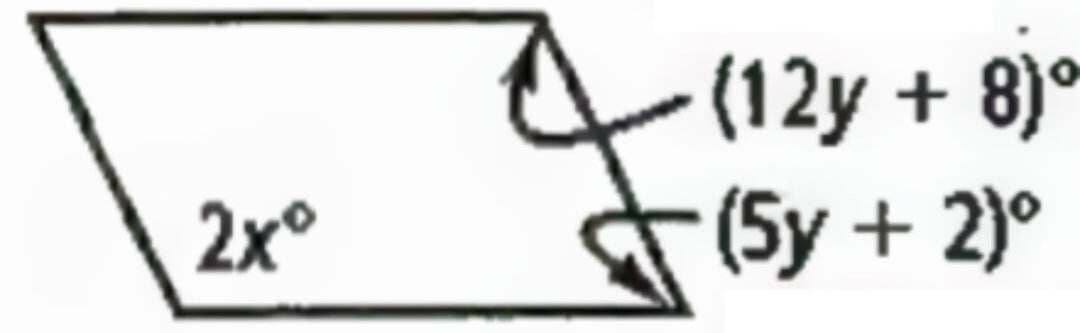
Find x and y.
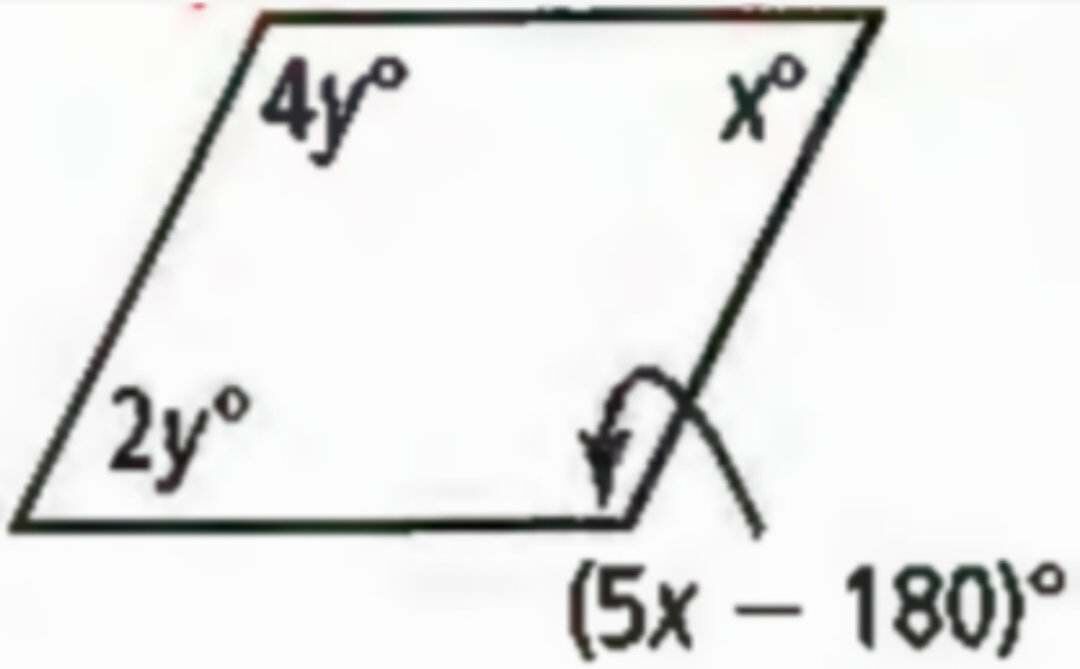
Find x and y.
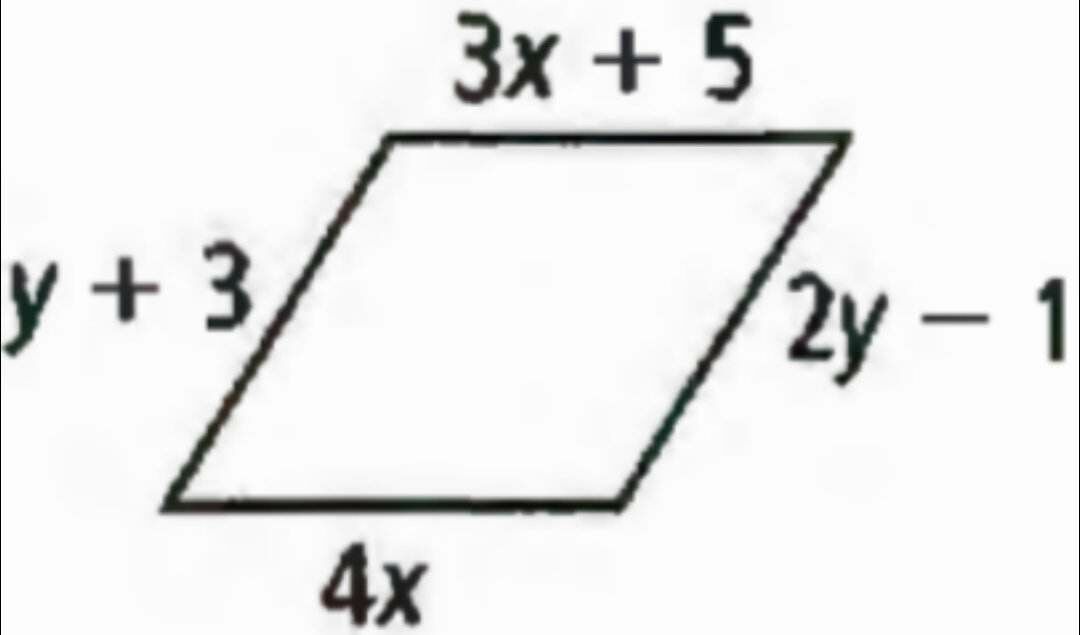
Find x and y.
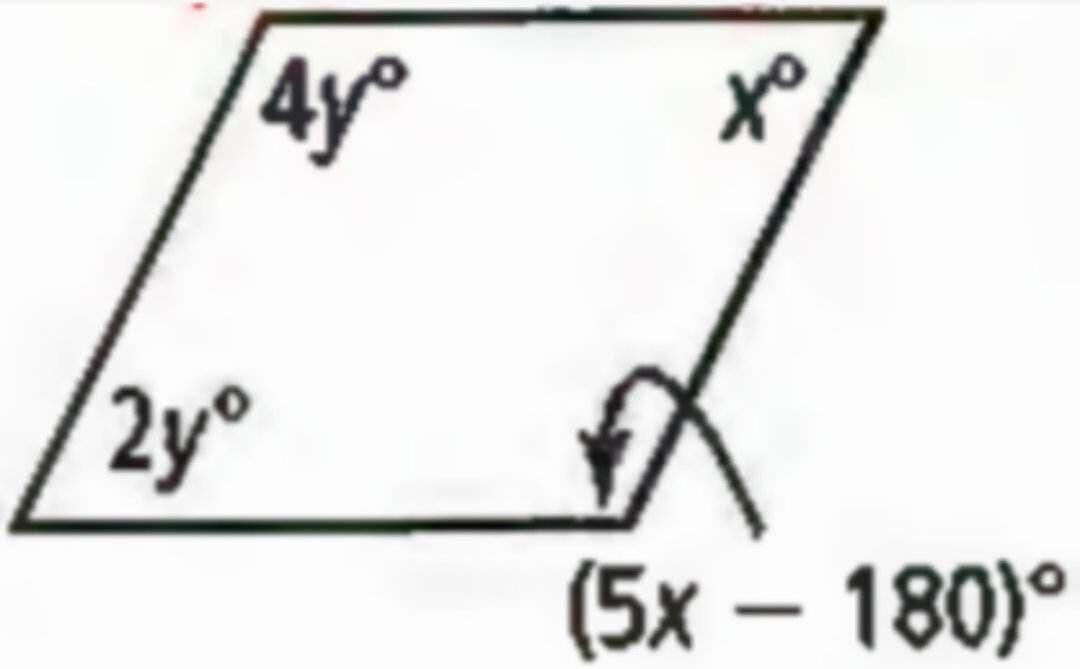
Find x and y.
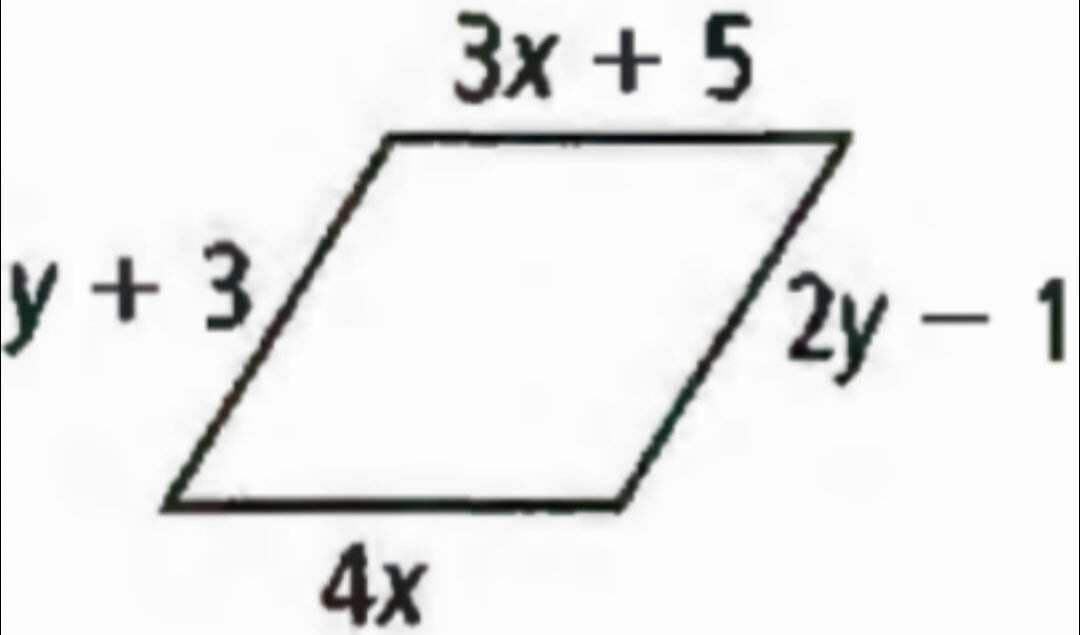
Find x and y.

Find x and y.

Find x and y.
ABCD is a parallelogram inwhich ∠A = 110°. Find the measure of each of the angles ∠B, ∠C and ∠D.
Two adjacent angles of a parallelogram are equal. What is the measure of each of these angles?
Two adjacent angles of a parallelogram are (3x - 4)°and (3x + 16)°. Find the value of x and hence find the measure of each of its angles.
If AD=20, then BC=______
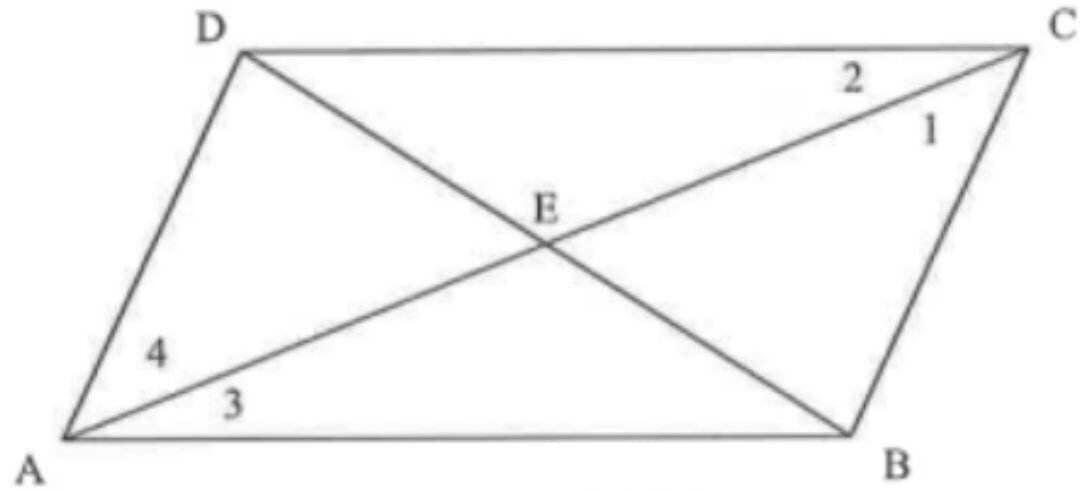
If AB=13, then DC=______
If DB=22, then DE=______
If AE=18, then AC=______
If AC=30 and AE=3x=3. Then x=_____
If AC=30 and AE=3x+3, then what is x.
HEALTH EDUCATION 3. SPECIFIC OBJECTIVES: Students should able to know about_______ 1. definition of health education 2. aims of health education 3. objectives of health education 4. principles of health education 5. scope of health education 6. planning of health education 7. steps in planning health education 8. levels of health education 9. doctors s responsibility 4. INTRODUCTION: Health education is a term frequently used by health care professional. its aims at individual and community health. Health education is the translation of what is known about health into desirable individual and community behaviour pattern by means of an education process. Definition: “A process aimed at encouraging people to want to be healthy , to know how to stay healthy, to do what they can individually and collectively to maintain health And seek help when needed”. OBJECTIVES - To inform people or disseminate scientific knowledge about prevention of disease and promotion of health - To motivate people to change their habits and lifestyle that are harmful to their health also motivate people to adopt habits and ways of living conducive to healthy living. - To guide the people who need help to adapt and maintain healthy practices and lifestyle by showing proper community resources. --- PRINCIPLES OF HEALTH EDUCATION - Credibility Of Message: It is the degree to which the message to be communicated is perceived as trustworthy by the receiver. - Creating interest among participants: It is a psychological principle that people are unlikely to listen to things that are not of their interest. If a health programme is based on the felt needs, people will participate in the programme willingly. - Motivating the participants: Motivation is like a petrol engine that drives the mental engine. It is the fundamental desire in every person to learn. Motivation is contagious; one motivated person may spread motivation throughout the group. 13. - Enhance comprehension of content: It means health education should be based on the level of understanding, education and literacy of people at whom the teaching is directed. Teaching should be within the mental capacity of the audience. - Ensure reinforcement: Repetition at intervals is necessary to promote learning. Without reinforcement and feedback, students can go back to the pre-awareness stage. - Encourage active participation: Health education should aim at encouraging people to work actively with health workers and others in identifying their own health problems and also in developing solutions. 14. - Learning by doing: Teaching is effective when individuals actively participate in health education. Learning becomes active and quicker if the individuals are made active physically as well as psychologically. - Known to unknown: The people in a community know something and the health educator enlarges this knowledge. If the health educator links new knowledge with the old knowledge, it can enhance learning. - Maintaining good human relations: Sharing of information, ideas and feelings happens most easily between people who have a good relationship. 15. - Setting an example: The health educators should set a good example in the topic they are dealing with as it fosters better understanding. - Regular feedback: Feedback is one of the key concepts of the system approach. The health educator can modify the elements of the system in light of the feedback from his audience. For effective communication, feedback is of paramount importance - Efficient leadership: Leaders are agents of change and they can be made use of in health education work. Psychologists have shown and established that we learn best from people we respect and regard. 16. The essential attributes of a leader are as follows - Understands the needs of the community. - Provides proper guidance. - Takes initiative. - Is receptive to the views and suggestions of people. - Identifies himself with the community. Is selfless, honest, impartial, considerate and sincere. - Is easily accessible to people. 17. SCOPE OF HEALTH EDUCATION 1. Nutrition 2. Hygiene 3. Family health 4. Disease prevention and cantrol 5. Psychological health 6. Prevention of accident 7. Use of health services 8. Human biology 19. - Nutrition: The aim of nutrition education is to guide people to choose optimum and balanced diets, remove prejudices and promote good dietary habits. nutrition education is a major intervention for the prevention of malnutrition, promotion of health and improving the quality of life. 20. - Hygiene: This has two aspects: personal and environmental. Personal: The aim of personal hygiene is to promote standards of personal cleanliness . Environmental: Has two aspects: Domestic and community. All environmental sanitation programmes should include health education 21. - Family health: The family is the first defence as well as the chief reliance for the well-being of its members. One of the main tasks of health education is to promote family self-reliance, especially regarding the family's responsibilities in child bearing, child rearing, self-care and in influencing their children to adopt a healthy lifestyle. 22. - Disease prevention and control: Drugs alone will not solve health problems. Without health education, a person may fall sick again and again from the same disease. Educating the people about the prevention and control of locally endemic diseases is the first of the eight essential activities in primary health care. 23. - Psychological health: Psychological health problem can occur everywhere. There is a tendency to an increase in the prevalence of psychological diseases when there is a change in society from agriculture to an industrial economy and when people move from the warm intimacy of a village. 24. - Prevention of accidents: Accidents are a feature of the complexity of modern life. Accidents can occur in home, road and place of work. The predominant factor in accidents is carelessness that can be tackled by health education. 25. - Use of health services: Many people, particularly in rural areas, do not know what health services are available and many more do not know. There is a communication gap between the public and state health administration in the form of feedback for further improvement of health services. One of the declared aims of health education is to inform people about the health services available in their community. 26. PLANNING FOR HEALTH EDUCATION planning: is the process of making thoughtful and systemic decision about what needs to be done , how it has to be done, by whom And with what sources. 27. Principles of planning health education 1) Focus on actual current needs and context of community: It is important that plans are made with the needs and context of the community in mind. Health education should try to understand what is currently happening in the community one works in. 2) Plan for basic needs and interest of the community: Consider the basic needs and interests of the community. If the local needs and interests are not kept under consideration, the plans may not be effective. 28. 3) Planning with actual beneficiaries of health education: Plan with the people involved in the implementation of an activity. If people are included in planning, they will be more likely to participate and the plan will be more likely to succeed. 4) Identify and use all relevant community resources: It is essential that the health educator identify all the relevant resources that are locally available which could be used for benefit of people receiving the health education. 29. 5) Follow principle of flexibility: Planning should be flexible, not rigid. One should be able to modify the plans when necessary. For example, you would have to change your priorities if a new problem needing an urgent response arose. 6) A realistic plan not hypothetical: The planned activity should be achievable and take into consideration the financial, personal resources available and time constraints. Planning must be realistic; do not plan unachievable activities. 30. Steps in planning health education Planning is a continuous process. It does not just happen at the start of project . Health education must be well planned to actually improve and promote individual, family and community health 31. - Needs assessment: Conducting needs assessment is the first and probably the most important step in any successful planning process. assessment is the process of identifying and understanding the health problems of the community and their possible causes. - Identify priorities: After identifying the needs and resources of the community, the next is to identify their priorities because each community may have several problems but the urgent have to be given top priority in health education. For example: goitre 32. - Set the goals and objectives: In planning the process of health education, setting goals and objectives is the third and most essential step because these goals and objectives serve as consciously thought baseline parameters to be achieved during health education. - Develop strategies: Prior to the implementation of the health education intervention one must plan, develop and evaluate the several alternative strategies to achieve the set goals and objectives of health education because each problem and target community is quite unique. 33. - Implementation: This is the core phase of the health education process which includes carrying out the planned strategies so that the set goals and objectives of health education may be achieved. - Monitor and evaluation: This is the final step of the planning process of health education where continuous monitoring as well as end evaluation is carried out to ensure the degree to which stated goals and objectives have been achieved. 34. LEVELS/APPROACH OF HEALTH EDUCATION 35. INDIVIDUAL LEVEL - Individual Approach: The health education must first create an atmosphere of friendship and allow the individual to talk as much as possible. In this individual teaching we can discuss, argue and persuade the individual to change his behaviour. But by this we can reach to a small population and who come in contact with us. Methods of individual health education 1) Home visit 2) Personal contact/ counselling 3) Personnel letters 36. 1) Home visit: A home visit is one of the best approaches for individual health education because it can become one of the best opportunities for health education with individuals and their families. Home visits are important to understand the real background of families, their living conditions and the environment in which they live. 37. 2) Personal contact/counseling : Personal contacts or counselling (one-to-one communication) is a helping process where one person explicitly and purposefully gives his or her time to assist people explore their situations and act on a solution. After this the counsellor needs to work together with the person to find solutions that are appropriate to their situation. 38. 3) personal letters: Personal letters may also be used for individual health education, where health educators may get an opportunity to dispatch letters or printed education material to the people in a target community. 39. GROUP LEVEL Group health education may be useful way to deliver health education massages in efficient manner. A well organized group permits sharing of experiences and skills so that people are able to learn from each other. 40. Methods of group discussion 1)Lecture method: (Chalk & Talk ) A lecture may be defined as carefully prepared oral presentation of facts organized thoughts and ideas by a qualified person. The group should not be more than 30 and talk should not exceed 15-20 minutes. By using suitable audiovisual aids. 2) Group discussion: A group is an aggregation of people interacting in a face to face situation. It is a very effective method of health communication. 41. 3) Demonstration: A demonstration is a carefully prepared presentation to show how to perform a skill. This procedure is carried out step by step before an audience. 4) Panel discussion: In a panel discussion 4-8 qualified persons talk about the topic. Sit and discuss a given topic in front of a large group/audience. The chairman opens the meeting. Panel comprises of a chair person and 4-8 speakers. After the main aspect of the subject are explored, the audience is invited to take part. 42. 5) Symposium: It is a series of speeches on a selected subject. Each expert person present it briefly and at the end of session the chair person make a comprehensive summary. Audience are allowed to raise question. 6) Workshops : It consists of series of meetings usually 4 or more with emphasis on an individual work, within the group and with the help of consultants and response personnel. 7) Role play: This is a brief acting out of an actual situation for the benefit of the audience for better understanding. 43. 8) Conference and seminars: This programmes are usually held on a regional, state/national level. Where several experts from different disciplines meet to deliberate on a particular theme, to appraise others of latest knowledge and research in a particular field. 9) Open forum: It refers to the public meeting which are held for various purposes in the community, for example: gram sabha 44. COMMUNITY LEVEL It is meant for a defined community and is not only to create awareness but also to help people understand their health problems and needs, find alternatives solutions to their problems and needs , implement them, evaluate and get feedback and accordingly do the needful. For health education at the community level, it is better to approach local leaders who are influential and who have the people’s confidence. These may include local officers such as gramsevak, panchayat sarpanch ,police officer or block development officer etc . 45. HOSPITAL LEVEL 1) Health Education in OPD/Outdoor: The patient and his attendants have to spend a lot of time in the outpatient department for health check-up, treatment, registration, diagnosis, admission procedure etc. This period can be utilised for health education. For this, the following means/devices can be used: - Exhibiting pictures, posters, charts, bulletin board and models in the waiting hall. - Arranging group discussion, slide show, or documentary film in a proper place and on a proper topic. - Giving health education on a personal level in the consulting room. This mainly includes nutrition clinic, family planning clinic, psychiatric clinic etc. 46. - Distributing pamphlets. - Arranging street plays or nukkad naatak in the outpatient department or its neighbourhood. 47. 2) Health Education in wards/ IPD: While taking care of the patients the indoor patients, doctors s have the opportunities to educate them. This period can be fully utilised to give health education to the patients. For this the following methods can be effective: - Conversation with the patient and motivating him for change in his behaviour. - Imparting health education by arranging live demonstration for nutrition, treatment, diagnosis etc. - Providing clinical or bedside teaching. - Providing incidental teaching to patient and his attendants. 48. - Presenting examples. To describe the gains of health education in an individual suffering from the same health education in an individual suffering from the same disease and arranging a meeting between the patient and the cured old patients.Strand 4.4 Performance management 4.4.1 Demonstrate knowledge and understanding of the implementation of the performance management system in improving school personnel and office performance. 4.4.2 Implement the performance management system with a team to support the career advancement of school personnel, and to improve office performance. 4.4.3 Monitor and evaluate with school personnel the implementation of the performance management system to ensure career advancement for individual school personnel and to improve office performance. 4.4.4 Exhibit exemplary practice in the efficient and effective implementation of the performance management system to ensure career advancement for individual school personnel, and to sustain improved office performance. Provide a StemGUIDELINES ON THE ESTABLISHMENT AND IMPLEMENTATION OF THE RESULTS-BASED PERFORMANCE MANAGEMENT SYSTEM IN THE DEPARTMENT OF EDUCATION I. Rationale 1. The Civil Service Commission (CSC), through the issuance of Memorandum Circular (MC) No. 06, series of 2012, sets the guidelines on the establishment and implementation of the Strategic Performance Management System (SPMS) in all government agencies. The SPMS gives emphasis to the strategic alignment of the agency’s thrusts with the day-to-day operation of the units and individual personnel within the organization. It focuses on measures of performance vis-a-vis the targeted milestones, and provides a credible and verifiable basis for assessing the organizational outcomes and the collective performance of the government employees. 2. As a learner-centered institution, the Department of Education (DepEd) is committed to continuously improve itself to better serve the Filipino learners and the community. The adoption of the SPMS in DepEd strengthens the culture of performance and accountability in the agency, with the DepEd’s mandate, vision and mission at its core. 3. There is a need to concretize the linkage between the organizational thrusts and the performance management system. It is important to ensure organizational effectiveness and track individual improvement and efficiency by cascading the institutional accountabilities to the various levels, units and individual personnel, as anchored on the establishment of a rational and factual basis for performance targets and measures. Finally, it is necessary to link the SPMS with other systems relating to human resources and to ensure adherence to the principle of performance-based tenure and incentives. 4. In view of the above, this Order aims to adopt the SPMS as the Results-based Performance Management System (RPMS). II. Scope of Policy 5. This DepEd Order provides for the establishment and implementation of the RPMS in all DepEd schools and offices, covering all officials and employees, school-based and non school-based, in the Department holding regular plantilla positions. It stipulates the specific mechanisms, criteria and processes for the performance target setting, monitoring, evaluation and development planning. IV. Policy Statement 9. The DepEd hereby sets the guidelines on the establishment and implementation of the Results-based Performance Management System (RPMS) in the Department, stipulating the strategies, methods, tools and rewards for assessing the accomplishments vis-a-vis the commitments. This will be used for measuring and rewarding higher levels of performance of the various units and development planning of all personnel in all levels. 10. For non school-based personnel, the RPMS shall provide for an objective and verifiable basis for rating and ranking the performance of units and individual personnel in view of the granting of the Performance-Based Bonus (PBB) starting 2015. 11. For school-based personnel, the RPMS shall be used only as an appraisal tool, which shall be the basis for training and development. The granting of PBB shall be governed by the existing PBB guidelines. 12. The Department shall adopt the RPMS framework shown in Annex B. 13. The DepEd RPMS shall follow the four-stage performance management system cycle as prescribed by the CSC: i. Performance planning and commitment (Phase I); ii. Performance monitoring and coaching (Phase II); iii. Performance review and evaluation (Phase III); and iv. Performance rewarding and development planning (Phase IV). V. Performance Cycle/Process 14. The RPMS shall align the performance targets and accomplishments with the Department’s mandate, vision, mission and strategic goals. It shall ensure 100% results orientation vis-a-vis the planned targets. On the other hand, the ratee’s demonstration of the required competencies shall be monitored for developmental purposes only. 15. The RPMS cycle shall cover performance for one whole year. All school-based personnel shall follow a performance cycle starting in April of the current year and ending in March of the following year; while non school-based personnel shall follow a performance cycle starting in January and ending in December. Annexes C and D illustrate the performance cycles which shall apply to school-based and non school-based personnel, respectively. 16. The performance planning and commitment shall be done prior to the beginning of the performance cycle; while the performance monitoring and coaching shall take place immediately after Phase I, and continue throughout the performance cycle. The performance review and evaluation, as well as the performance rewarding and development planning shall be done at the end of the performance cycle. A. Phase I: Performance Planning and Commitment 17. The performance planning and commitment shall be done prior to the start of the performance cycle where the rater meets with the ratee to discuss and agree on the following: i. Office KRAs, Objectives and Performance Indicators as anchored to the overall organizational outcomes; and ii. Individual KRAs, Objectives and Performance Indicators as anchored to the Office KRAs and Objectives. 18. The Office Performance Commitment and Review Form (OPCRF) shall be accomplished by the head of office to reflect the Office KRAs, Objectives and Performance Indicators. The head of office, in coordination with the Planning Office, shall ensure alignment of the office plans and commitments to the overall organizational outcomes. The OPCRF shall be equivalent to the IPCRF of the head of office. A sample of the filled out OPCRF, including the instructions for accomplishing the form, is shown in Annex E. 19. The Individual Performance Commitment and Review Form (IPCRF) shall be accomplished by the individual personnel to reflect the agreed Individual KRAs, Objectives and Performance Indicators. A sample of the filled out IPCRF, including the instructions for accomplishing the form, is shown in Annex F. 20. Defining the Key Result Areas. The head of office, in coordination with the Planning Office, shall define the office KRAs as anchored on the overall organizational outcomes. The rater and the ratee shall discuss and agree on the break down of the office KRAs into individual KRAs. Three (3) to five (5) KRAs shall be defined for each office and individual employee. KRAs are broad categories of general outputs or outcomes. It is the mandate or function of the office and/or individual employee. The KRA is the reason why an office and/or job exist. It is an area where the office and/or individual employee are expected to focus on. 21. Setting the Objectives. The head of office shall set three (3) objectives per office KRA. The rater and the ratee shall discuss and agree on three (3) objectives per individual KRA. Objectives are specific tasks, which an office and/or employee need to do to achieve their specific KRAs. In objective setting, the SMART criteria, which stands for Specific, Measurable, Attainable, Relevant, Time Bound, shall be applied. The SMART criteria are illustrated in Annex G. 22. Setting the Timeline. The timeline shall define the target date for accomplishing each of the Objectives. The timeline for the office Objectives shall be set by the head of office in coordination with the Planning Office and School Planning Team; while the timeline for the individual Objectives shall be discussed and agreed by the rater and the ratee. 23. Assigning the Weight. Assigning of weights shall be done per KRA. Weights for each office KRA shall be assigned by the head of office in coordination with the Planning Office; while the weights for each of the individual KRAs shall be discussed and agreed upon by the rater and the ratee. 24. Identifying the Performance Indicators. Using a five (5)-point rating scale, the head of office shall identify a performance indicator for each of the office objectives, while the rater and the ratee shall identify and agree on the performance indicator for each of the individual objectives. Performance indicators are exact quantification of objectives expressed through rubrics. They are assessment tools, which gauge whether a performance is positive or negative. In identifying the performance indicator, the operational definition or meaning of each numerical rating shall be indicated under each relevant dimension (i.e., quality, efficiency, or timeliness) per performance target or success indicator. This shall ensure that the rating is objective, impartial and verifiable. Table 1 below discusses the performance measures by which the indicator must satisfy. Table 1. Performance Measures CATEGORY DEFINITION Effectiveness/Quality The extent to which actual performance compares with targeted performance. The degree to which objectives are achieved and the extent to which targeted problems are solved. In management, effectiveness relates to getting the right things done. Efficiency The extent to which time or resources is used for the intended task or purpose. Measures whether targets are accomplished with a minimum amount or quantity of waste, expense, or unnecessary effort. Timeliness Measures whether the deliverable was done on time based on the requirements of the rules and regulations, and/or clients/stakeholders. Time-related performance indicators evaluate such things as project completion deadlines, time management skills and other time-sensitive expectations. Some Performances are only rated on quality and efficiency, some on quality and timeliness, and others on efficiency only. You need not use all three (3) categories. 25. Demonstration of Competencies. During Phase I, the rater shall discuss with the ratee the competencies required of the individual personnel. Competencies are defined as the knowledge, skills and behavior that individuals demonstrate in achieving one’s results. Competencies shall uphold the DepEd’s core values. They represent the way individuals define and live the values. 26. DepEd shall adopt four classes of competencies as follows: i. Core behavioral competencies are competencies, which cut across the organization; ii. Leadership competencies are competencies intended for managerial positions; a. Third level officials b. Chiefs and Assistant Chiefs c. School Heads and Department Heads iii. Staff Core Skills are competencies intended for staff and teaching-related personnel; and iv. Teaching competencies are competencies intended for teachers. The DepEd-required competencies are illustrated in Annex I. 27. The ratee’s demonstration of the required competencies shall be monitored to effectively plan the interventions needed for behavioral and professional development. The assessment in the demonstration of competencies shall not be reflected in the final rating. 28. Reaching Agreement. Once the office and individual KRAs, Objectives and Performance Indicators are clearly defined, the rater and the ratee shall commit and reach an agreement by signing the OPCRF and IPCRF. The signed/approved OPCRF and IPCRF shall be the basis for monitoring and assessment, which shall take place in Phases II and III, respectively. B. Phase II: Performance Monitoring and Coaching 29. The performance monitoring and coaching shall commence after the rater and the ratee commit on the KRAs, Objectives and Performance Indicators, and sign the OPCRF and IPCRF. This shall be done throughout the year. 30. The two (2) main components of Phase II are the following: i. Performance monitoring; and ii. Coaching and feedback. 31. Performance monitoring shall provide key inputs and objective basis for rating. It shall facilitate feedback and provide evidence of performance. Performance monitoring shall be the responsibility of both the rater and the ratee who agree to track and record significant incidents through the use of the Performance Monitoring and Coaching Form (PMCF) shown in Annex J. Significant incidents are actual events and behaviors in which both positive and negative performances are observed and documented. 32. Coaching and feedback shall be a continuous process. Coaching and feedback shall be provided by the rater and/or shall be sought by the ratee to improve work performance and behavior. The rater, as the coach or mentor of the ratee, playing a critical role in the performance monitoring and coaching, shall provide an enabling environment and intervention to improve the office performance and to manage and develop individual potentials. 33. The PMCF shall capture the significant incidents. It shall provide a record of demonstrated behaviors, competencies and performance, and shall be an effective substitute in the absence of quantifiable data. The rater and the ratee shall sign each significant incident recorded in the PMCF to ensure that agreement has been reached. C. Phase III: Performance Review and Evaluation 34. The performance review and evaluation shall be done at the end of the performance cycle to assess the office and individual employee’s performance level based on the commitments and measures as contained in the signed OPCRF and IPCRF. 35. A mid-year review is prescribed to determine the progress in achieving the Objectives. In exceptional cases, and only if the situation warrants, a one-time recalibration of office and individual Objectives shall be allowed during the mid-year review. Exceptional cases shall include instances when high level decisions are taken into effect such as changes in strategic directions, and circumstances beyond the control of the ratee such as natural and/or man-made calamities, including typhoon, earthquake and other fortuitous events. During the mid-year review, the rater shall inform in writing the ratee of the status of performance, in case of an Unsatisfactory or Poor performance. Coaching, feedback and appropriate interventions shall be provided where necessary. 36. The RPMS shall put premium on KRAs towards the realization of organizational vision, mission, strategic priorities and the OPIF logframe. Hence, rating for planned and/or intervening tasks shall always be supported by reports, documents or any output as proofs of actual performance. In the absence of said bases or proofs, a particular task shall not be rated and shall be disregarded. 37. Office and Individual Performance Assessment. The head of office, in coordination with the Planning Office, shall assess the performance of the office vis-a-vis the committed targets at the beginning of the performance cycle. The rater and the ratee shall discuss and agree on the individual assessment based on the actual accomplishments of each of the KRAs and Objectives. The final rating shall be based solely on the accomplishment of the specific objectives as measured by the Performance Indicators. The OPCRF and IPCRF shall be accomplished and completed by the rater and the ratee to: i. Reflect actual accomplishments and results; ii. Rate each of the objectives; iii. Compute for the score per objective; iv. Determine the overall rating for accomplishments; v. Reach an agreement; and vi. Assess the competencies. 38. Initial self-rating shall be encouraged prior to the rater-ratee discussion. 39. Third Level Officials, as heads of offices, shall accomplish the OPCRF for submission to the Planning Office. The individual assessment of Third Level Officials shall be contained in the CESPES Forms for submission to the Career Executive Service Board (CESB). The BHROD and Personnel Division shall be furnished a copy of both forms. 40. Actual Results. The rater and the ratee shall discuss and agree on the actual accomplishments and results based on the performance commitments and measures made at the beginning of the rating period. They shall evaluate each objective whether it has been achieved or not. The significant incidents as reflected in the PMCF shall be considered for the actual results. 41. Rating the Objectives. Based on the actual accomplishments and results, each of the Objectives shall be rated using the rating scale specified below: Table 2. The RPMS Rating Scale NUMERICAL RATING ADJECTIVAL RATING DESCRIPTION OF MEANING OF RATING 5 Outstanding Performance represents an extraordinary level of achievement and commitment in terms of quality and time, technical skills and knowledge, ingenuity, creativity and initiative. Employees at this performance level should have demonstrated exceptional job mastery in all major areas of responsibility. Employee achievement and contributions to the organization are of marked excellence. 4 Very Satisfactory Performance exceeded expectations. All goals, objectives and targets were achieved above the established standards. 3 Satisfactory Performance met expectations in terms of quality of work, efficiency and timeliness. The most critical annual goals were met. 2 Unsatisfactory Performance failed to meet expectations, and/or one or more of the most critical goals were not met. 1 Poor Performance was consistently below expectations, and/or reasonable progress toward critical goals was not made. Significant improvement is needed in one or more important areas. The final assessment shall correspond to the adjectival description of Outstanding, Very Satisfactory, Satisfactory, Unsatisfactory or Poor. The range of adjectival rating is as per attached in Forms A, B, and C. 42. Process for Computing the Score per KRA. i. The rater and ratee shall ensure that each KRA has been assigned weight according to priority. ii. As an option, the rater and ratee may assign weights to objectives which shall be equal to the total weight assigned to a particular KRA. KRA 1 – Weight assigned is 40% Objective 1 is 20% Objective 2 is 10% Objective 3 is 10% iii. The score per KRA shall be computed using the following formula: 43. Plus Factor. The plus factor shall be considered as another KRA. These are value adding accomplishments, which are not covered within the regular duties and responsibilities. The weight on the plus factor shall not exceed the weight of the highest mandated KRA. For teachers, the plus factor shall be limited to work/activities, which contribute to the teaching-learning process. 44. Determining the Overall Rating for Accomplishments. The overall rating/assessment for the accomplishments shall fall within the following adjectival ratings and shall be in three (3) decimal points: Table 3. Adjectival Ratings RANGE ADJECTIVAL RATING 4.500-5.000 Outstanding 3.500-4.499 Very Satisfactory 2.500-3.499 Satisfactory 1.500-2.499 Unsatisfactory below 1.499 Poor 45. Reaching Agreement. Upon determining the overall rating for the actual accomplishments and results, the rater and the ratee shall reach an agreement by signing the OPCRF and IPCRF. The average rating of individual staff members should not go higher than the collective performance assessment of the office. 46. Assessing the Competencies. The rater shall discuss with the ratee the set of competencies observed during the performance cycle. The competencies shall not be reflected in the final rating. Competencies shall be monitored for developmental purposes. In evaluating the individual’s demonstration of competencies, the rating scale in Table 4 shall apply: Table 4. The DepEd Competencies Scale SCALE DEFINITION 5 Role model 4 Consistently demonstrates 3 Most of the time demonstrates 2 Sometimes demonstrates 1 Rarely demonstrates 5 (role model) – all competency indicators 4 (consistently demonstrates) – four competency indicators 3 (most of the time demonstrates) – three competency indicators 2 (sometimes demonstrates) – two competency indicators 1 (rarely demonstrates) – one competency indicator D. Phase IV: Performance Rewarding and Development Planning 47. The results of the performance review and evaluation shall be used in performance rewarding and development planning. This phase shall be done after Phase III. 48. The rater shall discuss and provide qualitative comments, observations and recommendations in the individual employee’s performance commitment, competency assessment and significant incidents which shall be used for training and professional development. These can be written under the strengths and development needs column of the Part IV-Development Plans of the IPCRF. 49. The rater and the ratee shall identify and discuss the individual’s strengths and development needs, and reflect them in the Part IV-Development Plans of the IPCRF. The competencies which the ratee demonstrated consistently and the areas, where the ratee meet or exceed expectations shall be referred to as the ratee’s strengths. The competencies, which the ratee rarely demonstrates and the areas where the ratee has room for improvement and has not met the expectations, shall be identified as the ratee’s development needs. Make a situational SOLO-based questions in the context of school leadershipStrand 4.5 Professional development of school personnel 4.5.1 Demonstrate knowledge and understanding of professional development in enhancing strengths and in addressing performance gaps among school personnel. 4.5.2 Implement professional development initiatives to enhance strengths and address performance gaps among school personnel. 4.5.3 Monitor and evaluate the implementation of professional development initiatives in enhancing strengths and in addressing performance gaps among school personnel. 4.5.4 Model exemplary practice in the implementation of professional development initiatives to enhance strengths and address performance gaps among school personnel. Give me a situational HOTS/SOLO based multiple choice questions The LMS has been an essential tool in curriculum design and development and in organizing factors that motivate student learning, especially in online distance learning. However, an LMS can be used in blended, hybrid, and in-class delivery modes. It is a software application designed to help in the administration of courses for both students and instructors. Such systems have been designed for use in learning and teaching activities (Chung et al., 2012). They also provide a variety of interaction methods between instructors and learners to facilitate the learning process better, You must remember well-designed LMS could also help improve student skills, such as effective online learning and self-direction (Norouzi, 2014). Students could use the system to enhance performance (perceived usefulness), and they could use such systems with little effort (perceived ease of use) (Venkatesh & Davis, 2000). A majority of higher education institutions have incorporated LMS systems; they have been used in university systems by schools, faculty members, and instructors (Klobas & McGill,. 2010), Because so much of higher education has been focused on course delivery Chapter3 INSTRUCTIONAL DELIVERY SYSTEMS AND EDUCATIONAL TECHNOLOGY i 71 in a physical classroom, the implementation of an LYS has a;ded institutons in transitioning to new online universe of curriculum de!ivery (Georgou!i, & Guerre. 2NS). Repositories, central databases, and online meeting 'oations are all characteristcs of a management system. As a concept, a 'earning management system is a broad idea and an example of technology's inabifity to be specific in terms of a definition. Several requirements a generat overview of what constitutes a leaming management system, such as those listed above Finally, end-user access is also a part of a learning management system with various levels being set up by security. For example, students have read-onty access, faculty members have read and write access, and technical staff has complete access for support and administrative duties (Graf & Chien, 2009). At its core, a learning management system contains internal or Web-based support and management for numerous aspects of learning and teaching (Hiary & Abu-Shawar, 2009). This allows access from numerous locales, usually on a 24-hour basis. When looking at a university or college, this concept begins to grow greatly depending on the organization's size and scope; department, and degree program. Leaming management systems also go by other names such as course management systems, and their use goes beyond higher education institutions to include businesses and individual instructors. Meis)ar-Tal, Kurtz, and Pieterse (2012) mentioned three primary purposes of an CMS. They include the following: 1. to provide students with digital learning materials; 2. to employ interactive learning activities with students in the forums; and 3. to manage the course and the learners. Faculty members who use an LMS to make available lecture notes and other classroom resources for their face-to-face class create a web-enhanced classroom experience. Regardless of its usage, requirements for classification as a learning management system include several key concepts like the availability of assets over networks, providing hosting, administration. and support. With the requirements set, utilization becomes the focal point. A fully utilized learning management system looks at use at the student level, faculty level, and administration level. proper utilization of learning management systems should mirror traditional higher education goals, enhancing students' experiences. For learninä management systems, this creates a central hub for a class activity. For some classes, all activities work in the learning management system, while others only use its resources for select activities.Management and Globalization Global Management Why companies go global How companies for global Global Business environments Global Business Types of global business Pros and cons of global businesses Ethnic Challenges for global business Culture and Global Diversity Cultural intelligence Silent language of culture Tight and loose cultures Values and national cultures Global Management Learning Are management theories universal? Intercultural competencies Global learning goals Key concepts of the challenges of globalisation: Global economy Resources, markets and competition are worldwide in scope Internationalisation The process of increasing involvement in international operations Globalization/Deglobalization Glob- the growing interdependence among elements in the global economy The worldwide interdependence of resource flows, product markets and business competition World 3.0 Different views: World flat vs. round Distance is a metaphor that represents the degree of dissimilarities between countries Balancing cooperation in the global Global Management Global management - managing things in different countries Managing business and organizations with interests in more than one country What do we expect from global Managers Knowing how to adapt Knowing the language Global Manager Is culturally aware and informed on international affairs International Business Conducting for-profit transactions of goods and services across national boundaries International Motive Why do firms internatioalize their activities Cheaper labour Labour tax Natural resources Enrolments to do business Clientele Exclusive materials Personal benefits: Taxes Reasons why businesses go global Customers Suppluers Capital During (1993) - 4 motive 1. Market seeking 2. Efficiency Seeking 3. Resource seeking 4. Strategic Asset Seeking Cuervo Cazurra, Narula and un (2015) - 4 motive s Internationalization Motives A company may also explore the opportunities in different markets in order to take advantage and in some cases extend the product life cycle What is a Market Entry Strategy Involves the sale of goods or services to foreign markets but do not require expensive investments Franchising Exporting and importing Involve the sale of goods or services to foreign markets but do Types of market entry strategies Global sourcing Exporting Importing Licensing agreement Franchising Types of Foreign Direct Investment (FDI) strategies: Joint venture Strategic alliance Owned Subsidiary (sometimes called WOS) How to go abroad What conditions will affect the decisions of firms on how to internationalize their activities? During (1978)- Eclectic paradigm OLI model OLI- Ownership, Location and Internalization Advantages Ownership advantages Resources owned by the organization that can be transferred across locations include trademarks, production techniques and processes, managerial skills and other resources not available to the competitors Location Advantages Represent the implications of choosing to produce or to perform activities in a specific location (country or region) Internalization Advantages: The ability to internalize or to incorporate activities that add value to its business Evolution of Concepts- New Elements Although economic factors are certainly important to explain the formation, growth and expansion of firms within and across national borders, they are not sufficient to explain the additional complexity when a firm decides to expand its activities across national borders Economic factors Investigate the economic elements that affect the internationalization of firms Behavioural Elements Explaining the additional challenges (and perhaps opportunities) a firm faces in foreign host countries when compared to indigenous (local) firms Behavioural theories Johanson and Wiedersheim-Paul (1975) and Johanson and Vahlne (1977) Included the psychic Distance concept (beckerman,1956) to explain the internationalization behaviour of firms The Uppsala internationalization model Psychic distance is: the sum of factors preventing the flow of infomatio from and to the market Psychic Distance is a broad concept that includes several elements such as: language, culture, political systems, level of education, level of industrial development Firms behave in a “Risk Averse” manner It means that when the perceived risk goes down, the firm increase its commitment to the foreign market \ The Haier Group Data Strategy Big DATA and Small DATA The use of small data to satisfy individual customers’ needs, however, the book mentions a huge cultural shock at the plant in Camden, south caroline Ex: top down, hard hat colors and hierarchy Culutral Differnces can have a huge impact on the internationalization of firms Kogut and Singh (1988)- Cultural Distance Index First statsical study on the implication of ciltiral distance to the selection of entry mode When investigating in culturally distant countries, foreign firms can choose to partner with foreign firms in order to gain local knowledge and share the risk associated to the investment (higher commitment = higher risk) How Companies Go Global Global sourcing The process of purchasing materials or services around teh world for local use Exporting Selling locally made products in foreign markets Importing Buying foreign made products and selling them domestically Exports correspond to what percentage of Candain GDP What countries are the major trending partners of Canada Management and Globalization How Companies Go Global Licensing Agreement One firm pays a fee for rights to make or sell another company’s products What are the potential risks associated to licesning The case of new balance in China Franchising A fee is paid for the rights to use another firms name, branding and methods Insourcing Insourcing: refers to local job creation that results from foreign direct investment Types of insourcing Joint ventures: operate in a foreign country through co-ownership by foreign and local partners Strategic alliances: A partnership in which foreign and domestic firms share resources and knowledge for mutual gains Foreign subsidiaries: local operation completely owned by a foreign firm Criteria for choosing a joint venture partner: Familiarity with your firm’s major business String local workforce Values its customers Future expansion possibilities Strong local market for partner’s own products Good Profit potential Sound financial standing Global business environments Legal and poliical systems Trade agreements and trade barriers Regional economic alliances Legal and political systems Differing laws and practices regards Business ownership Negotiation and implementation of contracts Foreign currency exchange Protection of intellectual property rights Counterfeit merchandise Political risk Potential loss in value of foreign investment due to instability and political changes in the host country Political risk analysis (expertise/experience) Forecast political disruptions that threaten the value of a foreign investment Changes in the rules of the game Brexit US Trade Wars-mexico-China Other examples Bolivia, Venezuela, China De-globalization The process of weakening interdependence among nations Trade Agreements and trade Barriers World trade organization Most favourd nation status Tariffs Nontariss barriers (quotes, restrictions, etc.) Protectionism Regional Economic Alliances USMCA (replacment for the NAFTA-North American Free trade Agreement) EU- European Union APEC- Aisa Pacific Economic Copperation ASEAN - Association of Southeast Asian Nationas SADC - Southern Africa Development Community MERCOSUR- Chapter 5- Global Management and Cultural Diversity (part 2) Review Types of global business Global corporation MNE (multinational enterprise) or MNC (multinational corporation) with extensive business operations in more than one foreign country Transnational corporation A global corporation that operates worldwide on borderless basis Some host country complaints about MNCs Host Country companits about MNCs: Excessive profits Interference with local government Domination of local economy Interference with local government Hiring the best local talent Limited technology transfer Disrespect for local customers Examples - War in Ukraine Disruption in global -value chains and increased pressure and interference of MNCs with local government Fertilizer imports in Brazil (one of the major producers of agricultural commodities) We must consider the triple bottom line and the impact in society, the environment and the economy $2.5 billion invest in potash mine in Brazill What about Globalization gap Large multinationals adn industrilizednaitons gaining disporoportinonally form globalization Globalization gap: Large multinational and industrialized nations gaining disproportionally from Globalization Some MNC complaints about host countries MNC Complaints about host countries: Profiit limitations Laws and regulations Overpirce resources Exploitative rules Foreign exchange restriction Failure to uphold contracts Mutual benefits for host countries and multinational companies Mutual benefits for host country and global corporation of MNC: Shared growth opportunities Shared income opportunities Shared learning opportunities Share development opportunities Develop projects together What are some of the ethical challenges for global business Ethincal challenges for global business Child labour Employmnet of children for worl otherwise done by adults Sweatshops Employment of workers at very low wages for long hours in poor working conditions Ex: Nike bad labour prices Unsafe working conditions Corruption Illegal practices that further one’s business interests Corrupiotn of froeign public officials Act makes it illegal for Candain firms and their representatives to engage in corrupt practices overseas Bribes to foreign officials Excessive commissions Non-monetary gifts Sweatshops Conflict materials What is culture Culture : The shared set of beliefs, values, and patterns of behvaiourr common to a group of people Food preferences Values and traditions Language and beliefs Religion Art music Life style Hofstede defines culture as: “The collectiv programing of teh mind distinguishing the members of one group or category of people from others” What is culture shock Culture Shock: Confusion and discoumfert a person experiences in an unfaamiliar culture Stages to adjusting to a new culture Confusion Small vitorires The honeymoon Irritation and anger Reality Cultural Intelligence The ability to adapt and adjust to new cultures What is Ethnocentrism Tendency to consider one’s own culture as superior others Slinet languages of culture Contect Low context High context Space Proxemics Ex: personal space Time Monochronic Polychronic High and low contexts cultures Edward T.Hall (1959) Def: Part of a discourse that surround a word or passage and can throw on its meaning Low context cultures Emphizes communication via spoken or written words Countries like United States, Canada and Germany High context cultures Rely on nonverbal and situational cues as well as on spoken or written works Thailand Malaysia Time Monochronic cultures People tend to do one thing at a time Canda Polychronic cultures Time is used to accomplish many different things at once Egypt Space Proxemics Study of how people use space to communicate In North American people value “personal space’ Many Latin and Asian cultures expect much less personal space Tight and Loose Cultures Cultural tightness-looseness Tight = Strength of norms that govern social behvaviour Japan, Korea, Malaysia Loose = tolerance for any deviation from norms Australia, Brazil, Hungary Values and national cultures (Hofstede) Power distance Uncertainty avoidance Individalism-collectivism Masculinity-femininty Time Orientation Indulgence vs. Restraint Comparative management How management pratices systematically differ among countries and /or cultures Intercultural competencies Skills and personal characteristics that help us be successful in cross cultural situations Global Managers (know how to adapt) Need to successfully apply management functions across interantional boundaries Global Learning goals Not universal Engage critical thinking Look everywhere for new management ideas Always consider culture THE STRATEGIC PLAN OF RICHARD BLAND COLLEGE OF WILLIAM & MARY 2020-2025 “The dogmas of the quiet past are inadequate to the stormy present. The occasion is piled high with difficulty, and we must rise with the occasion. As our case is new, so we must think anew and act anew.” – Abraham Lincoln What is the role of a selective, two-year, residential, liberal arts transfer institution within the higher education landscape of the Commonwealth of Virginia? This is a key question that must be answered to ensure the success of Richard Bland College (RBC) and the constituency that the College serves. The 2020 RBC strategic plan’s primary objective is to answer that very question so that the College, the community and the Commonwealth can engage successfully within this identity and purpose to the benefit of all. RBC has long been identified as the hidden gem of higher education in Virginia. The hidden adjective is based both on its relative obscurity—few are aware of RBC outside the Tri-Cities region—and its rural setting featuring 750+ acres of wetlands, bucolic forest, and the state’s oldest and largest pecan grove. Additionally, on average, a student of Richard Bland College travels a mere 36 miles to campus. This keeps the knowledge of RBC in a tightly focused radius. The gem moniker refers both to the College’s reputation for excellence and the undeniable sensation that the campus often elicits in its students, visitors, faculty and staff, the feeling of a warm and palpable embrace of care, compassion and support. That sensation is where we start. According the State Council of Higher Education for Virginia (SCHEV), 99% of the 11.5 million new jobs created since the great recession require workers to have more than a high-school education. Students with a bachelor’s degree have an earning potential almost double that of people with only a high school education, and yet only 17% of residents in the Petersburg area have a bachelor’s degree, 15% below the national average. The obstacles in the way of education have been exhaustively researched and include financial challenges, academic under-preparedness, low self-esteem, slow college assimilation and immature levels of self-efficacy. To combat this growing problem, Richard Bland College initiated a pilot program to determine the viability of a data-driven approach to improve retention and graduation rates. The program ultimately effected a cultural, organizational and operational shift at RBC, resulting in a personalized model of student support, the Exceptional Student Experience (ESE@RBC). Originally many of the practices that RBC used as the basis of ESE@RBC were adapted from the four key principles found in the American Association of Community Colleges (AACC) Pathways Project: 1) map pathways to student end goals; 2) help students choose and enter a program pathway; 3) keep students on path; and 4) ensure that students are learning. Unfortunately, limited resources made it necessary to skip some primary elements of guided pathways and instead to focus on a specific, high-priority project that was immediately available for implementation, dedicated student support. This strategic framework reimagines the way that RBC serves students, faculty and staff within the context of our existing culture, the principles of guided pathways and a hybrid work-college experience. Rather than thinking of a two-year college as a pipeline to a four-year university, this vision describes a more expansive menu of well-defined pathways to high-demand fields, all radiating from a curriculum constructed around the development of soft skills that define the liberal arts experience: critical thinking, written communication, analytical reasoning, civic engagement and oral communication. Furthermore, the impact of meaningful work is a resonating theme, providing avenues to participate in career-focused internships and jobs that develop important life & work skills, confidence, and character. Richard Bland has tested its entrepreneurial mettle and its capacity for transformation in recent years. The College was among a select few Competency-Based Education sites established by the U.S. Department of Education. We were ahead of the curve using predictive analytics to improve student retention and success rates, and online enrollment now makes up nearly 20 percent of course offerings. It may be counter-intuitive, but these and other deep-level institutional changes still to come will ensure that Richard Bland College remains true to its original mission. We prepare our students for a lifetime of endless potential.MYTH The British helped the Jews displace the native Arab population of Palestine. FACT Herbert Samuel, a British Jew who served as the first High Commissioner of Palestine, placed restrictions on Jewish immigration “in the ‘interests of the present population’ and the ‘absorptive capacity’ of the country.”1 The influx of Jewish settlers was said to force the Arab fellahin (native peasants) from their land. This was when less than a million people lived in an area that now supports more than nine million. The British limited the absorptive capacity of Palestine when, in 1921, Colonial Secretary Winston Churchill severed nearly four-fifths of Palestine—some thirty-five thousand square miles—to create a new Arab entity, Transjordan. As a consolation prize for the Hejaz and Arabia (which are both now Saudi Arabia) going to the Saud family, Churchill rewarded Sharif Hussein’s son Abdullah for his contribution to the war against Turkey by installing him as Transjordan’s emir. The British went further and placed restrictions on Jewish land purchases in what remained of Palestine. By 1949, the British had allotted 87,500 acres of the 187,500 acres of cultivable land to Arabs and only 4,250 acres to Jews. This contradicted Article 6 of the Mandate which stated that “the Administration of Palestine…shall encourage, in cooperation with the Jewish Agency…close settlement by Jews on the land, including State lands and waste lands not acquired for public purposes.”2 Ultimately, the British admitted that the argument about the country’s absorptive capacity was specious. The Peel Commission said, “The heavy immigration in the years 1933–36 would seem to show that the Jews have been able to enlarge the absorptive capacity of the country for Jews.”3 MYTH The British allowed Jews to flood Palestine while Arab immigration was tightly controlled. FACT The British response to Jewish immigration set a precedent of appeasing the Arabs, which was followed for the duration of the Mandate. The British restricted Jewish immigration while allowing Arabs to enter the country freely. Apparently, London did not feel that a flood of Arab immigrants would affect the country’s “absorptive capacity.” During World War I, the Jewish population in Palestine declined because of the war, famine, disease, and expulsion by the Turks. In 1915, approximately 83,000 Jews lived in Palestine among 590,000 Muslim and Christian Arabs. According to the 1922 census, the Jewish population was 83,000, while the Arabs numbered 643,000.4 Thus, the Arab population grew exponentially while that of the Jews stagnated. In the mid-1920s, Jewish immigration to Palestine increased primarily because of anti-Jewish economic legislation in Poland and Washington’s imposition of restrictive quotas.5 The record number of immigrants in 1935 (see table) was a response to the growing persecution of Jews in Nazi Germany. The British administration considered this number too large, however, so the Jewish Agency was informed that less than one-third of the quota it asked for would be approved in 1936.6 The British gave in further to Arab demands by announcing in the 1939 White Paper that an independent Arab state would be created within ten years and that Jewish immigration was to be limited to 75,000 for the next five years, after which it was to cease altogether. It also forbade land sales to Jews in 95% of the territory of Palestine. The Arabs, nevertheless, rejected the proposal. Jewish Immigration to Palestine7 1919 1,806 1931 4,075 1920 8,223 1932 12,533 1921 8,294 1933 37,337 1922 8,685 1934 45,267 1923 8,175 1935 66,472 1924 13,892 1936 29,595 1925 34,386 1937 10,629 1926 13,855 1938 14,675 1927 3,034 1939 31,195 1928 2,178 1940 10,643 1929 5,249 1941 4,592 1930 4,944 By contrast, throughout the Mandatory period, Arab immigration was unrestricted. In 1930, the Hope Simpson Commission, sent from London to investigate the 1929 Arab riots, said the British practice of ignoring the uncontrolled illegal Arab immigration from Egypt, Transjordan, and Syria had the effect of displacing the prospective Jewish immigrants.8 The British governor of the Sinai from 1922 to 1936 observed, “This illegal immigration was not only going on from the Sinai, but also from Transjordan and Syria, and it is very difficult to make a case out for the misery of the Arabs if at the same time their compatriots from adjoining states could not be kept from going in to share that misery.”9 The Peel Commission reported in 1937 that the “shortfall of land is…due less to the amount of land acquired by Jews than to the increase in the Arab population.”10 MYTH The British changed their policy to allow Holocaust survivors to settle in Palestine. FACT The gates of Palestine remained closed for the duration of the war, stranding hundreds of thousands of Jews in Europe, many of whom became victims of Hitler’s “Final Solution.” After the war, the British refused to allow the survivors of the Nazi nightmare to find sanctuary in Palestine. On June 6, 1946, President Truman urged the British government to relieve the suffering of the Jews confined to displaced persons camps in Europe by immediately accepting 100,000 Jewish immigrants. Britain’s foreign minister Ernest Bevin replied sarcastically that the United States wanted displaced Jews to immigrate to Palestine “because they did not want too many of them in New York.”11 Some Jews reached Palestine, many smuggled in on dilapidated ships organized by the Haganah. Between August 1945 and the establishment of the State of Israel in May 1948, sixty-five “illegal” immigrant ships, carrying 69,878 people, arrived from European shores. In August 1946, however, the British began to intern those they caught in camps on Cyprus. Approximately 50,000 people were detained in the camps, and 28,000 remained imprisoned when Israel declared independence.12 MYTH As the Jewish population grew, the plight of the Palestinian Arabs worsened. FACT In July 1921, Hasan Shukri, the mayor of Haifa and president of the Muslim National Associations, sent a telegram to the British government in reaction to a delegation of Palestinians that went to London to try to stop the implementation of the Balfour Declaration. Shukri wrote: We are certain that without Jewish immigration and financial assistance there will be no future development of our country as may be judged from the fact that the towns inhabited in part by Jews such as Jerusalem, Jaffa, Haifa, and Tiberias are making steady progress while Nablus, Acre, and Nazareth where no Jews reside are steadily declining.13 The Jewish population increased by 470,000 between World War I and World War II, while the non-Jewish population rose by 588,000.14 The permanent Arab population increased by 120% between 1922 and 1947.15 This rapid growth of the Arab population was a result of several factors. One was immigration from neighboring states—constituting 37% of the total immigration to pre-state Israel—by Arabs who wanted to take advantage of the higher standard of living the Jews had made possible.16 The Arab population also grew because of the improved living conditions created by the Jews as they drained malarial swamps and brought improved sanitation and health care to the region. Thus, for example, the Muslim infant mortality rate fell from 201 per thousand in 1925 to 94 per thousand in 1945, and life expectancy rose from 37 years in 1926 to 49 in 1943.17 The Arab population increased the most in cities where large Jewish populations had created new economic opportunities. From 1922–1947, the non-Jewish population increased by 290% in Haifa, 131% in Jerusalem, and 158% in Jaffa. The growth in Arab towns was more modest: 42% in Nablus, 78% in Jenin, and 37% in Bethlehem.18 MYTH Jews stole Arab land. FACT Despite the growth in their population, the Arabs continued to assert they were being displaced. From the beginning of World War I, however, part of Palestine’s land was owned by absentee landlords who lived in Cairo, Damascus, and Beirut. About 80% of the Palestinian Arabs were debt-ridden peasants, semi-nomads, and Bedouins.19 Jews went out of their way to avoid purchasing land in areas where Arabs might be displaced. They sought land that was largely uncultivated, swampy, cheap, and—most important—without tenants. In 1920, Labor Zionist leader David Ben-Gurion expressed his concern about the Arab fellahin, whom he viewed as “the most important asset of the native population.” He insisted that “under no circumstances must we touch land belonging to fellahs or worked by them.” Instead, he advocated helping liberate them from their oppressors. “Only if a fellah leaves his place of settlement,” Ben-Gurion added, “should we offer to buy his land, at an appropriate price.”20 Jews only began to purchase cultivated land after buying all the uncultivated territory. Many Arabs were willing to sell because of the migration to coastal towns and because they needed money to invest in the citrus industry.21 When John Hope Simpson arrived in Palestine in May 1930, he observed, “They [the Jews] paid high prices for the land and, in addition, they paid to certain of the occupants of those lands a considerable amount of money which they were not legally bound to pay.”22 In 1931, Lewis French conducted a survey of landlessness for the British government and offered new plots to any Arabs who had been “dispossessed.” British officials received more than 3,000 applications, of which 80% were ruled invalid by the government’s legal adviser because the applicants were not landless Arabs. This left only about 600 landless Arabs, 100 of whom accepted the government land offer.23 In April 1936, a new outbreak of Arab attacks on Jews was instigated by local Palestinian leaders who were later joined by Arab volunteers led by a Syrian guerrilla named Fawzi al-Qawuqji, the commander of the Arab Liberation Army. By November, when the British finally sent a new commission headed by Lord Peel to investigate, 89 Jews had been killed and more than 300 wounded.24 The Peel Commission’s report found that Arab complaints about Jewish land acquisition were baseless. It pointed out that “much of the land now carrying orange groves was sand dunes or swamp and uncultivated when it was purchased…There was at the time of the earlier sales little evidence that the owners possessed either the resources or training needed to develop the land.”25 Moreover, the Commission found the shortage was “due less to the amount of land acquired by Jews than to the increase in the Arab population.” The report concluded that the presence of Jews in Palestine, along with the work of the British administration, had resulted in higher wages, an improved standard of living, and ample employment opportunities.26 It is made quite clear to all, both by the map drawn up by the Simpson Commission and by another compiled by the Peel Commission, that the Arabs are as prodigal in selling their land as they are in useless wailing and weeping (emphasis in the original). —Transjordan’s king Abdullah27 Even at the height of the Arab revolt in 1938 (which began in April 1936 with the murder of two Jews by Arabs and the subsequent murder of two Arab workers by members of the Jewish underground28), the British high commissioner to Palestine believed the Arab landowners were complaining about sales to Jews to drive up prices for lands they wished to sell. Many Arab landowners had been so terrorized by Arab rebels they decided to leave Palestine and sell their property to the Jews.29 The Jews paid exorbitant prices to wealthy landowners for small tracts of arid land. “In 1944, Jews paid between $1,000 and $1,100 per acre in Palestine, mostly for arid or semiarid land; in the same year, rich black soil in Iowa was selling for about $110 per acre.”30 By 1947, Jewish holdings in Palestine amounted to about 463,000 acres. Approximately 45,000 were acquired from the mandatory government, 30,000 were bought from various churches, and 387,500 were purchased from Arabs. Analyses of land purchases from 1880 to 1948 show that 73% of Jewish plots were purchased from large landowners, not poor fellahin.31 Many leaders of the Arab nationalist movement, including members of the Muslim Supreme Council, and the mayors of Gaza, Jerusalem, and s sold land to the Jews. As’ad el-Shuqeiri, a Muslim religious scholar and father of Palestine Liberation Organization chairman Ahmed Shuqeiri, took Jewish money for his land. Even King Abdullah leased land to the Jews.32 MYTH The British helped the Palestinians to live peacefully with the Jews. FACT In 1921, Haj Amin el-Husseini first began to organize fedayeen (“one who sacrifices himself”) to terrorize Jews. El-Husseini hoped to duplicate the success of Kemal Atatürk in Turkey by driving the Jews out of Palestine just as Kemal had driven the invading Greeks from his country.33 Arab radicals gained influence because the British administration was unwilling to take effective action against them until they began a revolt against British rule. Colonel Richard Meinertzhagen, former head of British military intelligence in Cairo, and later chief political officer for Palestine and Syria, wrote in his diary that British officials “incline towards the exclusion of Zionism in Palestine.” The British encouraged the Palestinians to attack the Jews. According to Meinertzhagen, Col. Bertie Harry Waters-Taylor (financial adviser to the military administration in Palestine 1919–23) met with el-Husseini in 1920, a few days before Easter, and told him that “he had a great opportunity at Easter to show the world…that Zionism was unpopular not only with the Palestine administration but in Whitehall.” He added that “if disturbances of sufficient violence occurred in Jerusalem at Easter, both General [Louis] Bols [chief administrator in Palestine, 1919–20] and General [Edmund] Allenby [commander of the Egyptian force, 1917–19, then high commissioner of Egypt] would advocate the abandonment of the Jewish Home. Waters-Taylor explained that freedom could only be attained through violence.”34 El-Husseini took the colonel’s advice and instigated a riot. The British withdrew their troops and the Jewish police from Jerusalem, allowing the Arab mob to attack Jews and loot their shops. Because of el-Husseini’s overt role in instigating the pogrom, the British decided to arrest him. He escaped, however, and was sentenced to ten years in absentia. A year later, some British Arabists convinced High Commissioner Herbert Samuel to pardon el-Husseini and to appoint him Mufti (a cleric in charge of Jerusalem’s Islamic holy places). By contrast, Vladimir Jabotinsky and several followers, who had formed a Jewish defense organization during the unrest, were sentenced to 15 years. They were released a few months later.35 Samuel met with el-Husseini on April 11, 1921, and was assured “that the influences of his family and himself would be devoted to tranquility.” Three weeks later, riots in Jaffa and elsewhere left forty-three Jews dead.36 El-Husseini consolidated his power and took control of all Muslim religious funds in Palestine. He used his authority to gain control over the mosques, the schools, and the courts. No Arab could reach an influential position without being loyal to the Mufti. His power was so absolute that “no Muslim in Palestine could be born or die without being beholden to Haj Amin.”37 The Mufti’s henchmen also ensured he would have no opposition by systematically killing Palestinians who discussed cooperation with the Jews from rival clans. As the spokesman for Palestinian Arabs, el-Husseini did not ask that Britain grant them independence. On the contrary, in a letter to Churchill in 1921, he demanded that Palestine be reunited with Syria and Transjordan.38 The Arabs found rioting an effective political tool because of the lax British response toward violence against Jews. In handling each riot, the British prevented Jews from protecting themselves but made little effort to prevent the Arabs from attacking them. After each outbreak, a British commission of inquiry would try to establish the cause of the violence. The conclusion was always the same: The Arabs feared being displaced by the Jews. To stop the rioting, the commissions would recommend that restrictions be placed on Jewish immigration. Thus, the Arabs learned they could always stop the influx of Jews by staging riots. This cycle began after a series of riots in May 1921. After failing to protect the Jewish community from Arab mobs, the British appointed the Haycraft Commission to investigate the cause of the violence. Although the panel concluded the Arabs had been the aggressors, it rationalized the cause of the attack: “The fundamental cause of the riots was a feeling among the Arabs of discontent with, and hostility to, the Jews, due to political and economic causes, and connected with Jewish immigration, and with their conception of Zionist policy.”39 One consequence of the violence was the institution of a temporary ban on Jewish immigration. The Arab fear of being “displaced” or “dominated” was an excuse for their attacks on Jewish settlers. Note, too, that these riots were not inspired by nationalistic fervor—nationalists would have rebelled against their British overlords—they were motivated by economics, the radical Islamic views of the Mufti, and misunderstanding. In 1929, Arab provocateurs convinced the masses that the Jews had designs on the Temple Mount (a tactic still used today to incite violence). A Jewish religious observance at the Western Wall, which forms a part of the Temple Mount, served as a pretext for rioting by Arabs against Jews, which spilled out of Jerusalem into other villages and towns, including Safed and Hebron. Again, the British administration made no effort to prevent the violence, and, after it began, the British did nothing to protect the Jewish population. After six days of mayhem, the British finally brought troops in to quell the disturbance. By this time, most of Hebron’s Jews had fled or been killed. In all, 133 Jews were killed and 399 wounded in the pogroms.40 After the riots, the British ordered an investigation, resulting in the Passfield White Paper. It said the “immigration, land purchase and settlement policies of the Zionist Organization were already or were likely to become, prejudicial to Arab interests. It understood the mandatory government’s obligation to the non-Jewish community to mean that Palestine’s resources must be primarily reserved for the growing Arab economy.”41 This meant it was necessary to restrict Jewish immigration and land purchases. MYTH The Mufti was not a Nazi collaborator. FACT In 1941, Haj Amin al-Husseini, the Mufti of Jerusalem, fled to Germany and met with Adolf Hitler, Heinrich Himmler, Joachim Von Ribbentrop, and other Nazi leaders. He wanted to persuade them to extend the Nazis’ anti-Jewish program to the Arab world. The Mufti sent Hitler fifteen drafts of declarations he wanted Germany and Italy to make concerning the Middle East. One called on the two countries to declare the illegality of the Jewish home in Palestine. He also asked the Axis powers to “accord to Palestine and to other Arab countries the right to solve the problem of the Jewish elements in Palestine and other Arab countries in accordance with the interest of the Arabs, and by the same method that the question is now being settled in the Axis countries.”42 In November 1941, the Mufti met with Hitler, who told him the Jews were his foremost enemy. The Nazi dictator rebuffed the Mufti’s requests for a declaration in support of the Arabs, however, telling him the time was not right. The Mufti offered Hitler his “thanks for the sympathy which he had always shown for the Arab and especially Palestinian cause, and to which he had given clear expression in his public speeches.” He added, “The Arabs were Germany’s natural friends because they had the same enemies as had Germany, namely…the Jews.” Hitler told the Mufti he opposed the creation of a Jewish state and that Germany’s objective was destroying the Jewish element in the Arab sphere.43 In 1945, Yugoslavia sought to indict the Mufti as a war criminal for his role in recruiting twenty thousand Muslim volunteers for the SS, who participated in the killing of Jews in Croatia and Hungary. He escaped French detention in 1946, however, and continued his fight against the Jews from Cairo and later Beirut where he died in 1974. MYTH The bombing of the King David Hotel was part of a deliberate terror campaign against civilians. FACT British troops seized the Jewish Agency compound on June 29, 1946, and confiscated large quantities of documents. At about the same time, more than 2,500 Jews from all over Palestine were arrested. A week later, news of a massacre of 40 Jews in a pogrom in Poland reminded the Jews of Palestine how Britain’s restrictive immigration policy had condemned thousands to death. In response to the British provocations, and a desire to demonstrate that the Jews’ spirit could not be broken, the United Resistance Movement planned to bomb the King David Hotel, which housed the British military command and the Criminal Investigation Division in addition to hotel guests. The Haganah pulled out of the plot and left it up to the Irgun. Irgun leader Menachem Begin stressed his desire to avoid civilian casualties and the plan was to warn the British so they would evacuate the building before it was blown up. Three telephone calls were placed on July 22, 1946, one to the hotel, another to the French Consulate, and a third to the Palestine Post warning that explosives in the King David Hotel would soon be detonated. The call to the hotel was received and ignored. Begin quotes one British official who supposedly refused to evacuate the building, saying, “We don’t take orders from the Jews.”44 As a result, when the bombs exploded, the casualty toll was high: 91 killed and 45 injured. Among the casualties were 15 Jews. Few people in the main part of the hotel were injured.45 For decades, the British denied they had been warned. In 1979, however, a member of the British Parliament provided the testimony of a British officer who heard other officers in the King David Hotel bar joking about a Zionist threat to the headquarters. The officer who overheard the conversation immediately left the hotel and survived.46 In contrast to Arab attacks against Jews, which Arab leaders hailed as heroic actions, the Jewish National Council denounced the bombing of the King David.47 1 Aharon Cohen, Israel and the Arab World, (NY: Funk and Wagnalls, 1970), p. 172