Loading...

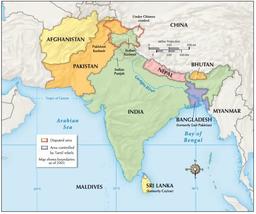
Independent Nations of South Asia
Quiz by Scott Hoskins
Customize this quiz to suit your class
Instantly translate to 100+ languages
Tag the questions with any skills you have. Your dashboard will track each student's mastery of each skill.
Give this quiz to my class
 Yaama I'm Jack Evans and you're watching BTN. Here's what's coming up. We uncover the story behind this famous photo, learn about First Nations seasons and find out the history of Book Week. What is Statehood? Reporter: Tatenda Chibika INTRO: But first, the Prime Minister Anthony Albanese has announced that Australia will join other countries in recognising Palestine as an independent state. So, what does that mean? Tatenda found out. Anthony Albanese, Prime Minister: Australia will recognise the state of Palestine. Australia will recognise the right of the Palestinian people to a state of their own. We will work with the international community to make this right a reality. Tatenda Chibika, Reporter: That's the moment our Prime Minister said Australia would recognise Palestine as an independent state at the upcoming United Nations General assembly next month. It's something other countries, including France and Canada, have said they'll be doing too. So, what does that mean exactly? To be considered an independent state under international law a place needs to have its own land or territories with defined borders, it needs to have people who permanently live there, have a working government and it has to be able to talk and make deals with other countries. Once a place meets all those rules, it can ask to be recognised by other independent states and countries. But a big step in becoming an independent state is being fully recognised by the United Nations. To do that you first need to get approval from at least nine members of the UN's Security Council. That's a group of countries responsible for maintaining international peace and security. But even then, that tick of approval can still be blocked by one of the Security Council's five permanent members Russia, China, the UK, the US and France. If the Security Council approves, the decision then goes to the UN's General Assembly where at least two thirds of the UN's 193 members have to agree to make it official. Yeah, it's a pretty complex process which is why we've only seen a handful of countries recognised by the UN in recent years like South Sudan and Montenegro. Others like Kosovo are only 'partially' recognised which means they have some recognition but not enough to become a full member state at the UN. Right now, Palestine is recognised by more than 140 countries — that's more than two thirds of the UN General Assembly. So, why hasn't it become a UN member state yet? Well, it came pretty close last year when 12 members of the Security Council voted in favour of it. VANESSA FRAZIER, AMBASSADOR OF MALTA, APRIL 2024 UNSC PRESIDENT: I shall now put the draft resolution to the vote. But the US, a close ally to Israel, used its special powers to block Palestine from becoming a member state. VANESSA FRAZIER: Those against? At the time, the U.S said Palestine and Israel needed to come to an agreement on their own first. Throughout the years, there have been attempts to figure out a way for both Palestine and Israel to exist peacefully alongside each other but that hasn't happened yet. And now Israel has said that recognising Palestine as an independent state would be rewarding Hamas the group in charge of Gaza which was responsible for the terror attacks on October 7th, 2023. But the Palestinian Authority which governs parts of the West Bank says Hamas won't have a role in any future state of Palestine which will exist peacefully alongside Israel. Australia, like the US, had previously said that it wanted Israel and Palestine to figure out things by themselves first but because of how the war has been going the Australian government is worried that if it continues to wait, there might not be a Palestinian state to recognise. ANTHONY ALBANESE, PRIME MINISTER: There has been too many lives lost, both Israeli's and Palestinians and the world is saying we need a solution to this conflict, we need to end the cycle of violence and the way to do that is to have a two-state solution. News Quiz Russia's President Vladimir Putin stepped foot on American Soil for the first time in a decade to meet with US President Donald Trump. What state did they meet in? Alabama, Alaska or Arizona?It's Alaska. The two leaders met to discuss a way to end the war in Ukraine but weren't able to make any final agreements. DONALD TRUMP, US PRESIDENT: There were many, many points that we agreed on. Most of them, I would say, a couple of big ones, that we haven't quite got there, but we've made some headway. There's no deal until there's a deal. A lot of people criticised the two world leaders for not including Ukraine's president Volodymyr Zelenskyy in the meeting. But that didn't seem to worry Mr Trump who said the meeting was a success and Mr Putin even invited the US President to meet up again in Russia. DONALD TRUMP: We'll see you again very soon. Thank you very much, Vladimir. VLADIMIR PUTIN, RUSSIAN PRESIDENT: Next time in Moscow. DONALD TRUMP: Oh, that's an interesting one. No, no, no. I'll get a little heat on that one. Last week thousands of people marked the 80th anniversary of VJ Day. What does VJ Day commemorate? The victory of Allied forces in Europe, the surrender of Japan and the end of World War II or the dropping of the first atomic bomb? VJ Day or Victory over Japan day commemorates the surrender of Japan and the end of World War II on the 15th of August 1945. Around the world, and here in Australia, people marked the anniversary with ceremonies remembering those who fought in the war. REPORTER: Who will you be remembering today? VETERAN: Oh, a lot of fellows that I knew that never made it home. Scientists in the UK have created toothpaste that includes which of these ingredients? Hair, eye lashes or fingernails? Yeah, they're all a bit random and gross but the answer is hair. According to scientists from King's College in London, hair could be the key to good oral health because it contains a protein called Keratin which they say when mixed with saliva forms a crystal-like protective coating similar to enamel. And Swifties rejoice because Taylor Swift has announced her 12th Studio album. It's called life of a show what? Is it show pony, show girl or show bag? It's Life of a Showgirl and it'll be released October 3rd. Vincent Lingiari Reporter: Joseph Baronio INTRO: Now to this very famous photograph. It was taken 50 years ago and depicts a really significant moment in Australian history. Joe found out about the story behind it. On the 16th of August 1975, this famous photo was taken. It shows the former Prime Minister Gough Whitlam pouring sand into the hand of Aboriginal leader Vincent Lingiari. A simple gesture that symbolised handing the land at Wave Hill in the Northern Territory back to the Gurindji people. But the journey to get there was far from simple. It started back in the 1960s. At the time, Wave Hill was the biggest cattle station in the world, controlled by British landowner Lord Vestey. The Gurindji people, who had lived on the land for generations, worked for Vestey, but they weren't paid fairly, and conditions were tough. NEWS REPORTER: The station's 100 aboriginal stockmen, with their 100 dependents, are camped in the dry bed of the Victoria River with little shade from 90-degree heat, dust and flies. Eventually, Gurindji leader Vincent Lingiari said it was time to act. VINCENT LINGIARI: I said, "What was it before Lord Vestey born and I was born?" It was blackfella country. So, on August 23rd, 1966, Mr Lingiari and his fellow Aboriginal workers went on strike. It became known as the Wave Hill Walk Off. They moved their camp away from the Wave Hill station to a sacred site called Daguragu on Wattie Creek. They wanted to set up their own cattle station, and said they wouldn't move until their land was returned to them. For years, petitions and negotiations went on between the Gurindji people, the NT Administration, and the Australian Government in Canberra. CLAPPERS: 31. 32. 33. DAVID QUINN, ABSCOL: Well, it's basic justice that their land is recognised. PROTESTORS: Equal rights! As the news spread across the country, thousands of Aussies joined the campaign, including the leader of the Labor Party, Gough Whitlam, who made this promise during his 1972 election campaign. GOUGH WHITLAM: We will legislate to give Aborigines land rights. Not just because their case is beyond argument, but because all of us as Australians are diminished, while the Aborigines are denied their rightful place in this nation. Later that year, Gough Whitlam became Prime Minister. (Song From Little Things Big Things Grow, Song by Kev Carmody and Paul Kelly, 1993) From little things big things grow,from little things big things grow… But it wasn't until 1975, 9 years after the Wave Hill Walk Off started, that he followed through with his promise. Eight years went by, eight long years of waiting'Til one day a tall stranger appeared in the landAnd he came with lawyers and he came with great ceremony GOUGH WHITLAM: I solemnly hand to you these deeds as proof in Australian law that these lands belong to the Gurindji people. And through Vincent's fingers poured a handful of sandFrom little things big things grow 50 years on, and The Wave Hill Walk Off is seen as a pivotal moment in Australia's history. It led to significant legal and social changes for First Nations people, which is something many agree is worth celebrating. First Nations Seasons Reporter: Saskia Mortarotti INTRO: Recently, Melbourne's Lord Mayor suggested ditching the four-season calendar that most of us are familiar with and adopting a six-season Wurundjeri calendar instead saying it gives a better description of what the weather's actually like there. Sas found out more about the different seasonal calendars used by First Nations people. SASKIA MORTAROTTI, REPORTER: Right now, in most of the country, it's pretty cold. COLD GIRL: Think of somewhere warm. What? It's 32 degrees in Darwin in the middle of winter? But ah, yeah. There are some places where it's, well, quite warm. Which makes you wonder whether the weather actually matches the seasons. You see, Australia is pretty big, and we have lots of different weather patterns. Which is something First Nations people have tracked for thousands of years with their own seasonal calendars. KARL WINDA TELFER, CULTURAL CREATIVE KANYANYAPILLA: Why have we got four seasons when you know that don't make any sense here. It doesn't relate to the country here. This is Karl Telfer. He's an artist and storyteller who produced the Kuri Kurru exhibition at the Museum of Discovery in Adelaide that explores the 6 different seasons of the Kaurna Meyunna. SASKIA MORTAROTTI: So, how do you know when you're in one of those six seasons? KARL WINDA TELFER: Well, there are stars that rise. So, you know, there are certain stars, like in Parnatti, for example. There's a star called Parna, and we know what that star is. So, that talks to us about, okay, the time now is going to be cold on the ground. First Nations calendars like the Kaurna one don't just tell us what's happening with the weather; they're also used to track when certain plants and animals are around. KARL WINDA TELFER: It teaches you about what plants you can, you know, what you can eat what you can't and all that what is ready certain times a year and fruit everything, bird shows you the right time to eat the fruit, perfect time, if you try and go get them the next week they're gone. Karl says we can also use these calendars to see how the environment has changed over time. KARL WINDA TELFER: Kudlilla is the season we're in now and Kudlilla that talks about like the rain but we're not having enough rain these days, well, these times. And this is due to climate and the climate changing. There are many different First Nations seasonal calendars around the country. Like Ngan'gi calendar from the Northern Territory which has 13 seasons that follow the life cycle of the native spear grass. Or the Wurundjeri Calendar in Victoria which has 6 seasons. And recently, Melbourne's Lord Mayor, Nicholas Reece, said Melbourne, or Naarm, would be better off adopting the Wurundjeri calendar because it's more in tune to what's happening with the weather. Something many, including Karl, think we should be doing right across the country. KARL WINDA TELFER: I'm talking about the English four seasons. So, this is totally different systems that we're talking about and weather patterns and currents and all sorts of different things, because it's the sea country too. So, my question is, well, why do we have that? If that doesn't work, you know? Quiz How many seasons are there in the Tiwi Island Calendar? 1, 2 or 3? It's 3, although they also have 13 minor seasons. Book Week Reporter: Wren Gillett INTRO: This week, kids across Australia have been dressing up as their favourite characters to celebrate Book Week. Wren finds out why Book Week began 80 years ago and why it's still important today for getting young Aussies into reading. STUDENT: I read an hour every night, maybe even two hours some nights. STUDENT: My favourite book series are the Harry Potter series and the Keeper of the Lost City series. STUDENT: Probably Bad Guys and Weirdo. STUDENT: I like the Amulet, I've been reading that. STUDENT: I love reading Dork Diaries and Exploding Endings. Whether it's Fantasy, mystery, history — whatever you're into. Book week is a time to celebrate, well, books. STUDENT: Me and my friends are dressing up as Inside Out. STUDENT: I was thinking SpongeBob. STUDENT: I'm dressing up as Winnie the Pooh and it's just a fun way to express what kind of books you like. And guess what, book week has actually been a thing for many, many years. WREN GILLETT, REPORTER: Once upon a time, in a land not so far away, literacy lovers noticed a problem. The year was 1945. The second World War had just ended, and kids were mainly reading books from overseas, in particular the UK. Because, at the time, there weren't many Aussie authors writing books for children. WREN GILLETT: So, a group of passionate teachers, librarians, booksellers, publishers, and book-loving volunteers, decided to create what we now know as The Children's Book Council of Australia. Familiar logo, right? Together, they launched book week, all in an effort to get Aussie kids' reading more. And it seemed to work. The 1960s saw a boom in Australian children's books being published. REPORTER: How many books do you read a week? STUDENT: Well, it really depends on the week. If there's exams, I might read only one or two. But if there's no exams and if I've got plenty of time, I might read up to five or six. WREN GILLETT: But today, it's a slightly different story. Studies show that less than one in five eight to 18-year-olds are reading in their free time, and that only one in three actually enjoy reading for fun. WREN GILLETT: Why do you reckon we're seeing this trend? STUDENT: People are getting sucked into screens and they're like spending hours just scrolling through TikTok and stuff, and they're getting so attached to it that they don't feel the need to pick up books and read them. Yeah, there's a lot of different things competing for our attention these days, but many think books are still worth our time. PETER HELLIER, AUSSIE COMEDIAN AND AUTHOR: Books are the exact opposite of boring. And if you think they're boring, I'm sorry, but you're wrong. This is Peter Hellier, he's a pretty famous Aussie comedian, actor, and the author behind these books. And he's just released another one called Detective Galileo, about a trail horse who dreams of solving crimes. PETER HELLIER: He joins the police force and quickly finds out that the horses don't actually solve the crimes, it's the police officers who solve the crime. So he promptly gets thrown out of the force and begins his own detective agency, which I'm reliably told is the only detective agency in the world run by a horse. Peter actually started writing books when he was a kid. PETER HELLIER: I started writing when I was six, seven, eight years old. In fact, I started my own publishing company called Better Books. And I would write these books, and then I would get a parent or one of my parents or teachers to type them up. And I would read them in front of the class. And, you see, each has the logo, the Better Books logo, there it is — the famous Better Books logo. WREN GILLETT: You weren't mucking around. PETER HELLIER: There all on all of them. There we go. There we go. Many, Including Peter, say there's plenty to get from a good book. They help us learn new words and phrases, get a better understanding of the world around us, and strengthen our imaginations. PETER HELLIER: Books can take you absolutely anywhere. They can take you to countries that you never dreamed about going. Countries that exist, countries that don't exist. Reading just makes the world a much bigger place. It's why for the past 80 years, schools around the country have been taking part in book week. STUDENT: Reading is a place where you can have your own world just to yourself. STUDENT: It's like watching a movie inside your head, but you can choose how it goes. STUDENT: Picking up a book is a good idea, maybe you should start with something that you're interested with and then you can start exploring from there. Quiz What is the title of the book that took out this year's Book of the year Award for younger readers? It's Laughter is the Best Endingby Maryam Master. Some other winners included I'm not really here by Gary Loneborough which took out book of the year for older readers and best picture book went to The Truck Cat, by Deborah Frenkel. Sport Australia's men's national basketball team — the Boomers — have won their third Asia Cup in a row, with an epically narrow victory over China. COMMENTATOR: It is Australia who are celebrating! China started strong, leading 25-17 at quarter time. But Aussie Xavier Cooks led a fierce comeback, shooting 30 points and collecting nine rebounds, earning him the title of MVP. And there seriously couldn't have been a tighter finish. Just as the final buzzer went off, China missed a shot that would have won them the game, leaving Australia with a 90-89 victory. COMMENTATOR: An unbelievable finish. The 2025 AFLW season kicked off last week, and so did a new trick. Yeah, 19-year-old Ash Centra from Collingwood, pulled out this move in the warm-up before their season-opener to Carlton, and since then, a lot of people have been trying to do it, with some success, kind of? FOOTY PLAYER: No, I'm not doing it on camera. But despite the epic warmup, Carlton did end up beating Collingwood by 24 points. Now, the moves from these athletes in China weren't quite so graceful but give 'em a break, okay, they're robots. For the first time ever, humanoid robots from all over the world, competed in their very own games, which featured, soccer, boxing, running, and ahh, lots of falling over. Lots. Luckily though, they did bring their own cheer squad. Young Rapper Reporter: Rylie INTRO: Finally, we're going to meet another winner of this year's Heywire competition — which asks young people in regional areas to share their stories. Rylie's going to tell us how music helped to transform his life. Check it out. Mum and I were homeless. We lived at a caravan park, in motels and tents around Warrnambool. It wasn't pretty. I'm First Nations, and I remember feeling like, my own country is failing me right now. So, we camped right along here. I remember pitching a tent right here and this was actually around the same time I started to get into music which was a good way for me to have something to look forward to. I was raised by the SoundCloud era, listening to a lot of trap music. When I was in school, I'd rap along to songs by Juice World, then I started to make my own. My first track was recorded on my phone. It was bad but a lot of fun to make. Some kids in my school heard it and shamed me. That put me off music for the next couple of years, until a friend of mine bought a microphone and encouraged me to give it another go. There was something about that mic and the energy of the crew around me that gave me confidence. It lit a fire in me. Over time, I was able to focus my flow. My songs are about escapism, living the life, being a success. I rap about stuff that takes me to a better place in my head. I'm manifesting my future. My stage name is Hundo Milli, it's short for hundreds of millions. Money's not really the end goal; it's more about having the freedom to dream big. Mum taught me to never stop believing. Even when times were tough, she kept pushing for us to get housing and eventually we did. We're some of the lucky ones. Today, I'm in a Melbourne studio recording my next single. I remember living in my tent dreaming about this very moment and now I'm here, doing what I love. Ain't nothing going to stop me. Closer Well, that's all we've got for you today, but we'll be back before you know it. In the meantime, you can head to our website, there's plenty to see and do. You can also catch Newsbreak every weeknight and there's BTN High for all you highschoolers out there. Have an awesome week and I'll see you next time. Bye.Democratic Constitution in South Africa Struggle against Apartheid • Apartheid was the name of a system of racial discrimination unique to South Africa. • This system was particularly oppressive for the blacks. → They were forbidden from living in white areas. • Since 1950, the blacks, coloured and Indians fought against the apartheid system. • The African National Congress (ANC) was the umbrella organisation that led the struggle against the policies of segregation. • In 1964, Nelson Mandela and seven other leaders were sentenced to life imprisonment in 1964 for daring to oppose the apartheid regime in his country. Towards a New Constitution • As protests and struggles against apartheid had increased, the white regime changed its policies. • After 28 years of imprisonment, Nelson Mandela released from jail. • At the midnight of 26 April 1994, democracy was adopted as a form of government in South Africa. • After two years, a constitution came out which gave to its citizens the most extensive rights available in any country. Why do we need a Constitution? • A constitution is necessary because: → It generates a degree of trust and coordination that is necessary for different kind of people to live together. → It specifies how the government will be constituted, who will have power to take which decisions. → It lays down limits on the powers of the government and tells us what the rights of the citizens are. → It expresses the aspirations of the people about creating a good society. Making of the Indian Constitution • In 1928, Motilal Nehru and eight other Congress leaders drafted a constitution for India. • In 1931, the resolution at the Karachi session of the Indian National Congress dwelt on how independent India’s constitution should look like. • Factors contributed to the making of our Constitution. → Ideals of French Revolution → The practice of parliamentary democracy in Britain → The Bill of Rights in the US → The socialist revolution in Russia The Constituent Assembly • In July 1946, Elections to the Constituent Assembly were held. → The drafting of the document called the constitution was done Constituent Assembly. → Dr. Rajendra Prasad was the Chairman of the Constituent Assembly. → In December 1946, the first meeting was held. • After the country was divided into India and Pakistan, the Constituent Assembly also got divided. • The Assembly adopted the Constitution on 26 November 1949 but it came into effect on 26 January 1950. • To mark this day we celebrate January 26 as Republic Day every year. • The Constituent Assembly worked in a systematic, open and consensual manner. → First some basic principles were decided and agreed upon. → Then a Drafting Committee chaired by Dr. B.R. Ambedkar prepared a draft constitution for discussion. → More than two thousand amendments were considered. Philosophy of the Constitution • The Constitution begins with a short statement of its basic values which is called the Preamble to the constitution. The preamble focuses on: → Justice, social, economic and political. → Liberty of thoughts, expression, belief, faith and worship. → Equality of status and of opportunity. → Fraternity assuring the dignity of the individual and the unity and integrity of the nation.Multiple choice quiz on this reading: By 1900, the United States had claimed its place as a world power through the Spanish-American War. As the new century began, the country governed subject territories in Puerto Rico, Hawaii, Guam, the Wake Islands, and the Philippines. U.S. troops also occupied Cuba. U.S. businesses reached beyond the country's borders. During the first decade of the new century, the Coca-Cola Company, Quaker Oats, AT&T, the Standard Oil Company, Du Pont, General Electric, and Ford Motor Company seized the opportunity for international sales. After finding international markets, they built factories abroad, taking advantage of lower labor costs in foreign countries. Then they asked for U.S. protection of their investments and interests. Foreign countries invested heavily in Central America. U.S. investors focused on banana plantations and mining, as well as railroads, with little money in government bonds. By 1913, U.S. investments in Central America totaled about $93 million. British investment in Central America peaked at about $115 million in 1913. About $75 million of that total represented railroad holdings, mostly in Costa Rica and Guatemala. The other $40 million was in government bonds, which were worth little or nothing. The Roosevelt Corollary to the Monroe Doctrine From its earliest days, the United States claimed a special interest in the Western Hemisphere. The Monroe Doctrine, issued in 1823, warned European powers to keep their hands off Latin America. In 1902, Britain, Germany, and Italy mounted a naval blockade of Venezuela. They wanted to force the government to repay its debts. All the countries involved eventually agreed to settle the matter by arbitration. The United States stood back and did nothing, but U.S. citizens were clearly uneasy with the appearance of European military forces in "their" hemisphere. In 1904, President Theodore Roosevelt issued a corollary to the Monroe Doctrine, saying that the United States would act as a police officer to keep order in the region. He intended both to keep European military forces out of the hemisphere and to protect U.S. and European investors, exerting whatever pressure or control on Latin American governments that might be necessary to these ends. In 1905, the Dominican Republic owed $40 million in debts to European lenders. In order to prevent the European nations from using military force to collect their debts, Roosevelt used U.S. power. The United States basically took over collection of Dominican customs taxes, declared that $20 million of the debt was unjustified, and began repayment of the rest. Building a Canal The United States needed a canal through Central America, in order to save shipping time and costs. Colombia had the best location for a canal, and the United States negotiated a deal. It would pay Colombia $10 million for a three-mile-wide strip of land and would make annual rental payments of $250,000 yearly, beginning in 1912. Colombia's Senate turned down the deal, and Roosevelt exploded in rage, calling its members "foolish and homicidal corruptionists." Roosevelt considered seizing the land for the canal by military force but soon found an easier way. The province of Panama seceded from Colombia. A U.S. gunship stood off shore, protecting the Panamanian rebels. They formed a new republic under the protection of the United States. The new country of Panama and the United States agreed on a canal treaty within days. The new treaty had similar terms except that the Canal Zone would be five miles wide, instead of three, and the United States would guarantee and maintain the independence of Panama. Revolutions While Roosevelt welcomed the revolution that separated Panama from Colombia, he opposed most other revolutionary activity. So did his successors in office, William Howard Taft and Woodrow Wilson. The U.S. presidents sent troops to put down revolutions in Nicaragua and Haiti, using U.S. military forces to set up new governments in those countries and maintaining military occupations for years. U.S. military interventions were frequent throughout the hemisphere. Dollar Diplomacy President Taft preferred using "dollar diplomacy" to control Latin American countries. In Honduras, for example, U.S.-based banana companies virtually ran the government. Taft supported expanded U.S. investment in South and Central American countries, the Caribbean, and the Far East. He ordered Secretary of State Philander Chase Knox to protect U.S. investments, sending in military troops if necessary. On the World Stage As a world power, the United States did not limit its involvement to the Western Hemisphere. In 1905, President Roosevelt brought Russia and Japan to the negotiating table to end their war over control of Korea and Manchuria. Roosevelt agreed to Japanese annexation of Korea in return for Japan giving up any claim to China, Hawaii, and the Philippines. Roosevelt won the Nobel Peace Prize for settling this dispute. In 1906, Roosevelt's negotiating powers were tested again. This time, he mediated a dispute between the Alliance powers—Germany, Austria-Hungary, and Italy—with the Entente—France, Russia, and Britain—over control of Morocco. The United States backed France and ended the dispute. No longer an upstart, the United States had taken its place as a world power alongside its former colonial ruler.Hi, I'm John Green, this is Crash Course U.S. History, and today, we're going to talk about slavery, which is not funny. 0:06 Yeah, so we put a lei on the eagle to try and cheer you up, but let's face it, this is going to be depressing. 0:10 With slavery, every time you think, like, "Aw, it couldn't have been that bad," it turns out to have been much worse. 0:14 Mr. Green, Mr. Green! But what about – 0:15 Yeah, Me from the Past, I'm going to stop you right there, because you're going to embarrass yourself. Slavery was hugely important to America. 0:20 I mean, it led to a civil war and it also lasted what, at least in U.S. history, counts as a long-ass time, from 1619 to 1865. 0:29 And yes, I know there's a 1200-year-old church in your neighborhood in Denmark, but we're not talking about Denmark! 0:35 But slavery is most important because we still struggle with its legacy. 0:38 So, yes, today's episode will probably not be funny, but it will be important. 0:42 [Theme Music] North & South economic ties 0:51 So the slave-based economy in the South is sometimes characterized as having been separate from the Market Revolution, but that's not really the case. 0:57 Without southern cotton, the North wouldn't have been able to industrialize, at least not as quickly, because cotton textiles were one of the first industrially products. 1:04 And the most important commodity in world trade by the nineteenth century, and 3/4 of the world's cotton came from the American South. 1:11 And speaking of cotton, why has no one mentioned to me that my collar has been half popped this entire episode, like I'm trying to recreate the Flying Nun's hat. 1:18 And although there were increasingly fewer slaves in the North as northern states outlawed slavery, cotton shipments overseas made northern merchants rich. 1:26 Northern bankers financed the purchase of land for plantations. 1:29 Northern insurance companies insured slaves who were, after all, considered property, and very valuable property. 1:35 And in addition to turning cotton into cloth for sale overseas, northern manufacturers sold cloth back to the South, where it was used to clothe the very slaves who had cultivated it. 1:45 But certainly the most prominent effects of the slave-based economy were seen in the South. Slave-based agriculture in the South 1:49 The profitability of slaved-based agriculture, especially King Cotton, meant that the South would remain largely agricultural and rural. 1:56 Slave states were home to a few cities, like St. Louis and Baltimore, but with the exception of New Orleans, 2:00 almost all southern urbanization took place in the upper South, further away from the large cotton plantations. 2:06 And slave-based agriculture was so profitable that it siphoned money away from other economic endeavors. 2:11 Like, there was very little industry in the South. 2:13 It produced only 10% of the nation's manufactured goods. 2:16 And, as most of the capital was being plowed into the purchase of slaves, there was very little room for technological innovation, like, for instance, railroads. 2:23 This lack of industry and railroads would eventually make the South suck at the Civil War, thankfully. 2:27 In short, slavery dominated the South, shaping it both economically and culturally, and slavery wasn't a minor aspect of American society. Popular attitudes concerning slavery 2:35 By 1860, there were four million slaves in the U.S., and in the South, they made up one third of the total population. 2:42 Although in the popular imagination, most plantations were these sprawling affairs with hundreds of slaves, 2:47 in reality, the majority of slaveholders owned five or fewer slaves. 2:51 And, of course, most white people in the South owned no slaves at all, though, if they could afford to, they would sometimes rent slaves to help with their work. 2:57 These were the so-called yeoman farmers who lived self-sufficiently, raised their own food, and purchased very little in the Market Economy. 3:04 They worked the poorest land and, as a result, were mostly pretty poor themselves. 3:08 But even they largely supported slavery, partly, perhaps, for aspirational reasons, and partly because the racism inherent to the system gave even the poorest whites legal and social status. 3:18 And southern intellectuals worked hard to encourage these ideas of white solidarity and to make the case for slavery. 3:23 Many of the founders, a bunch of whom you'll remember, held slaves, saw slavery as a necessary evil. 3:29 Jefferson once wrote, quote, "As it is, we have the wolf by the ear, and we can neither hold him, nor safely let him go. 3:37 Justice is on one scale, and self-preservation in the other." 3:41 The belief that justice and self-preservation couldn't sit on the same side of the scale was really opposed to the American idea, 3:47 and, in the end, it would make the Civil War inevitable. 3:50 But as slavery became more entrenched in these ideas of liberty and political equality were embraced by more people, 3:55 some southerners began to make the case that slavery wasn't just a necessary evil. 3:59 They argued, for instance, that slaves benefited from slavery. 4:03 Because, you know, because their masters fed them and clothed them and took care of them in their old age. 4:07 You still hear this argument today, astonishingly. 4:09 In fact, you'll probably see asshats in the comments saying that in the comments. 4:12 I will remind you, it's not cursing if you are referring to an actual ass. 4:15 This paternalism allowed masters to see themselves as benevolent and to contrast their family-oriented slavery with the cold, mercenary Capitalism of the free-labor North. 4:26 So yeah, in the face of rising criticism of slavery, some southerners began to argue that the institution was actually good for the social order. 4:33 One of the best-known proponents of this view was John C. Calhoun, who, in 1837, said this in a speech on the Senate floor: 4:40 "I hold that, in the present state of civilization, 4:43 where two races of different origin and distinguished by color and other physical differences as well as intellectual, are brought together, 4:51 the relation now existing in the slave-holding states between the two is, instead of an evil, a good. A positive good." 4:59 Now, of course, John C. Calhoun was a fringe politician, and nobody took his views particularly seriously. 5:04 Stan: Well, he was Secretary of State from 1844 to 1845. 5:07 John: Well, I mean, who really cares about the Secretary of State, Stan? 5:10 Danica: Eh, he was also Secretary of War from 1817 to 1825. 5:13 John: All right, but we don't even have a Secretary of War anymore, so... 5:16 Meredith: And he was Vice President from 1825 to 1832. 5:19 John: Oh my god, were we insane?! 5:21 We were, of course, but we justified the insanity with Biblical passages and with the examples of the Greeks and Romans, 5:28 and with outright racism, arguing that black people were inherently inferior to whites. 5:33 And that not to keep them in slavery would upset the natural order of things. 5:37 A worldview popularized millennia ago by my nemesis, Aristotle. God, I hate Aristotle. 5:42 You know what defenders of Aristotle always say? 5:44 "He was the first person to identify dolphins." 5:47 Well, ok, dolphin identifier. 5:50 Yes, that is what he should be remembered for, but he's a terrible philosopher! Lives & experiences of enslaved people 5:53 Here's the truth about slavery: 5:55 It was coerced labor that relied upon intimidation and brutality and dehumanization. 6:00 And this wasn't just a cultural system, it was a legal one. 6:03 I mean, Louisiana law proclaimed that a slave "owes his master... a respect without bounds, and an absolute obedience." 6:09 The signal feature of slaves' lives was work. 6:12 I mean, conditions and tasks varied, but all slaves labored, usually from sunup to sundown, and almost always without any pay. 6:20 Most slaves worked in agriculture on plantations, and conditions were different, depending on which crops are grown. 6:25 Like, slaves on the rice plantations of South Carolina had terrible working conditions, 6:29 but they labored under the task system, which meant that once they had completed their allotted daily work, they would have time to do other things. 6:36 But lest you imagine this is like how we have work and leisure time, bear in mind that they were owned and treated as property. 6:42 On cotton plantations, most slaves worked in gangs, usually under the control of an overseer, or another slave who was called a "driver." 6:49 This was back-breaking work done in the southern sun and humidity, and so it's not surprising that whippings – or the threat of them – were often necessary to get slaves to work. 6:58 It's easy enough to talk about the brutality of slave discipline, but it can be difficult to internalize it. 7:03 Like, you look at these pictures, but because you've seen them over and over again, they don't have the power they once might have. 7:09 The pictures can tell a story about cruelty, but they don't necessarily communicate how arbitrary it all was. 7:14 As, for example, in this story, told by a woman who was a slave as a young girl: 7:18 "[The] overseer... went to my father one morning and said, "Bob, I'm gonna whip you this morning." 7:22 Daddy said, "I ain't done nothing," and he said, "I know it, I'm going to whip you to keep you from doing nothing," 7:28 and he hit him with that cowhide – you know it would cut the blood out of you with every lick if they hit you hard." 7:33 That brutality – the whippings, the brandings, the rape – was real, and it was intentional, because, in order for slavery to function, slaves had to be dehumanized. 7:43 This enabled slaveholders to rationalize what they were doing, and it was hoped to reduce slaves to the animal property that is implied by the term "chattel slavery." 7:51 So the idea was that slaveholders wouldn't think of their slaves as human, and slaves wouldn't think of themselves as human. 7:57 But it didn't work. Let's go to the Thought Bubble. 7:59 Slaves' resistance to their dehumanization took many forms, but the primary way was by forming families. Family, love, & religion of enslaved people 8:05 Family was a refuge for slaves and a source of dignity that masters recognized and sought to stifle. 8:10 A paternalistic slave owner named Bennet H. Barrow wrote in his rules for the Highland Plantation: 8:15 "No rule that I have stated is of more importance than that relating to Negroes marrying outside of the plantation... It creates a feeling of independence." 8:23 Most slaves did marry, usually for life, and, when possible, slaves grew up in two-parent households. 8:28 Single-parent households were common, though, as a result of one parent being sold. 8:32 In the upper South, where the economy was shifting from tobacco to different, less labor-intensive cash crops, the sale of slaves was common. 8:40 Perhaps one-third of slave marriages in states like Virginia were broken up by sale. 8:45 Religion was also an important part of life in slavery. 8:47 While masters wanted their slaves to learn the parts of the Bible that talked about being happy in bondage, 8:52 slave worship tended to focus on the stories of Exodus, where Moses brought the slaves out of bondage, 8:57 or Biblical heroes, who overcame great odds, like Daniel and David. 9:01 And, although most slaves were forbidden to learn to read and write, many did anyway. And some became preachers. 9:07 Slave preachers were often very charismatic leaders, and they roused the suspicion of slave owners, and not without reason. 9:13 Two of the most important slave uprisings in the South were led by preachers. 9:16 Thanks, Thought Bubble. 9:17 Oh, it's time for the Mystery Document? Mystery Document 9:19 We're doing two set pieces in a row? All right. [buzzing noise] [music] 9:24 The rules here are simple. 9:26 I wanted to re-shoot that, but Stan said no. 9:29 I guess the author of the Mystery Document. 9:30 If I am wrong, I get shocked with the shock pen. 9:33 "Since I have been in the Queen's dominions I have been well contented, yes well contented for sure, man is as God intended he should be. 9:40 That is, all are born free and equal. 9:43 This is a wholesome law, not like the southern laws which puts man made in the image of God on level with brutes. 9:49 O, what will become of the people, and where will they stand in the day of judgment. 9:53 Would that the 5th verse of the 3rd chapter of Malachi were written as with a bar of iron, 9:59 and the point of a diamond upon every oppressor's heart that they might repent of this evil, and let the oppressed go free..." 10:06 All right, it's definitely a preacher, because only preachers have read Malachi. 10:10 Probably African American, probably not someone from the South. 10:13 I'm going to guess that it is Richard Allen, the founder of the African Methodist Episcopal Church? 10:18 [buzzing noise] DAAAH, DANG IT! 10:19 It's Joseph Taper, and Stan just pointed out to me that I should have known it was Joseph Taper because it starts out, 10:24 "Since I have been in the Queen's dominions..." 10:27 He was in Canada. He escaped slavery to Canada. The Queen's dominions! 10:31 All right, Canadians, I blame you for this, although, thank you for abolishing slavery decades before we did. 10:36 [electric sounds] AHHH! How people resisted & escaped slavery 10:37 So, the Mystery Document shows one of the primary ways that slaves resisted their oppression: by running away. 10:42 Although some slaves like Joseph Taper escaped for good by running away to northern free states, 10:47 or even to Canada, where they wouldn't have to worry about fugitive slave laws, even more slaves ran away temporarily, hiding out in the woods or the swamps, and eventually returning. 10:55 No one knows exactly how many slaves escaped to freedom, but the best estimate is that a thousand or so a year made the journey northward. 11:01 Most fugitive slaves were young men, but the most famous runaway has been hanging out behind me all day long: Harriet Tubman. 11:07 Harriet Tubman escaped to Philadelphia at the age of 29, and over the course of her life, she made about 20 trips back to Maryland to help friends and relatives make the journey north on the Underground Railroad. 11:17 But a more dramatic form of resistance to slavery was actual, armed rebellion, which was attempted. 11:22 Now, individuals sometimes took matters into their own hands and beat or even killed their white overseers or masters. 11:27 Like Bob, the guy who received the arbitrary beating, responded to it by killing his overseer with a hoe. 11:33 But that said, large-scale slave uprisings were relatively rare. 11:36 The four most famous ones all took place in a 35-year period at the beginning of the 19th century. Slave rebellions 11:41 Gabriel's Rebellion in 1800 – which we've talked about before – was discovered before he was able to carry out his plot. 11:45 Then, in 1811, a group of slaves upriver from New Orleans seized cane, knives, and guns, and marched on the city before militia stopped them. 11:52 And in 1822, Denmark Vesey, a former slave who had purchased his freedom, may have organized a plot to destroy Charleston, South Carolina. 11:59 I say "may have" because the evidence against him is disputed and comes from a trial that was not fair. 12:05 But regardless, the end result of that trial was that he was executed, as were 34 slaves. Nat Turner's Rebellion 12:09 But the most successful slave rebellion, at least in the sense that they actually killed some people, was Nat Turner's in August 1831. 12:15 Turner was a preacher, and with a group of about 80 slaves, he marched from farm to farm in South Hampton County, Virginia, 12:21 killing the inhabitants, most of whom were women and children, because the men were attending a religious revival meeting in North Carolina. 12:27 Turner and 17 other rebels were captured and executed, but not before they struck terror into the hearts of whites all across the American South. 12:34 Virginia's response was to make slavery worse, passing even harsher laws that forbade slaves from preaching, and prohibited teaching them to read. 12:42 Other slave states followed Virginia's lead and, by the 1830s, slavery had grown, if anything, more harsh. 12:47 So, this shows that large-scaled armed resistance was – Django Unchained aside – not just suicidal, but also a threat to loved ones and, really, to all slaves. How enslaved people resisted their oppression & why it matters 12:55 But, it is hugely important to emphasize that slaves did resist their oppression. 12:59 Sometimes this meant taking up arms, but usually it meant more subtle forms of resistance, 13:03 like intentional work slowdowns or sabotaging equipment, or pretending not to understand instructions. 13:08 And, most importantly, in the face of systematic legal and cultural degradation, they re-affirmed their humanity through family and through faith. 13:16 Why is this so important? 13:17 Because too often in America, we still talk about slaves as if they failed to rise up, 13:21 when, in fact, rising up would not have made life better for them or for their families. 13:26 The truth is, sometimes carving out an identity as a human being in a social order that is constantly seeking to dehumanize you, is the most powerful form of resistance. 13:34 Refusing to become the chattel that their masters believed them to be is what made slavery untenable and the Civil War inevitable, so make no mistake, slaves fought back. 13:45 And in the end, they won. I'll see you next week. Credits 13:48 Crash Course is produced and directed by Stan Muller. 13:50 The script supervisor is Meredith Danko. 13:52 Our associate producer is Danica Johnson. 13:54 The show is written by my high school history teacher Raoul Meyer and myself. 13:57 And our graphics team is Thought Cafe. 13:58 Every week, there's a new caption to the Libertage, but today's episode was so sad that we couldn't fit a Libertage in... 14:04 UNTIL NOW! [Libertage Rock Music] 14:08 Suggest Libertage caption in comments, where you can also ask questions about today's video that will be answered by our team of historians. 14:13 Thanks for watching Crash Course, and as we say in my home town, don't forget to be abolitionist.When it was his turn to speak, Adam Malik, Presidium Minister for Political Affairs and Minister for Foreign Affairs of Indonesia, recalled that about a year before, in Bangkok, at the conclusion of the peace talks between Indonesia and Malaysia, he had explored the idea of an organization such as ASEAN with his Malaysian and Thai counterparts. One of the “angry young men” in his country’s struggle for independence two decades earlier, Adam Malik was then 50 years old and one of a Presidium of five led by then General Soeharto that was steering Indonesia from the verge of economic and political chaos. He was the Presidium’s point man in Indonesia’s efforts to mend fences with its neighbors in the wake of an unfortunate policy of confrontation. During the past year, he said, the Ministers had all worked together toward the realization of the ASEAN idea, “making haste slowly, in order to build a new association for regional cooperation.” Adam Malik went on to describe Indonesia’s vision of a Southeast Asia developing into “a region which can stand on its own feet, strong enough to defend itself against any negative influence from outside the region.” Such a vision, he stressed, was not wishful thinking, if the countries of the region effectively cooperated with each other, considering their combined natural resources and manpower. He referred to differences of outlook among the member countries, but those differences, he said, would be overcome through a maximum of goodwill and understanding, faith and realism. Hard work, patience and perseverance, he added, would also be necessary. The countries of Southeast Asia should also be willing to take responsibility for whatever happens to them, according to Tun Abdul Razak, the Deputy Prime Minister of Malaysia, who spoke next. In his speech, he conjured a vision of an ASEAN that would include all the countries of Southeast Asia. Tun Abdul Razak was then concurrently his country’s Minister of Defence and Minister of National Development. It was a time when national survival was the overriding thrust of Malaysia’s relations with other nations and so as Minister of Defence, he was in charge of his country’s foreign affairs. He stressed that the countries of the region should recognize that unless they assumed their common responsibility to shape their own destiny and to prevent external intervention and interference, Southeast Asia would remain fraught with danger and tension. And unless they took decisive and collective action to prevent the eruption of intra-regional conflicts, the nations of Southeast Asia would remain susceptible to manipulation, one against another. “We the nations and peoples of Southeast Asia,” Tun Abdul Razak said, “must get together and form by ourselves a new perspective and a new framework for our region. It is important that individually and jointly we should create a deep awareness that we cannot survive for long as independent but isolated peoples unless we also think and act together and unless we prove by deeds that we belong to a family of Southeast Asian nations bound together by ties of friendship and goodwill and imbued with our own ideals and aspirations and determined to shape our own destiny”. He added that, “with the establishment of ASEAN, we have taken a firm and a bold step on that road”. For his part, S. Rajaratnam, a former Minister of Culture of multi-cultural Singapore who, at that time, served as its first Foreign Minister, noted that two decades of nationalist fervor had not fulfilled the expectations of the people of Southeast Asia for better living standards. If ASEAN would succeed, he said, then its members would have to marry national thinking with regional thinking. “We must now think at two levels,” Rajaratnam said. “We must think not only of our national interests but posit them against regional interests: that is a new way of thinking about our problems. And these are two different things and sometimes they can conflict. Secondly, we must also accept the fact, if we are really serious about it, that regional existence means painful adjustments to those practices and thinking in our respective countries. We must make these painful and difficult adjustments. If we are not going to do that, then regionalism remains a utopia.” S. Rajaratnam expressed the fear, however, that ASEAN would be misunderstood. “We are not against anything”, he said, “not against anybody”. And here he used a term that would have an ominous ring even today: balkanization. In Southeast Asia, as in Europe and any part of the world, he said, outside powers had a vested interest in the balkanization of the region. “We want to ensure,” he said, “a stable Southeast Asia, not a balkanized Southeast Asia. And those countries who are interested, genuinely interested, in the stability of Southeast Asia, the prosperity of Southeast Asia, and better economic and social conditions, will welcome small countries getting together to pool their collective resources and their collective wisdom to contribute to the peace of the world.” The goal of ASEAN, then, is to create, not to destroy. This, the Foreign Minister of Thailand, Thanat Khoman, stressed when it was his turn to speak. At a time when the Vietnam conflict was raging and American forces seemed forever entrenched in Indochina, he had foreseen their eventual withdrawal from the area and had accordingly applied himself to adjusting Thailand’s foreign policy to a reality that would only become apparent more than half a decade later. He must have had that in mind when, on that occasion, he said that the countries of Southeast Asia had no choice but to adjust to the exigencies of the time, to move toward closer cooperation and even integration. Elaborating on ASEAN objectives, he spoke of “building a new society that will be responsive to the needs of our time and efficiently equipped to bring about, for the enjoyment and the material as well as spiritual advancement of our peoples, conditions of stability and progress. Particularly what millions of men and women in our part of the world want is to erase the old and obsolete concept of domination and subjection of the past and replace it with the new spirit of give and take, of equality and partnership. More than anything else, they want to be master of their own house and to enjoy the inherent right to decide their own destiny …” While the nations of Southeast Asia prevent attempts to deprive them of their freedom and sovereignty, he said, they must first free themselves from the material impediments of ignorance, disease and hunger. Each of these nations cannot accomplish that alone, but by joining together and cooperating with those who have the same aspirations, these objectives become easier to attain. Then Thanat Khoman concluded: “What we have decided today is only a small beginning of what we hope will be a long and continuous sequence of accomplishments of which we ourselves, those who will join us later and the generations to come, can be proud. Let it be for Southeast Asia, a potentially rich region, rich in history, in spiritual as well as material resources and indeed for the whole ancient continent of Asia, the light of happiness and well-being that will shine over the uncounted millions of our struggling peoples.” The Foreign Minister of Thailand closed the inaugural session of the Association of Southeast Asian Nations by presenting each of his colleagues with a memento. Inscribed on the memento presented to the Foreign Minister of Indonesia, was the citation, “In recognition of services rendered by His Excellency Adam Malik to the ASEAN organization, the name of which was suggested by him.” And that was how ASEAN was conceived, given a name, and born. It had been barely 14 months since Thanat Khoman brought up the ASEAN idea in his conversations with his Malaysian and Indonesian colleagues. In about three more weeks, Indonesia would fully restore diplomatic relations with Malaysia, and soon after that with Singapore. That was by no means the end to intra-ASEAN disputes, for soon the Philippines and Malaysia would have a falling out on the issue of sovereignty over Sabah. Many disputes between ASEAN countries persist to this day. But all Member Countries are deeply committed to resolving their differences through peaceful means and in the spirit of mutual accommodation. Every dispute would have its proper season but it would not be allowed to get in the way of the task at hand. And at that time, the essential task was to lay the framework of regional dialogue and cooperation. The two-page Bangkok Declaration not only contains the rationale for the establishment of ASEAN and its specific objectives. It represents the organization’s modus operandi of building on small steps, voluntary, and informal arrangements towards more binding and institutionalized agreements. All the founding member states and the newer members have stood fast to the spirit of the Bangkok Declaration. Over the years, ASEAN has progressively entered into several formal and legally-binding instruments, such as the 1976 Treaty of Amity and Cooperation in Southeast Asia and the 1995 Treaty on the Southeast Asia Nuclear Weapon-Free Zone. Against the backdrop of conflict in the then Indochina, the Founding Fathers had the foresight of building a community of and for all Southeast Asian states. Thus the Bangkok Declaration promulgated that “the Association is open for participation to all States in the Southeast Asian region subscribing to the aforementioned aims, principles and purposes.” ASEAN’s inclusive outlook has paved the way for community-building not only in Southeast Asia, but also in the broader Asia Pacific region where several other inter-governmental organizations now co-exist. The original ASEAN logo presented five brown sheaves of rice stalks, one for each founding member. Beneath the sheaves is the legend “ASEAN” in blue. These are set on a field of yellow encircled by a blue border. Brown stands for strength and stability, yellow for prosperity and blue for the spirit of cordiality in which ASEAN affairs are conducted. When ASEAN celebrated its 30th Anniversary in 1997, the sheaves on the logo had increased to ten – representing all ten countries of Southeast Asia and reflecting the colors of the flags of all of them. In a very real sense, ASEAN and Southeast Asia would then be one and the same, just as the Founding Fathers had envisioned. This article is based on the first chapter of ASEAN at 30, a publication of the Association of Southeast Asian Nations in commemoration of its 30th Anniversary on 8 August 1997, written by Jamil Maidan Flores and Jun Abad.Honduras is a Central American nation bordered by Nicaragua, Guatemala, and El Salvador. The Caribbean Sea forms its northern coastline. The Pacific Ocean borders a small southern strip of land. Almanaque Nombre oficial: República de Honduras Área total: 112.090 km2 Población: 9.038.741 Ciudad capital: Tegucigalpa Moneda: lempira Lenguas: español, dialectos amerindios Early History Explorer Christopher Columbus came to Honduras in 1502 on his fourth trip to the New World. As was the case in North America, Honduras, in Central America, had been home to many native indigenous groups including the Sumu and Lenca. Some estimates suggest an indigenous population of up to 2,000,000 before the Europeans arrived. Among these indigenous groups were the Maya. Their civilization spread from the Yucatán area of Mexico to Honduras’ ancient city of Copán. Spain’s conquest of Honduras began in 1525, but it was not easy. It took until 1539 to fully conquer it. There were conflicts with the native population, who were forced into labor. Many died from disease and abuse. Others were enslaved and sent to the Caribbean islands. In addition, there were pirate attacks and in-fighting among the Spaniards. Phawat/Shutterstock Gold and silver deposits were discovered in Honduras in the 1530s, attracting more settlers. By the mid-16th century, mining was an important industry, mainly in the towns of Gracias and Comayagua. More native labor was needed, taking its toll on the dwindling indigenous population. As a solution, enslaved Africans were introduced in the 1540s. This was well before 1619, when enslaved Africans first arrived in Jamestown in the American colonies. The 17th century was filled with conflicts, primarily between the Spanish and the British. Britain wanted to establish colonies on the Caribbean coast of Honduras. They eventually seized the coast with help from the native Sambo and Miskito peoples. However, Spain later regained control. Independence In the early 1800s in Honduras, resentment toward Spain grew. One reason was that Honduras was subject to more taxes to help pay for conflicts that were happening between Spain and France. Other Spanish colonies were also increasingly resentful toward Spain. In 1776 in North America, the 13 colonies banded together to declare their independence from Britain. Similarly, Honduras joined other Central American provinces. Together, they declared independence from Spain on September 15, 1821. Honduras briefly became a part of Mexico, but in 1823, it became independent from Mexico. It then joined the United Provinces of Central America. This included other former Spanish colonies: Costa Rica, El Salvador, Guatemala, and Nicaragua. But the federation did not last, partially due to divisions in political beliefs. In 1838, Honduras declared its independence from the federation. By the early 1900s, the United States had economic interests in Honduras. American fruit corporations like the Standard Fruit Company and United Fruit Company began investing in Honduras to export bananas. To protect American investments, the United States became more involved in Honduras’ political affairs. When Nicaragua appeared to threaten the stability in Honduras, US President Taft sent forces to Honduras to protect American interests. The Great Depression caused economic havoc in the United States and elsewhere. In Honduras, this meant economic problems and political turmoil. During this time, General Tiburcio Carías Andino was elected president, in 1932. He worked to strengthen the military and pay off Honduran debt. Yet he also worked to gather and maintain his own power. He changed the constitution so that he could extend his term in office as president until 1949. His advanced age and pressure from the United States forced him to allow free elections in 1948. General Francisco Morazán In 1823, Honduras joined the United Provinces of Central America. In 1830, Tegucigalpa-born General José Francisco Morazán was elected president of the federation. He remained president until just before the federation disbanded in 1840. aalezk/Shutterstock Morazán favored liberal policies and the reduced power of the church. Morazán was a self-educated man. He recognized the importance of education and the need for schools in Honduras. He believed that girls and boys should have an equal opportunity for education. During his presidency, he tried to make improvements in education. He opened schools that were free to attend. In addition to improving education, he established a system of trial by jury. It was based on the Livingston Code, created in Louisiana. This was a set of reforms to the system of legal punishment. Today, Honduras celebrates the Day of the Honduran Soldier on October 3, Morazán’s birthday. This holiday honors Morazán for his fight for democracy, liberalism, and the nation. Modern Honduras The last half of the 20th century was a political rollercoaster. There were various coups (government takeovers), conflicts, and changing leaders. Starting in 1963, Honduras was primarily led by military governments. This continued for almost 20 years. In 1969, Honduras fought a four-day war with El Salvador. The conflict was over immigration and the shared border. Though the war was brief, the two nations didn’t sign a peace treaty until 1980. With the election of president Roberto Suazo Córdova in 1981, Honduras returned to a civilian government. In the 1980s Honduras was tangled in conflicts of Nicaragua and El Salvador, partly because of the United States. Nicaraguan Contras, who wanted to overthrow the Sandinista government in Nicaragua, were using US-approved bases in Honduras. The United States was also running training camps in Honduras for Salvadoran forces facing their own civil war. This sparked anti-American protests and a desire to reduce the US presence in Honduras. Over the next few decades, Honduras continued to experience political instability. In 2009, President Manuel Zelaya was removed from power by a military coup. People were upset because he called for a referendum to change the constitution. The international community condemned this coup. As a result, Honduras cut diplomatic ties with several countries. In 2010, the United States recognized President Porfirio Lobo Sosa as a democratically elected leader. He was followed by Juan Orlando Hernández in 2014. However, protests in 2015 called for his resignation over claims of campaign fraud. In 2017, Orlando Hernández was re-elected in a disputed election.John Adams the first Vice President and second President of the United States James Armistead black slave who served in the colonial army as a spy General Edward Braddock commander of all British forces in North America during the French and Indian War Nathan Hale "I only regret that I have but one life to lose for my country." Patrick Henry Virginian who said, "Give me liberty, or give me death!" New York City our nation's first capital Battle of Bunker Hill the first major battle in the War for Independence judicial the branch of government that interprets the law executive the branch of government that enforces the law legislative the branch of government that makes the law Articles of Confederation the first plan of government that the United States had agreed upon Bill of Rights lists the rights or freedoms the Constitution gives to Americans; written in the form of ten amendments Constitution of the U.S. plan of government our country still follows today Declaration of Independence document written by Jefferson declaring the independence of the colonies from England First Amendment gives Americans the following freedoms: religion, speech, press, and assembly Treaty of Paris document signed by England giving up the American colonies and making them officially free and independent Inauguration Day The day the President takes his oath of office Valley Forge Washington's army spent the harsh winter of 1777-1778 Second Continental Congress The decision to organize the Continental Army was made at the ??? in 1775. constitutional republic The form of government in which the people and their elected representatives are limited by a constitution patriots Those who wanted America to be free from Britain's controlAgriculture Agriculture is the main source of livelihood in every country in the region except Brunei and Singapore. Agricultural employment, however, has been declining. More than two-thirds of the workforces of Cambodia and Laos practice agriculture. As the economies of the ASEAN countries have been restructured toward growth in industry and services, there has been a corresponding decline in the proportion of the gross domestic product (GDP) derived from agriculture, most significantly in Indonesia, Malaysia, and Thailand. Agricultural output in Southeast Asia has increased significantly since 1970. There are wide variations in this growth across the region, with the greatest gains in Malaysia and Thailand and little or no increase in Cambodia, Laos, and Vietnam. Hunger and malnutrition are problems in pockets of even the most developed countries, but they have been especially serious in Cambodia because of crop failures and internal strife. The condition of the rural population everywhere is clearly related to limited access to land, the landless experiencing greater poverty and poorer health. Landlessness is perhaps most serious in the Philippines. The dominant form of agriculture in the region is wet-rice cultivation. Where conditions permit, two crops typically are planted each year. Other food crops such as corn (maize), cassava, and pulses (legumes) frequently are grown in drier areas where there is too little water for a second planting of rice. Rice production requires a reliable water supply. Thailand and the Philippines rely heavily on rain-fed systems, while Indonesia utilizes irrigation to a large extent. Irrigation or some other form of water control is especially critical in the cultivation of the high-yielding varieties (HYVs) of rice that have been introduced since the 1960s. The spread of the so-called Green Revolution—in which HYVs and chemical fertilizers and pesticides are utilized—has brought mixed results. There is little doubt that production has increased because of the higher yields of these hybrid strains and because their more rapid maturation increases the possibility of multiple annual crops. Frequently, however, poorer farmers are not able to take advantage of these strains, because of the high cost of their use. The goal of rice self-sufficiency has been difficult to achieve for most countries. A large variety of cash crops are grown for the local and export markets, both on large commercial estates and by individual growers or smallholders. Tree crops are the most important in terms of value, although the area devoted to them is limited largely to equatorial areas. Rubber and palm oil are significant in Malaysia, Indonesia, and southern Thailand, while coconuts and sugar are important in the Philippines. Other major export crops are cacao, coffee, and spices, while crops grown largely for local and regional consumption include chilies, sweet potatoes, peanuts (groundnuts), and tobacco. The cultivation of opium poppies is important in parts of Myanmar and Thailand. The emphasis on rubber and palm oil production is in response to a considerable (though fluctuating) worldwide demand for these commodities and because of a nearly continuous harvest period that provides year-round employment. Foreign corporations once dominated production, but, as the region’s countries gained independence, much of the production was nationalized. Government ownership continues to predominate, with increasing private ownership. Fishing contributes only a token amount to the GDP of Southeast Asian countries, but it is an important livelihood in certain areas and supplies a significant portion of the local diet. Marine output has gradually expanded with new technologies. The maritime nations of Thailand, Indonesia, Malaysia, and the Philippines all have globally important fishing industries. Shrimp catches are especially in demand in the world economy. Aquaculture has become increasingly important in the region, such species as shrimp, carp, and grouper being raised in excavated ponds.