Loading...

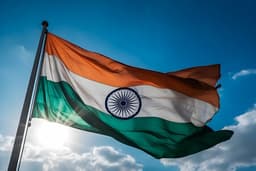
Indian Independence Day Quiz: Preliminary Round
Quiz by Tejal Shirsat
Customize this quiz to suit your class
Instantly translate to 100+ languages
Tag the questions with any skills you have. Your dashboard will track each student's mastery of each skill.
Give this quiz to my class
What is the philosophy of nonviolence called in Indian culture?
Ahimsa
Moksha
Dharma
Karma
Which of the following religions originated in India?
Islam
Buddhism
Judaism
Christianity
What is the philosophy of nonviolence called in Indian culture?
Which of the following religions originated in India?
Which of the following Indus Valley Civilization Towns is in India?
Which festival celebrates the bond between brothers and sisters, where sisters tie a protective thread on their brothers' wrists?
The dance form "Kathak" originated in which Indian state?
 Indian Independence Day QuizEE India - Independence Day - Quiz (Aug 2022) OldIndian Independence DayJohn Adams the first Vice President and second President of the United States James Armistead black slave who served in the colonial army as a spy General Edward Braddock commander of all British forces in North America during the French and Indian War Nathan Hale "I only regret that I have but one life to lose for my country." Patrick Henry Virginian who said, "Give me liberty, or give me death!" New York City our nation's first capital Battle of Bunker Hill the first major battle in the War for Independence judicial the branch of government that interprets the law executive the branch of government that enforces the law legislative the branch of government that makes the law Articles of Confederation the first plan of government that the United States had agreed upon Bill of Rights lists the rights or freedoms the Constitution gives to Americans; written in the form of ten amendments Constitution of the U.S. plan of government our country still follows today Declaration of Independence document written by Jefferson declaring the independence of the colonies from England First Amendment gives Americans the following freedoms: religion, speech, press, and assembly Treaty of Paris document signed by England giving up the American colonies and making them officially free and independent Inauguration Day The day the President takes his oath of office Valley Forge Washington's army spent the harsh winter of 1777-1778 Second Continental Congress The decision to organize the Continental Army was made at the ??? in 1775. constitutional republic The form of government in which the people and their elected representatives are limited by a constitution patriots Those who wanted America to be free from Britain's controlInfluence of China and India China ChinaChina under the Han emperor Wudi (c. 100 bce) and (inset) at the end of the Chunqiu (Spring and Autumn) Period (c. 500 bce). Between approximately 150 bce and 150 ce, most of Southeast Asia was first influenced by the more mature cultures of its neighbours to the north and west. Thus began a process that lasted for the better part of a millennium and fundamentally changed Southeast Asia. In some ways the circumstances were very different. China, concerned about increasingly powerful chiefdoms in Vietnam disturbing its trade, encroached into the region and by the end of the 1st century bce had incorporated it as a remote province of the Han empire. For generations, the Vietnamese opposed Chinese rule, but they were unable to gain their independence until 939 ce. From India, however, there is no evidence of conquests, colonization, or even extensive migration. Indians came to Southeast Asia, but they did not come to rule, and no Indian power appears to have pursued an interest in controlling a Southeast Asian power from afar, a factor that may help to explain why only the Vietnamese accepted the Chinese model. Yet, in other ways the processes of Indianization and Sinicization were remarkably similar. Southeast Asia already was socially and culturally diverse, making accommodation easy. Furthermore, indigenous peoples shaped the adaption and adoption of outside influences and, indeed, seem to have sought out concepts and practices that enhanced rather than redirected changes already underway in their own societies. They also rejected some components: for example, some of the vocabulary and general theories related to the Indian notions of social hierarchy were borrowed but much of the specific practices were not, and neither Indian nor Chinese views of women as socially and legally inferior were accepted. In the later stages of the assimilation process—particularly in the Indianized areas—local syncretism often produced exuberant variations, which, despite familiar appearances, were expressions of local genius rather than just inspired borrowings. Get Unlimited Access Try Britannica Premium for free and discover more. Sculptures at Borobudur, central Java, Indonesia. 1 of 2 Sculptures at Borobudur, central Java, Indonesia. Pagan, Myanmar 2 of 2 Pagan, MyanmarRuins of ancient Buddhist shrines and pagodas, Pagan, Myanmar. Still, Chinese and Indian influences were anything but superficial. They provided writing systems and literature, systems of statecraft, and concepts of social hierarchy and religious belief, all of which were both of intrinsic interest and pragmatic significance to Southeast Asians of the day. For elites seeking to gain and retain control over larger and more complex populations, the applications of these ideas were obvious, but it would also seem that the sheer beauty and symbolic power of Hindu and Buddhist arts tapped a responsive vein in the Southeast Asian soul. The result was an imposing array of architectural and other cultural wonders, at first very much in the Indian image and hewing close to current styles and later in more original, indigenous interpretations. The seriousness and profundity with which all this activity was undertaken is unmistakable. By the 7th century ce, Palembang in southern Sumatra was being visited by Chinese and other Buddhist devotees from throughout Asia, who came to study doctrine and to copy manuscripts in institutions that rivaled in importance those in India itself. Later, beginning in the 8th century, temple and court complexes of surpassing grandeur and beauty were constructed in central Java, Myanmar, and Cambodia; the Borobudur of the Śailendra dynasty in Java, the myriad temples of the Burman dynastic capital of Pagan, and the monuments constructed at Angkor during the Khmer empire in Cambodia rank without question among the glories of the ancient world.Democratic Constitution in South Africa Struggle against Apartheid • Apartheid was the name of a system of racial discrimination unique to South Africa. • This system was particularly oppressive for the blacks. → They were forbidden from living in white areas. • Since 1950, the blacks, coloured and Indians fought against the apartheid system. • The African National Congress (ANC) was the umbrella organisation that led the struggle against the policies of segregation. • In 1964, Nelson Mandela and seven other leaders were sentenced to life imprisonment in 1964 for daring to oppose the apartheid regime in his country. Towards a New Constitution • As protests and struggles against apartheid had increased, the white regime changed its policies. • After 28 years of imprisonment, Nelson Mandela released from jail. • At the midnight of 26 April 1994, democracy was adopted as a form of government in South Africa. • After two years, a constitution came out which gave to its citizens the most extensive rights available in any country. Why do we need a Constitution? • A constitution is necessary because: → It generates a degree of trust and coordination that is necessary for different kind of people to live together. → It specifies how the government will be constituted, who will have power to take which decisions. → It lays down limits on the powers of the government and tells us what the rights of the citizens are. → It expresses the aspirations of the people about creating a good society. Making of the Indian Constitution • In 1928, Motilal Nehru and eight other Congress leaders drafted a constitution for India. • In 1931, the resolution at the Karachi session of the Indian National Congress dwelt on how independent India’s constitution should look like. • Factors contributed to the making of our Constitution. → Ideals of French Revolution → The practice of parliamentary democracy in Britain → The Bill of Rights in the US → The socialist revolution in Russia The Constituent Assembly • In July 1946, Elections to the Constituent Assembly were held. → The drafting of the document called the constitution was done Constituent Assembly. → Dr. Rajendra Prasad was the Chairman of the Constituent Assembly. → In December 1946, the first meeting was held. • After the country was divided into India and Pakistan, the Constituent Assembly also got divided. • The Assembly adopted the Constitution on 26 November 1949 but it came into effect on 26 January 1950. • To mark this day we celebrate January 26 as Republic Day every year. • The Constituent Assembly worked in a systematic, open and consensual manner. → First some basic principles were decided and agreed upon. → Then a Drafting Committee chaired by Dr. B.R. Ambedkar prepared a draft constitution for discussion. → More than two thousand amendments were considered. Philosophy of the Constitution • The Constitution begins with a short statement of its basic values which is called the Preamble to the constitution. The preamble focuses on: → Justice, social, economic and political. → Liberty of thoughts, expression, belief, faith and worship. → Equality of status and of opportunity. → Fraternity assuring the dignity of the individual and the unity and integrity of the nation.Indian IndependenceIndian independence movement