Loading...


Jump Start 5th Grade
Quiz by Jill
Customize this quiz to suit your class
Instantly translate to 100+ languages
Tag the questions with any skills you have. Your dashboard will track each student's mastery of each skill.
Give this quiz to my class
Landon had one string that was 10 meters long. He used 6.275 meters of this string for a project.
What is the length of the string that Landon had left?
4.725 m
3.725 m
16.275 m
4.274
Herriett baked 3 cakes. She cut each cake into equal size pieces. Each piece was 1/9 of the whole cake.
What was the total number of pieces after Harriett cut these cakes?
27 pieces
9 pieces
12 pieces
3 pieces
Landon had one string that was 10 meters long. He used 6.275 meters of this string for a project.
What is the length of the string that Landon had left?
Herriett baked 3 cakes. She cut each cake into equal size pieces. Each piece was 1/9 of the whole cake.
What was the total number of pieces after Harriett cut these cakes?
Which table contains only x-values that make the equation y=4.8x true?

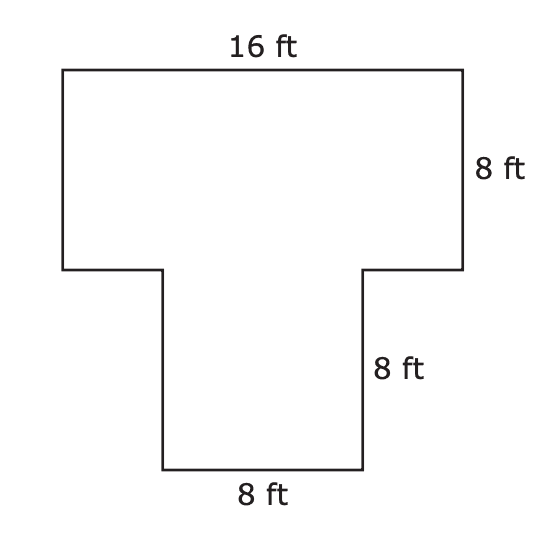
Edgar built a deck in his backyard with a section in the shape of a rectangle and a section in the shape of a square. The model shows the dimensions of the deck in feet.
What is the area of the deck Edgar built? Area = LxW
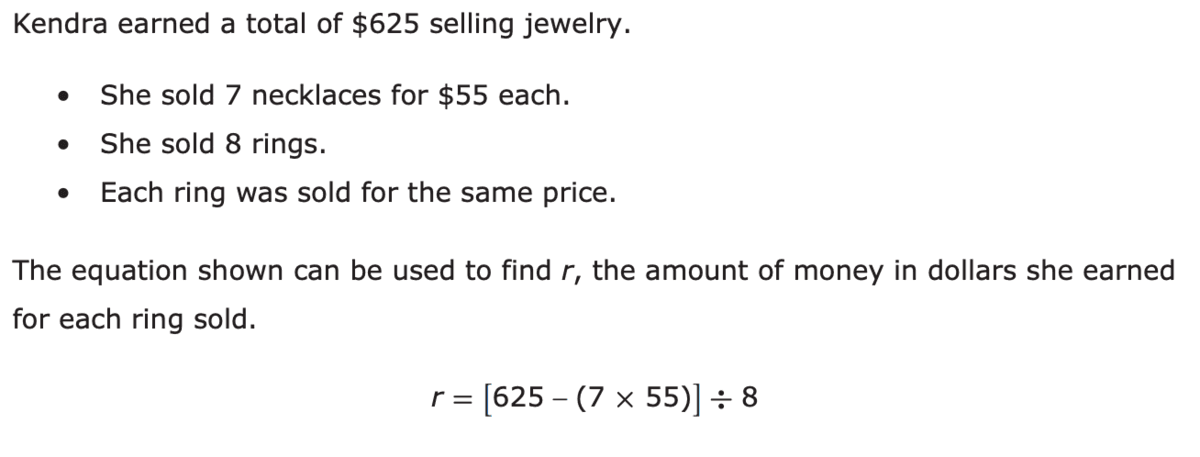
What was the amount of money in dollars Kendra earned for each ring sold?
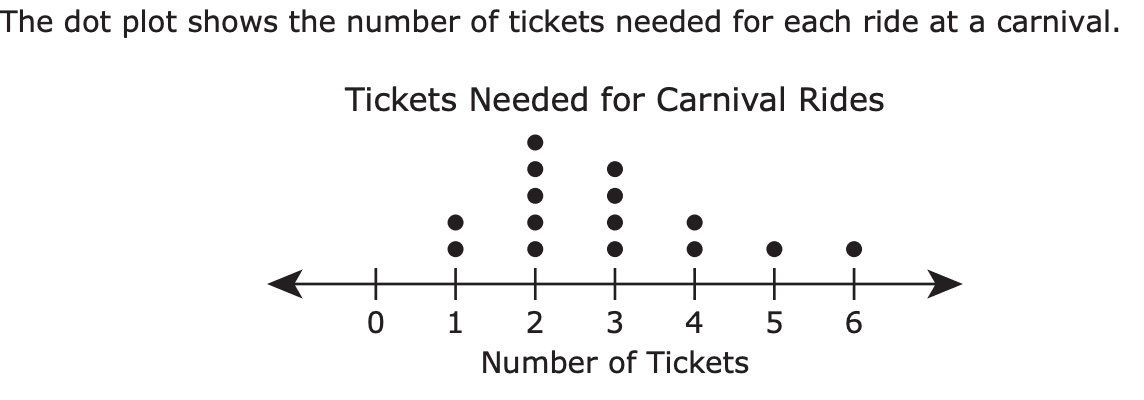
What is the difference between the number of rides that need fewer than 4 tickets and the number of rides that need 4 or more tickets?
Angelina used 1/3 of a bag of soil to fill 6 flowerpots. She filled each flowerpot with the same amount of soil.
How much soil did Angelina use to fill each flowerpot?
Fabio drinks 2 quarts of water each day. How many cups of water does Fabio drink each day?
Ms. Fitz had 2 1/4 gallons of fruit punch. She served 3/8 gallon of the fruit punch to her family at lunch.
How many gallons of fruit punch did Ms. Fritz have left after lunch?
Name: Marco Ramirez - “I Am Not Batman” TW: language It’s the middle of the night. And the sky is glowing like mad radioactive red. And if you squint, you could maybe see the moon through a thick layer of cigarette smoke and airplane exhaust that covers the entire city like mosquito net that won’t let the angels in. And if you look up high enough you could see me-standing on the edge of a eighty seven story building. And up there-a place for gargoyles and broken clock towers that have stayed still and dead for maybe like a hundred years-up there is me. And I’m freakin Batman. And I gots Bat-mobiles and Bat-a-rangs and freakin Bat-caves like for real, and all it takes is a broom closet or a back room or a fire escape and Danny’s hand-me-down jeans are gone. And my navy blue polo shirt? – The one that looks kinda good on me but has a hole on it near the butt from when it got snagged on the chain linked fence behind Arturo’s but it isn’t even a big deal cause I tuck that part in and its like all good? –that blue polo shirt? – It’s gone too. And I get like, like transformational. And nobody pulls out a belt and whips Batman for talking back –-Or for not talking back –And nobody calls Batman simple –- Or stupid –- Or skinny –- And nobody fires Batman’s brother from the Eastern Taxi Company ‘cause they was making cutbacks, neither, ‘cause they got nothing but respect, and not like afraid-respect. Just like respect-respect. ‘Cause nobody’s afraid of you. Cause Batman doesn’t mean nobody harm. Ever. Cause all Batman really wants to do is save people and maybe pay Abuela’s bills one day and die happy and maybe get like mad famous. For real.…And kill the Joker. Tonight, like most nights, I’m all alone. And I’m watching…And I’m waiting… Like a eagle. Or like a –no, yea, like a eagle. And my cape is flappin’ in the wind (‘cause it’s freakin’ long), and my pointy ears are on, and that mask that covers like half my face is on too, and I got like bulletproof stuff all in my chest so no one could hurt me and nobody – nobody – is gonna come between Batman, And Justice. From where I am I could hear everything. Somewhere in the city there’s a old lady picking Styrofoam leftovers up outta a trash can and she’s putting a piece of sesame chicken someone spit out into her own mouth. And somewhere there’s a doctor with a whack haircut in a black lab coat trying to find a cure for the diseases that are gonna make us all extinct for real one day. And somewhere there’s a man, a man in a janitor’s uniform, stumbling home drunk and dizzy after spending half his paycheck on forty-ounce bottles of twist-off beer and the other half on a four hour visit to some lady’s house on a street where the lights have all been shot out by people who’d rather do what they do, in this city, in the dark. And half a block away from JanitorMan there’s a group of good-for-nothings who don’t know no better waiting to beat JanitorMan with rusted bicycle chains and imitation Lousiville Sluggers, and if they don’t find a cent on him – which they won’t – they’ll just pound at him till the muscles in their arms start burning, till there’s no more teeth to crack out. But they don’t count on me. They don’t count on no dark night (with a stomach full of grocery store brand macaroni-and-cheese and cut up Vienna sausages), Cause they’d rather believe I don’t exist, And from eighty-seven stories up I could hear one of the good-for-nothings say “Gimmethecash” real fast (like that) just “Gimmethefuckingcash” and I see JAnitorMan mumble something in drunk language and turn pale and from eighty-seven stories up I could hear his stomach trying to hurl its way out of his Dickies. So I swoop down like and fast and I’m like darkness. I’m like SWOOSH –- And I throw a Bat-a-rang at the one naked lightbulb –- And they’re all like “whoa-motherfucker-who-just-turned-out-the-lights?” –“What’s that over there?” –-“What?” –- “Gimme whatchou got old man” –- “Did anybody hear that?!” –- “No, really” –- “There ain’t. No. Bat.” – But then –- One out of three good-for-nothings gets it to the head! And number Two swings blindly into the dark cape before him but before his fist hits anything I grab a trash can lid and –-- Right into the gut, and number One comes back with a jump-kick but I know judo-karate too so I’m like –-- Twice –-- but before I can do any more damage suddenly we all hear a CLIC – CLIC –And suddenly everything gets quiet And the one good-for-nothing left standing grips a handgun and aims straight up, like he’s holding Jesus hostage, like he’s threatening maybe to blow a hole in the moon. And the good-for-nothing who got it to the head who tried to jump-kick me and the other good-for-nothing who got it in the gut is both scrambling back away from the dark figure before him. And the drunk man the JanitorMan is huddled in a corner, praying to Saint Anthony ‘cause that’s the only one he could remember. And there’s me, Eyes glowing white, cape blowing softly in the wind. Bulletporoof chest heaving. My heart beating right through it in a Morse code for “fuck with me, just once, come on, just try.” And the one good-for-nothing left standing, the one with the handgun, he laughs he lowers his arm, and he points it at me and gives the moon a break, and he aims it right between my pointy ears, like goalposts and he’s special teams. And JanitorMan is still calling Saint Anthony but he ain’t pickin’ up, And for a second it seems like…maybe I’m gonna lose. Naw. SHOO – SHOO! FUACATA! --“Don’t kill me man!” –“SNAP! – Wrist CRACK – Neck – SLASH! – Skin – meets – acid – “AHH!!” –And he’s on the floor. And I’m standing over him. And I got the gun in MY hands now. And I hate guns, I hate holding ‘em cause I’m Batman, and –Batman don’t like guns ‘cause his parents got iced by guns a long time ago – but for just a second, my eyes glow white, and I hold this thing, for I could speak to the good-for-nothing in a language he maybe understands…CLIC – CLIC…And the good-for-nothings become good-for-disappearing into whatever toxic-waste-chemical-sludge-shit-hole they crawled out of. And it’s just me and JanitorMan. And I pick him up. And I wipe sweat and cheap perfume off his forehead. And he begs me not to hurt him and I grab him tight by his JanitorMan shirt collar and I pull him to my face, and he’s taller than me, but the cape helps so he listens when I look him straight in the eyes and I say two words to him: “Go home.” And he does, checking behind his shoulder every ten feet. And I SWOOSH from building to building on his way there, ‘cause I know where he lives. And I watch his hands where he lives. And I watch his hands tremble as he pulls out his keychain and opens the door to his building. And I’m back in bed before he even walks in through the front door. And I hear him turn on the faucet and pour himself a glass of warm tap water And he puts the glass back in the sink. And I hear his footsteps, And they get slower as they get to my room. And he creaks my door open like mad slow. And he takes a step in, which he never does. And he’s staring off into nowhere, his face the color of sidewalks in summer, and I act like I’m just waking up, and I say, “What’s up, Pop?” And JanitorMan says nothing to me. But I see, in the dark, I see his arms go limp and his head turns back, like towards me, and he lifts it for I could see his face, For I could see his eyes, And his cheeks is dripping but not with sweat. And he just stands there, breathing, like he remembers my eyes glowing white. Like he remembers my bulletproof chest. Like he remembers he’s my pop. And for a long time I don’t say nothing. And he turns around, hand on the doorknob, and he ain’t looking up my way but I hear him mumble two words to me. “I’m sorry.” And I lean over and open my window just a crack.… If you look up high enough you could see me. And from where I am? I could hear everything.In this video we take a look at the 0:02 fetch to code 0:03 execute cycle including its effect on 0:06 the various registers we've previously 0:12 [Music] 0:14 discussed a computer is defined Definition 0:17 as an electronic device that takes an 0:20 input 0:22 processes data 0:25 and delivers output 0:29 in this simple example you can see we're 0:31 taking the input 5 0:35 we're multiplying it by 2 that's our 0:37 process 0:39 and we're outputting 10. 0:44 but this could be way more complex for 0:46 example of a game console 0:48 the input could be the buttons you press 0:50 on a controller 0:53 the processes would then be carried out 0:55 by the console itself 0:59 and the output would be some form of 1:01 update to a monitor 1:02 and sound out for a speaker possibly 1:04 vibration feedback through the 1:06 controller 1:10 to process data a computer follows a set 1:13 of instructions 1:14 known as a computer program 1:18 if we take the lid off a typical desktop 1:20 computer we can identify 1:22 two critical components the memory 1:26 that stores the program and the central 1:29 processing unit or processor 1:31 which is under this large fan and 1:33 carries out the instructions 1:37 a computer carries out its function by 1:40 fetching 1:41 instructions decoding them and then 1:43 executing them 1:44 in a continuous repetitive cycle 1:46 billions of times a second 1:48 let's look at each of these stages in a 1:50 little more detail Fetch 1:53 so let's start with the fetch stage the 1:55 very first thing that happens 1:57 is the program counter is checked as it 2:00 holds the address 2:01 of the next instruction to be executed 2:07 the address stored is then copied into 2:09 the memory address register 2:14 the address is then sent along the 2:16 address bus to main memory 2:18 where it waits to receive a signal from 2:21 the control 2:22 bus so it knows what to do 2:27 as we want to read the data that's 2:29 stored in memory address 2:30 0 0 0 0 the control unit sends 2:34 a read signal along the control bus to 2:36 main memory 2:41 now main memory knows the data needs to 2:44 be read 2:45 the content stored in memory address 000 2:49 can be sent along the data bus to the 2:51 memory data register 2:56 now as we're currently in the process of 2:58 fetching an instruction 3:00 the data received by the memory data 3:03 register gets copied 3:04 into the current instruction register 3:11 the instruction effectively has now been 3:14 fetched from memory 3:16 just before we proceed to the decode 3:18 phase we now 3:19 increment the program counter so that 3:22 the address it contains 3:24 points to the address of the next 3:26 instruction which will need to be 3:30 executed 3:32 the instruction now being held in the 3:33 current instruction register 3:35 is ready to be decoded 3:39 now as we mentioned in the previous 3:41 video the instruction is made up of two 3:43 parts 3:44 we have the op code that's what it is we 3:47 need to do 3:50 and we have the operand what are we 3:53 going to do it to 3:55 now the operand could contain the actual 3:57 data 3:58 or indeed it could contain an address of 4:01 where the data is to be found 4:06 by decoding this instruction we can see 4:08 the operation we need 4:10 is a load operation so we need to load 4:14 the contents of memory location0101 4:18 into the cpus accumulator 4:25 in the exam a simple model will be used 4:27 to describe the 4:29 structure of any given instruction 4:32 you're not going to be expected to 4:34 define how an opcode is made up 4:36 but simply to interpret opcodes in the 4:39 given context of an exam 4:40 question in the example here 4:44 you can see there's a total of 16 4:46 different opcodes available 4:48 and this is because we're using four 4:50 bits for our representation 4:56 so now we've fetched the instruction and 4:59 we've decoded it so we know what we need 5:00 to do 5:01 we're finally ready to execute it 5:05 so we now send address 0101 5:08 to the memory dress register 5:13 now we're in the memory address register 5:15 we can finally send the address 5:18 down the address bus to main memory 5:24 this time we want to read the data 5:26 that's stored in memory 5:28 and so the control unit again sends a 5:30 read signal along the control bus 5:36 so main memories now receive an address 5:38 and a read signal 5:40 so the content stored at memory location 5:43 0101 5:44 can now be sent along the data bus back 5:46 to the cpu 5:47 and into the memory data register 5:54 finally the contents of the memory data 5:56 register are copied to the accumulator 5:59 and this is one of a number of general 6:00 purpose registers found in the cpu 6:04 this first instruction is now complete Branching 6:11 so what does this program actually do 6:14 you should be able to work it through 6:16 carefully and figure it out 6:19 we're now pointing instructions zero 6:21 zero zero one in the program counter 6:23 and we're ready to fetch the second 6:25 instruction 6:27 at the end of this video we're gonna 6:29 provide you with the answer 6:34 so let's talk a second about programs 6:37 that branch 6:40 on the left here we have a very simple 6:42 piece of pseudo code 6:44 line zero says first execute this line 6:46 of code 6:47 line 1 now execute this line and then 6:50 line 2 says 6:52 if the age is greater than 18 then 6:56 we're going to execute lines 3 and 4 6:58 otherwise 6:59 we're going to execute lines six and 7:02 seven 7:03 so this program doesn't necessarily 7:05 follow strictly in sequence from line 7:07 zero through to seven there's a chance 7:10 here the program may branch and jump 7:14 around 7:16 so we're going to pretend that this 7:17 program has been loaded into memory 7:20 each line of code on the left here has 7:23 ended up 7:24 as a location in memory now this is not 7:27 strictly how this would happen in this 7:28 one-to-one way 7:29 but for the purpose of example it's 7:31 absolutely fine 7:35 so the program counter starts by 7:37 pointing to memory address zero 7:39 and we fetch the first instruction 7:41 decode it and execute it 7:44 it then updates and tells us the next 7:47 instruction 7:48 is zero zero zero one because remember 7:50 the program counter is being incremented 7:52 so we fetch it decode it and we execute 7:55 line one of our program 7:59 we then fetch line two which in binary 8:01 is one 8:02 zero 8:06 now at this point depending on what 8:10 happens during the execution 8:11 of line two the program may be required 8:15 to fetch line three from memory or 8:18 line five from memory 8:25 so let's look at how this actually works 8:27 because we've said the program counter 8:28 simply gets incremented 8:31 well in the current instruction register 8:33 we have an instruction with the op code 8:36 0 1 1 0. 8:41 now when we look this up in the decode 8:43 unit we discover that this 8:45 code means branch always 8:51 this replaces the value held in the 8:54 program counter 8:56 with the contents of the operand that's 8:58 the second part of the instruction 9:01 from the current instruction register so 9:03 this case 9:04 one zero zero one 9:09 now when the next fetch cycle begins the 9:12 program counter is obviously checked 9:14 and as its contents have been previously 9:16 updated to a new memory location 9:19 and not simply incremented the program 9:22 effectively is able to jump 9:24 around memory 9:28 so having watched this video you should 9:30 be able to answer the following key 9:32 question 9:33 how does a cpu work 9:39 okay so let's um answer the question we 9:41 posed 9:42 earlier what did that program actually 9:48 do 9:50 so this is the first fetch to code 9:53 execute cycle 9:55 and this is the one that we ran through 9:57 in detail earlier 9:58 it effectively loaded the contents of 10:01 the memory 10:02 stored at location location0101 10:05 into the accumulator in other words 10:08 the dna number 3 is moved 10:11 from memory into the cpu 10:18 we then proceed onto the second fetch 10:20 decode execute cycle 10:23 now this one adds the contents of memory 10:27 located at 0 1 1 0 10:30 to the current contents of the 10:32 accumulator 10:34 so in other words the dna number one 10:38 because that's what's stored at address 10:40 zero one one zero 10:43 is added to the number three that was in 10:45 the accumulator 10:46 the results are stored back over the 10:48 accumulator 10:49 so effectively we've done three plus one 10:53 equals four 10:58 the third fetch to code execute cycle 11:00 stores the contents which are in the 11:02 accumulator 11:03 into memory location zero one one one 11:07 and that's because the op code the first 11:09 part of this current instruction 11:10 zero zero one one is the command to 11:13 store when we look it up in the decoder 11:15 unit 11:16 so in other words the result of the 11:17 previous calculation three plus one 11:19 equals four 11:20 is now written back into main memory 11:28 the fourth fetch decode execute cycle 11:30 outputs the contents of the accumulator 11:33 remember they were copied into main 11:34 memory but they're still held in the 11:35 accumulator 11:37 so in this simple abstraction the number 11:40 four is now 11:41 output to the user so they can see the 11:43 result of the calculation 11:49 the fifth and final fetch code execute 11:51 cycle 11:52 brings a halt to the current program 11:58 so this very simple program which has 12:01 five 12:02 fetch decode execute cycles has 12:04 performed the calculation 12:06 three plus one is then stored the result 12:09 in main memory 12:10 and displayed the result four to the 12:12 user 12:13 and in a high-level language this may 12:15 look something very similar to the 12:17 following two lines of code 12:20 sum variable equals num1 plus num2 12:24 print sum to the user 12:27 so you can start to get an appreciation 12:29 here of how the high level code you 12:32 write actually ends up being fetched 12:34 decoded 12:35 and executed inside a processor 12:38 of course your processor is doing 12:40 billions and billions of these 12:42 operations a second 12:43 which when you think about it is really 12:45 very impressive 12:52 [Music] 13:03 you. make 10 questions for a standerd of a levelThe Revolt of the Northern Earls (1569) Most people in the North remained loyal to the Catholic noble families who controlled the north and their Catholic faith. When Elizabeth came to power, she promoted ‘new men’ (Protestants) from the gentry and the powerful Catholic nobles lost their power and influence. This led them to organise the most serious rebellion of Elizabeth’s reign in 1569. Why did the Northern Earl’s revolt? The Earls had lost their power when Elizabeth became Queen (and wanted it back). They wanted Catholicism restored in England (and felt that ordinary Catholics would support it). Elizabeth was refusing to marry or to name an heir, causing uncertainty about England’s future. Mary Queen of Scots (if freed from prison) could replace Elizabeth and solve all these problems Who were the key players in the Revolt? Earl of Northumberland • A Catholic who had held an important position under Mary I. • He lost a lot of influence under Elizabeth (as she favoured Protestant gentry) • Elizabeth also took the rights to a valuable copper mine found on his lands Earl of Westmorland • From a rich Catholic family in the north Also the Duke of Norfolk’s brother in law Duke of Norfolk • England’s most senior Protestant noble, but he had very close links to old northern Catholic families, & was sympathetic to them & greedy for power. • He hated William Cecil & Robert Dudley, Earl of Leicester (Elizabeth’s favourite) who were Protestant and from the gentry • He planned to marry Mary QS, but later backed down and urged the earls to call off the rebellion. Mary also supported the plan to marry him What role did religion play? (7/10 – but only because it was linked to power) • Most northerners held onto their Catholic beliefs & although Elizabeth didn’t persecute them, they knew that she wanted their religion to gradually die out, so they supported the revolt. • In 1561 Elizabeth hired a strict Protestant as archbishop of Durham to promote Protestantism in the north, but he was unpopular & turned many northerners against the Protestant religion. What role did politics/power play? (9/10 – this was the most important cause of the revolt) • The Northern Earls lost a lot of their power/influence (even jobs/money under Elizabeth) • Northumberland was jealous of new Protestant families being given top jobs in the North • William Cecil & Robert Dudley were not from ancient noble families, but were very close to the Queen, so the northern Earls resented them getting top jobs in her Government • Elizabeth also confiscated large areas of land & the profits from their copper mines • It is possible, that had Elizabeth allowed the Catholic Northern Earls to keep their jobs, money and influence at court, they may have ‘tolerated’ her as a Protestant Queen (greedy/selfish). What role did Mary Queen of Scots and the Succession play? • Elizabeth was refusing to name an heir and it was becoming clear that she would not marry • If Mary Queen of Scots married the Duke of Norfolk, England would have an heir and England would be Catholic again. The country would be stable without people competing for power. • However, some of Elizabeth’s courtiers got worried that it might not work and that it might lead to charges of treason (punishable by death) • So by September 1569, Robert Dudley (Earl of Leicester) decided to tell Elizabeth about the plot. By this time it was much more serious than simply marrying Norfolk to Mary. • Mary QS had secretly asked Spain to send troops to help the rebellion & overthrow Elizabeth Plan for the Revolt of the Northern Earls (1569) • The Earls of Northumberland & Westmorland will raise rebel troops from their lands in the north and take control of Durham. • The rebels will then march south towards London to join with the Duke of Norfolk • 1000s of Spanish troops will land in England to support the rebel forces • The Duke of Norfolk & rebel forces will seize control of Government & overthrow Elizabeth • Mary Queen of Scots is to be freed, ready to marry the Duke of Norfolk Key Events of the Revolt • Once Elizabeth knew of the plot, Norfolk was arrested and sent to the Tower of London • The Northern Earls were worried they would be executed for their involvement and in a desperate attempt to avoid punishment, pushed ahead with the revolt • They raised an army of ordinary Catholics and took control of Durham cathedral • Catholic mass was celebrated across the north for 2 weeks. • They then headed south, to try and free Mary • Mary QSs was moved south to Coventry on the orders of Elizabeth, so she couldn’t escape • The rebellion failed as Spanish troops never arrived • Elizabeth’s friend (Earl of Sussex) had raised an army of 7,000 men to defend her throne. Results: • The rebellion was a serious threat to Elizabeth • She executed 450 rebels in the north • Northumberland was executed in 1572 & his head was put on a spike on the city gate • The Privy Council called for the Duke of Norfolk’s execution too, but Elizabeth released him. • Mary Queen of Scots was kept in prison for the next 14 years. • The failed plot also led the Pope to take action against Elizabeth • In 1570 he excommunicated Elizabeth from the Catholic Church • He also issued a Papal Bull (order) calling on all loyal Catholics to overthrow her hoping it would encourage another rebellion. • In 1571 Elizabeth called parliament to pass an Act making it treason to claim that she was not the rightful Queen and to bring in/print papal bulls in England. The Significance of the Revolt of the Northern Earls • It was the first and most serious rebellion by English Catholics against Elizabeth • Treason laws were made much harsher • It ended the influence of the powerful Catholic Earls in the North • It led to harsher treatment of Catholics, e.g. 1572 Elizabeth sent the Earl of Huntingdon (strict Protestant) to the north to carry out laws against Catholics (and suppress Catholicism). • Although Elizabeth’s brutal revenge on the rebels show how serious a threat it was, most Catholics in the north stayed loyal, but the Pope’s Papal Bull now put their loyalty in doubt There was little support for the revolt among the rest of the Catholic nobility and ordinary people. When faced with a choice between Elizabeth and their religion, most Catholics chose to support the Queen. 1569, was the last time English Catholics tried to remove Elizabeth by force. The future plots against her were always uncovered by Cecil & Walsingham, before they had a chance to get any public support. Despite this, the Northern Revolt & Papal Bull changed Elizabeth’s attitude towards Catholics who were now seen as potential traitors. From 1570, Elizabeth became less tolerant of recusants (people refusing to attend her church) & took increasingly tough measures against Catholics. The Ridolfi, Throckmorton & Babington plots • In the 1870s-80s, there were 3 Catholic plots to assassinate Elizabeth & replace her with Mary. • The plots were supported by France, Spain, the Pope and some Catholic nobles. • They reinforced the form Mary & from Catholics at home and abroad. Also the threat from Spain. The Ridolfi Plot (1571) • Ridolfi was an Italian banker living in England and a spy for the Pope. • He organised a plot to murder Eliz, marry Mary QS to the Duke of Norfolk & make her Queen. • The Pope & King Philip supported the plot & Philip told the Duke of Alba in the Netherlands to prepare 10,000 troops (but to only invade AFTER the English had overthrown Elizabeth). • The plot failed because Sir William Cecil intercepted coded letters & Norfolk was executed. • Mary was kept under closer watch. • Ridolfi was abroad when the plot was discovered and never returned to England. 1574: Catholic Priests and Priest Holes • From 1574 Catholic priests were smuggled into England to keep the religion alive. • They stayed with rich Catholic families, so Catholic families were kept under surveillance. • Catholic homes were raided – to find ‘priest holes’ where Catholic priests were hiding. • Catholic priests who were found could be hung, drawn and quartered (although not all were) • In 1581, Parliament also passed 2 new tougher laws against Catholics: • Recusants would be fined £20 (which would bankrupt most families) • Trying to convert people to Catholicism was now treason (punishable by death) The Throckmorton Plot (1583) • It aimed to assassinate Elizabeth and replace her with Mary. The French Duke of Guise (Mary’s cousin) would invade England with an army, funded by King Philip (Pope also supported it). • An Englishman, Throckmorton carried messages between Mary & Catholic plotters abroad. • Sir Walsingham (Secretary of State) uncovered the plot after his agents found the plans for the plot in Throckmorton’s house. Throckmorton confessed under torture and was executed. Significance: • The plots showed that Mary’s presence in England posed a serious threat • It also showed that France & Spain were a serious threat (& could invade) • Throckmorton’s papers showed a list of Catholic supporters in England, so the threat from English Catholics was also real • 1,000s of Catholics were imprisoned or kept under surveillance/house arrest • In 1585 another Act was passed to make helping Catholic priests punishable by death. • The Bond of Association was signed by the English nobles & gentry & forced them to promise to execute anyone who tried to overthrow the Queen. Weaknesses of the Plots The plots lacked public support & were uncovered by informers & spies before they had the chance to work King Philip was reluctant to destroy his alliance with Elizabeth (France was still a bigger rival) so is support for the plots was half-hearted, he rarely followed through on his promises to help the plotters or send an army The Babington Plot (1586) In 1586, Walsingham used his spy network to PROVE that Mary supported the Babington plot. His evidence persuaded Elizabeth to put Mary on trial & execute her for treason. • This was a plot to murder Elizabeth and put Mary on the throne • France would invade England with 60,000 men and Spain would also send an army • Babington was passing coded letters between Mary & her supporters in England & Europe. • But all of her letters were being intercepted and read by Walsingham. • Walsingham used his spies to follow every stage of the plot & had the letters decoded • One of Mary’s letters approved plans to murder the Queen and free Mary from prison • They also contained the names of 6 Catholics who planned to kill Elizabeth • They were arrested, hung, drawn and quartered for treason. • Mary had been implicated in plots before, but Elizabeth was always reluctant to execute her • But the proof found by Walsingham finally persuaded her to put Mary on trial • In October 1586, Mary was found guilty & was sentenced to death • But Elizabeth still hesitated, and did not sign the death warrant until February 1587. Significance 1) This plot was very significant because by 1585 England was effectively at war with Spain since Elizabeth had sent her army to help the Dutch Protestants fight the Spanish 2) This meant that Elizabeth’ situation was more dangerous than during previous plots. 3) Elizabeth’s government also became more determined to crush Catholicism 4) 1000s of recusants were arrested & 31 priests were executed 5) Mary’s execution removed the Catholic threat at home 6) English Catholics had no one to rally around, & lost hope of overthrowing Elizabeth 7) But Mary’s death increased the threat of a foreign invasion as England was at war with Spain and King Philip had been preparing an attack on England since 1585 8) Mary’s death made Philip even more determined to invade, Mary had left her claim to the English throne to King Philip upon her death Why was Mary Queen of Scots finally executed? 1 • A new Act in 1585 stated that in the event of Elizabeth’s assassination, Mary could be executed as long as she had been proved guilty & Walsingham had provided hard proof. 2 • Another reason was that by 1587, it was clear that Philip was planning to invade England • There were rumours that Spanish ships had landed in Wales & that Mary had escaped. This convinced Elizabeth that Mary had to be executed if she wanted to keep her throne. Walsingham’s Spy Network: • Walsingham (Secretary of State from 1573) had a network of spies all over England & abroad. He had spies in every English town, some were normal people paid to spy on neighbours. • He also had agents and spies in Spain, France, Germany and Italy • He hired mathematicians to crack written codes and people to open/seal letters secretly • He also pressured captured Catholic priests to spy on others for him in return for a pardon. • He used double agents to infiltrate Catholic networks - to help him discover traitors • But he only used torture against Catholic priests caught in England in the most serious cases • But 130 priests and 60 of their supporters were still executed during Elizabeth’s reign. Why did Relations with Spain get worse (1569-1588) • England had tried to stay on good terms with Spain, because Eliz wanted to avoid an expensive war that could lead to her being overthrown (English Catholics could support it) • But by the 1570s, Elizabeth wanted to have an empire of her own. • She also needed to make more money to defend her country and throne (by improving trade) • This religious, political and economic rivalry led to growing tensions between England & Spain Political and Religious Rivalry 1) Land abroad, gave countries wealth/power. By the 1580s, Eliz wanted an empire to rival Spain’s (especially as Spain had supported the Catholic plots against Eliz – even if it was half-hearted) 2) Religion was another cause of conflict. Philip opposed Elizabeth’s religious settlement 1559 3) Luckily for Elizabeth, in the 1550s Spain & France were competing to be the greatest European power and both wanted England as an ally against the other. 4) But from 1567, Spanish ships were sailing to the Netherlands with money for the Alba’s army 5) This alarmed English Protestants and Elizabeth’s Privy Council who put more and more pressure on her to send an army to help the Dutch Protestant rebels (in the Netherlands). Economic (commercial) Rivalry: The New World, privateers and Sir Francis Drake • Under Elizabeth, English merchants wanted to make big profits in the New World (Americas). • However, trading in the New World was difficult because of Spain’s power 1) Spain controlled most of the New World where there were huge profits to be made and anyone who wanted to trade there needed a licence from Spain (which it would not give): 2) But the Americas had valuable crops like tobacco, sugar, and also silver and gold 3) Elizabeth secretly encouraged privateers to trade illegally & raid Spanish ports & ships 4) At first Elizabeth denied responsibility for their actions, which delaye war with Spain Sir Francis Drake: Elizabeth sends Drake to rob Spanish colonies and ships (which infuriates Spain) 1) Spain’s support for the Ridolfi plot (1571) made her more willing to support Drake • In 1572 Eliz hired Drake to sail to the New World & steal £40,000 of Spanish silver • In 1577 she sent Drake back again with a secret mission to rob Spain’s colonies/ships • Drake brought back £400,000 of Spanish treasure & claimed an area of California in Elizabeth’s name (New Albion). He gave a lot of this money to Elizabeth • He boosted England’s finances at a time of growing concern over Spain’s threat • He became famous as the first Englishman to circumnavigate the globe. • Eliz knighted Drake as a reward, which infuriated Philip (as he saw Drake as a pirate) • Drake’s actions & his claim to California made it clear that England did not accept Spain’s domination of the New World. Elizabeth’s Support for the Dutch Rebels led to War with Spain (1585-88) • By the 1580s, tension between England & Spain had reached boiling point • At first, Eliz refused to send her army to help the Dutch rebels, because she wanted to avoid a war with Spain. So she tried to get the Spanish to leave the Netherlands in other INDIRECT ways: 1) By allowing Drake (& other English privateers) to attack and rob Spanish ships and colonies 2) By encouraging others (the French heir/mercenaries) to fight the Spanish in the Netherlands • In the 1570s, Elizabeth promised to marry the heir to the French throne (the Duke of Alencon) so that he would take an army to fight the Spanish in the Netherlands The Spanish Fury (1576) and the Pacification of Ghent (1576) • By 1576, the Spanish Govt in the Netherlands was bankrupt (the war was expensive) • After months without pay, Spain’s soldiers violently robbed Dutch towns in the “Spanish Fury” Spanish troops rebelling and robbing cities in the Netherlands in 1576. This united the Dutch Protestants & Catholics against Spain. They drew up the ‘Pacification of Ghent’ (demanding that): • Spanish troops leave the Netherlands • Spain allows the Dutch to rule themselves • The persecution of Dutch Protestants stops What did Elizabeth do? • Elizabeth sent £100,000 to help the Dutch rebels • In 1577 King Philip’s brother, Don Juan agreed to the rebels demands (but this was a trick) as just 6 months later Philip sent an even bigger army to attack the Dutch. • Elizabeth then hired a mercenary army of 6000 English & Scottish volunteers to help the Dutch. • But her plan backfired because the mercenaries destroyed Dutch Catholic churches, which caused the Catholics to make peace with Spain. • In 1578, her Privy Council urged Eliz to send her official army to help the Dutch, but she refused. The Dutch were disappointed & turned to France for help. The French Duke of Alencon arrived with an army to fight the Spanish, but by 1579 Spain had taken control again. • In 1580 Spain got even stronger after Philip won control of Portugal & its empire. • So Elizabeth gave the Duke of Alencon £70,000 to help him fight the Spanish • In 1582, Alencon took his army the Netherlands but failed to defeat Spain. • Elizabeth’s foreign policy in the Netherlands had failed & she had only managed to annoy Spain 1585: Why did Eliz finally decide to send her army to the Netherlands? (she lost her 2 main allies) • 1584 the Duke of Alencon died (so he could no longer fight the Spanish in the Netherlands) • 1 month later, William of Orange, the leader of the Dutch Protestant rebels was assassinated. • In 1585, Spain signed the Treaty of Joinville with France, agreeing to stamp out Protestantism in France/Europe meaning France & Spain were now allies against Protestantism • Elizabeth now felt she had no choice but to send her official army to the Netherlands • She signed the Treaty of Nonsuch with the Dutch rebels which promised them military help 1585: Robert Dudley’s campaign in the Netherlands was unsuccessful She sent 7,400 man army to the Netherlands led by Dudley. But he accepted the title of ‘Governor General’. Eliz was angry as it suggested that she had deposed King Philip so she told Dudley to resign this position. His army was defeated by the bigger Spanish Army as Eliz had not provided him with enough money to win. In 1587 Dudley resigned and returned to England. At the same time, Eliz had sent Drake to raid Spanish colonies in the New World to disrupt King Philip’s flow of money. Philip was furious and told the Pope he planned to invade England at the end of 1585. Drake singes the King of Spain’s beard 1587 • In 1587 Elizabeth ordered Drake to attack Spain’s most important port Cadiz • He destroyed 30 ships in 3 days – known as the ‘Singeing of the King of Spain’s Beard’ • He also stole lots of wood, meaning the Armada did not have quality barrels for food/water • Drake’s disruption delayed the Armada by a year (& meant that its food rotted in 1588). • This bought England more time to prepare for war. The Spanish Armada (1588) The Plan • By 1588, the Spanish Armada was ready to invade England • It had 130 ships with 8000 sailors & 18,000 soldiers • The Duke of Medina Sidonia would lead the Armada, but he had little experience at sea and didn’t want the job • The Armada would collect Parma’s army from France & sail to England under the protection of the Armada’s warships • Parma would march to London to depose Elizabeth & impose a Catholic government in England. 1) The Armada reached the English Channel The Armada set out in May 1588, but was delayed for a few weeks by bad weather In July the Armada was near England & signal fires were lit to warn Elizabeth English ships set sail to meet the Armada The Armada sailed up the channel in a crescent (half moon) formation, to use the large armed galleons to protect the weaker supply and army ships The English navy carried out a few minor raids, but did not inflict much damage Only 2 Spanish ships were lost (by accident) 2) The English attack the Spanish at Calais (with fire ships) and at Gravelines The Armada sailed up the English channel & anchored at Calais to wait for Parma’s army But Parma’s men didn't reach the coast in time (news had reached them too late) At midnight, the English sent 8 fireships into the Spanish ships causing panic They cut their anchors, broke formation & headed for the open sea (without Parma) The Spanish ships sailed to Gravelines, but bad weather stopped them returning to Calais The English attacked and the battle lasted many hours (5 Spanish ships were sunk) The rest were forced to sail away from France towards Scotland The English ships followed them to make sure they didn’t come back to collect Parma’s army 3) The Armada’s Journey back to Spain around Ireland was a disaster The Spanish called off the attack and returned to Spain around Scotland & Ireland Bad storms sank many ships and wrecked more on the Irish coast Many sailors died from starvation & disease – less than half the men made it back to Spain How did England defeat the Spanish Armada? !) Faster Ships • Years before the battle, England had started building smaller, faster ships (galleons) that could fire canon balls quicker & further than Spanish ships • Spanish ships were huge and slow to change direction. 2) Bad Planning & Communication (Spanish) • Philip’s plan to join with the Duke of Parma’s army in France was risky. • Parma had lots of small ships which took 48 hours to load, man and set sail. • It took too long (a week) for word to reach Parma that Medina was in the English Channel, by which time Medina had set sail to Calais. • Parma was not ready to set sail & the English were already ready to attack (leaving Medina with very little back up when anchored in France). 2) English Tactics were more effective • Spanish ships aimed to come alongside the English ones, jump on board & fight the enemy. But the English ships were faster & kept a safe distance. • They chased the Armada down the Channel, with heavy cannon fire, which forced the Spanish to arrive in France before Parma’s army was ready • As the Armada was waiting, the English sent fireships into the Spanish fleet. • This caused the Armada to panic, cut their anchors & sail away to the north • When the Spanish ships regrouped, the English attacked them in the Battle of Gravelines & the Armada was forced to sail north, chased by faster ships. 5) Bad Weather • Strong winds made it impossible for the Armada to return & pick up Parma’s army and storms wrecked or sunk Spanish ships as they tried to return home along the Scottish-Irish coasts. 2) Spanish Supplies • The Armada was not well supplied with food/weapons. Drake’s attack on Cadiz port in 1587 had destroyed food barrels. Delays in setting sail meant that by the time the English attacked the Armada it had been at sea for 10 weeks and had rotting food. 1000s died from starvation/disease. The consequences of the English victory? • Victory over the Spanish Armada gave Elizabeth a great propaganda victory • A new portrait was made, and a medal was made to commemorate her victory, it said “God blew and they were scattered”. • Elizabeth claimed that God was on the side of Protestantism • This led to a feeling of English pride and encouraged the Dutch rebels to renew their fight against the Spanish • The defeat of the Armada showed the strength of the English navy and gave England the confidence to trade and explore more widely at sea • Although Philip did not give up and continued the war for the rest of Elizabeth’s reign, the defeat had cost Spain dearly, both financially and in terms of its power • The Armada marked the start of a long decline in Spain’s power and fortunes. • English ships were sent on voyages of discovery and set up valuable new trade routes • By the end of Elizabeth’s reign, the navy was also trying to set up a new colony in Virginia • The English victory boosted Elizabeth’s popularity & strengthened the Protestant causeThe following days are a jumble of gunfire, digging, gobbled food, soldiers running in and out of the forest in small groups, distant explosions, stray shells, bandaged heads and unexpected lulls. On the very first day, before dawn, I am ordered into one of the newly dug trenches. I huddle there, squeezing my magic buttons and singing songs to the dog. When the fighting stops, the dog disappears, but a new companion takes his place. A strange little soldier crawls along the trench toward me. ‘Private Sasha!’ he cries. ‘I’ve been looking for you all day long!’ He’s old, like a grandfather, a dedushka. He has a black patch over one eye, a tape measure around his neck and a row of pins threaded into his sleeve. Hanging from his belt is the most enormous pair of scissors I have ever seen and I wonder if he uses them as a weapon. He doesn’t tell me his name, so in my head he becomes Dedushka. Dedushka squats, cups his hand to his ear, peers over the top of the trench and smiles. ‘It’s safe to be upright . . . for now.’ He helps me to my feet, dusts me off and commands me to stand as tall and straight as I can. Then he measures me. Everything from head to toe – even my toes! He writes numbers in a little notebook, strings his tape measure back around his neck, salutes and hurries away. It’s all very strange, and I wonder if Dedushka has been bumped on the head during the battle and is now a little bit muddled. I should have given him a hug before he left. I chase after him but stop when I’m hit by a shovelful of flying dirt. Sleepy Bear is digging a cave! ‘Are you going to hibernate?’ I ask. Sleepy Bear chuckles. ‘No, although that would be wonderful! I could do with a lo-o-o-ong sleep.’ He sighs and closes his eyes. He doesn’t open them again and I realise that he has gone to sleep. Standing up! I shake his arm, and he opens his eyes and keeps talking. ‘No, I’m not hibernating. I’m digging a little nook where I can sleep and eat. I’ll hang up my raincape as a door that can open and close so it feels just like a real home . . . except for the lice . . . and the bad smells . . . and the bombs that make the walls shake and crumble.’ He points further along the trench to where other soldiers are digging. ‘We’re all making little houses in the ground.’ ‘Like rabbits and moles,’ I say. Sleepy Bear chuckles. ‘Yes! And soldiers who need to hide from German bullets and bombs.’ He stops digging to roll a cigarette. ‘Should I be making a house?’ I ask. ‘I want to hide from German bullets and bombs, too.’ Sleepy Bear flops to the ground, lights his cigarette, closes his eyes and takes a deep puff. I wait for him to answer, but, instead, he begins to snore! I poke him in the side. He snorts and he murmurs, ‘I think someone has already built you a house, Sasha. Keep going along this beautiful village street and you are sure to find it.’ He falls asleep once more. I kiss his dusty cheek and whisper, ‘Thank you, Sleepy Bear.’ A little way along, I see Cook in a cloud of smoke. He has lit a fire, right here in the middle of the trench, and is stirring a cauldron full of kasha. He squats as he stirs. ‘What are you doing?’ I ask. ‘Cooking supper, of course!’ he cries. ‘But why are you doing it here?’ Cook points his spoon at the ground above the trenches. ‘Because if I do it up there, my pot will be filled with holes from German bullets and all of the kasha will leak out onto the ground. It’s bad enough that our supplies can’t get through German lines and there’s nothing to cook but buckwheat for kasha. But if we lost the kasha, too . . .’ ‘Hungry soldiers,’ I say. Cook nods. ‘And grumpy!’ ‘Like Boris!’ I gasp. ‘Even worse,’ warns Cook. I picture the kasha pot full of bullet holes. And then I realise that if the kasha pot were full of holes, then Cook would be, too. I wrap my arms around Cook’s neck and say, ‘I think this is a very good place for cooking our supper.’ I kiss his smoky cheek and run along. At the end of the trench, I find the biggest hole of all. It’s wide and deep and as busy as a beehive in a blossom tree. Above, a group of soldiers is rolling logs into place for a roof, while below, typewriters rattle and pencils scratch and papers flutter and voices crackle out of five different radios. Their words tangle together to tell a strange wartime fairy tale about German guns and a loving father called Stalin and a Red Army regiment that is lost in the deep, dark forest and a wicked beast called Hitler and a delivery of vegetables that was hit by a bomb and blown into a million tiny pieces too small even to make soup. In the middle of it all, wrestling with a rumpled map, his rifle still slung over his shoulder, is Major Scruff. ‘Major Scruff!’ I run and jump into his arms. ‘Is this our new home?’ ‘Yes, Sasha. I suppose it is.’ ‘Is it safe from German bullets and bombs?’ I ask. He stares at me. ‘Were you scared in the trenches today, Sasha?’ ‘No,’ I reply. ‘I had magic buttons and a dog and some songs to sing. Were you scared in the forest, Major Scruff?’ ‘Yes,’ he says. ‘Poor Major Scruff!’ I press my hand against his cheek. The dark, rough stubble is grubby with grit and his eyelids are taking a long time to open after every blink. ‘You need a shave and a nap!’ I scold. He chuckles. ‘I am too tired to shave and too busy to nap.’ I scrunch my nose while I consider his problem. ‘I know!’ I cry. ‘You nap and I will shave your whiskers. That will be two jobs tumbled into one!’ And so that’s what we do. Major Scruff slumps into a chair and snoozes while I lather his face with soapy water and shave his whiskers. The soap suds travel from his face, up into his hair and down the front of his uniform, and I have to shave his jaw and chin three times because I keep missing bits, but I finally get it all done. I am just wiping his cheeks dry when the dog appears. He licks my hand, then stretches up and licks soap suds from Major Scruff’s ear. Major Scruff wakes with a start. He feels his newly shaved face and cries, ‘Wonderful, Sasha! I feel smooth, clean, rested and ready for action.’ He ruffles my hair. ‘We must do this again tomorrow. Although next time, you might wake me with a gentle shake of the shoulder instead of licking my ear.’Dogs at Work Introduction. Dogs are friendly and smart. Dogs have natural senses. Dogs’ senses help them smell, see, and hear things. Dogs are good at doing many things that help people. Dogs can learn to do special types of work. Dogs That Help People. Some people can’t hear. A dog can listen for sounds. Some people can’t see. A dog helps them walk safely. Some people can’t move. A dog can get things for them. Some people feel sad. A dog can make them smile. Some Dogs Work Outdoors. A dog can bring home sheep that get lost. A dog can help a hunter find wild birds. Some Work Is Strange. A dog can chase geese away from airports. A dog can smell insects that harm buildings. Dogs Help Keep Us Safe. A dog can help the police solve a crime. A dog can help find out how a fire started. A dog can sniff to find out where drugs are hidden. A dog can jump in the water to help a swimmer. A dog can search for people who are lost or hurt. Conclusion. Dogs can learn many jobs that help people. A dog’s best work is to be a friend!Brainstorm Bear Sam was setting up tables in the driveway. He noticed a brown bear up a tree nearby. "Mom, there's a bear over there!" Sam called. "What if it comes down and attacks us?" asked Sam's little sister Sarah. Mrs. Miller took Sarah's hand. "We'll keep a safe distance away" she replied. "We need to get the bear down before our yard sale starts" Sam said. "We could always cancel the yard sale," Mrs. Miller said. "I put up so many signs," Sam groaned. I know we can get the bear to come down if we just brainstorm the right idea." "Like the idea you had for the squirrels?" his mom asked. Two weeks before, Sam tried to stop the squirrels from eating all the birdseed. He dug a pit around the bird feeder and ruined his mother's tulips. "This is different," Sam said. "I promised you I'd draw all my ideas first before I actually do anything." "We could move our trampoline under the tree so the bear could jump onto it," Sarah suggested. Sam drew the idea on his notepad. He pictured the bear bouncing high into the air. "I think the trampoline's too bouncy, Sarah," he said. "Mom, what would you do to get the bear out of the tree?" Sarah asked. "I'd play a really bad song from the radio," Mrs. Miller laughed. Sam drew the idea on his notepad. He imagined the bear climbing even higher in the tree to get away from the noise. "If you play a bad song the bear will never come down," Sam sighed. "Look, the bear's eating something up there," Sarah said. "He's probably found some nuts that were stashed away by squirrels," Mrs. Miller said. "I've got it!" Sam shouted. He scribbled his plan in the notepad and showed Sarah and his mom. "We can make a trail of nuts leading back to the forest," Sam said. "Let's get nuts!" Sarah yelled. "All right, let's try it," Mrs. Miller said. Everyone raced to the chestnut tree in the backyard. "We're going to get that bear out of the tree!" Sam shouted. While they were gathering the chestnuts, the bear climbed down from the tree. Sam returned just in time to see the bear disappear into the woods behind the neighbors' house. "Aw, the bear is gone!" he said. "Look on the bright side," Mrs. Miller said. "At least you can have the yard sale now," she smiled. What do an ancient Greek philosopher and a 19th century Quaker have in common with Nobel Prize-winning scientists? Although they are separated over 2,400 years of history, each of them contributed to answering the eternal question: what is stuff made of? It was around 440 BCE that Democritus first proposed that everything in the world was made up of tiny particles surrounded by empty space. And he even speculated that they vary in size and shape depending on the substance they compose. He called these particles "atomos," Greek for indivisible. His ideas were opposed by the more popular philosophers of his day. Aristotle, for instance, disagreed completely, stating instead that matter was made of four elements: earth, wind, water and fire, and most later scientists followed suit. Atoms would remain all but forgotten until 1808, when a Quaker teacher named John Dalton sought to challenge Aristotelian theory. Whereas Democritus's atomism had been purely theoretical, Dalton showed that common substances always broke down into the same elements in the same proportions. He concluded that the various compounds were combinations of atoms of different elements, each of a particular size and mass that could neither be created nor destroyed. Though he received many honors for his work, as a Quaker, Dalton lived modestly until the end of his days. Atomic theory was now accepted by the scientific community, but the next major advancement would not come until nearly a century later with the physicist J.J. Thompson's 1897 discovery of the electron. In what we might call the chocolate chip cookie model of the atom, he showed atoms as uniformly packed spheres of positive matter filled with negatively charged electrons. Thompson won a Nobel Prize in 1906 for his electron discovery, but his model of the atom didn't stick around long. This was because he happened to have some pretty smart students, including a certain Ernest Rutherford, who would become known as the father of the nuclear age. While studying the effects of X-rays on gases, Rutherford decided to investigate atoms more closely by shooting small, positively charged alpha particles at a sheet of gold foil. Under Thompson's model, the atom's thinly dispersed positive charge would not be enough to deflect the particles in any one place. The effect would have been like a bunch of tennis balls punching through a thin paper screen. But while most of the particles did pass through, some bounced right back, suggesting that the foil was more like a thick net with a very large mesh. Rutherford concluded that atoms consisted largely of empty space with just a few electrons, while most of the mass was concentrated in the center, which he termed the nucleus. The alpha particles passed through the gaps but bounced back from the dense, positively charged nucleus. But the atomic theory wasn't complete just yet. In 1913, another of Thompson's students by the name of Niels Bohr expanded on Rutherford's nuclear model. Drawing on earlier work by Max Planck and Albert Einstein he stipulated that electrons orbit the nucleus at fixed energies and distances, able to jump from one level to another, but not to exist in the space between. Bohr's planetary model took center stage, but soon, it too encountered some complications. Experiments had shown that rather than simply being discrete particles, electrons simultaneously behaved like waves, not being confined to a particular point in space. And in formulating his famous uncertainty principle, Werner Heisenberg showed it was impossible to determine both the exact position and speed of electrons as they moved around an atom. The idea that electrons cannot be pinpointed but exist within a range of possible locations gave rise to the current quantum model of the atom, a fascinating theory with a whole new set of complexities whose implications have yet to be fully grasped. Even though our understanding of atoms keeps changing, the basic fact of atoms remains, so let's celebrate the triumph of atomic theory with some fireworks. As electrons circling an atom shift between energy levels, they absorb or release energy in the form of specific wavelengths of light, resulting in all the marvelous colors we see. And we can imagine Democritus watching from somewhere, satisfied that over two millennia later, he turned out to have been right all along.Alright, Isti — here’s a longer and more detailed English version of the Isaac Newton text, still written at a level that’s accessible for Grade 4 students, but rich enough in information to meet PISA literacy expectations and EF A2-level vocabulary. I’ve kept sentences short, clear, and with explanations for new concepts so it’s easier for young learners to follow, while still including both famous facts and lesser-known stories. ⸻ Isaac Newton: The Man Who Changed the Way We See the World A Boy from a Small Village Isaac Newton was born on January 4, 1643, in Woolsthorpe, a small village in England. His life was not easy. His father died before he was born. When he was just a few months old, his mother remarried and left him to live with his grandmother. Isaac missed his parents, but he kept himself busy by making things and exploring the world around him. As a child, Isaac liked to build models and machines. He made a small windmill that could turn with the wind. He built a water clock that told the time by dripping water into a container. He even made a sundial — a clock that tells the time by using the shadow of the sun. 💡 Did you know? The sundial marks that Isaac carved as a boy can still be seen today on the wall of his old house. ⸻ School and Curiosity When Newton first went to school, he was not the top student. At first, he did not pay much attention in class. But one day, another boy teased him for not being smart. Newton decided to study hard to prove him wrong. Soon, he became the best in his class. Isaac loved asking questions. He wanted to know how and why things happened. He enjoyed watching the stars at night and thinking about how the world worked. ⸻ The Falling Apple and Gravity One of the most famous stories about Newton is the falling apple. One afternoon, Isaac sat in his mother’s garden and saw an apple drop from a tree. This made him think: “Why does the apple fall straight down? Why doesn’t it fly up into the sky?” From this question, Newton began to think about gravity — an invisible force that pulls objects toward each other. Gravity is what keeps our feet on the ground. It’s also what keeps the Moon moving around the Earth and the planets moving around the Sun. 💡 Fun fact: The apple did not hit Newton’s head. That’s just a story people made up later to make the tale more exciting. ⸻ Newton’s Three Laws of Motion Newton studied movement and wrote three important rules: 1. Objects stay still or keep moving unless something makes them change. • Example: A ball will not roll unless you push it. 2. The bigger the push, the bigger the movement. • Example: If you kick a ball harder, it will go faster and farther. 3. Every action has an equal and opposite reaction. • Example: When you jump off a boat, the boat moves backward as you move forward. These three laws are still used today to understand how cars, rockets, and even roller coasters work. ⸻ Discoveries in Light and Color Newton also studied light. He found that white light is not just one color — it is made of many colors. He used a glass prism to split sunlight into a rainbow. This helped scientists understand how colors work. ⸻ Inventions and New Ideas Newton made a special telescope that used mirrors instead of lenses. This type of telescope made images of planets and stars much clearer. It is still called the Newtonian telescope today. He also worked in mathematics and helped create a new type of math called calculus, which is used to study changes and movement. ⸻ Strange Experiments Newton was so curious that he sometimes tested ideas on himself. Once, he put a thin needle, called a bodkin, beside his eye to see how it would change his vision. It was very dangerous, but luckily he did not go blind. 💡 Did you know? Newton also studied alchemy — an old kind of science where people tried to turn metal into gold. He never succeeded, but it showed how wide his interests were. ⸻ Later Life and Work At the age of 27, Newton became a professor at Cambridge University. He later worked for the Royal Mint, making sure coins were made safely and stopping people from making fake money. He was very strict, and some criminals were sent to prison because of his work. Newton never married. He spent most of his life reading, writing, and doing experiments. ⸻ The End of His Life Isaac Newton died in 1727 at the age of 84. He was buried in Westminster Abbey, a famous place in London where great people of Britain are honored. His work changed the world forever. Even today, scientists, engineers, and students still use Newton’s laws and ideas. 💬 Newton once said: “If I have seen further, it is by standing on the shoulders of giants.” This means we can make new discoveries by learning from the work of others who came before us. give 10 questions to each passage with PISA literacy standard for kid 10 years, 1. Nikola Tesla: The Man Who Dreamed of Lightning Born: July 10, 1856 Died: January 7, 1943 When Nikola Tesla was a boy in Croatia, he saw a flash of lightning and asked his mother, “Can we catch the light?” That question never left him. As he grew older, Tesla became a brilliant inventor, especially fascinated by electricity. He believed in a future where energy could be sent wirelessly through the air—like music through the radio! Tesla invented the alternating current (AC) system, which became the foundation of modern electricity. At the time, Thomas Edison promoted direct current (DC), and the two men had a fierce competition. Many laughed at Tesla's bold ideas, but he never gave up. He dreamed of wireless communication, flying machines, and even free energy for everyone. Though he died alone and poor, today the world honors his vision. Think About It: Why do you think people didn’t believe Tesla at first? What can we learn from Tesla’s courage to dream big? 2. Charles Darwin: The Man Who Studied the World’s Weirdest Creatures Born: February 12, 1809 Died: April 19, 1882 When young Charles Darwin got on a ship called HMS Beagle, he didn’t know he would change science forever. He sailed around the world for five years, collecting plants, animals, and fossils. On the Galápagos Islands, he noticed something curious: finches had different beaks depending on their island. Why? Darwin’s observations led him to write the theory of evolution by natural selection. It explained how animals adapt and survive. But his ideas shocked many people because they seemed to challenge religious beliefs. Despite the controversy, Darwin continued his work. His book On the Origin of Species changed how we see life on Earth. Think About It: Should scientists share their ideas even if they go against what others believe? How did traveling help Darwin make new discoveries? 3. Marie Curie: The Woman Who Glowed in the Dark Born: November 7, 1867 Died: July 4, 1934 Marie Curie was born in Poland at a time when girls were not allowed to study science. But that didn’t stop her. She moved to France, worked day and night, and discovered radioactivity, a powerful energy hidden inside atoms. She and her husband, Pierre Curie, found two new elements: polonium and radium. She became the first woman to win a Nobel Prize, and the only person to win in two different sciences: physics and chemistry. Even when Pierre died in an accident, Marie continued their work. Her discoveries helped doctors treat cancer—but working with radioactive materials also harmed her health. She died from radiation exposure, but her legacy lives on. Think About It: What challenges did Marie Curie face as a woman in science? Why is it important to balance discovery with safety? 4. Galileo Galilei: The Star Watcher Who Defied the Church Born: February 15, 1564 Died: January 8, 1642 Galileo loved looking at the stars. He built one of the first powerful telescopes and made stunning discoveries: mountains on the Moon, moons around Jupiter, and that the Earth orbits the Sun—not the other way around. This idea, called heliocentrism, went against the teachings of the Church. He was put on trial and forced to say he was wrong. But he wasn’t. He spent his last years under house arrest, quietly writing. Today, Galileo is called the father of modern science for daring to question what others blindly believed. Think About It: Why do you think Galileo was punished for telling the truth? Should science always follow evidence, even if it goes against powerful beliefs? 5. Isaac Newton: The Man Who Asked “Why?” When an Apple Fell Born: January 4, 1643 Died: March 31, 1727 One day, an apple fell from a tree, and Isaac Newton began to wonder: Why did it fall down, not sideways or up? This simple question led to his theory of gravity. Newton also invented calculus, described the laws of motion, and changed physics forever. But Newton wasn’t just a genius—he was curious, quiet, and often worked alone. He believed everything in nature followed rules, and it was our job to discover them. Thanks to him, we understand how planets move, how rockets launch, and why you fall when you trip. Think About It: How did Newton’s curiosity lead to great discoveries? Do you think working alone helped or hurt Newton? 6. Ada Lovelace: The First Computer Programmer Before Computers Existed Born: December 10, 1815 Died: November 27, 1852 Ada Lovelace was the daughter of the famous poet Lord Byron, but she didn’t love poetry—she loved numbers! At a time when girls were expected to sew, Ada studied mathematics. She met Charles Babbage, who designed an early computer called the Analytical Engine. Ada imagined the machine could do more than just math—it could create music, art, and even write! She wrote what is now considered the first computer program, long before real computers were built. Think About It: How did Ada imagine something that didn’t exist yet? Why do we call her a pioneer in technology? 7. Albert Einstein: The Man Who Brought Time and Space Together Born: March 14, 1879 Died: April 18, 1955 Albert Einstein wasn’t always a good student. In fact, his teachers thought he was slow. But Einstein thought deeply. He asked big questions like, “What if you could ride a beam of light?” His theories of relativity changed how we see space, time, and gravity. He also warned the world about the dangers of nuclear weapons, even though his ideas helped create them. Einstein believed science should help people, not harm them. With his messy hair, kind smile, and brilliant mind, he remains a symbol of genius. Think About It: Can someone be bad in school but still be brilliant? Should scientists be responsible for how their inventions are used? 8. Pythagoras: The Musician Who Loved Math Born: Around 570 BC Died: Around 495 BC Long ago in ancient Greece, Pythagoras believed the universe followed numbers. He discovered the Pythagorean Theorem, a rule about triangles that helps us build houses, design computers, and navigate space. He also believed that music had math inside it—that certain notes made perfect harmony because of mathematical ratios. Pythagoras started a secret school and taught his students to search for truth through numbers, shapes, and sound. Think About It: Why do you think Pythagoras saw math in everything? How does music relate to math? 9. Rosalind Franklin: The Woman Behind the DNA Discovery Born: July 25, 1920 Died: April 16, 1958 Rosalind Franklin loved looking closely at things. She used a special machine called X-ray crystallography to photograph molecules. One of her greatest photos, called Photo 51, showed the shape of DNA, the molecule that carries life’s instructions. But her work was taken without credit. Two men, Watson and Crick, used her photo to build their famous model of DNA and won the Nobel Prize. Rosalind died young and never knew how important her work became. Think About It: Why is it important to give credit in science? What can we learn from Rosalind’s quiet strength? 10. Carl Linnaeus: The Man Who Gave Names to Everything Born: May 23, 1707 Died: January 10, 1778 Have you ever wondered why a tiger is called Panthera tigris? That’s thanks to Carl Linnaeus, a Swedish scientist who created a way to name and organize every living thing. His system is still used today in biology. Linnaeus loved nature and spent his life collecting plants, animals, and even rocks. He believed that by organizing life, we could better understand it. Thanks to him, we now have a global “dictionary of nature.” Think About It: Why is it important to name and organize living things? How does order help us understand the world?