Laws of Thermodynamics
Quiz by Garrett Dyer
High School
Physics (2017)
Texas Essential Knowledge and Skills (TEKS)
Feel free to use or edit a copy
includes Teacher and Student dashboards
Measures 1 skill from
Measures 1 skill from
Track each student's skills and progress in your Mastery dashboards
With a free account, teachers can
- edit the questions
- save a copy for later
- start a class game
- automatically assign follow-up activities based on students’ scores
- assign as homework
- share a link with colleagues
- print as a bubble sheet


19 questions
Show answers
- Q1At absolute zero, all substances would be in the _____________ phase.PlasmaGasLiquidSolid60s112.39.c.6.e
- Q2Absolute zero is equal to zero in the _______________ temperature scale.KelvinFahrenheitDigitalCelsius60s112.39.c.6.e
- Q3State whether the process is accompanied by an increase or decrease in entropy for the system: A brand new deck of cards is shuffled.Entropy DecreasesNo ChangeEntropy Increases60s112.39.c.6.e
- Q4State whether the process is accompanied by an increase or decrease in entropy for the system: Dew condenses on a leaf.Entropy IncreasesNo ChangeEntropy Decreases60s112.39.c.6.e
- Q5State whether the process is accompanied by an increase or decrease in entropy for the system: A porcelain vase shatters on the ground.No ChangeEntropy IncreasesEntropy Decreases60s112.39.c.6.e
- Q6Select the law of thermodynamics that best represents the following situation: Thermal energy is transferred from a warmer object to a colder object which are in contact with each other. Eventually, after some amount of time, both objects have the same thermal energy (temperature).1st Law - Conservation of Energy2nd Law - Law of EntropyZeroth Law - Equilibrium Principle3rd Law - Temperature Principle60s112.39.c.6.e
- Q7Select the law of thermodynamics that best represents the following situation: The chemical potential energy in fuel is used to increase a car's kinetic energy.2nd Law - Law of EntropyZeroth Law - Equilibrium Principle3rd Law - Temperature Principle1st Law - Conservation of Energy60s112.39.c.6.e
- Q8Select the law of thermodynamics that best represents the following situation: An open box of books fell over and all of the books fell out of the box randomly onto the floor.1st Law - Conservation of EnergyZeroth Law - Equilibrium Principle3rd Law - Temperature Principle2nd Law - Law of Entropy60s112.39.c.6.e
- Q9What is the temperature at which kinetic energy and entropy for all atomic motion stops?-273.15 K or 0 C0 F or -273.15 K0 C or -273.15 F0 k or -273.15 C60s112.39.c.6.e
- Q10Which of the following describes a system in thermal equilibrium?A hot object and a cold object are in contact with each other.An object is heating up due to a nearby fireplace.Two objects of exactly the same temperature are in contact with each other - heat can transfer freely between them, but their temperatures are equal.Two objects of exactly the same temperature have an impenetrable heat barrier between them.60s112.39.c.6.e
- Q11By what mechanism do two objects of different temperatures reach thermal equilibrium?Heat spontaneously transfers from one place to another, regardless of temperature.None of the answers are correct; the objects never reach thermal equilibrium.Faster moving molecules in the hotter object hit the slower moving molecules in the colder object, until the heat has fully equalized.Faster moving molecules in the colder object hit the slower moving molecules in the hotter object, until heat has fully equalized.60s112.39.c.6.e
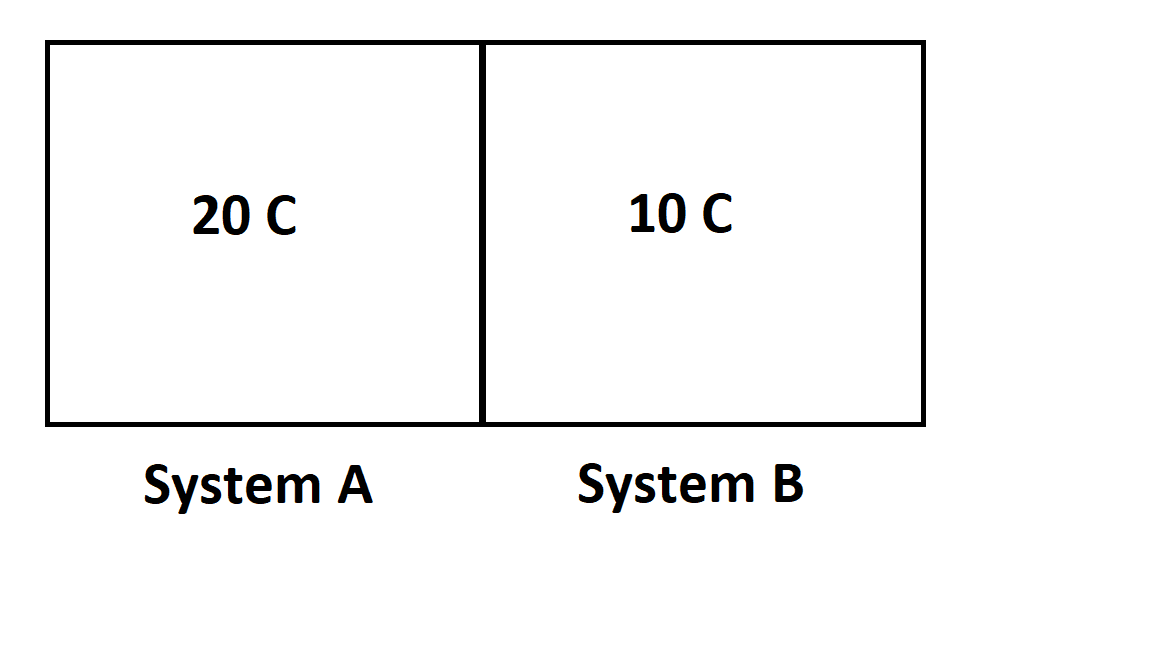
- Q12What will eventually be the equilibrium temperature for both systems?10 C20 C30 C15 C60s112.39.c.6.e
- Q13What is the definition of thermodynamics?The study of the relationship between heat, work, and energy.The energy available to do work.The amount of heat it takes to move an engine.The movement of heat.60s112.39.c.6.e
- Q14What is temperature?The measure of the average kinetic energy of particles in an object.Total energy in an object.The measure of the average potential energy of particles in an object.The measure of the kinetic energy of particles in an object.60s112.39.c.6.e
- Q15A substance with a high specific heat:Requires a lot of energy to become hot.Is heavy.Is always extremely hot.Does not require a lot of energy to become hot.60s112.39.c.6.e