Legal Speed Refresher - June 2024
Quiz by Mark Lester Diacos
Feel free to use or edit a copy
includes Teacher and Student dashboards
Measure skillsfrom any curriculum
Tag the questions with any skills you have. Your dashboard will track each student's mastery of each skill.
- edit the questions
- save a copy for later
- start a class game
- automatically assign follow-up activities based on students’ scores
- assign as homework
- share a link with colleagues
- print as a bubble sheet
- Q1
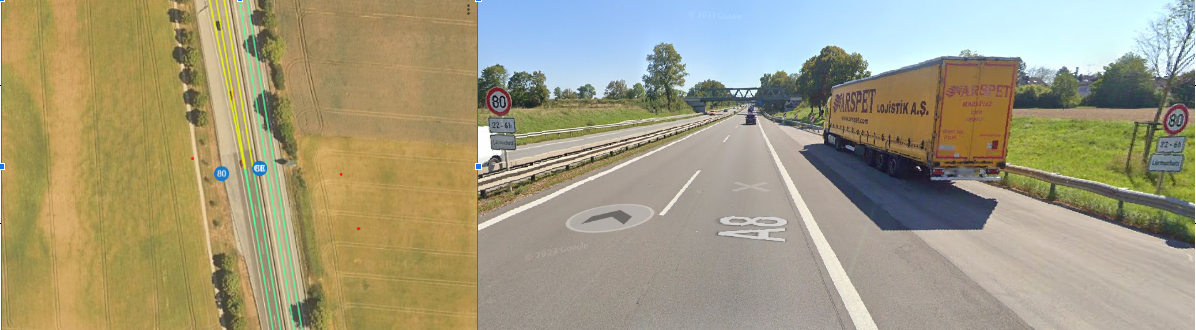
What is wrong with this image?
In this scenario, we ignore the 80 sign because it doesn't state when it takes effect.
In this scenario, we don't follow the 80 sign, which has a time stated at the bottom indicating when it takes effect.
In this scenario, we follow the 80 sign because it is appropriate for the type of road we are on.
In this scenario, we always follow the 80 sign, regardless of its time at the bottom.
30s - Q2
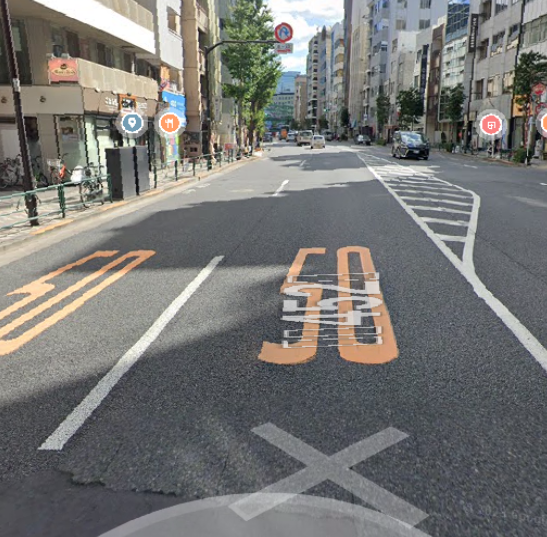
Is this a explicit sign?
truefalseTrue or False30s - Q3
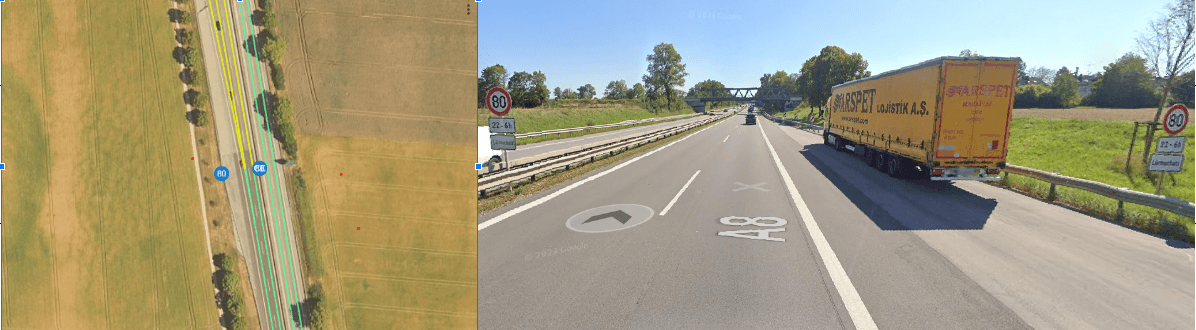
What is wrong with this image?
The 80 speed limit is not affected by the merging, so it remains the same.
The 100 speed is merging to 80. So the 100 speed will change to 80 at the end of solid
The 100 speed is incorrect because the origin of the spline is also 80.
The 80 speed is merging to 100. So the 80 speed will change to 100 at the end of solid
30s - Q4
Why is this image incorrect?
In this scenario, The speed limit changes immediately after the 'End of Residential Area' sign, so you can drive faster.
In this scenario, there's a sign "End of Residential Area" followed by another "Residential Area sign". Even though the sign comes first, you should stick to the speed suited for residential areas based on the road type. So, you don't need to change your speed just because of the sign.
In this scenario, there's a "Residential Area" sign followed by an "End of Residential Area" sign. The "End of Residential Area" sign indicates that the speed will be based on the road type. After this sign, the correct speed limit is 50 km/h urban area, as stated in LS rules in Israel.
In this scenario, "The 'End of Residential Area' sign means you must increase your speed as you approach the residential area.
30s - Q5
Why is this image incorrect?
In this scenario, The construction sign signifies a speed limit of 30 km/h so the speed needs to change.
In this scenario, The construction details are updated in GT that's why we need to follow the sign and change LS to 30 km/h.
In this scenario, The image is correct we don't follow construction sign in FPA Maps.
In this scenario, The image is incorrect; we always follow construction signs in FPA Maps.
30s - Q6
What is wrong with this image?
The tags are perfect; there are no mistakes or changes to be made.
We need to disregard the HWE and CX signs, similar to how we handle highways and motorways. The legal speed will continue until the end of the solid lane, merging with the road.
In this scenario, the map indicates that the road type changes from LS 50 to a motorway, marked with a CX sign. According to this scenario, we should use the CX sign to establish a speed limit of LS 100, and implement a secondary speed of 254 starting from the CX sign and continuing until the end of the solid lane.
CX sign is not an explicit sign; therefore, LS 50 should continue until the end of the solid lane. Starting at the HWE sign until the end of the solid lane, we will implement a secondary speed of 254.
30s - Q7
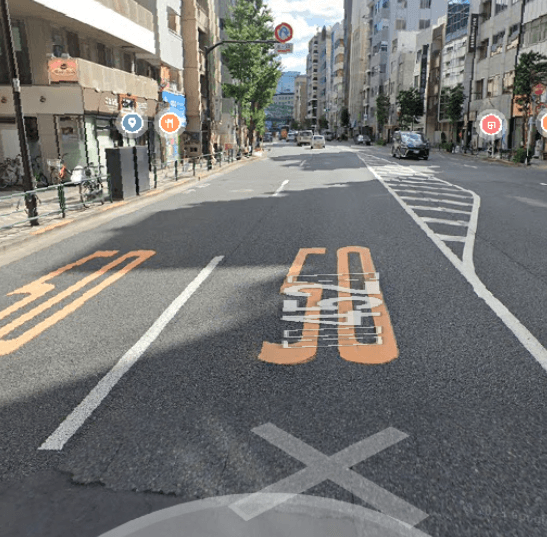
Do we need to put secondary speed on the HWE ramp when there is an explicit sign?
falsetrueTrue or False30s - Q8
Is this correctly tagged?
falsetrueTrue or False30s - Q9
Is this correctly tagged?
falsetrueTrue or False30s - Q10
Where will the end of secondary speed?
Until it merges with other lanes.
Until the next sign.
Secondary speed has no end; it's unlimited.
End of solid lane.
30s