Loading...


linked gene
Quiz by อรอุมา มุสะวะ
Customize this quiz to suit your class
Instantly translate to 100+ languages
Tag the questions with any skills you have. Your dashboard will track each student's mastery of each skill.
จากภาพ ยีนในข้อใดมีโอกาสเกิดลิงค์เกจ (Linkage) กันมากที่สุด
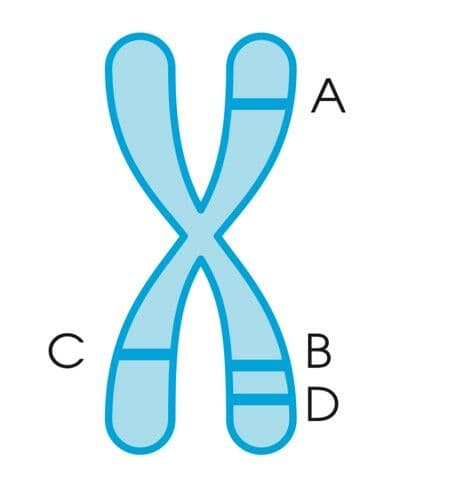
ชนิดและอัตราส่วนของเซลล์สืบพันธุ์ในข้อใด ที่สร้างจากจีโนไทป์ AaBb เมื่อมีลิงค์เกจระหว่างยีน A และยีน
จากภาพ ยีนในข้อใดมีโอกาสเกิดลิงค์เกจ (Linkage) กันมากที่สุด
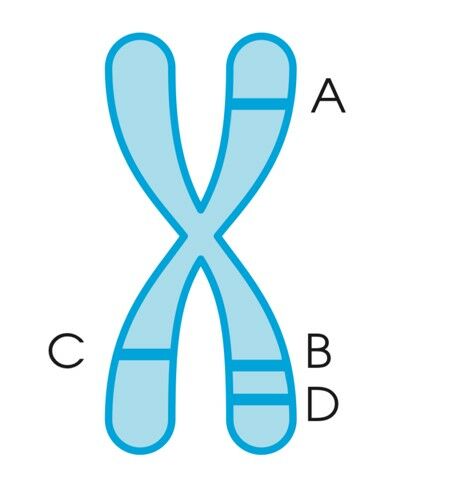
ยีน B และ C
ยีน A และ D
ยีน B และ D
ยีน A และ C
ชนิดและอัตราส่วนของเซลล์สืบพันธุ์ในข้อใด ที่สร้างจากจีโนไทป์ AaBb เมื่อมีลิงค์เกจระหว่างยีน A และยีน
AB : Ab :aB : ab เท่ากับ 1:1 : 1:1
AB : ab ไม่เท่ากับ 1:1
AB : Ab :aB : ab ไม่เท่ากับ 1:1 : 1:1
AB : ab เท่ากับ 1:1
Give this quiz to my class
 The inheritance of biological sex and sex-linked genetic disordersAllele variation of a specific gene Artificial Insemination (AI) collecting and preserving semen from sires and using artificial means to introduce it to the dam’s reproductive tract Body Cells make up the organs and tissue of an animal and have chromosomes in pairs, called diploids Clustered Regularly Interspaced Short Palindromic Repeats (CRISPR) gene editing technology Codominance heterozygous individual expresses the phenotype of both alleles simultaneously Complete Dominance heterozygous gene pair is expressed the same as a homozygous dominant gene pair Crossbreeding sire from one breed and a dam from another, with each breed excelling in a certain characteristic to benefit the producer and the offspring Deoxyribonucleic Acid (DNA) stores genetic information and acts as a blueprint for all genetic material in the organism in two strands arranged in a double helix Dominant Alleles represent a dominant phenotype and are expressed as uppercase letters Embryo Transfer eggs are collected from a desirable female, fertilized and then implanted in several other females Expected Progeny Differences (EPDs) measure of the heritability of breeding values and traits Gametes fulfill the purpose of sexual reproduction, passing on half of the genetic code in the form of sperm and ovum and are also called haploids or sex cells Genotype organism's genetic composition, which determines its heredity potential and limitations Grading Up using a purebred sire to breed grade (unregistered or commercial) females Heritability degree to which offspring resemble their parent for a particular trait Heterosis (Hybrid Vigor) ability of crossbred animals to have the best traits from each parent Heterozygosity phenomenon of inheriting a different version of an allele from each biological parent Homozygosity phenomenon of inheriting the same version of an allele from each biological parent Inbreeding breeding of closely related animals with the goal of concentrating traits from a superior individual Incomplete Dominance dominant allele does not completely overcome the recessive Law of Dominance states genes will express themselves with the dominant gene appearing in the phenotype Law of Independent Assortment states unlinked or distantly linked gene pairs separate independently of other genes Law of Segregation states paired genes must segregate equally into gametes in a way so offspring have an equal likelihood of inheriting either factor Locus place on a chromosome where a gene is found Meiosis process of cellular reproduction of gametes and results in four genetically different daughter cells Mitosis process of cellular reproduction of body cells which creates two genetically identical daughter cells Outcrossing breeding highly unrelated individuals within a breed Phenotype all the observable characteristics of an organism resulting from the interaction of its genotype with its environment Polygenic Traits controlled by many gene pairs Punnett Square graphical representation of the possible genotypes of an offspring arising from a particular breeding, using letters to represent the genes Recessive Alleles non-dominant phenotypes which can still affect the appearance of an animal, but not as commonly, and are expressed as lowercase letters Ribonucleic Acid (RNA) replicates genetic information found in DNA to build proteins in processes known as transcription and translation Simply Inherited Traits typically controlled by one gene pairMake a quiz using this information: Professional Learning Communities Despite compelling evidence indicating that working collaboratively represents best practice, teachers in many schools continue to work in isolation. Even in schools that endorse the idea of collaboration, the staff's willingness to collaborate often stops at the classroom door. Educators must stop working in isolation and hoarding their ideas, materials, and strategies and begin to work together to meet the needs of all students. Educators who are building a professional learning community recognize that they must work together to achieve their collective purpose of learning for all. Therefore, they create structures to promote a collaborative culture. The powerful collaboration that characterizes professional learning communities is a systematic process in which teachers work together to analyze and improve their classroom practice. Teachers work in teams, engaging in an ongoing cycle of questions that promote deep team learning. This process, in turn, leads to higher levels of student achievement. Collaborative conversations call on team members to make public what has traditionally been private—goals, strategies, materials, pacing, questions, concerns, and results. These discussions give every teacher someone to turn to and talk to, and they are explicitly structured to improve the classroom practice of teachers—individually and collectively.’ Each team must have time to meet during the workday and throughout the school year. Teams must focus their efforts on crucial questions related to learning and generate products that reflect that focus, such as lists of essential outcomes, different kinds of assessment, analyses of student achievement, and strategies for improving results. Teams must develop norms or protocols to clarify expectations regarding roles, responsibilities, and relationships among team members. Teams must adopt student achievement goals linked with school and district goals. Professional learning communities judge their effectiveness on the basis of results. Working together to improve student achievement becomes the routine work of everyone in the school. Every teacher team participates in an ongoing process of identifying the current level of student achievement, establishing a goal to improve the current level, working together to achieve that goal, and providing periodic evidence of progress. Example of a PLC Goal: “We will increase the percentage of students who meet the state standard in language arts from 83 percent to 90 percent” or “We will reduce the failure rate in our course by 50 percent.” The results-oriented professional learning community not only welcomes data but also turns data into useful and relevant information for staff.A. Arundhati Roy B. Jhumpa Lahiri C. Salman Rushdie D. Anita Desai ________________________________________ 2. The Lowland was published in: A. 2001 B. 2013 C. 2010 D. 2005 ________________________________________ 3. Which earlier work earned Lahiri the Pulitzer Prize? A. The Namesake B. Unaccustomed Earth C. Interpreter of Maladies D. The Lowland ________________________________________ 4. The novel is primarily about: A. Technology and modernity B. Immigration, family, and political violence C. Business rivalry D. Mythology and folklore ________________________________________ 5. The two central brothers in the novel are: A. Rahul and Anil B. Subhash and Udayan C. Gogol and Ashoke D. Amit and Nikhil ________________________________________ 6. Where did the brothers grow up? A. Mumbai B. Dhaka C. Calcutta D. Delhi ________________________________________ 7. Udayan becomes involved in: A. Peace activism B. Cinema C. Naxalite movement D. Business ________________________________________ 8. Subhash moves to: A. London B. Rhode Island C. Toronto D. Chicago ________________________________________ 9. Udayan is killed in: A. Jail B. A riot C. The lowland near his house D. A car accident ________________________________________ 10. Why does Subhash marry Gauri? A. Love B. To protect her and her unborn child C. Financial benefit D. Family pressure ________________________________________ 11. Gauri eventually: A. Becomes a politician B. Starts a business C. Leaves her family D. Returns to India ________________________________________ 12. Subhash raises Bela: A. With Gauri B. Alone C. With help from his parents D. In India ________________________________________ 13. Bela grows up believing: A. Udayan is her father B. Subhash is her father C. She has no father D. Her father died in war ________________________________________ 14. The setting of political unrest is linked to: A. Partition B. Naxalbari uprising C. Independence movement D. Civil War ________________________________________ 15. The narrative style uses: A. Magical realism B. Non-linear structure C. Poetry D. Second-person narration ________________________________________ 16. Gauri’s character represents: A. Traditional motherhood B. Obedient wife C. Intellectual autonomy and emotional detachment D. Political activism ________________________________________ 17. Bela’s character signifies: A. Rebellion against education B. Second-generation identity struggle C. Complete assimilation D. Materialistic living ________________________________________ 18. Memory in the novel functions as: A. A simple recollection B. A haunting presence affecting identity C. A forgotten history D. A symbolic decoration ________________________________________ 19. The lowland itself symbolizes: A. Wealth B. Stability C. Transitional, unstable space D. Escape ________________________________________ 20. Lahiri’s prose style can be described as: A. Flowery and ornate B. Minimalistic and restrained C. Dramatic and verbose D. Highly poetic ________________________________________ 21. Water imagery reflects: A. Joy and happiness B. Power and victory C. Memory and emotional fluidity D. Evil ________________________________________ 22. Which theory applies strongly to this novel? A. Structuralism B. Postcolonial hybridity C. Absurdism D. Modernism ________________________________________ 23. Postcolonial hybridity is linked to: A. Complete assimilation B. Identity in-between cultures C. Traditional values D. Language fluency alone ________________________________________ 24. Which character best reflects second-generation identity conflict? A. Gauri B. Bela C. Subhash D. Udayan ________________________________________ 25. What does Subhash struggle with most? A. Career failure B. Language C. Guilt and secrecy D. Wealth ________________________________________ 26. Udayan’s ideology centers on: A. Business growth B. Armed communist revolution C. Religious reform D. Education ________________________________________ 27. The novel shows how political violence leads to: A. Personal healing B. Economic prosperity C. Emotional trauma across generations D. Cultural unity ________________________________________ 28. Betrayal appears as: A. Only political B. Only emotional C. Both political and familial D. A background idea ________________________________________ 29. The genre of the text best fits: A. Fantasy B. Realistic political family saga C. Science fiction D. Thriller ________________________________________ 30. The narrative constantly shifts between: A. Dream and reality B. India and America C. Past and future India D. Fiction and nonfiction ________________________________________ 31. Homi Bhabha’s "third space" represents: A. Physical land B. A zone of cultural in-betweenness C. A literal building D. A heavenlike vision ________________________________________ 32. Gauri symbolizes: A. Traditional widowhood B. Female agency vs social expectation C. Blind loyalty D. Economic dependence ________________________________________ 33. Bela unknowingly inherits: A. Udayan’s ideology B. Gauri’s academic passion only C. Subhash’s calmness D. Grandparents’ wealth ________________________________________ 34. Lahiri uses silence to: A. Avoid details B. Deepen psychological complexity C. Reduce story relevance D. Simplify events ________________________________________ 35. A major structural device is: A. Letters B. Non-linear flashbacks C. Mythic storytelling D. Metafiction ________________________________________ 36. Which text offers a migrant theme comparison? A. The God of Small Things B. The White Tiger C. The Namesake D. Train to Pakistan ________________________________________ 38. The Naxalite movement first emerged in: A. Mumbai B. Naxalbari village C. Delhi D. Kerala ________________________________________ 39. Which theme repeats strongly? A. Celebration of success B. Silence and secrets C. Fantasy D. Heroism ________________________________________ 40. What does Bela do as an adult? A. Becomes a doctor B. Engages in environmental activism C. Joins corporate life D. Moves into politics ________________________________________ 41. The immigrant experience in the novel is portrayed as: A. Full belonging B. Alienation and partial belonging C. Achievement D. Liberation ________________________________________ 42. Which idea does Lahiri question through Gauri? A. Heroism B. Maternal expectation C. Religious devotion D. Wealth ________________________________________ 43. Subhash represents: A. Pure rebellion B. Survival and adaptation C. Anti-immigrant sentiment D. Total withdrawal ________________________________________ 44. Lahiri’s writing expects readers to: A. Passively accept the plot B. Read emotional subtext in silences C. Ignore symbols D. Only enjoy the story ________________________________________ 45. The lowland as a metaphor mainly signifies: A. Joy B. Unstable cultural ground C. Triumph D. Isolation from family ________________________________________ 46. Why is The Lowland considered significant? A. Its fantasy themes B. Its deep engagement with politics & identity C. Its humor D. Its romantic style ________________________________________ 47. Which comparative author also writes about diaspora identity? A. Chetan Bhagat B. Amitav Ghosh C. Premchand D. Ruskin Bond ________________________________________ 48. Udayan’s death drives the plot because: A. Family hides it B. It forces new relationships & trauma C. People forget him D. It has no consequence ________________________________________ 49. The narrative ends emphasizing: A. Closure and peace B. Lasting consequences of secrets C. National identity D. Religious conflict ________________________________________ 50. Scholars study this work because it explores: A. Only Indian history B. Trauma, diaspora, gender & politics C. Folk storytelling D. ComedyInstructions: Please answer the following questions to test your understanding of aptitudes and interests. 1. What are Core Drivers (Talents) in the context of aptitudes and interests? a) Abilities that are developed through education b) Natural gifts that predict job effectiveness and contentment c) Interests that change over time d) Personality traits 2. Determine how effective and satisfied you'll be doing a particular kind of work. a) Visual Comparison Speed b) Numerical Reasoning c) Spatial Visualization d) Sequential Reasoning 3. Which Core Driver is associated with the knack for organizing things in a sequential and systematic manner? a) Visual Comparison Speed b) Numerical Reasoning c) Spatial Visualization d) Sequential Reasoning 4. What is the primary role of Space Planners in careers? a) They are responsible for interior design b) They read maps and blueprints c) They generate creative ideas d) They manage financial accounts 5. Which Core Driver relates to the ability to mentally translate two-dimensional images into three-dimensions? a) Visual Comparison Speed b) Numerical Reasoning c) Spatial Visualization d) Sequential Reasoning 6. What type of individuals are known as 3D Visualizers? a) Those who excel in visual art b) People who can quickly process numerical data c) Individuals who can mentally create 3D models from 2D representations d) Creative writers 7. How do Brainstormers differ from Concentrated & Focused individuals in terms of generating ideas? a) Brainstormers generate more ideas b) Concentrated & Focused individuals generate more ideas c) They generate ideas at the same rate d) Both groups struggle to generate ideas 8. What is the primary advantage of having high Visual Comparison Speed? a) It helps in artistic endeavors b) It is useful in complex mathematical problems c) It aids in tasks requiring clerical detail and accuracy d) It enhances spatial visualization 9. Which career is NOT associated with the Core Driver: Visual Comparison Speed? a) Fire Inspector b) Astronomer c) Creative Writer d) Orthoptist 10. What is the main focus of Numerical Reasoning? a) Identifying numerical patterns and trends b) Analyzing historical data c) Solving abstract problems d) Communicating effectively 11. Which Core Driver involves the ability to rapidly draw conclusions from seemingly unrelated pieces of information? a) Numerical Reasoning b) Idea Generation c) Spatial Visualization d) Inductive Reasoning 12. What is the primary characteristic of Diagnostic Problem Solvers? a) They follow a logical step-by-step method of problem-solving b) They rely on specific information and observed experience c) They intuitively leap to conclusions based on limited information d) They are meticulous and deliberate in decision-making 13. What is the role of Fact Checkers in the problem-solving process? a) They intuitively provide solutions b) They rely on specific information and observed experience c) They enjoy acquiring new information and learning d) They make conclusions based on limited facts 14. In what type of role are Abstract Thinkers most comfortable? a) Counseling b) Law c) Marketing d) Construction 15. How can understanding your Core Drivers benefit collaborative work? a) It allows individuals with similar aptitudes to work together more effectively b) It creates conflicts within the team c) It doesn't affect collaborative work d) It makes collaboration more challenging 16. Which Core Driver is associated with processing complex mathematical problems logically? a) Visual Comparison Speed b) Numerical Reasoning c) Sequential Reasoning d) Idea Generation 17. What are Collaborative Planners more likely to do in a team project? a) Lead the team b) Create individual pieces of a project c) Solve abstract problems d) Generate creative ideas 18. How can understanding your aptitudes and interests help you make informed career choices? a) It guarantees job satisfaction b) It allows you to align your career with your strengths c) It helps you choose any career at random d) It has no impact on career decisions 19. Which Core Driver affects whether your thoughts go in several directions at once or follow single ideas more readily? a) Visual Comparison Speed b) Numerical Reasoning c) Idea Generation d) Inductive Reasoning 20. What is the primary characteristic of Idea Contributors? a) They generate creative ideas b) They discuss the big picture and next steps c) They are highly focused and detailed d) They follow a logical step-by-step approach 21. What is the role of Space Planners in the problem-solving process? a) They intuitively provide solutions b) They rely on specific information and observed experience c) They quickly organize information d) They create abstract plans 22. Which Core Driver is linked to the ability to see relationships in seemingly unrelated pieces of information? a) Spatial Visualization b) Inductive Reasoning c) Idea Generation d) Visual Comparison Speed 23. Which career is NOT associated with the Core Driver: Numerical Reasoning? a) Statistician b) Survey Researcher c) Chef d) Actuary 24. What are Core Drivers, and why are they important in the context of aptitudes and interests? a) They are educational qualifications b) They are interests that change over time c) They are natural gifts that predict job effectiveness and contentment d) They are personality traits 25. How can understanding your Core Drivers benefit collaborative work? a) It allows individuals with similar aptitudes to work together more effectively b) It creates conflicts within the team c) It doesn't affect collaborative work d) It makes collaboration more challenging Answers: b) Natural gifts that predict job effectiveness and contentment a) Visual Comparison Speed d) Sequential Reasoning b) They read maps and blueprints c) Spatial Visualization c) Individuals who can mentally create 3D models from 2D representations a) Brainstormers generate more ideas c) It aids in tasks requiring clerical detail and accuracy c) Creative Writer a) Identifying numerical patterns and trends d) Inductive Reasoning c) They intuitively leap to conclusions based on limited information b) They rely on specific information and observed experience b) Law a) It allows individuals with similar aptitudes to work together more effectively b) Numerical Reasoning b) Create individual pieces of a project b) It allows you to align your career with your strengths c) Idea Generation b) They discuss the big picture and next steps c) They quickly organize information b) Inductive Reasoning c) Chef c) They are natural gifts that predict job effectiveness and contentment a) It allows individuals with similar aptitudes to work together more effectivelyOral Manifestations of Viral Infections Viral infections can lead to a variety of oral manifestations, which may vary depending on the type of virus involved. Below are the key viral infections and their associated oral symptoms. --- 1. Herpes Simplex Virus (HSV) Infections Type: HSV-1 and HSV-2 Common Oral Manifestations: Primary Herpetic Gingivostomatitis: In children, presents as painful swelling and redness of the gums, with vesicular lesions on the lips, tongue, and hard palate. Recurrent Herpes Simplex: Cold sores (herpes labialis) often appear on the lips or around the mouth, and are painful and fluid-filled. Herpetic Whitlow: Infection of the fingers, often seen in healthcare workers. Clinical Features: Vesicular lesions that break to form ulcers Painful and burning sensations in affected areas Swollen lymph nodes Fever (during primary infection) Diagnosis: Direct immunofluorescence, PCR, or viral culture. --- 2. Varicella-Zoster Virus (VZV) Infections Type: Varicella (chickenpox) and Herpes Zoster (shingles) Common Oral Manifestations: Varicella: Enanthem (oral lesions) such as vesicular lesions on the hard palate, tongue, and lips, in conjunction with the characteristic skin rash. Herpes Zoster (Shingles): Unilateral painful oral lesions, often involving the hard and soft palate, and can extend to the tongue or buccal mucosa along the distribution of the trigeminal nerve. Clinical Features: Vesicular lesions that ulcerate Pain and discomfort in affected areas Fever, malaise, and headache (for chickenpox) Diagnosis: PCR, direct fluorescence antibody test, and clinical signs. --- 3. Human Papillomavirus (HPV) Infections Type: Multiple strains, including HPV types 16 and 18 Common Oral Manifestations: Oral Warts: Benign, non-painful growths typically found on the lips, palate, tongue, and floor of the mouth. Condyloma Acuminatum: Wart-like lesions in the mouth, often associated with genital HPV. Oropharyngeal Cancer: Certain high-risk HPV strains (e.g., HPV-16) are linked to cancers of the oropharynx, including tonsils and base of tongue. Clinical Features: Raised, fleshy, or cauliflower-like growths Rarely associated with pain or discomfort Diagnosis: Biopsy and PCR testing for HPV. --- 4. Coxsackievirus Infections Type: Hand, Foot, and Mouth Disease (HFMD) Common Oral Manifestations: Oral Ulcers: Painful, shallow ulcers typically seen on the soft palate, tonsils, tongue, and buccal mucosa. Vesicular Lesions: Small vesicles that ulcerate to form painful sores. Clinical Features: Red spots or vesicles that turn into ulcers Fever, sore throat, and malaise Rash and lesions on hands and feet Diagnosis: Clinical presentation and PCR. --- 5. Measles (Rubeola) Type: Paramyxovirus Common Oral Manifestations: Koplik Spots: Small, white or bluish-white spots seen on the buccal mucosa opposite the molars before the rash appears. Generalized Oral Ulceration: Following the appearance of Koplik spots, mucosal lesions may develop. Clinical Features: High fever, cough, and rash (starts on the face and spreads) Conjunctivitis Koplik spots as early indicators Diagnosis: Clinical signs and serology for measles antibodies. --- 6. HIV/AIDS Type: Human Immunodeficiency Virus Common Oral Manifestations: Oral Candidiasis: Fungal overgrowth in the mouth due to immunosuppression. Kaposi's Sarcoma: A form of cancer that appears as purple or brown lesions in the mouth, especially in the palate or gingiva. Oral Hairy Leukoplakia: White, hairy lesions on the lateral borders of the tongue, often associated with Epstein-Barr virus. Herpes Simplex and Zoster: Recurrent infections in the oral cavity. Clinical Features: Candidiasis: White plaques that can be scraped off Kaposi’s Sarcoma: Purple, macular lesions Hairy Leukoplakia: White, corrugated patches on the tongue Recurrent infections and oral ulcers Diagnosis: HIV testing, biopsy for Kaposi's sarcoma, and culture for candidiasis. --- 7. Influenza Virus Type: Influenza A and B Common Oral Manifestations: Pharyngitis: Sore throat and erythema of the oropharyngeal mucosa. Dry Mouth: Often secondary to fever and dehydration. Mucosal Erosions: Rare, but may occur in severe cases. Clinical Features: Fever, cough, sore throat, muscle aches, and headache Red or swollen tonsils and oral mucosa Diagnosis: Rapid influenza tests and PCR. --- 8. Epstein-Barr Virus (EBV) Type: Epstein-Barr virus Common Oral Manifestations: Oral Hairy Leukoplakia: White, asymptomatic, corrugated patches on the lateral borders of the tongue. Pharyngitis: Sore throat with swelling of tonsils. Oral Ulcers: Occasionally seen in association with infectious mononucleosis. Clinical Features: Fever, sore throat, and swollen lymph nodes (mononucleosis) Fatigue and malaise Diagnosis: EBV serology and PCR. --- 9. Rabies Virus Type: Rabies virus Common Oral Manifestations: Hydrophobia: Difficulty swallowing and fear of water. Increased Salivation: Resulting from dysfunction in the throat and jaw muscles. Clinical Features: Progressive neurological symptoms Paroxysms of pain or spasms in the throat and mouth Diagnosis: Clinical signs, rabies testing (saliva, CSF, or tissue biopsy). --- 10. Human Immunodeficiency Virus (HIV) Common Oral Manifestations: Oral Candidiasis: White, creamy lesions in the mouth, especially in immunocompromised individuals. Kaposi’s Sarcoma: Purple or red lesions on the palate and gingiva. Herpes Simplex: Recurrent oral lesions. Oral Hairy Leukoplakia: A condition linked with Epstein-Barr virus, presenting as white patches on the lateral borders of the tongue. --- Conclusion Oral manifestations of viral infections are varied and can provide valuable clues for diagnosing systemic viral diseases. Clinicians must consider the specific features and patterns of lesions in combination with other clinical signs for an accurate diagnosis. Some infections may also have long-term oral health implications, requiring management and prevention strategies.The Revolt of the Northern Earls (1569) Most people in the North remained loyal to the Catholic noble families who controlled the north and their Catholic faith. When Elizabeth came to power, she promoted ‘new men’ (Protestants) from the gentry and the powerful Catholic nobles lost their power and influence. This led them to organise the most serious rebellion of Elizabeth’s reign in 1569. Why did the Northern Earl’s revolt? The Earls had lost their power when Elizabeth became Queen (and wanted it back). They wanted Catholicism restored in England (and felt that ordinary Catholics would support it). Elizabeth was refusing to marry or to name an heir, causing uncertainty about England’s future. Mary Queen of Scots (if freed from prison) could replace Elizabeth and solve all these problems Who were the key players in the Revolt? Earl of Northumberland • A Catholic who had held an important position under Mary I. • He lost a lot of influence under Elizabeth (as she favoured Protestant gentry) • Elizabeth also took the rights to a valuable copper mine found on his lands Earl of Westmorland • From a rich Catholic family in the north Also the Duke of Norfolk’s brother in law Duke of Norfolk • England’s most senior Protestant noble, but he had very close links to old northern Catholic families, & was sympathetic to them & greedy for power. • He hated William Cecil & Robert Dudley, Earl of Leicester (Elizabeth’s favourite) who were Protestant and from the gentry • He planned to marry Mary QS, but later backed down and urged the earls to call off the rebellion. Mary also supported the plan to marry him What role did religion play? (7/10 – but only because it was linked to power) • Most northerners held onto their Catholic beliefs & although Elizabeth didn’t persecute them, they knew that she wanted their religion to gradually die out, so they supported the revolt. • In 1561 Elizabeth hired a strict Protestant as archbishop of Durham to promote Protestantism in the north, but he was unpopular & turned many northerners against the Protestant religion. What role did politics/power play? (9/10 – this was the most important cause of the revolt) • The Northern Earls lost a lot of their power/influence (even jobs/money under Elizabeth) • Northumberland was jealous of new Protestant families being given top jobs in the North • William Cecil & Robert Dudley were not from ancient noble families, but were very close to the Queen, so the northern Earls resented them getting top jobs in her Government • Elizabeth also confiscated large areas of land & the profits from their copper mines • It is possible, that had Elizabeth allowed the Catholic Northern Earls to keep their jobs, money and influence at court, they may have ‘tolerated’ her as a Protestant Queen (greedy/selfish). What role did Mary Queen of Scots and the Succession play? • Elizabeth was refusing to name an heir and it was becoming clear that she would not marry • If Mary Queen of Scots married the Duke of Norfolk, England would have an heir and England would be Catholic again. The country would be stable without people competing for power. • However, some of Elizabeth’s courtiers got worried that it might not work and that it might lead to charges of treason (punishable by death) • So by September 1569, Robert Dudley (Earl of Leicester) decided to tell Elizabeth about the plot. By this time it was much more serious than simply marrying Norfolk to Mary. • Mary QS had secretly asked Spain to send troops to help the rebellion & overthrow Elizabeth Plan for the Revolt of the Northern Earls (1569) • The Earls of Northumberland & Westmorland will raise rebel troops from their lands in the north and take control of Durham. • The rebels will then march south towards London to join with the Duke of Norfolk • 1000s of Spanish troops will land in England to support the rebel forces • The Duke of Norfolk & rebel forces will seize control of Government & overthrow Elizabeth • Mary Queen of Scots is to be freed, ready to marry the Duke of Norfolk Key Events of the Revolt • Once Elizabeth knew of the plot, Norfolk was arrested and sent to the Tower of London • The Northern Earls were worried they would be executed for their involvement and in a desperate attempt to avoid punishment, pushed ahead with the revolt • They raised an army of ordinary Catholics and took control of Durham cathedral • Catholic mass was celebrated across the north for 2 weeks. • They then headed south, to try and free Mary • Mary QSs was moved south to Coventry on the orders of Elizabeth, so she couldn’t escape • The rebellion failed as Spanish troops never arrived • Elizabeth’s friend (Earl of Sussex) had raised an army of 7,000 men to defend her throne. Results: • The rebellion was a serious threat to Elizabeth • She executed 450 rebels in the north • Northumberland was executed in 1572 & his head was put on a spike on the city gate • The Privy Council called for the Duke of Norfolk’s execution too, but Elizabeth released him. • Mary Queen of Scots was kept in prison for the next 14 years. • The failed plot also led the Pope to take action against Elizabeth • In 1570 he excommunicated Elizabeth from the Catholic Church • He also issued a Papal Bull (order) calling on all loyal Catholics to overthrow her hoping it would encourage another rebellion. • In 1571 Elizabeth called parliament to pass an Act making it treason to claim that she was not the rightful Queen and to bring in/print papal bulls in England. The Significance of the Revolt of the Northern Earls • It was the first and most serious rebellion by English Catholics against Elizabeth • Treason laws were made much harsher • It ended the influence of the powerful Catholic Earls in the North • It led to harsher treatment of Catholics, e.g. 1572 Elizabeth sent the Earl of Huntingdon (strict Protestant) to the north to carry out laws against Catholics (and suppress Catholicism). • Although Elizabeth’s brutal revenge on the rebels show how serious a threat it was, most Catholics in the north stayed loyal, but the Pope’s Papal Bull now put their loyalty in doubt There was little support for the revolt among the rest of the Catholic nobility and ordinary people. When faced with a choice between Elizabeth and their religion, most Catholics chose to support the Queen. 1569, was the last time English Catholics tried to remove Elizabeth by force. The future plots against her were always uncovered by Cecil & Walsingham, before they had a chance to get any public support. Despite this, the Northern Revolt & Papal Bull changed Elizabeth’s attitude towards Catholics who were now seen as potential traitors. From 1570, Elizabeth became less tolerant of recusants (people refusing to attend her church) & took increasingly tough measures against Catholics. The Ridolfi, Throckmorton & Babington plots • In the 1870s-80s, there were 3 Catholic plots to assassinate Elizabeth & replace her with Mary. • The plots were supported by France, Spain, the Pope and some Catholic nobles. • They reinforced the form Mary & from Catholics at home and abroad. Also the threat from Spain. The Ridolfi Plot (1571) • Ridolfi was an Italian banker living in England and a spy for the Pope. • He organised a plot to murder Eliz, marry Mary QS to the Duke of Norfolk & make her Queen. • The Pope & King Philip supported the plot & Philip told the Duke of Alba in the Netherlands to prepare 10,000 troops (but to only invade AFTER the English had overthrown Elizabeth). • The plot failed because Sir William Cecil intercepted coded letters & Norfolk was executed. • Mary was kept under closer watch. • Ridolfi was abroad when the plot was discovered and never returned to England. 1574: Catholic Priests and Priest Holes • From 1574 Catholic priests were smuggled into England to keep the religion alive. • They stayed with rich Catholic families, so Catholic families were kept under surveillance. • Catholic homes were raided – to find ‘priest holes’ where Catholic priests were hiding. • Catholic priests who were found could be hung, drawn and quartered (although not all were) • In 1581, Parliament also passed 2 new tougher laws against Catholics: • Recusants would be fined £20 (which would bankrupt most families) • Trying to convert people to Catholicism was now treason (punishable by death) The Throckmorton Plot (1583) • It aimed to assassinate Elizabeth and replace her with Mary. The French Duke of Guise (Mary’s cousin) would invade England with an army, funded by King Philip (Pope also supported it). • An Englishman, Throckmorton carried messages between Mary & Catholic plotters abroad. • Sir Walsingham (Secretary of State) uncovered the plot after his agents found the plans for the plot in Throckmorton’s house. Throckmorton confessed under torture and was executed. Significance: • The plots showed that Mary’s presence in England posed a serious threat • It also showed that France & Spain were a serious threat (& could invade) • Throckmorton’s papers showed a list of Catholic supporters in England, so the threat from English Catholics was also real • 1,000s of Catholics were imprisoned or kept under surveillance/house arrest • In 1585 another Act was passed to make helping Catholic priests punishable by death. • The Bond of Association was signed by the English nobles & gentry & forced them to promise to execute anyone who tried to overthrow the Queen. Weaknesses of the Plots The plots lacked public support & were uncovered by informers & spies before they had the chance to work King Philip was reluctant to destroy his alliance with Elizabeth (France was still a bigger rival) so is support for the plots was half-hearted, he rarely followed through on his promises to help the plotters or send an army The Babington Plot (1586) In 1586, Walsingham used his spy network to PROVE that Mary supported the Babington plot. His evidence persuaded Elizabeth to put Mary on trial & execute her for treason. • This was a plot to murder Elizabeth and put Mary on the throne • France would invade England with 60,000 men and Spain would also send an army • Babington was passing coded letters between Mary & her supporters in England & Europe. • But all of her letters were being intercepted and read by Walsingham. • Walsingham used his spies to follow every stage of the plot & had the letters decoded • One of Mary’s letters approved plans to murder the Queen and free Mary from prison • They also contained the names of 6 Catholics who planned to kill Elizabeth • They were arrested, hung, drawn and quartered for treason. • Mary had been implicated in plots before, but Elizabeth was always reluctant to execute her • But the proof found by Walsingham finally persuaded her to put Mary on trial • In October 1586, Mary was found guilty & was sentenced to death • But Elizabeth still hesitated, and did not sign the death warrant until February 1587. Significance 1) This plot was very significant because by 1585 England was effectively at war with Spain since Elizabeth had sent her army to help the Dutch Protestants fight the Spanish 2) This meant that Elizabeth’ situation was more dangerous than during previous plots. 3) Elizabeth’s government also became more determined to crush Catholicism 4) 1000s of recusants were arrested & 31 priests were executed 5) Mary’s execution removed the Catholic threat at home 6) English Catholics had no one to rally around, & lost hope of overthrowing Elizabeth 7) But Mary’s death increased the threat of a foreign invasion as England was at war with Spain and King Philip had been preparing an attack on England since 1585 8) Mary’s death made Philip even more determined to invade, Mary had left her claim to the English throne to King Philip upon her death Why was Mary Queen of Scots finally executed? 1 • A new Act in 1585 stated that in the event of Elizabeth’s assassination, Mary could be executed as long as she had been proved guilty & Walsingham had provided hard proof. 2 • Another reason was that by 1587, it was clear that Philip was planning to invade England • There were rumours that Spanish ships had landed in Wales & that Mary had escaped. This convinced Elizabeth that Mary had to be executed if she wanted to keep her throne. Walsingham’s Spy Network: • Walsingham (Secretary of State from 1573) had a network of spies all over England & abroad. He had spies in every English town, some were normal people paid to spy on neighbours. • He also had agents and spies in Spain, France, Germany and Italy • He hired mathematicians to crack written codes and people to open/seal letters secretly • He also pressured captured Catholic priests to spy on others for him in return for a pardon. • He used double agents to infiltrate Catholic networks - to help him discover traitors • But he only used torture against Catholic priests caught in England in the most serious cases • But 130 priests and 60 of their supporters were still executed during Elizabeth’s reign. Why did Relations with Spain get worse (1569-1588) • England had tried to stay on good terms with Spain, because Eliz wanted to avoid an expensive war that could lead to her being overthrown (English Catholics could support it) • But by the 1570s, Elizabeth wanted to have an empire of her own. • She also needed to make more money to defend her country and throne (by improving trade) • This religious, political and economic rivalry led to growing tensions between England & Spain Political and Religious Rivalry 1) Land abroad, gave countries wealth/power. By the 1580s, Eliz wanted an empire to rival Spain’s (especially as Spain had supported the Catholic plots against Eliz – even if it was half-hearted) 2) Religion was another cause of conflict. Philip opposed Elizabeth’s religious settlement 1559 3) Luckily for Elizabeth, in the 1550s Spain & France were competing to be the greatest European power and both wanted England as an ally against the other. 4) But from 1567, Spanish ships were sailing to the Netherlands with money for the Alba’s army 5) This alarmed English Protestants and Elizabeth’s Privy Council who put more and more pressure on her to send an army to help the Dutch Protestant rebels (in the Netherlands). Economic (commercial) Rivalry: The New World, privateers and Sir Francis Drake • Under Elizabeth, English merchants wanted to make big profits in the New World (Americas). • However, trading in the New World was difficult because of Spain’s power 1) Spain controlled most of the New World where there were huge profits to be made and anyone who wanted to trade there needed a licence from Spain (which it would not give): 2) But the Americas had valuable crops like tobacco, sugar, and also silver and gold 3) Elizabeth secretly encouraged privateers to trade illegally & raid Spanish ports & ships 4) At first Elizabeth denied responsibility for their actions, which delaye war with Spain Sir Francis Drake: Elizabeth sends Drake to rob Spanish colonies and ships (which infuriates Spain) 1) Spain’s support for the Ridolfi plot (1571) made her more willing to support Drake • In 1572 Eliz hired Drake to sail to the New World & steal £40,000 of Spanish silver • In 1577 she sent Drake back again with a secret mission to rob Spain’s colonies/ships • Drake brought back £400,000 of Spanish treasure & claimed an area of California in Elizabeth’s name (New Albion). He gave a lot of this money to Elizabeth • He boosted England’s finances at a time of growing concern over Spain’s threat • He became famous as the first Englishman to circumnavigate the globe. • Eliz knighted Drake as a reward, which infuriated Philip (as he saw Drake as a pirate) • Drake’s actions & his claim to California made it clear that England did not accept Spain’s domination of the New World. Elizabeth’s Support for the Dutch Rebels led to War with Spain (1585-88) • By the 1580s, tension between England & Spain had reached boiling point • At first, Eliz refused to send her army to help the Dutch rebels, because she wanted to avoid a war with Spain. So she tried to get the Spanish to leave the Netherlands in other INDIRECT ways: 1) By allowing Drake (& other English privateers) to attack and rob Spanish ships and colonies 2) By encouraging others (the French heir/mercenaries) to fight the Spanish in the Netherlands • In the 1570s, Elizabeth promised to marry the heir to the French throne (the Duke of Alencon) so that he would take an army to fight the Spanish in the Netherlands The Spanish Fury (1576) and the Pacification of Ghent (1576) • By 1576, the Spanish Govt in the Netherlands was bankrupt (the war was expensive) • After months without pay, Spain’s soldiers violently robbed Dutch towns in the “Spanish Fury” Spanish troops rebelling and robbing cities in the Netherlands in 1576. This united the Dutch Protestants & Catholics against Spain. They drew up the ‘Pacification of Ghent’ (demanding that): • Spanish troops leave the Netherlands • Spain allows the Dutch to rule themselves • The persecution of Dutch Protestants stops What did Elizabeth do? • Elizabeth sent £100,000 to help the Dutch rebels • In 1577 King Philip’s brother, Don Juan agreed to the rebels demands (but this was a trick) as just 6 months later Philip sent an even bigger army to attack the Dutch. • Elizabeth then hired a mercenary army of 6000 English & Scottish volunteers to help the Dutch. • But her plan backfired because the mercenaries destroyed Dutch Catholic churches, which caused the Catholics to make peace with Spain. • In 1578, her Privy Council urged Eliz to send her official army to help the Dutch, but she refused. The Dutch were disappointed & turned to France for help. The French Duke of Alencon arrived with an army to fight the Spanish, but by 1579 Spain had taken control again. • In 1580 Spain got even stronger after Philip won control of Portugal & its empire. • So Elizabeth gave the Duke of Alencon £70,000 to help him fight the Spanish • In 1582, Alencon took his army the Netherlands but failed to defeat Spain. • Elizabeth’s foreign policy in the Netherlands had failed & she had only managed to annoy Spain 1585: Why did Eliz finally decide to send her army to the Netherlands? (she lost her 2 main allies) • 1584 the Duke of Alencon died (so he could no longer fight the Spanish in the Netherlands) • 1 month later, William of Orange, the leader of the Dutch Protestant rebels was assassinated. • In 1585, Spain signed the Treaty of Joinville with France, agreeing to stamp out Protestantism in France/Europe meaning France & Spain were now allies against Protestantism • Elizabeth now felt she had no choice but to send her official army to the Netherlands • She signed the Treaty of Nonsuch with the Dutch rebels which promised them military help 1585: Robert Dudley’s campaign in the Netherlands was unsuccessful She sent 7,400 man army to the Netherlands led by Dudley. But he accepted the title of ‘Governor General’. Eliz was angry as it suggested that she had deposed King Philip so she told Dudley to resign this position. His army was defeated by the bigger Spanish Army as Eliz had not provided him with enough money to win. In 1587 Dudley resigned and returned to England. At the same time, Eliz had sent Drake to raid Spanish colonies in the New World to disrupt King Philip’s flow of money. Philip was furious and told the Pope he planned to invade England at the end of 1585. Drake singes the King of Spain’s beard 1587 • In 1587 Elizabeth ordered Drake to attack Spain’s most important port Cadiz • He destroyed 30 ships in 3 days – known as the ‘Singeing of the King of Spain’s Beard’ • He also stole lots of wood, meaning the Armada did not have quality barrels for food/water • Drake’s disruption delayed the Armada by a year (& meant that its food rotted in 1588). • This bought England more time to prepare for war. The Spanish Armada (1588) The Plan • By 1588, the Spanish Armada was ready to invade England • It had 130 ships with 8000 sailors & 18,000 soldiers • The Duke of Medina Sidonia would lead the Armada, but he had little experience at sea and didn’t want the job • The Armada would collect Parma’s army from France & sail to England under the protection of the Armada’s warships • Parma would march to London to depose Elizabeth & impose a Catholic government in England. 1) The Armada reached the English Channel The Armada set out in May 1588, but was delayed for a few weeks by bad weather In July the Armada was near England & signal fires were lit to warn Elizabeth English ships set sail to meet the Armada The Armada sailed up the channel in a crescent (half moon) formation, to use the large armed galleons to protect the weaker supply and army ships The English navy carried out a few minor raids, but did not inflict much damage Only 2 Spanish ships were lost (by accident) 2) The English attack the Spanish at Calais (with fire ships) and at Gravelines The Armada sailed up the English channel & anchored at Calais to wait for Parma’s army But Parma’s men didn't reach the coast in time (news had reached them too late) At midnight, the English sent 8 fireships into the Spanish ships causing panic They cut their anchors, broke formation & headed for the open sea (without Parma) The Spanish ships sailed to Gravelines, but bad weather stopped them returning to Calais The English attacked and the battle lasted many hours (5 Spanish ships were sunk) The rest were forced to sail away from France towards Scotland The English ships followed them to make sure they didn’t come back to collect Parma’s army 3) The Armada’s Journey back to Spain around Ireland was a disaster The Spanish called off the attack and returned to Spain around Scotland & Ireland Bad storms sank many ships and wrecked more on the Irish coast Many sailors died from starvation & disease – less than half the men made it back to Spain How did England defeat the Spanish Armada? !) Faster Ships • Years before the battle, England had started building smaller, faster ships (galleons) that could fire canon balls quicker & further than Spanish ships • Spanish ships were huge and slow to change direction. 2) Bad Planning & Communication (Spanish) • Philip’s plan to join with the Duke of Parma’s army in France was risky. • Parma had lots of small ships which took 48 hours to load, man and set sail. • It took too long (a week) for word to reach Parma that Medina was in the English Channel, by which time Medina had set sail to Calais. • Parma was not ready to set sail & the English were already ready to attack (leaving Medina with very little back up when anchored in France). 2) English Tactics were more effective • Spanish ships aimed to come alongside the English ones, jump on board & fight the enemy. But the English ships were faster & kept a safe distance. • They chased the Armada down the Channel, with heavy cannon fire, which forced the Spanish to arrive in France before Parma’s army was ready • As the Armada was waiting, the English sent fireships into the Spanish fleet. • This caused the Armada to panic, cut their anchors & sail away to the north • When the Spanish ships regrouped, the English attacked them in the Battle of Gravelines & the Armada was forced to sail north, chased by faster ships. 5) Bad Weather • Strong winds made it impossible for the Armada to return & pick up Parma’s army and storms wrecked or sunk Spanish ships as they tried to return home along the Scottish-Irish coasts. 2) Spanish Supplies • The Armada was not well supplied with food/weapons. Drake’s attack on Cadiz port in 1587 had destroyed food barrels. Delays in setting sail meant that by the time the English attacked the Armada it had been at sea for 10 weeks and had rotting food. 1000s died from starvation/disease. The consequences of the English victory? • Victory over the Spanish Armada gave Elizabeth a great propaganda victory • A new portrait was made, and a medal was made to commemorate her victory, it said “God blew and they were scattered”. • Elizabeth claimed that God was on the side of Protestantism • This led to a feeling of English pride and encouraged the Dutch rebels to renew their fight against the Spanish • The defeat of the Armada showed the strength of the English navy and gave England the confidence to trade and explore more widely at sea • Although Philip did not give up and continued the war for the rest of Elizabeth’s reign, the defeat had cost Spain dearly, both financially and in terms of its power • The Armada marked the start of a long decline in Spain’s power and fortunes. • English ships were sent on voyages of discovery and set up valuable new trade routes • By the end of Elizabeth’s reign, the navy was also trying to set up a new colony in Virginia • The English victory boosted Elizabeth’s popularity & strengthened the Protestant causeChapter 7 - Review Data and Decision Making *Glow bus due at midnight, name and student number: answer questions using content in class People have created wonderful things for centuries, and management Management can be traced as far back as 500 bc when the ancient Sumerians used written records to improve government and business activities Why is it important to lean from the past Not to repeat our mistakes Classical management approaches Scientific management Administrative Principles Bureaucratic organisation Behavioural Management Approaches Follett’s Organizations as communities The Hawthorne studies Maslow’s theory of human needs Mcgregor’s Theory x and Theory Y Argyris Personality and organisation Modern Management foundations Organises as systems Contingency thinking Quality management Quantitative and analysis and tools Evidence-based management Contributions Frederick Taylor - Father of Scientific management He noticed that workers often did their jobs with wasted motions and without a constant approach. His resulted in inefficiency and low performance He believed the problem could be fixed if workers were taught to do their jobs in the best ways and ten were helped and guided by supervisors Four guiding principles of scientific management Rules of motion, standardized work and proper working conditions Select workers with the right abilities Train workers and give them incentives Support workers by planning and smoothing the way as they do their work Frank and Lillian Gilbreth Pioneered use of motitono studies as a management tool In one famous case, the gilbreaths cut down the number of motions used by bricklayers adn tripled their productivity Contributions from scientific management Make results-based compensation a performance incentive Carefully design jobs with efficient work methods Carefully select workers with the ability to perform the job Trian workers to execute activities to the best of their abilities Train supervisors to support workers so they can perform jobs to the best of their abilities Classical Management Adiminstative principle (Henro Fayol) 1919, after a career in French industry, Henri F published “adminisration Industrielle et Generale” (General and industrial management) in which we out like his views on the management of organiztion and workers Rules and duties in management Foresight - to complete a plan of action for the future Organization - To provide and mobilize resources to implement the plan Common- to lead, select and evaluate workers to get the best work toward the plan Coordination- to fit diverse efforts together and ensure information is shared and problems solved Control- to make sure things happen according to plan and to take necessary corrective action Classical management Bureacratic organiztion (Max Weber) Max weber (Bureaucrativ organization) - late 19th century German political economist who had a major impact in the fields of management and sociology Bureaucratic Organization An ideal, intentionally rational adn very efficient form of organization Based on the principles of logic, order and legitimate authority Characteristics of BO Clear division of labour Clear hierarchy of authority Formal rules and procedure Impersonality Careers based on merit What are some disadvantages of bureaucracy Takes a long time for problems to become solved bec there are procedures and there is a chain of people in command Having the power Rules have to follow Excessive paperwork or “red tape” Slowness in handling problems Rigidity in the face of shifting needs Resistance to change Employee apathy Behavioural Management Approaches (focus on understanding the elements that affect human behaviour in organisations) Follett’s Organizations as communites Mary park follett contributed to the transition from classical thinking inot behavioural management Groups and human cooperation Groups allow individuales too combine their talents for a greater good Organizations are cooperating “communites” of managers adn workers Managers job is to help people copperate and achive an integration of goals and intrests Forward-looking managment insight: Making every emploee an owner creates a sense of collective responsibility Prescursor of employrr ownership, profit sharing and gain sharing Buniess problems invovle a varity of inter realted factors Prescursor of systems thinking Private profits realtive to public good Precursor of managerial ethics and social respinsibility Hawthorne studies Took place at western electric chicago plan, a tran led by Harvards Elton Mayo set out to learn how econmic incentives and workplace conditions affected workers output Maing objective Intial study examined how ecomoin incentives adn physical conditions affected worker output (productivity) No consistent relationship found During experientmetn they had 2 groups The expertiant groups (impoved wokring ocnditions ) The control group ( no changes to original working conidtions) No consitant relationship found, perfomance in both groups increased even after removing incentives Social setting and human relations Concluded New “social setting” led workers to do good job Good “Human relations” = higher productivity The contect - The Great Depression (1929-1940) Employee attitudes and groups processes Osme thinsf satisifed some workers but not others People resticited output to adhere to groups norms (Avoid layoffs) Lessons from he hawthrone stufirs Social and human concerns are keys to prductivity Hawthrone effect - People who are singled out for special attention perform as expected Maslow’s Theory of human needs Human needs The work of psychologist Abraham Maslow in the area if human “needs,” also has had a major impact in the behavioual apporach to management Maslow’s hierarchy of human needs Self actualization needs Higherst level: need foe self fulfillment to grow and use abilites to fullest and most creative extent Esteem needs Needs fro esteem in eyes of others need for respect, prestige, recognition; need for self esteem, personal sense of competence, mastery Social needs Need for love, affection, sense of belongingness in ones relationship either other people Safett needs Need for security, protection and stability in teh events of day to day life Physiological needs Most basic of all human needs: need for biological maintence; food, water and phydical well being Principles Defict principle: A satidifed need is not a motivator of behaviour Progress principles: A need becomes a motivator once the preceding lower-level need is satisfied Both principles cease to operate at self actulilzation level McGregor’s Theories Thepry x assumes that workers; Dislike work Lack ambition Are irresponsible Resist change Prefer to be led Theoyry y assumes that workers are Willing to work Willing to accept responsibility Capable of self control Capable of self direction Imaginative and creative According to McGregor, Managers create: Self fulfilling prophecies Implications of Theory x and y Theory x managers: Create situations where workers become dependent, passive and reluctant Theory y managers create situations where workers respond with initiative and high performance Central to notions of empowerment and self management Argyris’s theory of adult personality Classical management principles and practices inhibit worker maturation and are inconsistent with the mature adult personality Management practices should accommodate the mature personality: Increasing task responsibility Increasing task variety Using participative decision making Modern Management Foundation Quantitative analysis and Tools Analytics: the use of large data bases and mathematics to solve problems and make informed decision using systematic analysis Organization as systems System Collection of interrelated parts that function together to achieve a common purpose Subsystem A smaller component of a larger system Open systems Organisations that interact with their environment Contingency thinking Tires to maths managerial responses with problem (situation) No “one best way” to manage The “appropriate way to to manage depends on the situations Quality management Qality anc competitive advantafe are linked Total quality managment (TQM) Comprehensive approach to contiou impovment on teh entire organization ISO certification Gloval quality management standards Refine and upgrade quality to meet ISO requirments Evidednce Based Managment Making management decision on “hard facts” about what really works