Loading...


M2 Brain/Spinal Cord Formative Quiz
Quiz by Jenny Ousley
Tag the questions with any skills you have. Your dashboard will track each student's mastery of each skill.
An 8 year old boy is brought to the pediatrician because of a 4 month history of persistent headaches. His mother says that most days he wakes up because of a headache and it typically lasts the entire day. He has vomited twice over the past 2 days. His temperature is 37.1 C (98.8 F), pulse is 80 bpm, respiratory rate is 16 bpm and blood pressure is 120/70 mmHg. The boy appears tired but alert. Physical exam shows that the patient finds it difficult to maintain his balance when asked to walk heel to toe in a straight line. He has no vision problems and cranial nerves II-XII are grossly intact. A CT scan of the head shows a tumor located in the posterior cranial fossa. Biopsy confirms the diagnosis of medulloblastoma. Damage to which of the following brain structures is most likely responsible for this patient’s physical exam findings?
A 60 year old man dies from a progressive neurologic condition. His 25 year old son is currently presenting with the same symptoms he had at that age. At autopsy, a brain section of the elderly man shows cystic degenerative changes involving a part of the basal ganglia located laterally to the left lateral ventricle. Which of the following structures corresponds with the cystic degeneration?
A 12 year old boy is brought to the physician as a new patient by his father because of persistent headaches. He has a history of unsteady gait since early childhood and uses a wheelchair for ambulation. There is no history of recent trauma to the head. Physical examination shows an enlarged head circumference, muscle weakness, atrophy and spasticity. A head CT is shown. Which of the following conditions best describes this finding?

A 72 year old man with a history of atrial fibrillation and diabetes mellitus is brought to the emergency department by his family because of an inability to produce sensible speech. Physical examination shows the patient has spontaneous, fluent speech but is confusing and without meaning. He is unable to follow commands, except for closing his eyes. He substitutes words inappropriately when asked to identify objects. He is unable to read and cannot repeat words when asked. The image shows a CT scan of the brain. Which of the following structures is most likely damaged in this patient?

A 42 year old man comes to the physician because of tingling and weakness in the arms. He denies any recent syncope, fall or trauma, but describes increased episodes of burning his fingers and hands while cooking lately. There is no significant past medical history. His temperature is 37 C (98.6 F), pulse is 74 bpm, respirations are 14 bpm and blood pressure is 128/72 mmHg. Physical examination shows some atrophy of the small muscles of the hands, but no motor deficits in the lower limbs. There is an absence of pain and temperature sensation in both arms, shoulders, and upper chest, but intact touch, proprioception and vibratory sensations. Deep tendon reflex is 1+ in biceps brachii, brachioradialis, and triceps brachii. Which of the following findings would most likely be present on the MRI of this patient’s head and spine?
63 year old man is brought by the police to an emergency department after he has been found wandering around in his underwear in a mall. Attempts to question the patient produced a confused and tangential story regarding Russians having stolen all of his clothing. He is profoundly disoriented and inattentive. When the patient is asked to walk, he exhibits a staggering gait. Ocular examination shows nystagmus and palsy of the lateral rectus muscle of his right eye. MRI of the brain shows atrophy of the mammillary bodies. This patient’s neurologic dysfunction is most likely linked to the use of which of the following?
A 20 year old man comes to the physician because of a headache and a high fever. He recently returned from a 2 week trip to Europe where he went diving in several natural pools. A diagnosis of meningoencephalitis localized to the base of his brain is made. A photomicrograph of the cerebrospinal fluids (CSF) is shown. Through which of the following structures did the causal organism most likely gain access to the brain?
A preterm 5 day old is kept for observation after birth because of an enlarged head. The prenatal course and delivery were uncomplicated. Physical exam shows a small infant with an enlarged head and no other abnormalities. An MRI of the head confirms the diagnosis of noncommunicating hydrocephalus. Which of the following is the most likely cause of such a condition?
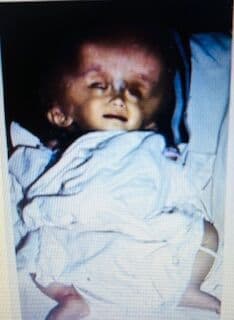
In the case of overproduction of CSF, drainage of CSF through the arachnoid villi may not be able to keep pace with the amount of CSF being produced, and hydrocephaly may result. The arachnoid villi allow CSF to pass between which two of the following spaces?
A 54-year-old man comes to the physician for a recent diagnosis of an aneurysm in the basilar artery, close to the cavernous sinus. Because of the risk of rupture, the vascular surgery team has recommended an endovascular aneurysm repair. An anterior approach to the sella turcica through the nasal cavity is chosen. Through which of the following routes is the surgeon most likely to gain access to the cranial cavity?
A 2-month-old girl is brought to the physician because of an enlarged head. The patient is quickly sent to the hospital for an MRI and admitted for further evaluation. The MRI of the head shows a complete dilation of the entire ventricular system. The treatment team is currently evaluating whether to place a shunt or consider surgery. Which of the following conditions most likely led to this type of clinical picture?
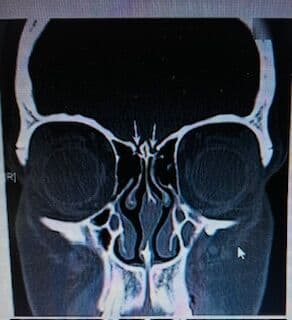
A 57-year-old man is brought to the emergency department after falling from a tree. The patient says he hit his face on a branch as he was falling but has no loss of consciousness. A CT scan of the head shows a fracture of the cribriform plate (see image below). Which of the following conditions will most likely be present during the physical examination?
A 46-year-old man is brought to the emergency department after he was found walking alongside the highway, confused and disoriented. He has a history of alcohol use with numerous hospitalizations for alcoholic intoxication requiring thiamine repletion. Physical examination shows a disheveled man with a stumbling gait and bilateral horizontal nystagmus. A magnetic resonance imaging (MRI) of the head would show pathology involving which of the following structures?
A 28 year old woman delivers a boy by spontaneous vaginal delivery without any complications. Physical exam of the boy shows a depression of the skull. The physician reassures the mother that the depression in the boy’s skull is normal and will close at a certain age. Which of the following fontanelles is located at the junction of the sagittal and coronal sutures and at what age does this fontanelle typically close?