Loading...


M2 CNS Pre-Summative Review Questions
Quiz by Jenny Ousley
Tag the questions with any skills you have. Your dashboard will track each student's mastery of each skill.
A 28 year old man is brought to the emergency department 40 minutes after he was involved in a motor vehicle collision. He was the unrestrained driver. The patient is alert and oriented to place and person only. Physical examination shows several abrasions on the face and chest. An x-ray of the skull shows minor maxillofacial injuries and a fracture at the foramen ovale. If there is injury to the nerve within the foramen ovale, which of the following clinical findings would most likely be seen?
A 36 year old woman comes to the physician because of worsening headache and vision problems for the past day. She started taking oral contraceptives 2 weeks ago. She has a BMI of 31 kg/m². Her temperature is 37.2 C (99 F), pulse is 84/min, blood pressure is 130/84 mmHg and respirations are 16/min. Physical exam shows mild ptosis, proptosis, periorbital edema, mydriasis, decreased visual acuity and decreased movements of the extraocular muscles of the left eye. There is diminished pinprick sensation over the left forehead and left mid-third of the face. At the end of the exam, she became lethargic and noncommunicative. Which of the following sites is most likely affected?
A 62 year old man comes to the emergency department because of loss of his right eye vision. He has a history of hypertension, hyperlipidemia, diabetes mellitus 2 and ischemic heart disease. His temperature is 37.2 C (99 F), pulse is 76/min, blood pressure is 144/96 mmHg, and respirations are 18/min. Physical exam shows that when light is shone on the right eye, no pupillary constriction is observed in either eye. When the light is shone on the right eye, no pupillary constriction is observed in either eye. When the light is shone on the left eye, both pupils constricted. Which of the following nerves is most likely affected?
A 16 year old is brought to the emergency department after being involved in a motor vehicle collision. The girl was unresponsive on the scene. The emergency response team decided to secure the airway by performing a cricothyroidotomy because of extensive facial injuries. Resuscitative efforts are successful, and the girl is later transferred to the intensive care unit. Her family is concerned about her extensive facial injuries and asks if she will have facial deformities from the collision. Reconstructive imaging of the skull is performed and shows damage to the superior orbital fissure. Which of the following functions would be impaired in this patient?
A 70 year old man comes to the physician because of a headache, difficulties with speech and swallowing, and weight loss. He has a history of prostate cancer which was treated with radical prostatectomy, orchiectomy, and radiotherapy. He has lost 11.3 kg (25 lbs) over the last 3 months. His vital signs are within normal limits. Physical exam shows hoarseness, uvular deviation to the left, right soft palate depression, and decreased right sided gag reflex. There is atrophy of the right sternocleidomastoid and trapezius muscles. An MRI of the head shows multiple lesions consistent with metastasis. Injury to which of the following anatomic structures is most likely responsible for this patient’s symptoms?
An 82 year old man is brought to the emergency department because of headache, vomiting, and impaired consciousness. The patient has a history of chronic hypertension and has no recent history of falls or trauma. His pulse is 85/min, blood pressure is 155/98 mmHg, and respirations are 18/min. Physical examination shows neck stiffness, an unsteady gait, and bilateral horizontal nystagmus. There is no hemiparesis. A CT scan of the head shows an intracranial hemorrhage. In which of the following anatomic sites is this hemorrhage most likely present?
An 8 year old boy is brought to the emergency department by his parents because of a 3 week history of mild intermittent headaches, vomiting, and fatigue. The headaches and fatigue have progressively worsened over the past week. He appears sluggish and is difficult to arouse. A CT scan of the brain shows the lateral ventricles measure 20 mm in diameter bilaterally (normal range: < 10 mm), the third ventricle measures 4 mm (normal range: < 5 mm), and the fourth ventricle measures 8 mm (normal range < 9 mm). Which of the following is the most likely source of obstruction in this patient?
A 51-year-old woman comes to the physician because of 6-week history of intermittent pain in the right side of her face. She describes it as a severe, sharp, stabbing pain in her right cheek and jaw that lasts several seconds. The pain occurs at multiple points during the day and is worsened with chewing, brushing her teeth, and smiling. Her other medical problems include hypertension and osteoarthritis. She does not smoke or cheek and jaw that lasts several seconds. The pain occurs at multiple points during the day and is worsened with chewing, brushing her teeth, and smiling. Her other medical problems include hypertension and osteoarthritis. She does not smoke or drink alcohol. Her pulse is 76/min, respirations are 16/min and blood pressure is140/90 mm Hg. Inspection of her face shows no lesions, rashes, or asymmetry. Lightly tapping the face on the right side elicits her symptoms. The affected nerve in this patient provides sensory input into which of the following structures?
A 60-year-old man dies from a progressive neurologic condition. His 25-year-old son is currently presenting with the same symptoms he had at that age. At autopsy, a brain section of the elderly man shows cystic degenerative changes involving a part of the basal ganglia located laterally to the left lateral ventricle. Which of the following structures corresponds with the cystic degeneration?
A 75-year-old man is brought to the emergency department because of involuntary twitching movements of his right arm that started last night. He was writing when his arm flung the pen across his desk. He has a longstanding history of hypertension and diabetes mellitus. He says he is not taking his medications as prescribed. Physical examination shows wild-swinging repetitive motions of the proximal muscles of his right arm. Which of the following is most likely damaged in this patient?
A 46-year-old man is brought to the emergency department after he was found walking alongside the highway, confused and disoriented. He has a history of alcohol use with numerous hospitalizations for alcoholic intoxication requiring thiamine repletion. Physical examination shows a disheveled man with a stumbling gait and bilateral horizontal nystagmus. A magnetic resonance imaging (MRI) of the head would show pathology involving which of the following structures?
A 63-year-old man comes to the emergency department because of sudden onset of severe headache, neck stiffness, nausea, and vomiting. The patient was watching television at home when he began having a headache. The patient has a 20-year history of hypertension, 20 pack-per-year of cigarette smoking, and polycystic kidney disease. A CT scan of the head shows a ruptured aneurysm arising from the anterior communicating artery. Before rupture, which of the following conditions was the patient at most risk of developing from an aneurysm at this location?
A 65-year-old man is brought to the emergency department because of an acute onset of headache and weakness. The patient was resting on his couch when the symptoms started 1 hour ago. He has 20-year history of hypertension, type 2 diabetes mellitus, and hyperlipidemia. His pulse is 90/min, respirations are 17/min, and blood pressure is 155/95 mm Hg. Physical examination shows dysarthria and right-sided facial weakness. Biceps tendon reflex is 3+ and there is 2/5 strength in the right arm. There is also decreased pinprick and temperature sensation over the right side of the body. A CT scan of the head shows an ischemic stroke. What vessel was most likely occluded in this patient?
A 82-year-old man is brought to the emergency department because of headache, vomiting, and impaired consciousness. The patient has a history of chronic hypertension and has no recent history of falls or trauma. His pulse is 85/min, blood pressure is 155/98 mm Hg, and respirations are 18/min. Physical examination shows neck stiffness, an unsteady gait, and bilateral horizontal nystagmus. There is no hemiparesis. A CT scan of the head shows an intracranial hemorrhage. In which of the following anatomic sites is this hemorrhage most likely present?
A 15-year-old boy is brought to the emergency department because of fever, nausea, vomiting, and abdominal pain. His parents say that their child has been feeling unwell for the past 2 days and has not been able to attend school. History includes type one diabetes mellitus. His blood pressure is 110/75 mm Hg, temperature is 38.3°C (101°F), respirations are 25/min, and SpO2% 97 on room air. Physical examination shows a young man who is somnolent. Respiratory examination shows rapid short breaths. Urine dipstick is positive for ketones. Blood serum studies show hyperglycemia, metabolic acidosis, and severe hyponatremia. The diabetic ketoacidosis protocol is initiated. Two days later the patient develops weakness of the upper and lower extremities, hallucinations, and tremors. The region affected in this condition is supplied by which of the following vessels?
A 15-year-old boy is brought to the emergency department because of fever, nausea, vomiting, and abdominal pain. His parents say that their child has been feeling unwell for the past 2 days and has not been able to attend school. History includes type one diabetes mellitus. His blood pressure is 110/75 mm Hg, temperature is 38.3°C (101°F), respirations are 25/min, and SpO2% 97 on room air. Physical examination shows a young man who is somnolent. Respiratory examination shows rapid short breaths. Urine dipstick is positive for ketones. Blood serum studies show hyperglycemia, metabolic acidosis, and severe hyponatremia. The diabetic ketoacidosis protocol is initiated. Two days later the patient develops weakness of the upper and lower extremities, hallucinations, and tremors. Which of the following is where the lesion is located?
A 25-year-old man comes to the physician because of uncontrollable choreiform movements. He has moderate dementia with a severe gait disturbance as well as agitation and problems with his mood. He has a family history of movement disorders. Which of the following findings will most likely be present on MRI in this condition?
A preterm 5 day old is kept for observation after birth because of an enlarged head. The prenatal course and delivery were uncomplicated. Physical exam shows a small infant with an enlarged head and no other abnormalities. An MRI of the head confirms the diagnosis of noncommunicating hydrocephalus. Which of the following is the most likely cause of such a condition?

A 28 year old woman delivers a boy by spontaneous vaginal delivery without any complications. Physical exam of the boy shows a depression of the skull. The physician reassures the mother that the depression in the boy’s skull is normal and will close at a certain age. Which of the following fontanelles is located at the junction of the sagittal and coronal sutures and at what age does this fontanelle typically close?
A 35-year-old woman is brought to the emergency department by her family because of worsening fever. Her family says that she has had a severe case of sinusitis for the past week that has not gotten better and this morning she seemed confused. Physical examination shows a lethargic woman with fever, tachycardia, and tachypnea. Laboratory studies show leukocytosis and a negative urine dip. A CT scan of the head shows a thrombus within the cavernous sinus. A diagnosis of sepsis secondary to cavernous sinus thrombosis is made. Which of the following is the most direct route for spread of infection from the face to the cavernous sinus?
A 45-year-old woman comes to the physician with severe ear pain for the past 3 days. She says that the pain was initially mild then progressively got worse, and yesterday she developed a fever. A CT scan of the head shows an infection of the mastoid cells. In mastoiditis, the infection can erode the thin layer of the bone between the mastoid cells and the posterior cranial fossa. If this occurs, the infection can spread into the skull through the venous system. Which of the following venous structures is most likely the route of infection?
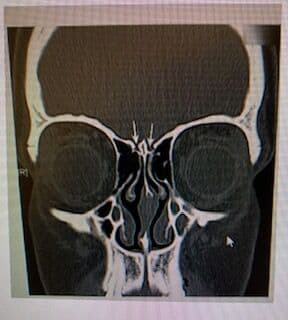
A 57-year-old man is brought to the emergency department after falling from a tree. The patient says he hit his face on a branch as he was falling but has no loss of consciousness. A CT scan of the head shows a fracture of the cribriform plate (Fig. 7.5). Which of the following conditions will most likely be present during the physical examination?
A 2-month-old girl is brought to the physician because of an enlarged head. The patient is quickly sent to the hospital for an MRI and admitted for further evaluation. The MRI of the head shows a complete dilation of the entire ventricular system. The treatment team is currently evaluating whether to place a shunt or consider surgery. Which of the following conditions most likely led to this type of clinical picture?
A 54-year-old man is brought to the emergency department after being struck by a moving vehicle. On arrival, the patient has a GCS of 10 and stable vital signs. The patient has no obvious signs of bleeding and a Facial drooping, Arm weakness, Speech difficulties and Time (FAST) examination is also negative. A CT scan of the head shows a fracture through the crista galli of the anterior cranial fossa, resulting in slow, local bleeding. Which of the following is the most likely source of bleeding?