Loading...


M2 Ear Pre-formative Quiz
Quiz by Jenny Ousley
Tag the questions with any skills you have. Your dashboard will track each student's mastery of each skill.
A 7-year-old boy is brought to the emergency department because of 2-day history of high fever. The boy says he has pain in his right ear and throat. Physical examination shows a red and inflamed pharynx. The tympanic membranes are intact and translucent without any exudate. A diagnosis of viral pharyngitis is made. Which of the following structures most likely provided a pathway for the infection to spread to the tympanic cavity (middle ear)?
A 34-year-old man comes to the physician because of recent sensitivity to sound. He works as security personnel during concerts and festivals. Physical examination shows no abnormalities with the tympanic membrane or external acoustic meatus. The patient says he does not have trouble hearing, but he has some ringing in his ears. A diagnosis of hyperacusis is made. Which of the following cranial nerve’s injury is most likely responsible for these symptoms?
A 34-year-old man comes to the physician because of 1-week history of pain in his right ear. When the patient is asked about events preceding his condition, he mentions swimming regularly in the lake nearby. Physical examination shows an external acoustic meatus infection (otitis externa) and the patient coughs while the external acoustic meatus is inspected with a speculum. The cough results from irritation to which nerve innervating an area of the external acoustic meatus?
A 63-year-old man comes to the physician because he has been having trouble hearing from his left ear. He says that food doesn’t seem to taste the same and at times he catches himself drooling from the left side of his mouth. A CT scan of the head shows a tumor compressing a nerve within the skull. Through which of the following openings is the nerve most likely passing?
A 27-year-old woman is brought to the emergency department after she was thrown from a motorcycle without wearing a helmet. An MRI of the head and neck shows a type I LeFort fracture and comminuted fracture of the mandible and temporomandibular joint. The patient underwent extensive reconstructive surgery and is recovering well. During the subsequent follow-up examination, the patient experiences high sensitivity to loud sounds. Which of the following muscles is most likely paralyzed?
A 17-year-old girl comes to the physician for a scheduled tonsillectomy because of recurrent infections. The procedure was done without complication. The patient returns to the clinic a week later for a follow-up appointment. The patient has not had any issues with her tonsils, however, since the surgery, she has been experiencing pain in her ear. Which of the following nerves was most likely injured during the surgical procedure?
A 32-year-old man comes to the emergency department because of nausea, vomiting, and a severe headache for 3 days. His vital signs are within normal limits. Physical examination examination shows nystagmus. An MRI of the head shows an acoustic neuroma (see image below). Which of the following nerves is most likely compressed by the tumor?
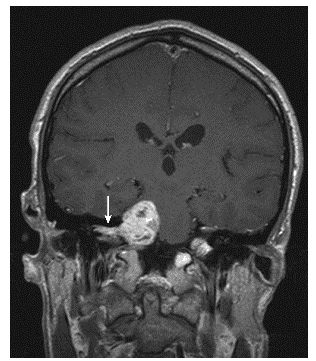
A 12-year-old boy was brought to the physician by his mother because of pain behind his ear. His vital signs are within normal limits. During physical examination, the physician palpates the mastoid process of the adolescent with tenderness elicited upon palpation. Which of the following bones is the physician palpating?
A 16-year-old girl is brought to the physician because of loss of sensation on the left side of her head. She says that while at a party last night, she asked her friend to pierce the tragus of her left ear. While attempting to pass a needle through the tragus, the friend slips and the needle deeply punctures the skin directly anterior to the tragus. Physical examination shows loss of sensation on the left temporal side of her scalp up to the vertex of her head. Which of the following nerves is most likely damaged?
A 15-year-old boy is brought to the emergency department with right ear pain. While attempting to clean his ear with a cotton swab, his little brother bumped into his elbow, causing the swab to penetrate deeply into the ear. Physical examination with the otoscope shows clotted blood in the right external acoustic meatus. A pearly-white right tympanic membrane with no cone of light is visualized. On Rinne test, bone conduction was greater than air conduction in the right ear. Weber test shows that sound lateralizes to the right ear. Which of the following best describes the nerves responsible for the perception of pain from the injured area?
A 56-year-old man comes to the physician because of severe headaches and ear pain. The patient also has ringing in his ears (tinnitus). He is otherwise healthy and his vital signs are within normal limits. The patient has no family history of cancer. A CT scan of the head shows a tumor in the middle ear cavity, invading through the bony floor. Which of the following structures will most likely be affected?