Loading...


Magnets 1
Quiz by Surya Parvathi
Customize this quiz to suit your class
Instantly translate to 100+ languages
Tag the questions with any skills you have. Your dashboard will track each student's mastery of each skill.
Give this quiz to my class
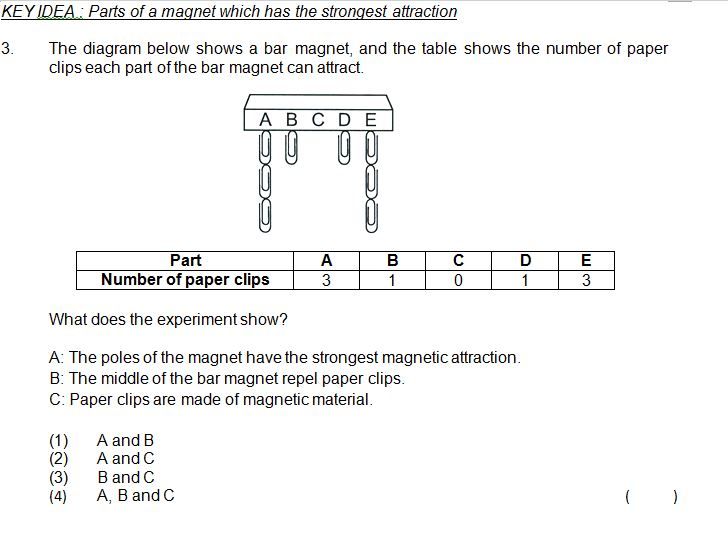
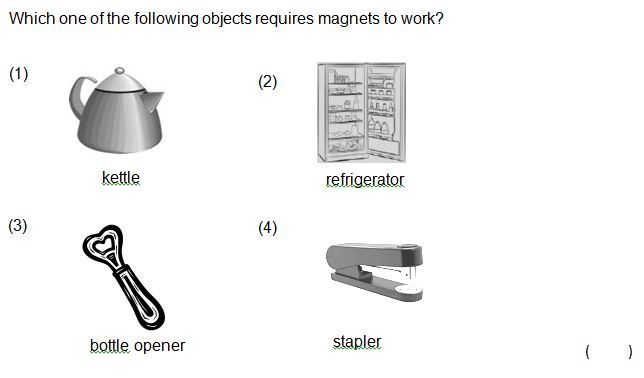

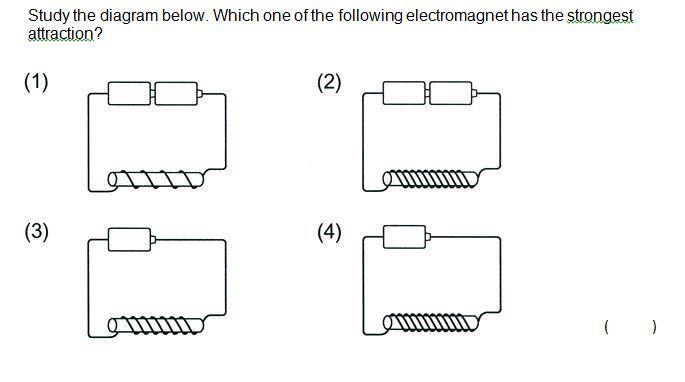
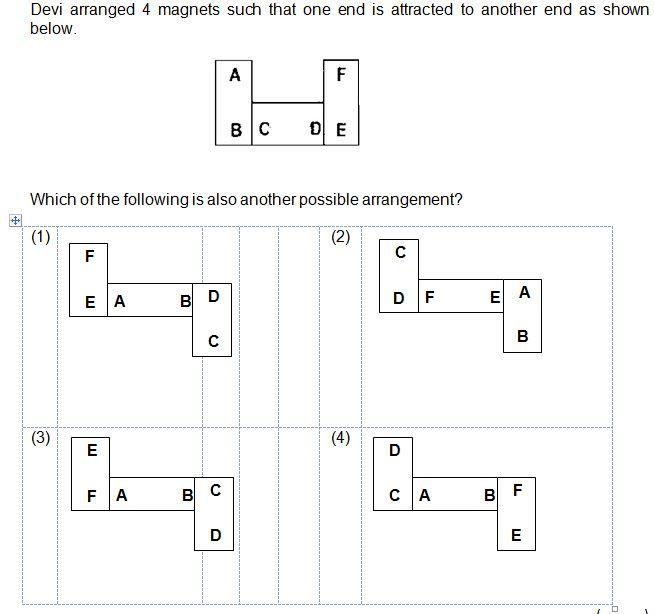 Magnets: Quiz 1Quiz 1-MagnetsChapter-10 Magnets Practice Quiz 13: Forces and magnets1. [Force] Part A: A student wants to test how friction affects a toy car. She rolls the car across a sheet of sandpaper and then across a sheet of wax paper. Which is the independent (changing) variable? A. The speed of the car B. The type of surface C. The distance traveled D. The size of the car Part B: On which surface will the car likely stop the SOONEST? A. The wax paper B. The sandpaper C. Both will be the same D. Neither surface has friction 2. [Magnets] Which of these is a measurable question for a magnet experiment? A. Are magnets more fun than springs? B. What is the prettiest color for a magnet? C. How many steel paperclips can a bar magnet lift? D. Why were magnets invented? 3. [Earth's Changes] A student observes a statue in a park that has lost its nose and has smooth edges after many years of rain and wind. What process caused this? A. Erosion B. Deposition C. Weathering D. Evaporation 4. [Earth's Changes] When a river reaches the ocean, it slows down and creates a landform called a delta by dropping sand and silt. This "dropping off" is called: A. Weathering B. Deposition C. Condensation D. Friction 5. [Resources] Why is coal considered a nonrenewable resource? A. It can be burned to make electricity. B. It is found deep underground. C. It takes millions of years to form and cannot be replaced quickly. D. It is made from ancient plants. 6. [Conservation] A school replaces all its old lightbulbs with energy-efficient LED bulbs. This is an example of: A. Weathering a resource B. Conserving a resource C. Deposition of energy D. Creating a renewable resource 7. [Aquifers] An aquifer is like a giant underground sponge. What characteristic of the rocks allows them to hold water? A. The rocks are solid and water-proof. B. The rocks are porous, with tiny spaces for water to sit. C. The rocks are magnetic and pull water toward them. D. The rocks are melted into a liquid state. 8. [Water Cycle] On a humid morning, you see dew on the grass even though it didn't rain overnight. Which part of the water cycle formed the dew? A. Evaporation B. Precipitation C. Condensation D. Transpiration 9. [Climate] Which of the following is a description of CLIMATE? A. "It is currently 85 degrees in McAllen." B. "There is a 40% chance of rain this afternoon." C. "South Texas typically has mild winters and very hot summers." D. "The wind is blowing from the North at 10 mph today." 10. [Weather/Climate] A scientist is looking at a chart that shows the total annual rainfall in a city from 1990 to 2020. What is the scientist most likely studying? A. The daily weather forecast B. The climate of the region C. The water cycle of a single pond D. The rate of erosion on a local hillMagnets Work! Did you know magnets are all around you? Magnets help you do amazing things! Keep reading! See if you think magnets have surprising uses. Magnets Pull. Look closely and you will see. Magnets can be found on a can opener. The magnet attracts, or pulls, the lid off of a soup can. A push or pull is called a force. There is also a magnet in a refrigerator. It pulls the metal in the door to make a tight seal. Do you know how? A magnet's force pulls objects made of metals called iron and steel. It will not pull other things. It will not pull a wooden pencil or a plastic toy. A magnet does not attract all items. Magnets Have Poles. You have proved, or shown, that magnets can pull some things to it. Why is this true? The two ends of a magnet are its poles. Every magnet has a north pole and a south pole. Have you ever played with trains that have magnets? Sometimes, you try to put two train cars together, but they repel. This means they push away from each other. Then you turn one of the cars around. The two cars snap together as quick as a wink. That's right! If you have played with these trains, you know it is true. When the train cars push away, two of the same poles are facing each other. However, if you put the north and south poles together, they will snap together like the train. Magnets Can Be Powerful. We know that magnets can move objects. But does the heaviness of an object matter? Can magnets move objects that have different weights? Yes, they can. Scientists are using magnets in new ways. People often wish they could travel at a faster speed than a train. There is a new train that uses powerful magnets to travel more quickly. Magnets lift the train above the track and push the train forward. The train appears to be moving as fast as lightning! Scientists have measured these train speeds. They are much faster than the trains we know. Can you imagine what magnets will help us do in the future? 10Magnet smart 1Magnet smart 1 LEKTION 1