Loading...


Maximum and minimum prices
Quiz by Koen De Mulder
Customize this quiz to suit your class
Instantly translate to 100+ languages
Tag the questions with any skills you have. Your dashboard will track each student's mastery of each skill.
Give this quiz to my class
True or False: A price ceiling set below the equilibrium price will have no effect on the market
True or False: A minimum price set below the equilibrium price will have no effect on the market
True or False: A price ceiling set below the equilibrium price will have no effect on the market
True or False: A minimum price set below the equilibrium price will have no effect on the market
True or False: When labour demand and labour supply is elastic, the introduction of a national minimum wage set above the free market equilibrium wage level may lead to a rise in unemployment
True or False: If the government introduces a maximum price on the cost of car insurance, then the demand for insurance will shift to the right
True or False: The introduction of rent controls on housing had the effect of creating a shortage for rental housing as the market supply of rented properties declined in the long run
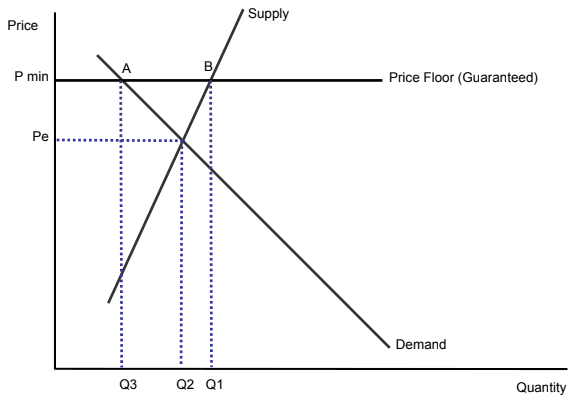
The diagram shows the demand for and supply of pepper. The government offers a guaranteed minimum price (P min) to pepper producers. If the government imposes this minimum price, then in the market there is likely to be
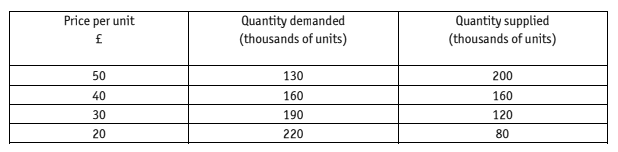
The table shows the demand for and supply of labour in an industry. The effect of the government introducing a minimum wage rate of £7 per hour would be to

The table shows the market demand and supply for a product. If a maximum price of £50 per unit is imposed on the market by the government, then
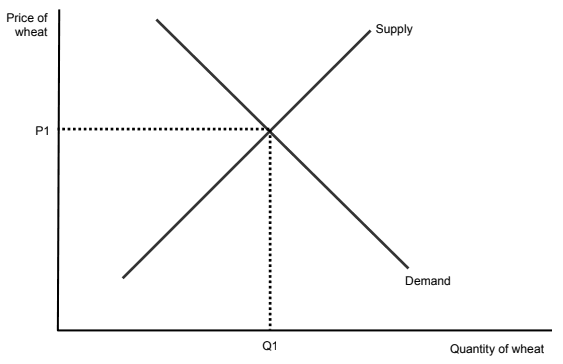
The diagram shows the free market equilibrium for wheat. The government aims to keep the price of wheat stable at price P1. If there was an inward shift of market supply due to a poor harvest, to keep the price at P1, the government could
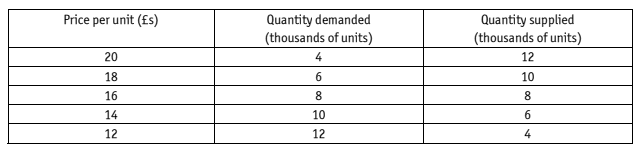
The annual demand and supply schedules for an agricultural good are shown in the table below. The government fixes the minimum price at £18 per tonne to be maintained by intervention. How much will such an action cost the government each year?
 Generate exact multiple choice questions as give below 1. **Which round of negotiations led to the establishment of the World Trade Organization (WTO)?** - (a) Doha Round - (b) Tokyo Round - (c) Uruguay Round - (d) Kennedy Round **Answer:** (c) Uruguay Round 2. **The General Agreement on Tariffs and Trade (GATT) dealt with:** - (a) Goods only - (b) Services only - (c) Intellectual property only - (d) All of the above **Answer:** (a) Goods only 3. **The 'National Treatment' principle means:** - (a) Exported products are treated equally in the domestic market - (b) Imported goods are treated the same as local goods in the domestic market - (c) Exported products should have the same tariff - (d) None of the above **Answer:** (b) Imported goods are treated the same as local goods in the domestic market 4. **'Bound tariff' refers to:** - (a) A limit on tariffs for imports based on WTO commitments - (b) The tax rate on all exports - (c) The overall cost of tariffs - (d) A tariff-free trade condition **Answer:** (a) A limit on tariffs for imports based on WTO commitments 5. **The Most-Favoured Nation (MFN) principle ensures:** - (a) Equal treatment for all WTO members - (b) Only certain countries receive benefits - (c) Tariffs are raised annually - (d) One country is favored over others **Answer:** (a) Equal treatment for all WTO members 6. **The Agreement on Agriculture includes commitments in:** - (a) Market access, domestic support, and export subsidies - (b) Increasing crop yield and technology access - (c) Subsidizing imports only - (d) Agricultural tariffs only **Answer:** (a) Market access, domestic support, and export subsidies 7. **Which agreement replaced the Multi-Fiber Arrangement (MFA)?** - (a) Agreement on Textiles and Clothing - (b) Agreement on Agriculture - (c) TRIPS Agreement - (d) Technical Barriers to Trade Agreement **Answer:** (a) Agreement on Textiles and Clothing 8. **The WTO's TRIPS Agreement pertains to:** - (a) Agricultural products - (b) Intellectual property rights - (c) Investment measures - (d) Customs valuation **Answer:** (b) Intellectual property rights 9. **The Doha Round primarily focuses on:** - (a) Tariffs on manufactured goods - (b) Trade in agricultural goods - (c) Technology trade - (d) Intellectual property in medicine **Answer:** (b) Trade in agricultural goods 10. **The WTO aims to:** - (a) Restrict all trade - (b) Facilitate free and fair trade - (c) Promote monopoly - (d) Limit member negotiations **Answer:** (b) Facilitate free and fair trade 11. **RTAs aim to:** - (a) Block international trade - (b) Reduce trade barriers within a group of countries - (c) Increase tariffs among members - (d) Promote non-trade-related policies **Answer:** (b) Reduce trade barriers within a group of countries 12. **Customs unions require members to:** - (a) Keep individual external tariffs - (b) Impose the same external tariff on non-members - (c) Remove tariffs only temporarily - (d) Avoid any tariffs within the union **Answer:** (b) Impose the same external tariff on non-members 13. **The WTO's highest decision-making body is:** - (a) General Council - (b) Ministerial Conference - (c) TRIPS Council - (d) Dispute Settlement Body **Answer:** (b) Ministerial Conference 14. **Which principle prevents discrimination between WTO members?** - (a) MFN - (b) National Treatment - (c) Market Access - (d) Subsidy Reduction **Answer:** (a) MFN 15. **A common market involves:** - (a) A shared currency - (b) Free movement of goods, services, and factors of production - (c) Only trade agreements for goods - (d) No tariffs on agriculture **Answer:** (b) Free movement of goods, services, and factors of production 16. **The Agreement on Subsidies and Countervailing Measures addresses:** - (a) Trade in textiles - (b) Subsidies that distort trade - (c) All intellectual property laws - (d) Agricultural trade only **Answer:** (b) Subsidies that distort trade 17. **The WTO's TRIMs Agreement regulates:** - (a) Investments - (b) Trade in goods - (c) Trade in services - (d) Agricultural products **Answer:** (a) Investments 18. **The primary goal of the WTO's SPS Agreement is:** - (a) To allow subsidies on food exports - (b) To prevent arbitrary sanitary restrictions on trade - (c) To regulate intellectual property - (d) To impose environmental standards **Answer:** (b) To prevent arbitrary sanitary restrictions on trade 19. **A trading bloc is:** - (a) A group of countries with no trade agreements - (b) A group of countries that may have a common external tariff - (c) Only formed by countries from the same continent - (d) An agreement that restricts all trade **Answer:** (b) A group of countries that may have a common external tariff 20. **The GATT was succeeded by the WTO because:** - (a) GATT was only for developed countries - (b) WTO covers more areas like services and intellectual property - (c) GATT was non-binding - (d) WTO allows subsidies for agriculture **Answer:** (b) WTO covers more areas like services and intellectual property Certainly! Here are an additional 30 multiple-choice questions based on the document content, with answers provided after each question. --- ### Additional Questions and Answers 21. **The WTO’s Agreement on Technical Barriers to Trade (TBT) seeks to:** - (a) Restrict imports to a minimum - (b) Prevent standards from becoming unnecessary trade barriers - (c) Allow countries to set any standard for goods - (d) Promote only national standards for products **Answer:** (b) Prevent standards from becoming unnecessary trade barriers 22. **The Trade Policy Review Mechanism (TPRM) is designed to:** - (a) Impose tariffs on certain goods - (b) Regularly review and assess national trade policies - (c) Regulate customs duties globally - (d) Control intellectual property rights **Answer:** (b) Regularly review and assess national trade policies 23. **The principle of “progressive liberalization” means that:** - (a) Trade barriers are reduced gradually over time - (b) All tariffs are removed immediately - (c) Only developed countries reduce trade barriers - (d) No commitments are required from developing countries **Answer:** (a) Trade barriers are reduced gradually over time 24. **Which council oversees the Agreement on Trade-Related Aspects of Intellectual Property Rights (TRIPS)?** - (a) General Council - (b) Services Council - (c) TRIPS Council - (d) Agriculture Council **Answer:** (c) TRIPS Council 25. **The WTO’s 'Dispute Settlement Body' is responsible for:** - (a) Deciding on national trade policies - (b) Settling trade disputes between member countries - (c) Creating new trade agreements - (d) Setting tariffs for member countries **Answer:** (b) Settling trade disputes between member countries 26. **A customs union differs from a free trade area because it:** - (a) Allows tariffs between member countries - (b) Establishes a common external tariff for non-members - (c) Applies only to services - (d) Imposes import quotas on all goods **Answer:** (b) Establishes a common external tariff for non-members 27. **Which of the following agreements deals with cross-border investments?** - (a) TRIPS - (b) TBT - (c) TRIMs - (d) GATS **Answer:** (c) TRIMs 28. **In a preferential trade agreement, member countries:** - (a) Impose the same tariffs as non-members - (b) Reduce trade barriers for each other only - (c) Apply high tariffs to non-member countries - (d) Have no external trade barriers **Answer:** (b) Reduce trade barriers for each other only 29. **The WTO’s Agreement on Agriculture includes which commitment?** - (a) Export subsidies for all agricultural goods - (b) Reduction of domestic support for farmers - (c) Complete elimination of tariffs on food products - (d) Increase in import quotas on agricultural goods **Answer:** (b) Reduction of domestic support for farmers 30. **The Agreement on Anti-Dumping allows countries to:** - (a) Increase exports by lowering prices - (b) Impose duties on imports sold below fair market value - (c) Eliminate all tariffs on certain goods - (d) Restrict domestic production of certain goods **Answer:** (b) Impose duties on imports sold below fair market value 31. **The main objective of WTO’s “National Treatment” principle is to:** - (a) Prevent imports altogether - (b) Treat foreign goods the same as domestic goods - (c) Impose tariffs on all foreign products - (d) Promote exports **Answer:** (b) Treat foreign goods the same as domestic goods 32. **Which of the following is a major goal of the WTO?** - (a) Ensuring trade restrictions remain high - (b) Promoting international free trade and competition - (c) Limiting access to global markets - (d) Supporting only developed countries **Answer:** (b) Promoting international free trade and competition 33. **An economic and monetary union involves:** - (a) A free trade area only - (b) A common currency among members - (c) No external trade agreements - (d) Different currencies for each member country **Answer:** (b) A common currency among members 34. **The WTO's Ministerial Conference meets:** - (a) Annually - (b) Every two years - (c) Quarterly - (d) Every five years **Answer:** (b) Every two years 35. **The WTO Agreement on Trade-Related Aspects of Intellectual Property Rights (TRIPS) mandates:** - (a) Free trade for all countries - (b) Uniform intellectual property protection standards - (c) Different IP laws for each country - (d) No IP protection for developing countries **Answer:** (b) Uniform intellectual property protection standards 36. **The WTO principle of 'transparency' requires member countries to:** - (a) Keep trade policies secret - (b) Publicly disclose trade policies and practices - (c) Have identical trade policies - (d) Eliminate tariffs on all goods **Answer:** (b) Publicly disclose trade policies and practices 37. **One of the WTO's objectives in dispute settlement is to:** - (a) Resolve trade disputes peacefully - (b) Impose sanctions on non-members - (c) Regulate global tariffs - (d) Control member states' import quotas **Answer:** (a) Resolve trade disputes peacefully 38. **Under the WTO's Market Access commitment, member countries agree to:** - (a) Allow unrestricted imports - (b) Set maximum tariff levels on imported goods - (c) Ban certain goods from other countries - (d) Only trade with specific countries **Answer:** (b) Set maximum tariff levels on imported goods 39. **GATS, or the General Agreement on Trade in Services, governs trade in:** - (a) Agricultural goods - (b) Intellectual property - (c) Services - (d) Manufactured products **Answer:** (c) Services 40. **The Agreement on Pre-shipment Inspection (PSI) aims to:** - (a) Ensure high tariffs on all imports - (b) Allow for inspection of goods before shipping - (c) Eliminate export taxes - (d) Control intellectual property trade **Answer:** (b) Allow for inspection of goods before shipping 41. **Which of the following agreements aims to harmonize customs valuation?** - (a) Anti-Dumping Agreement - (b) Customs Valuation Agreement - (c) TRIMs Agreement - (d) Agreement on Subsidies **Answer:** (b) Customs Valuation Agreement 42. **A significant aspect of the Doha Round is:** - (a) Reducing tariffs on agricultural products - (b) Restricting intellectual property rights - (c) Eliminating all forms of trade - (d) Blocking services trade agreements **Answer:** (a) Reducing tariffs on agricultural products 43. **The term “dumping” in international trade refers to:** - (a) Exporting goods at prices lower than domestic market prices - (b) Importing goods illegally - (c) Increasing domestic prices - (d) Imposing excessive tariffs **Answer:** (a) Exporting goods at prices lower than domestic market prices 44. **WTO members are expected to follow which key principle in reducing tariffs?** - (a) National Treatment - (b) Progressive Liberalization - (c) Quota System - (d) Non-Discrimination **Answer:** (b) Progressive Liberalization 45. **The WTO aims to promote fair competition by:** - (a) Allowing tariffs as the only form of protection - (b) Supporting MFN and anti-dumping measures - (c) Limiting access to agricultural products - (d) Increasing subsidies **Answer:** (b) Supporting MFN and anti-dumping measures 46. **A plurilateral agreement within the WTO:** - (a) Includes all WTO members - (b) Involves only specific countries with shared interests - (c) Bans all tariffs for members - (d) Imposes global trade restrictions **Answer:** (b) Involves only specific countries with shared interests 47. **Trade facilitation in the WTO context means:** - (a) Making trade faster, cheaper, and more predictable - (b) Increasing tariffs on imports - (c) Eliminating all customs procedures - (d) Restricting trade with non-members **Answer:** (a) Making trade faster, cheaperLand warfare is a complex domain that involves the application of military power on the ground to achieve political and strategic objectives. Modern military doctrine, such as that used by the U.S. Army and the Indian Army, categorizes these elements into Combat Power and the Principles of War. 1. The 8 Elements of Combat Power Combat power is the total means of destructive, constructive, and information capabilities that a military unit can apply. It is typically broken down into eight key elements: ElementDescriptionLeadershipThe "multiplier" of all other elements. It provides purpose, direction, and motivation to soldiers.InformationEnables commanders to make informed decisions and creates opportunities to achieve results.Mission CommandThe system used to integrate the other elements. It focuses on decentralized execution based on the commander's intent.Movement & ManeuverThe movement of forces to gain a positional advantage over the enemy to deliver lethal or non-lethal effects.IntelligenceThe understanding of the enemy, terrain, weather, and civil considerations.FiresThe use of weapon systems (artillery, mortars, air support) to create specific lethal or non-lethal effects.SustainmentThe logistics required to maintain operations, including ammunition, fuel, food, and medical support.ProtectionThe preservation of the force so that the commander can apply maximum combat power.2. The Principles of War These are the enduring "rules of thumb" that guide how land forces are employed strategically and tactically: Objective: Direct every operation toward a clearly defined and attainable goal. Offensive: Seize, retain, and exploit the initiative. You cannot win by defending alone. Mass: Concentrate the effects of combat power at the most advantageous place and time. Economy of Force: Allocate the minimum essential combat power to secondary efforts so you can "mass" elsewhere. Maneuver: Place the enemy in a position of disadvantage through flexible movement. Unity of Command: Ensure all forces operate under a single responsible commander toward a common objective. Security: Prevent the enemy from gaining an unexpected advantage. Surprise: Strike the enemy at a time, place, or in a manner for which they are unprepared. Simplicity: Prepare clear, uncomplicated plans to minimize confusion in the "fog of war." 3. The Modern Legal Framework Land warfare is also governed by the Law of Land Warfare (International Humanitarian Law), which rests on four pillars: Military Necessity: Actions must be necessary to achieve a legitimate military goal. Distinction: Forces must distinguish between combatants and non-combatants (civilians). Proportionality: The anticipated harm to civilians must not be excessive in relation to the concrete military advantage gained. Unnecessary Suffering: Weapons and methods must not cause gratuitous or superfluous injury. Note: Contemporary land warfare is increasingly "Multi-Domain," meaning land forces must now integrate with cyber, space, and electronic warfare to be effective. , While land warfare uses many tools, the two primary "philosophies" of how to win a war are Attrition and Maneuver. Most modern conflicts are a spectrum of both, but understanding the pure form of each helps explain military strategy. 1. Attrition Warfare: The "Sledgehammer" Attrition warfare is a strategy where one side attempts to win by wearing down the enemy to the point of collapse through continuous losses in personnel, equipment, and supplies. Core Logic: "I have more than you." It assumes that if you can destroy the enemy’s resources faster than they can replace them, you will eventually win. Focus: Firepower and mass. Success is measured by "body counts," equipment destroyed, and the steady seizing of terrain. Command Style: Usually centralized and methodical. It requires strict synchronization of massive resources (artillery, logistics, manpower). Historical Example: The Battle of Verdun (WWI). German Chief of Staff Erich von Falkenhayn famously stated his goal was to "bleed France white" by forcing them to defend a position they could not afford to lose, regardless of the cost in lives. 2. Maneuver Warfare: The "Scalpel" Maneuver warfare seeks to shatter the enemy’s moral and physical cohesion—their ability to act as a unified force—rather than simply destroying every soldier. Core Logic: "I am faster and more unpredictable than you." It aims to create a state of chaos where the enemy's leadership can no longer make effective decisions. Focus: Speed, surprise, and dislocation (forcing the enemy to be in the wrong place at the wrong time). The OODA Loop: Developed by Col. John Boyd, this is the heart of maneuver theory. It stands for Observe, Orient, Decide, Act. The goal is to cycle through these steps faster than the enemy, essentially "getting inside" their decision-making process until they collapse from confusion. Historical Example: The 1940 Invasion of France (Blitzkrieg). Instead of fighting a line-by-line battle of attrition, German forces used speed and concentrated armor to bypass strongpoints, cut communication lines, and cause a total systemic collapse of the French military in weeks. 3. Key Differences at a Glance FeatureAttrition WarfareManeuver WarfareObjectivePhysical destruction of the enemy army.Functional/Psychological collapse of the enemy.TargetThe enemy's strength (mass).The enemy's weakness (vulnerability).Primary ToolMassed Firepower.Movement and Tempo.Command"Command Push" (Top-down, rigid)."Recon Pull" (Decentralized, flexible).Success MetricExchange ratios (Kill counts).Disruption and loss of enemy control.4. The Modern Synthesis: "Schwerpunkt" In practice, no army is purely "maneuver" or "attrition." To maneuver successfully, you often need a period of attrition to punch a hole in the enemy's line. A critical concept here is the Schwerpunkt (Center of Gravity/Focus of Effort). A commander identifies the single most important place to strike and concentrates all available "elements of power" there. While the rest of the front might look like attrition, the Schwerpunkt is where the maneuver happens to achieve a breakthrough. Modern Reality: In high-intensity conflicts today (like the war in Ukraine), we see a "return to attrition" because modern sensors (drones, satellites) make it very difficult to achieve the surprise needed for pure maneuver warfare. When you can see everything, it's hard to be "unexpected."Re-order level, Maximum level, minimum level and danger level in raw materials usescreate 15 multiple choice question about this topic.Remember working principle of frequency filter circuits 5.1.1 Describe operation and function of filters 5.1.2 Describe applications of filter in electronic equipment 5.1.3 Name types of filter circuit a. Passive filter b. Active filter 5.1.4 Identify difference between passive filter and active filter 5.2 Understand operation and application of passive filters 5.2.1 Explain operation of passive filter 5.2.2 Explain with diagram the types of passive filter a. Low-pass filter b. High-pass filter c. Band-pass filter 5.2.3 Explain applications of each passive filter 5.2.4 Explain operation for each passive filter 5.2.5 Explain voltage gain and maximum voltage gain (Avmax) for passive filter 5.2.6 Explain following terms : a. voltage gain in decibel, Av (dB) b. cut-off frequency, fc c. frequency pass-band d. frequency bandwidth (BW)LESSON 3 Characteristics of Living Things Learning Objectives • Describe each characteristic of life • Relate each characteristic of life with how first forms of life evolved What sets living things apart from nonliving things? Organisms are equipped with different characteristics that allow them to grow, adapt, survive, and perpetuate. These include the ability to metabolize, respond to stimuli, interact, and reproduce, among others What are the characteristics of life? Try to look at your surroundings and identify the living things that you see. You have probably identified a lot. Many scientists believe that there are more than 10 million kinds of living things that exist on Earth today. But the question is, how can something be considered living? There are certain characteristics that all living things exhibit: the characteristics of life. Living things are made up of cells. They metabolize, grow and develop, respond to stimulus, adapt to their environment, and reproduce. Living Things Are Made up of Cells All living things are made up of cells. Cells are the basic building blocks of all living things. Each cell contains materials that carry out basic life processes such as respiration. In the 1600s, an argument against the theory of spontaneous generation was made. Italian physician and biologist Francesco Redi disproved the theory that all living things come from nonliving things. Cells have different properties and characteristics. The cell theory describes the properties of all cells. There are three tenets of the cell theory: 1. The cell is the basic unit of life. 2. All living things are composed of one or more cells. 3. All cells arise from preexisting cells. The discovery of the cell is largely attributed to Robert Hooke. Upon examining a piece of cork using a microscope that he built, Hooke observed tiny compartments that he called "cells" (from the Latin word cella, meaning "little room"). Matthias Schleiden suggested that all structural parts of plants are made up of cells. In 1839, Theodore Schwann stated that along with plants, all animals were composed of cells. From these conclusions about plants and animals, advancement on the study of animal parts and functions began. In 1855, Rudolf Virchow included the idea that all cells came from preexisting cells. Some living things are made up of only single cells. Single-celled or unicellular organisms include bacteria, some protists, and some fungi. Even though composed of single cells, these organisms carry out all the functions necessary for life. Most living things such as animals and plants, are multicellular organisms. They are composed of many cells, which are grouped together and perform specific tasks in the body. In different organisms, cells also vary in sizes, shapes, parts, and functions. There are two kinds of organisms according to their cell structure, the prokaryotes and eukaryotes (figure 5-3). Prokaryotes are single-celled organisms that lack a membrane-bound nucleus, mitochondria, and all other organelles. Its name comes from the Greek words pro, which means "before," and karyon, which means "nut or kernel." Eukaryotes are organisms with cells that contain membrane-bound nucleus and other membrane-bound organelles. The nucleus of a eukaryotic cell contains the genetic material (DNA), enclosed by a nuclear envelope. Other membrane-bound organelles are mitochondria, Golgi apparatus, and chloroplast found in photosynthetic organisms such as algae and plants. There are also unicellular eukaryotes known as protozoa. All other eukaryotes are multicellular organisms, such as plants, animals, and fungi. Living Things Metabolize Essential chemical reactions in life can be best described as building up (anabolism) and breaking down (catabolism) processes. In anabolism, the substances needed by organisms to grow, store energy, and repair tissues are synthesized. In contrast in catabolism, some complex substances are broken down, releasing the energy stored in their molecules. This happens in food digestion. This chemical building up and breaking down processes are collectively called metabolism. Metabolism, from the Greek word metabole meaning "change," is the sum total of all the life-sustaining chemical reactions in living things. It allows living things to grow, maintain their structures and functions, and respond to stimuli. Living Things Grow and Develop Growth and development are not new concepts to many. In all living things, growth involves the increase in one's size or height. However, growth is not just an increase in physical structure. It also involves complex changes in an organism. Growth and development occur rapidly from younger stages of life to maturity. In humans, animals, and plants, distinct changes brought by growth and development can be dearly identified. Microorganisms such as bacteria also undergo growth and development until they reach their maximum size and maturity. A life span is the average length of time a aving thing can live. Living things have different life spans. Humans have average life spectancy of 60 to 70 years, while some plants, such as the narra trees, can live for more than 100. Living Things Respond to Stimuli All living things respond to stimuli the environment. This responsiveness Increases survivability. Stimulus (plural: uli) is any signal or change in he environment of an organism that produces a response or reaction from that organism. Responses to stimuli depend on an organism's need. Responding to stimuli also maintains homeostasis in living things. Homeostasis is the internal balance of a body system. This balance is needed for the proper function and regulation of the living thing's body. For example, when a person is in a warmer environment, the body sweats, keeping the body maintain a temperature suited for the normal function of the body. Living Things Interact No living thing can live alone. Interaction among organisms is simultaneously happening on Earth. From the smallest microorganisms to the biggest organism, and from the North Pole to the South Pole of Earth, all are connected in one living system. An ecosystem is formed when a community of organisms interacts with another community and with their environment. Many processes and interactions, such as in a feeding relationship, life cycle, and the exchange of gases between plants and animals, occur in the ecosystem. These are some of the important processes needed to maintain life on Earth. Living Things Reproduce The ability of living things to produce offspring of their kind is called reproduction. Reproduction is not an individual organism's need, rather, it is for the species' perpetuation. In some cases, animals become extinct because of their inability to reproduce their kind. Higher forms of plants and animals reproduce through sexual reproduction. Sexual reproduction involves the union of sex cells or gametes-the egg cell from a female organism and the sperm cell from a male organism. This union gives rise to a new individual with characteristics or traits from both parents. Other simple organisms, such as bacteria and plants, can reproduce asexually. These organisms give rise to a new individual from their body. A bacterial cell divided in two through asexual reproduction gives rise to new bacteria, as shown in figure 5-5. A yeast can form buds that later on become separate individual. Plants grow new plants using their stem, leaf, and roots. Both sexual and asexual reproductions have important functions. In both cases, the genetic material (DNA) is passed on from one generation to the next, ensuring the survival of the species on Earth. 1. Bacteria copy their DNA by starting at any point on the circular chromosomes. 2. The two copies of DNA attach to the inside wall of the bacterial cell. 3. The cell starts to divide, forming a new membrane and cell wall. 4. The bacterial cell splits into two separate cells, each with their own DNA. Living Things Adapt and Evolve All living things can adapt to their environment. This adaptation is necessary for rvival. Adaptation depends on the need of an individual. A polar bear, for example, would not be able to survive in an extremely cold environment without its capacity adapt. Adaptation is any response or reaction toward a stimulus that helps in the survival of an organism. A seed-eating bird will eventually eat a worm when there are seeds to be found. This change in food choice is therefore its adapting mechanism. Prolonged adaptation to certain environments may lead to the gradual evolution of the succeeding generations. Evolution is the gradual change in organisms over a long period in response to changing environment. Living Things Are Organized Life on Earth exhibits organization. The atom is the smallest unit of matter, lowed by molecules, which are combinations of atoms. When these molecules are grouped together, they form a cell. The cell is the basic unit of life. In multicellular organisms, such as plants and animals, cells are grouped as tissues to perform specific Functions. Different tissues can be grouped further and form organs. Organs in animals include the heart, brain, and lungs, among others. The organs form organ systems that makes the function of the body more complex and efficient. Organ systems form the whole organism. All living things exhibit organization, whether they are unicellular or multicellular organisms.. When it was his turn to speak, Adam Malik, Presidium Minister for Political Affairs and Minister for Foreign Affairs of Indonesia, recalled that about a year before, in Bangkok, at the conclusion of the peace talks between Indonesia and Malaysia, he had explored the idea of an organization such as ASEAN with his Malaysian and Thai counterparts. One of the “angry young men” in his country’s struggle for independence two decades earlier, Adam Malik was then 50 years old and one of a Presidium of five led by then General Soeharto that was steering Indonesia from the verge of economic and political chaos. He was the Presidium’s point man in Indonesia’s efforts to mend fences with its neighbors in the wake of an unfortunate policy of confrontation. During the past year, he said, the Ministers had all worked together toward the realization of the ASEAN idea, “making haste slowly, in order to build a new association for regional cooperation.” Adam Malik went on to describe Indonesia’s vision of a Southeast Asia developing into “a region which can stand on its own feet, strong enough to defend itself against any negative influence from outside the region.” Such a vision, he stressed, was not wishful thinking, if the countries of the region effectively cooperated with each other, considering their combined natural resources and manpower. He referred to differences of outlook among the member countries, but those differences, he said, would be overcome through a maximum of goodwill and understanding, faith and realism. Hard work, patience and perseverance, he added, would also be necessary. The countries of Southeast Asia should also be willing to take responsibility for whatever happens to them, according to Tun Abdul Razak, the Deputy Prime Minister of Malaysia, who spoke next. In his speech, he conjured a vision of an ASEAN that would include all the countries of Southeast Asia. Tun Abdul Razak was then concurrently his country’s Minister of Defence and Minister of National Development. It was a time when national survival was the overriding thrust of Malaysia’s relations with other nations and so as Minister of Defence, he was in charge of his country’s foreign affairs. He stressed that the countries of the region should recognize that unless they assumed their common responsibility to shape their own destiny and to prevent external intervention and interference, Southeast Asia would remain fraught with danger and tension. And unless they took decisive and collective action to prevent the eruption of intra-regional conflicts, the nations of Southeast Asia would remain susceptible to manipulation, one against another. “We the nations and peoples of Southeast Asia,” Tun Abdul Razak said, “must get together and form by ourselves a new perspective and a new framework for our region. It is important that individually and jointly we should create a deep awareness that we cannot survive for long as independent but isolated peoples unless we also think and act together and unless we prove by deeds that we belong to a family of Southeast Asian nations bound together by ties of friendship and goodwill and imbued with our own ideals and aspirations and determined to shape our own destiny”. He added that, “with the establishment of ASEAN, we have taken a firm and a bold step on that road”. For his part, S. Rajaratnam, a former Minister of Culture of multi-cultural Singapore who, at that time, served as its first Foreign Minister, noted that two decades of nationalist fervor had not fulfilled the expectations of the people of Southeast Asia for better living standards. If ASEAN would succeed, he said, then its members would have to marry national thinking with regional thinking. “We must now think at two levels,” Rajaratnam said. “We must think not only of our national interests but posit them against regional interests: that is a new way of thinking about our problems. And these are two different things and sometimes they can conflict. Secondly, we must also accept the fact, if we are really serious about it, that regional existence means painful adjustments to those practices and thinking in our respective countries. We must make these painful and difficult adjustments. If we are not going to do that, then regionalism remains a utopia.” S. Rajaratnam expressed the fear, however, that ASEAN would be misunderstood. “We are not against anything”, he said, “not against anybody”. And here he used a term that would have an ominous ring even today: balkanization. In Southeast Asia, as in Europe and any part of the world, he said, outside powers had a vested interest in the balkanization of the region. “We want to ensure,” he said, “a stable Southeast Asia, not a balkanized Southeast Asia. And those countries who are interested, genuinely interested, in the stability of Southeast Asia, the prosperity of Southeast Asia, and better economic and social conditions, will welcome small countries getting together to pool their collective resources and their collective wisdom to contribute to the peace of the world.” The goal of ASEAN, then, is to create, not to destroy. This, the Foreign Minister of Thailand, Thanat Khoman, stressed when it was his turn to speak. At a time when the Vietnam conflict was raging and American forces seemed forever entrenched in Indochina, he had foreseen their eventual withdrawal from the area and had accordingly applied himself to adjusting Thailand’s foreign policy to a reality that would only become apparent more than half a decade later. He must have had that in mind when, on that occasion, he said that the countries of Southeast Asia had no choice but to adjust to the exigencies of the time, to move toward closer cooperation and even integration. Elaborating on ASEAN objectives, he spoke of “building a new society that will be responsive to the needs of our time and efficiently equipped to bring about, for the enjoyment and the material as well as spiritual advancement of our peoples, conditions of stability and progress. Particularly what millions of men and women in our part of the world want is to erase the old and obsolete concept of domination and subjection of the past and replace it with the new spirit of give and take, of equality and partnership. More than anything else, they want to be master of their own house and to enjoy the inherent right to decide their own destiny …” While the nations of Southeast Asia prevent attempts to deprive them of their freedom and sovereignty, he said, they must first free themselves from the material impediments of ignorance, disease and hunger. Each of these nations cannot accomplish that alone, but by joining together and cooperating with those who have the same aspirations, these objectives become easier to attain. Then Thanat Khoman concluded: “What we have decided today is only a small beginning of what we hope will be a long and continuous sequence of accomplishments of which we ourselves, those who will join us later and the generations to come, can be proud. Let it be for Southeast Asia, a potentially rich region, rich in history, in spiritual as well as material resources and indeed for the whole ancient continent of Asia, the light of happiness and well-being that will shine over the uncounted millions of our struggling peoples.” The Foreign Minister of Thailand closed the inaugural session of the Association of Southeast Asian Nations by presenting each of his colleagues with a memento. Inscribed on the memento presented to the Foreign Minister of Indonesia, was the citation, “In recognition of services rendered by His Excellency Adam Malik to the ASEAN organization, the name of which was suggested by him.” And that was how ASEAN was conceived, given a name, and born. It had been barely 14 months since Thanat Khoman brought up the ASEAN idea in his conversations with his Malaysian and Indonesian colleagues. In about three more weeks, Indonesia would fully restore diplomatic relations with Malaysia, and soon after that with Singapore. That was by no means the end to intra-ASEAN disputes, for soon the Philippines and Malaysia would have a falling out on the issue of sovereignty over Sabah. Many disputes between ASEAN countries persist to this day. But all Member Countries are deeply committed to resolving their differences through peaceful means and in the spirit of mutual accommodation. Every dispute would have its proper season but it would not be allowed to get in the way of the task at hand. And at that time, the essential task was to lay the framework of regional dialogue and cooperation. The two-page Bangkok Declaration not only contains the rationale for the establishment of ASEAN and its specific objectives. It represents the organization’s modus operandi of building on small steps, voluntary, and informal arrangements towards more binding and institutionalized agreements. All the founding member states and the newer members have stood fast to the spirit of the Bangkok Declaration. Over the years, ASEAN has progressively entered into several formal and legally-binding instruments, such as the 1976 Treaty of Amity and Cooperation in Southeast Asia and the 1995 Treaty on the Southeast Asia Nuclear Weapon-Free Zone. Against the backdrop of conflict in the then Indochina, the Founding Fathers had the foresight of building a community of and for all Southeast Asian states. Thus the Bangkok Declaration promulgated that “the Association is open for participation to all States in the Southeast Asian region subscribing to the aforementioned aims, principles and purposes.” ASEAN’s inclusive outlook has paved the way for community-building not only in Southeast Asia, but also in the broader Asia Pacific region where several other inter-governmental organizations now co-exist. The original ASEAN logo presented five brown sheaves of rice stalks, one for each founding member. Beneath the sheaves is the legend “ASEAN” in blue. These are set on a field of yellow encircled by a blue border. Brown stands for strength and stability, yellow for prosperity and blue for the spirit of cordiality in which ASEAN affairs are conducted. When ASEAN celebrated its 30th Anniversary in 1997, the sheaves on the logo had increased to ten – representing all ten countries of Southeast Asia and reflecting the colors of the flags of all of them. In a very real sense, ASEAN and Southeast Asia would then be one and the same, just as the Founding Fathers had envisioned. This article is based on the first chapter of ASEAN at 30, a publication of the Association of Southeast Asian Nations in commemoration of its 30th Anniversary on 8 August 1997, written by Jamil Maidan Flores and Jun Abad.Attendance and Absences Quiz Instructions: Choose the correct answer for each question. What is required for a student to have a lawful absence? A) A verbal excuse from the student B) A written excuse signed by a parent, guardian, or medical practitioner C) No excuse is needed D) A note from a friend Where should students submit their written excuses for absences? A) To their teacher directly B) In the basket outside the PowerSchool/Attendance clerk’s window C) To the principal's office D) In their backpack How many days does a student have to present a valid excuse for an absence? A) One day B) Three days C) Five days D) Ten days What happens if a student does not bring a valid excuse within three days? A) The absence is considered lawful B) The student will receive a detention C) The absence is considered unexcused and unlawful D) The absence is ignored What is the maximum time allowed to complete makeup work after returning to school? A) Five days B) Seven days C) Ten days D) Two weeks What kind of absences can be considered lawful? A) Absences for family vacations B) Absences due to a student's own illness C) Absences due to playing sports D) Absences for oversleeping Which of the following is NOT a lawful absence? A) Absence due to illness in the student's immediate family B) Absence for a recognized religious holiday C) Absence without the knowledge of the parent D) Absence for a medical appointment What action is taken if a student submits a false excuse? A) The student will be congratulated B) The excuse will be ignored C) The student will be referred to school administration for disciplinary action D) The student will be given a warning Which of the following is a reason for an absence that is considered unlawful? A) Absence due to a medical appointment B) Absence due to death in the family C) Absence without acceptable cause, with knowledge of the parent D) Absence due to a school-approved activity Who has the discretion to accept medical excuses beyond three days? A) The student's friends B) The teacher C) The principal D) The school nurseHome furnishings include the furniture, appliances and accessories found in your home. The furnishing should fit the needs of the family, it should be adequate for family activities. and arrange for maximum convenience. In selecting furniture, suited for your family here are some factors to take into account: a. The use of furniture – the furniture should be suitable for their intended use. b. The suitability of the furniture with other furnishings - select pieces of furniture which give a pleasant effect when grouped with other furniture. c. The availability of space in the room – furniture must be placed in such a manner that they do not block entry or passageway. d. The material used to make the furniture. - It is considered a good buy when it is made of durable materials. e. Maintenance of furniture –for practical reason, furniture with intricate designs need more cleaning time as compared with the simple one. I am sure that you are eager to learn more about home furnishings continue reading and keep your focus.