Tag the questions with any skills you have. Your dashboard will track each student's mastery of each skill.
Give this quiz to my class
Q 1/20
Score 0
A student uses a measuring cylinder to measure the volume of some water. The diagram shows part of the measuring cylinder. The top and bottom of the meniscus are labelled. What is the volume of the water?
45
47.0 cm3
47.5 cm3
49.0 cm3
49.5 cm3
Q 2/20
Score 0
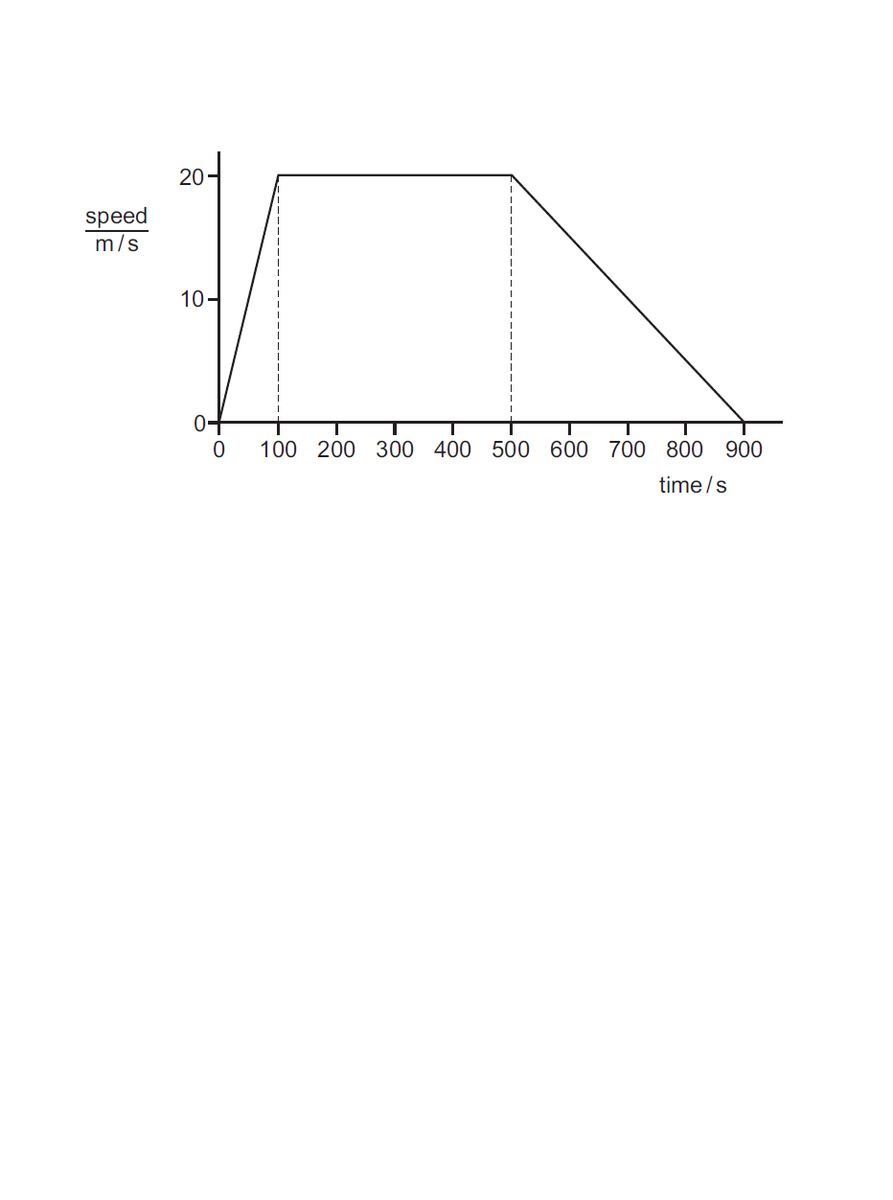
The graph represents the motion of a train travelling between two stations. Which statement about the train is correct?
45
It travels at constant speed for less than half of its journey time.
It travels 2000 m in the first 100 s.
Its acceleration takes a longer time than its deceleration.
It travels 10 000 m at constant speed
20 questions
Q.
A student uses a measuring cylinder to measure the volume of some water. The diagram shows part of the measuring cylinder. The top and bottom of the meniscus are labelled. What is the volume of the water?
1
45 sec
Q.
The graph represents the motion of a train travelling between two stations. Which statement about the train is correct?
2
45 sec
Q.
A car travels 6.0 km along a main road in 6.0 minutes. It then travels 2.0 km along a minor road in 6.0 minutes. Which calculation of average speed for the whole journey is correct?
3
45 sec
Q.
Two metal blocks P and Q have identical dimensions. They hang on identical spring balances. What can be deduced about P and Q?
4
45 sec
Q.
A person measures the length, width, height and mass of a metal block with rectangular sides.
Which of these measurements must be used in order to calculate the density of the metal?
5
45 sec
Q.
The diagram shows the only three forces acting on an object. What is the resultant force on the object?
6
45 sec
Q.
A uniform rod rests on a pivot at its centre. The rod is not attached to the pivot. Forces are then applied to the rod in four different ways, as shown. The weight of the rod can be ignored.
Which diagram shows the rod in equilibrium?
7
45 sec
Q.
A helicopter takes off from the ground and rises vertically. It then hovers at a constant height above the ground.
Which sequence of energy changes takes place during the gain in height?
8
45 sec
Q.
Four people of equal weight on a beach use different routes to get to the top of a sea wall. Which person produces the greatest average power?
9
45 sec
Q.
A vehicle sinks into soft ground.
The vehicle is changed so that it does not sink as far.
Which change is made?
10
45 sec
Q.
A manometer is used to measure the pressure of a gas trapped in a cylinder.
At which labelled point on the diagram is the pressure greatest?
11
45 sec
Q.
A geologist compares the volumes of three rocks, X, Y and Z. Three measuring cylinders contain
different volumes of water. He places each rock into one of the measuring cylinders.
The diagrams show the measuring cylinders before and after the rocks are put in. Which row shows the volumes of X, Y and Z in order, from largest to smallest?
12
60 sec
Q.
A car moves with constant speed and then constant acceleration.
Which graph is the speed-time graph for the car?
13
60 sec
Q.
A car travels 100 km. The journey takes two hours. The highest speed of the car is 80 km / h, and the lowest speed is 40 km / h.
What is the average speed for the journey?
14
60 sec
Q.
Diagram 1 shows a piece of foam rubber that contains many pockets of air. Diagram 2 shows the same piece of foam rubber after it has been compressed so that its volume decreases. What happens to the mass and to the weight of the foam rubber when it is compressed?
15
60 sec
Q.
A metal block has the dimensions shown. Its mass is 1000 g. What is the density of the metal?
16
60 sec
Q.
Four objects are each acted on by only two forces, as shown.
Which object is in equilibrium?
17
60 sec
Q.
A student measures the length of a spring. She then hangs different weights from the spring. She measures the length of the spring for each different weight.
The table shows her results. What is the extension of the spring when the weight hung from it is 3.0 N?
18
60 sec
Q.
Which energy resource is used to generate electricity without using any moving parts?
19
60 sec
Q.
A cyclist travels down a hill from rest at point X, without pedalling.
The cyclist applies his brakes and the cycle stops at point Y. Which energy changes have taken place between X and Y?