Feel free to use or edit a copy
includes Teacher and Student dashboards
Measures 2 skills from
Measures 2 skills from
With a free account, teachers can
- edit the questions
- save a copy for later
- start a class game
- automatically assign follow-up activities based on students’ scores
- assign as homework
- share a link with colleagues
- print as a bubble sheet
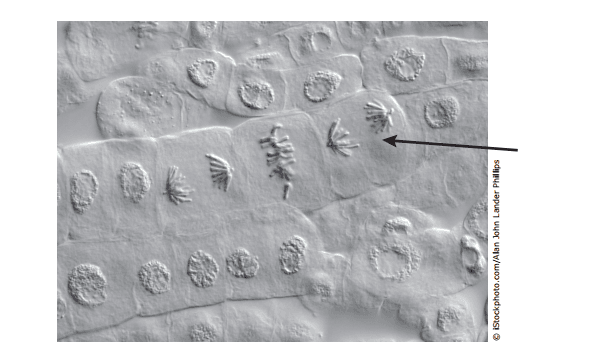
- Q 1/18Score 0A photomicrograph of onion root tip cells during mitosis is shown below. Which phase of mitosis is occurring in the cell indicated by the arrow?29MetaphaseTelophaseProphaseAnaphase


18 questions
Show answers
- Q1A photomicrograph of onion root tip cells during mitosis is shown below. Which phase of mitosis is occurring in the cell indicated by the arrow?MetaphaseTelophaseProphaseAnaphase60sBIOL.5a
- Q2Which of these must occur during S phase of the cell cycle so that two daughter cells can be produced during M phase?The cytoplasm must be separatedThe nuclear membrane must be dissolvedThe DNA must be replicatedThe chromosomes must be joined60sBIOL.5a
- Q3Checkpoints occur between the stages of the cell cycle. If a cell does not meet certain criteria at the end of a stage, it will not move to the next stage. Which of these occurs just before the cell enters the G2 stage of the cell cycle?DNA replicatesThe nucleolus dividesCentrioles formThe nuclear membrane disintegrates60sBIOL.5a
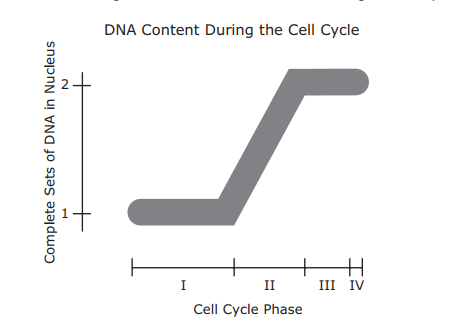
- Q4The model represents the change in the DNA content of a cell during the cell cycle. Which part of the model represents the S phase?IIIIIIVI60sBIOL.5a
- Q5Scientists can bioengineer skin in a laboratory to treat severe burns and other types of skin injuries. This bioengineered tissue is grown from living cells. The cellular process that enables the cells to grow and develop into tissue is -meiosismitosisbinary fissioninterphase60sBIOL.5a
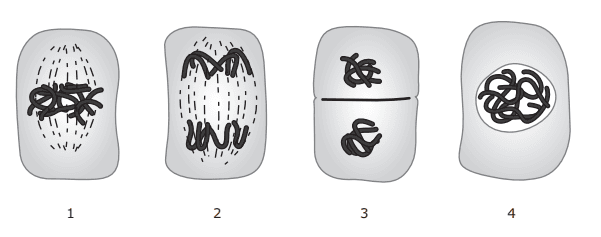
- Q6The diagram shows cells in different phases of mitosis. A student is trying to find a cell in a particular phase of mitosis. The student is looking for evidence that spindle fibers are separating the chromosomes to ensure that each new nucleus has one copy of each chromosome. Which cell is in the phase of mitosis that the student is searching for?Cell 1Cell 3Cell 2Cell 460sBIOL.5a
- Q760sBIOL.5a
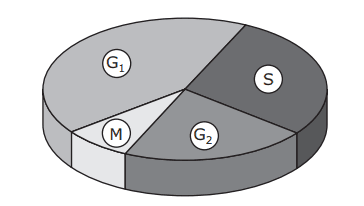
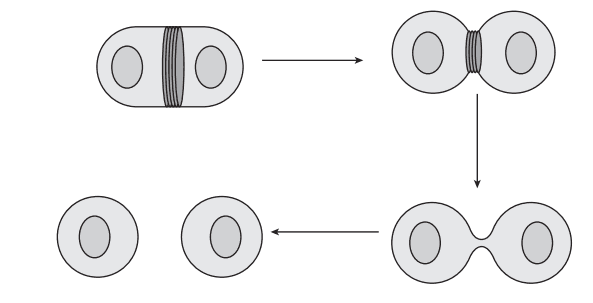
- Q8Part of the cell cycle is shown in this simplified model. This part of the cell cycle is best described as the process that -duplicates the DNAsynthesizes new moleculescompletes cell divisionmaintains genetic homeostasis60sBIOL.5a
- Q9People who have leukemia, a cancer that affects white blood cells, are often given Cytarabine. This drug inhibits the synthesis of DNA. Which phase of the cell cycle is most affected by Cytarabine?M phaseG2 phaseS phaseG1 phase60sBIOL.5a
- Q10The activities in the cell cycle occur during specific phases. In which phase of the cell cycle does the cell grow in size, and prepare to replicate DNA?MitosisG1 PhaseS phaseG2 phase60sBIOL.5a
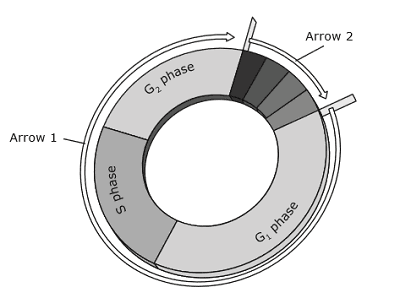
- Q11This model of the cell cycle includes two arrows that each represent a process in the cycle. What do the two arrows represent?Arrow 1 represents prophase, and Arrow 2 represents interphase.Arrow 1 represents mitosis, and Arrow 2 represents meiosis.Arrow 1 represents meiosis, and Arrow 2 represents prophase.Arrow 1 represents interphase, and Arrow 2 represents mitosis.60sBIOL.5a
- Q12Telophase is a stage of a cellular process that begins after the chromosomes have moved to opposite poles of the cell. During which cellular process does telophase occur?InterphaseTranslationTranscriptionMitosis60sBIOL.5a
- Q13Which of the following is a correct statement about the events of the cell cycle?Mitosis is usually the longest phase of the cell cycle when the cell is growing.Interphase consists of the G1, S, G2 phases, and mitosis.Little happens during G1 and G2 phases of the cell cycle.During G2, the cell grows and prepares to dissolve the nuclear membrane.60sBIOL.5a
- Q14The M phase of the cell cycle consists of both mitosis and cytokinesis. Mitosis refers to ____________, whereas cytokinesis refers to _______.Replication of nuclear material, cytoplasmic divisionNuclear division, cell/cytoplasmic divisionCell/cytoplasmic division, nuclear divisionNuclear division, replication of nuclear material60sBIOL.5a
- Q15A laboratory assistant was told to watch the mitosis of a eukaryotic cell under the microscope and inform the lead scientist when the cell entered prophase. What should the assistant expect to look for to indicate that the cell is in prophase?The sister chromatids separate into individual chromosomes and are moved apart.The chromosomes line up across the center of the cell, and each chromosome is connected to a spindle fiber.The chromosomes gather at opposite ends of the cell and two new nuclear envelopes form around this genetic material.The chromatin condenses into chromosomes, the nuclear envelope breaks down, and a spindle begins to form.60sBIOL.5a