Loading...


Module 2 - Examples of Astronomical Phenomena Before the Advent of Telescopes
Quiz by Julliane
Tag the questions with any skills you have. Your dashboard will track each student's mastery of each skill.
This is a reviewer covering the module 2 and 3 - Examples ofAstronomical Phenomena Before the Advent of Telescopes and Modern Astronomy in grade 11 4th quarter physical science. The questioners will going to be
a. multiple choices
b. classification (typing the answer)
c. checkbox (selecting multiple correct or incorrect answers depending on the question)
Note*don't mind the timer, the question will stay even if it runs out, focus on the question and answering it correctly.
Good luck!
Are you ready?
It is the science of the universe outside of our planet. This is the branch of physical science dealing with heavenly bodies. It has resulted in many practical inventions, ideas, including calendars, navigational techniques, laws of motion, engineering of products and an increased understanding of energy and weather.
also called a satellite, is a relatively small object that is orbiting around a planet.
when one celestial body such as a moon or planet moves into the shadow of another celestial body.
a type of eclipse that occurs when the Moon passes between the Sun and Earth, and the Moon fully or partially blocks the light from the Sun
one of the cyclically recurring apparent forms of the moon
the figure of the moon that is more than half full, looking swollen on one side
the figure of the moon that appears as a curve with pointy ends
growing; describes the moon when the illuminated portion is increasing
shrinking; describes the moon when the illuminated portion is decreasing
In the solar system, It is a large round object that orbits the Sun and has cleared out most of the other objects in its orbit.
The Sun and all of the planets, comets, etc. that revolve around it.
Check all the properties that describes the Solar Eclipse
Check all the properties that describes the Lunar Eclipse
Which of the following shows a SUNDIAL
Babylonian and Egyptian civilizations used a primitive version of a sundial, called __________, in systematically observing the motion of the sun.
By looking at the shadows that the gnomon casts, what part of the sky does the sun rises from?
By looking at the shadows that the gnomon casts, what part of the sky does the sun sets from?
Which one is true?
How many days does our Moon to complete one cycle of phases (from full Moon to full Moon) ?
Which is true?
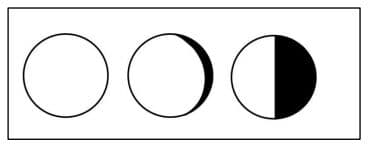
Mary Gneiss must keep a moon journal for her homework. Her sketches of how the Moon appeared on three different clear nights are shown. Based on Mary Gneiss’s drawings, it appears that the Moon is waxing.
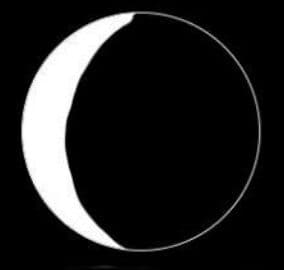
As viewed from Earth, the Moon appears in the sky as shown below. Which of the following best describes the phase of the Moon?
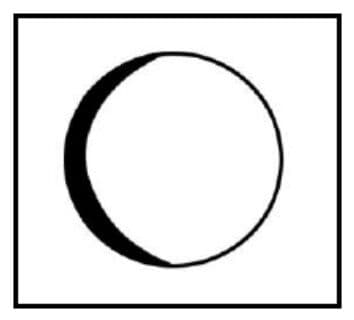
Jerzenn Clay is creating a moon phase diagram as part of an Astronomy project. She drew the image of the Moon as shown below. Which of the following best describes the phase of the Moon that could be represented by Jerzenn Clay’s drawing?
As viewed from Earth, the Moon appears in the sky as shown below. Which of the following best describes the phase of the Moon?
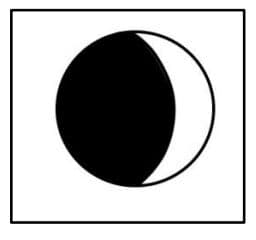
As viewed from Earth, the Moon appears in the sky as shown below. Which of the following best describes the phase of the Moon?
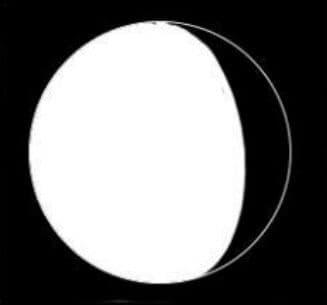
As viewed from Earth, the Moon appears in the sky as shown below. Which of the following best describes the phase of the Moon?
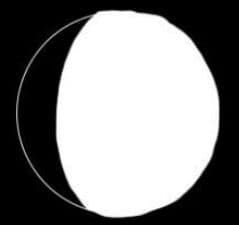
What are the Planets Discovered Before the Invention of Telescope
Complete the statements. Even before the advent of the telescopes, ancient astronomers were able to observe the following:
rising and setting of the ________ in the east and the west, respectively,
Complete the statements. Even before the advent of the telescopes, ancient astronomers were able to observe the following:
rising and setting of the SUN in the east and the west, respectively,
point where the Sun rises and sets in the _______ varies in a year,
Complete the statements. Even before the advent of the telescopes, ancient astronomers were able to observe the following:
rising and setting of the SUN in the east and the west, respectively,
point where the Sun rises and sets in the HORIZON varies in a year,
phases of the ________,
Complete the statements. Even before the advent of the telescopes, ancient astronomers were able to observe the following:
rising and setting of the SUN in the east and the west, respectively,
point where the Sun rises and sets in the HORIZON varies in a year,
phases of the MOON, ________ eclipse,
Complete the statements. Even before the advent of the telescopes, ancient astronomers were able to observe the following:
rising and setting of the SUN in the east and the west, respectively,
point where the Sun rises and sets in the HORIZON varies in a year,
phases of the MOON, SOLAR eclipse,
daily and annual motion of the _________, and
Complete the statements. Even before the advent of the telescopes, ancient astronomers were able to observe the following:
rising and setting of the SUN in the east and the west, respectively,
point where the Sun rises and sets in the HORIZON varies in a year,
phases of the MOON, SOLAR eclipse,
daily and annual motion of the STARS, and
planets Mercury, ________, ________, ________, and _______.
It is the apparent daily revolution of the celestial sphere around the celestial poles as a direct effect of the Earth's Rotation on its axis
It is the apparent motion of celestial bodies viewed from Earth is east to west
It is the apparent yearly movement of the stars as observed from Earth as a direct effect of the Earth's revolution around the sun
It is the apparent motion along the ecliptic as Earth 'wobbles', and this motion happens about every 26,000 years.
At present, Earth's North Pole points to Polaris. However, it will eventually point to another star, _____, because of precession
Which law describes that the actual path followed by the planets was elliptical, not circular, with the Sun at one focus of the ellipse
Which law describes that the square of a planet’s orbital period is directly proportional to the cube of the semimajor axis of its orbit
Which law states that when an imaginary line is drawn from the center of the sun to the center of a planet, the line will sweep out an equal area of space in equal time intervals
Which law describes that each planet moves around the Sun in an orbit that is an ellipse, with the Sun at one focus of the ellipse
Which law states that the ratio of the squares of the periods of two planets is equal to the ratio of the cubes of the average distances of these two planets from the sun
Which law describes that the straight line joining a planet and the Sun sweeps out equal areas in space in equal intervals of time
it is the unit of length defined as the average distance between Earth and the Sun; this distance is about 1.5 X 10⁸ kilometers or 1.5 X 10¹¹ metres
it is in an eclipse, the ratio of the distance between the foci to the major axis
it is a closed curve for which the sum of the distances from any point on the ellipse to two points inside (called the foci) is always the same
it is one of two fixed points inside an ellipse from which the sum of the distance to any point on the ellipse is constant
It is the plural form of focus
The average distance value is given in astronomical units where 1 AU is equal to the?
the orbital period is given in units of?
If the same T^2/R^3 ratio is computed for the other planets, it can be found that this ratio is nearly the _____
Where is the Celestial Sphere?
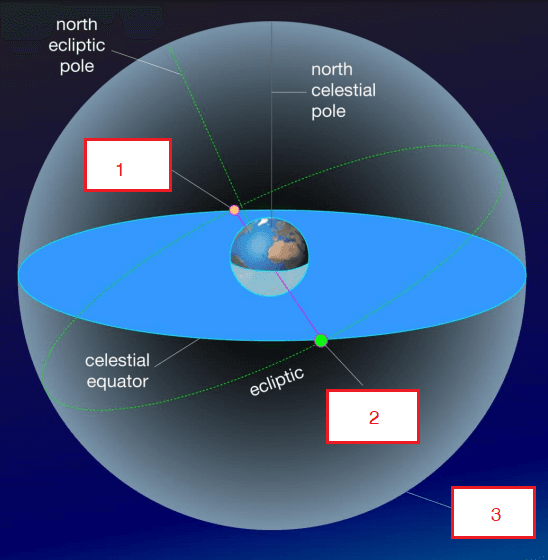
Where is the Diurnal Equinox?
Where is the Autumnal Equinox?
Celestial Sphere:
Where is the South Celestial Pole?
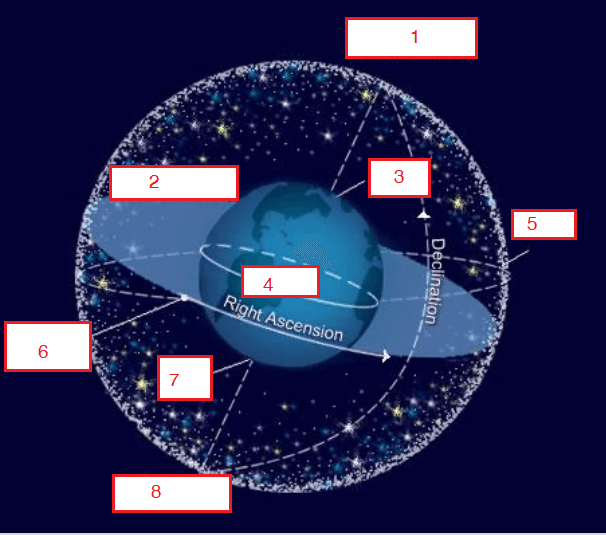
Celestial Sphere:
Where is the Equator?
Celestial Sphere:
Where is the Vernal Equinox?
Celestial Sphere:
Where is the Celestial Equator?
Celestial Sphere:
Where is the North Celestial Pole?
Celestial Sphere:
Where is the South Pole?
Celestial Sphere:
Where is the Ecliptic?
Celestial Sphere:
Where is the North Pole?
Type the phases of the moon from new moon to new moon by typing your answer accordingly (all lowercase letters):
_____ - _____ - f_____ - _____ - _____ - _____ - t_____ - _____ (8)
If the you start with the new moon, what is the 2nd phase?
If the you start with the new moon, what is the 3rd phase?
If the you start with the new moon, what is the 4th phase?
If the you start with the new moon, what is the 6th phase?
If the you start with the new moon, what is the 7th phase?
If the you start with the new moon, what is the 8th phase?