


NAT EARTH SCI
Quiz by Adrian Suba
Feel free to use or edit a copy
includes Teacher and Student dashboards
Measure skillsfrom any curriculum
Measure skills
from any curriculum
Tag the questions with any skills you have. Your dashboard will track each student's mastery of each skill.
With a free account, teachers can
- edit the questions
- save a copy for later
- start a class game
- automatically assign follow-up activities based on students’ scores
- assign as homework
- share a link with colleagues
- print as a bubble sheet
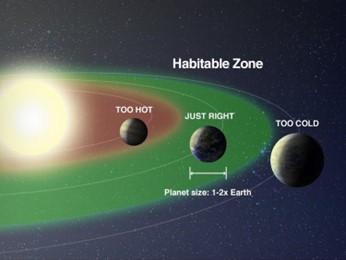
- Q 1/20Score 01. How does a planet's position in the Goldilocks zone impact the potential for liquid water, a key ingredient for life?29C. The Goldilocks zone ensures ideal conditions for liquid water.D. Liquid water is only found in the extreme outer regions of the zone.A. Liquid water is guaranteed regardless of the zone.B. The zone does not influence the presence of liquid water.


20 questions
Show answers
- Q11. How does a planet's position in the Goldilocks zone impact the potential for liquid water, a key ingredient for life?C. The Goldilocks zone ensures ideal conditions for liquid water.D. Liquid water is only found in the extreme outer regions of the zone.A. Liquid water is guaranteed regardless of the zone.B. The zone does not influence the presence of liquid water.30s
- Q22. Why is Earth's temperature suitable to sustain water for organisms, compared to Venus and Mars, due to their distances from the sun?A. Because Earth's low temperature freezes all water into ice constantly.D. Because Earth's temperature is adequate to create and preserve solid water on its surface.B. Because Earth's high temperature prevents rapid evaporation of surface water.C. Because Earth's temperature is optimal for maintaining and transforming liquid water.30s
- Q33. Consider Earth's unique combination of size and distance from the sun. How does this contribute to the planet's ability to support diverse ecosystems and life forms?D. Habitability is determined solely by a planet's geological features.A. The combination ensures a uniform environment, limiting biodiversity.C. Earth's characteristics have no impact on the diversity of life.B. Diverse ecosystems thrive due to the specific size-distance relationship.30s
- Q44. Scientists have discovered a new planet orbiting a star in another solar system. This planet has a similar size and rocky composition to Earth. It also possesses a liquid water surface covering a significant portion of its surface.Based on the information above and our current understanding of life on Earth, which of the following statements is the LEAST relevant to the question of whether life could potentially exist on this newly discovered planet?C. The existence of a magnetic field.B. The temperature range on the planet's surface.D. The planet's distance from its star.A. The presence of an atmosphere and its composition.30s
- Q55. Scientists are searching for potential signs of life on other planets in the solar system. They discover a planet with a similar temperature range to Earth and an atmosphere containing oxygen. Based on the information above, which of the following statements is the MOST relevant to the possibility of life existing on this planet?D. The planet has a magnetic field similar to Earth'C. The planet has a similar rotation period to Earth.A. The planet is located in the habitable zone of its solar system.B. The planet has a similar size and mass to Earth.30s
- Q66. Scientists discover a new exoplanet orbiting a distant star. This planet is roughly the same size as Earth and lies within the habitable zone of its star, meaning it receives the right amount of energy to potentially harbor liquid water on its surface. However, the exoplanet's atmosphere is found to be composed primarily of ammonia gas. Based solely on the information provided, which of the following statements is CRUCIAL to the possibility of life existing on the exoplanet?C. The exoplanet's atmosphere is composed primarily of ammonia gas, which is toxic to most life forms on Earth.D. Earth is the only planet in the solar system known to support life, suggesting life may be rare in the universe.B. The exoplanet is located within the habitable zone of its star, suggesting suitable temperatures for liquid water.A. The exoplanet is similar in size to Earth, suggesting it may have a rocky composition.30s
- Q77. You are researching the history of life on Earth and come across two sources: Source A: A well-established scientific journal article published by a team of paleontologists, detailing the fossil record and its implications for the evolution of dinosaurs. Source B: A blog post written by an individual with no scientific background, claiming that dinosaurs were wiped out by a giant asteroid based solely on a single, controversial movie. Based on your knowledge of evaluating sources, which source is MOST RELIABLE for understanding the Earth's history and the extinction of dinosaurs?C. Source A and B onlyA. Source A onlyD. Cannot be determinedB. Source B only30s
- Q88. You find additional information on Source A (the Paleontological Society website) concerning the Permian-Triassic extinction event, one of the most significant events in Earth's history. However, the specific details about the cause of the extinction are stillunder scientific debate. Which of the following actions would BEST demonstrate a critical evaluation of the information's credibility?A. Assume the explanation on the website is incorrect because different scientific theories exist.C. Search online forums with discussions about extinction and accept the most popular explanation.B. Cross-reference the information with other reliable sources, such as scientific journals or reports from reputable research institutions.D. Only consider peer-reviewed scientific journals published within the last five years; disregard older sources as potentially outdated30s
- Q99. When researching scientific topics, why is it important to consider the following criteria when evaluating a source? Authorship: Who created the source? Purpose: Why was the information created? Date of Publication: How recent is the information?A. These criteria ensure the source is accurate, unbiased, and up-to-date.C. These criteria focus on the appearance and readability of the source.B. These criteria allow you to only use sources from well-known universities.D. These criteria are unimportant for scientific research because everyone has an opinion. For questions 10-12 refer to the illustration on the right30s
- Q1010. What is one of the primary hazards associated with earthquakes, according to the poster?B. soil erosionD. floodsA. volcanic eruptionsC. landslides30s
- Q1111. What is the MOST LIKELY reason why ground shaking causes so much damage during an earthquake?C. The shaking ground makes it difficult for people to move around safely.D. The shaking ground disrupts electrical lines, causing power outagesB. The shaking ground disrupts the foundation of buildings, causing them to crack or crumble.A. The shaking ground creates loud noises that can startle people.30s
- Q1212. The poster identifies liquefaction as a primary earthquake hazard. What is the MOST LIKELY consequence of liquefaction in a city with many high-rise buildings?D. There will be widespread power outages throughout the city. For questions refer to the diagram below.B. High-rise buildings are more likely to collapse.C. Traffic congestion will increase due to road closures.A. The city's water supply will be contaminated.30s
- Q1313. Which of the following information can be gathered using the diagram above?A. the types of rocks and their formationC. where weathering, erosion, transportation, and deposition happenD. the process of bringing magma from the mantle to the crust via volcanoesB. the process of how metamorphic rocks are classified30s
- Q1414. Based on the diagram above, which of the following is a correct flow of the formation of rocks?D. I, and IVC. I and IIIB. II and IIIA. I and II30s
- Q1515. Listed below are processes on the formation of a sedimentary rock. Based on the diagram, which is the correct sequence of the formation of a sedimentary rock?A. I III IVD. II IV VFor questions 16-18 refer to the diagrams below:C. I III VB. I II V30s


