Summarize the relationships among producers, consumers, and decomposers including the positive and negative consequences of such interactions including:
• coexistence and cooperation
• competition (predator/prey)
• parasitism
• mutualism
Explain how the flow of energy within food webs is interconnected with the cycling of matter (including water, nitrogen, carbon dioxide, and oxygen)
Track each student's skills and progress in your Mastery dashboards
Give this quiz to my class
Q 1/9
Score 0
Which of these organisms is a producer in a marine ecosystem?
60
fish
algae
worm
gull
Q 2/9
Score 0
Which BEST determines the number of wolves that can live in an area?
60
the number of trees in the area
the amount of snow in the area each year
the amount of food available in the area
the number of birds that live in the area
9 questions
Q.
Which of these organisms is a producer in a marine ecosystem?
1
60 sec
8.L.3.2
Q.
Which BEST determines the number of wolves that can live in an area?
2
60 sec
8.L.3.1
Q.
What happens to a population and to competition when there is a reduction of living space?
3
60 sec
8.L.3.1
Q.
Kudzu vines grow by climbing and wrapping around trees. Trees covered by kudzu can die because they are starved of sunlight. What type of relationship exists between the trees and the kudzu growing on them?
4
60 sec
8.L.3.2
Q.
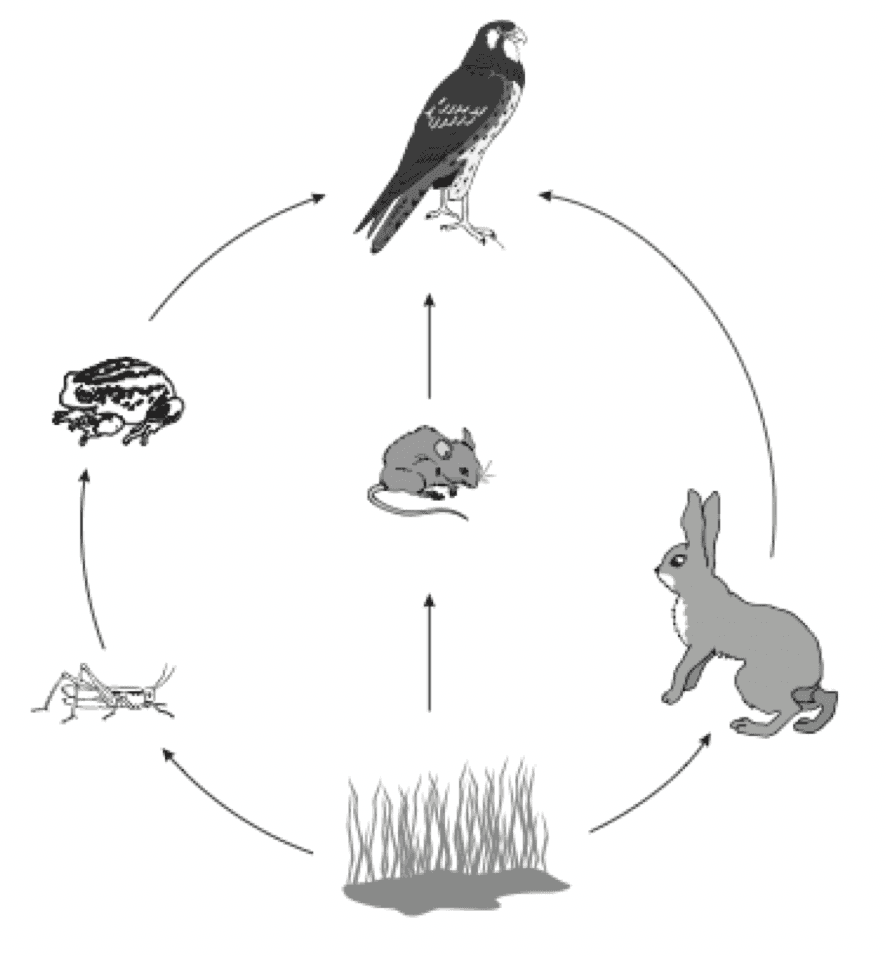
Consider this food web:
Where is the largest amount of energy found in this food web?
5
60 sec
8.L.3.3
Q.
Which BEST explains the importance of nitrogen in the cycling of energy and matter?
6
60 sec
8.L.3.3
Q.
If wolves prey on deer for food, what will MOST LIKELY happen to the deer population if wolves are removed from an area where deer live?
7
60 sec
8.L.3.2
Q.
Where do plants get most of the energy they need to live and grow?
8
60 sec
8.L.3.3
Q.
In a food pyramid, which BEST explains why the number of organisms decreases from one trophic level to the next?