Loading...


NQESH Mock Test D
Quiz by Tin
Tag the questions with any skills you have. Your dashboard will track each student's mastery of each skill.
1. Ms. Santos, a Grade 2 teacher, wants to align her lesson plans with the K to 12 curriculum's goals. She aims to develop her students' critical thinking skills and prepare them for real-world challenges.
Question:
Which of the following strategies best aligns with the K to 12 curriculum's goal of developing critical thinking skills?
A. Focusing solely on rote memorization of facts and figures.
B. Incorporating project-based learning and problem-solving activities.
C. Using only traditional lecture methods without student interaction.
D. Emphasizing the use of standardized tests for assessment.
2. Mr. Reyes, a high school teacher, is designing his lesson plan for the upcoming school year. He wants to ensure that his teaching methods reflect the core principles of the K to 12 curriculum.
Question:
Which principle should Mr. Reyes prioritize to enhance student engagement and learning according to DepEd Order No. 21, s. 2019?
A. Teacher-centered instruction with limited student participation.
B. Student-centered learning that encourages active participation and collaboration.
C. Extensive use of textbooks as the sole source of information.
D. Strict adherence to traditional grading systems without formative assessments.
3. Mr. Dela Cruz, a school principal, is reviewing the school's implementation of the K to 12 curriculum. He notices that the senior high school program needs improvements.
Question:
Which aspect of the senior high school program should Mr. Dela Cruz enhance to align with the goals of the K to 12 curriculum?
A. Offering a limited range of specialized tracks to students.
B. Ensuring that the curriculum includes both core and applied subjects.
C. Reducing the number of practical and hands-on learning experiences.
D. Maintaining a rigid and uniform curriculum without flexibility.
4. Mr. Dela Cruz, a school principal, is reviewing the school's implementation of the K to 12 curriculum. He notices that the senior high school program needs improvements.
Question:
Which aspect of the senior high school program should Mr. Dela Cruz enhance to align with the goals of the K to 12 curriculum?
A. Offering a limited range of specialized tracks to students.
B. Ensuring that the curriculum includes both core and applied subjects.
C. Reducing the number of practical and hands-on learning experiences.
D. Maintaining a rigid and uniform curriculum without flexibility.
5. Ms. Lim, a curriculum coordinator, is tasked with integrating 21st-century skills into the junior high school curriculum. She plans to develop activities that align with DepEd Order No. 21, s. 2019.
Question:
Which of the following activities best supports the development of 21st- century skills as outlined in the K to 12 curriculum?
A. Group activities that foster collaboration and problem-solving.
B. Individual assignments that focus on memorization.
C. Lectures that minimize student interaction.
D. Assessments based solely on multiple-choice questions.
The following are the priorities for Phase 2 of BEDP 2030
I. Continuation of programs and projects on access, quality, equity, and learner’s rights and resilience
II. Operationalization of the innovations initiated under the Educators Futures Program
III. Program and impact evaluation
IV. System wide capacity development
V. Development of new programs to address emerging education issues and opportunities
VI. End of plan assessment
A. I, II, III, IV
B. II, III, V, VI
C. I, III, IV, V, VI
D. I, II, III, V, VI
The Monitoring Evaluation Framework BEMEF will be operationalized into six integrated strategies that were designed to validate the different levels of results and support the decision-making needs of the different levels of governance. The six strategies are designed to ensure a more systemic and systematic approach to monitoring and tracking, evaluating, and enhancing the BEDP implementation programs to address emerging education issues and opportunities
I. establishment of baselines
II. quarterly program implementation review
III. annual implementation review
IV. mid-term review
V. results monitoring and evaluation
VI. impact evaluation
VII. End of plan assessment
A. I, II, III, IV, VI, VII
B. II, III, IV, V, VI, VII
C. I, II, III, IV, V, VI
D. I, II, III, V, VI, VII
8. What potential effects can the Mandanas ruling have on schools and school heads in the context of the DepEd Special Education Fund (SEF)?
A) Increased funding for teacher salaries
B) Enhanced infrastructure development in schools
C) Greater accountability for SEF utilization
D) Direct allocation of SEF funds to national programs
10. The signboard of the school should be of appropriate length and width to accommodate the name and location of the school. The littering, in simple block or Roman style should be big enough to be easily readable from the street at a distance of meters from the school.
A. 5 to 10 meters
B. 10 to 20 meters
C.15 to 30 meters
D. 20 to 40 meters
11. School Head B issued an office memorandum designating Teacher A as a property custodian of XYZ National High School. Is the action of School HeadB allowed?
A. Yes. School Head has the power to designate teachers to perform administrative task like property custodianship
B. Yes. School Head must ensure that teachers has enough workload
C. No. School Head have the sole responsibility to perform administrative task like property custodianship
D. No. School Head must ensure that teachers focus on teaching content
Which of the following are phases of Policy Development
I. Agenda-setting
II. Policy Formulation
III. Policy Adoption
IV. Policy Consultation
V. Policy Implementation
VI. Policy Monitoring
VII. Policy Review
A. I, II, IV, V, VII
B. II, III, V, VI, VII
C. II, III, IV, V, VI
D. I, II, III, V, VII
Which of the following are the features of the MATATAG Curriculum?
I. decongested curriculum;
II. focus on foundational skills;
III. balanced cognitive demands;
IV. clearer articulation of 21st-century skills;
V. reduced learning areas;
VI. intensified Values Education and Peace Education,
VII. on a par with international standards.
A. I, II, IV, V, VII only
B. I, II, III, V, VI, VII only
C. I, II, III, IV, V, VI only
D. I, II, III, IV, V, VI, VII
What is true about Basic Education Development Plan 2023?
A. BEDP 20230 is the Philippines' first long-term plan for basic education, covering formal education for Kindergarten to Grade 12 and non-formal education for youth and adults
B. It covers Kindergarten, Elem, JHS, SHS and ALS with articulation of linkages with the other education agencies - ECCD, CHED, and TESDA
C. It is a plan for deep economic & social transformation to reinvigorate job creation & accelerate poverty reduction by steering the economy back on a high growth path that is inclusive, building on environment and providing equal opportunities to all Filipino
What is the correct answer?
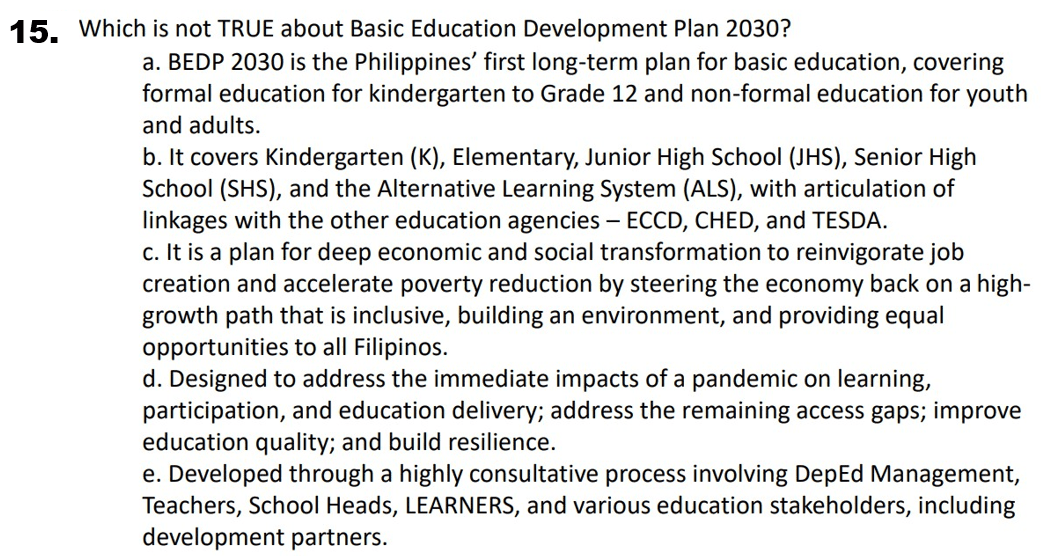
What is the correct answer?

What is the correct answer?
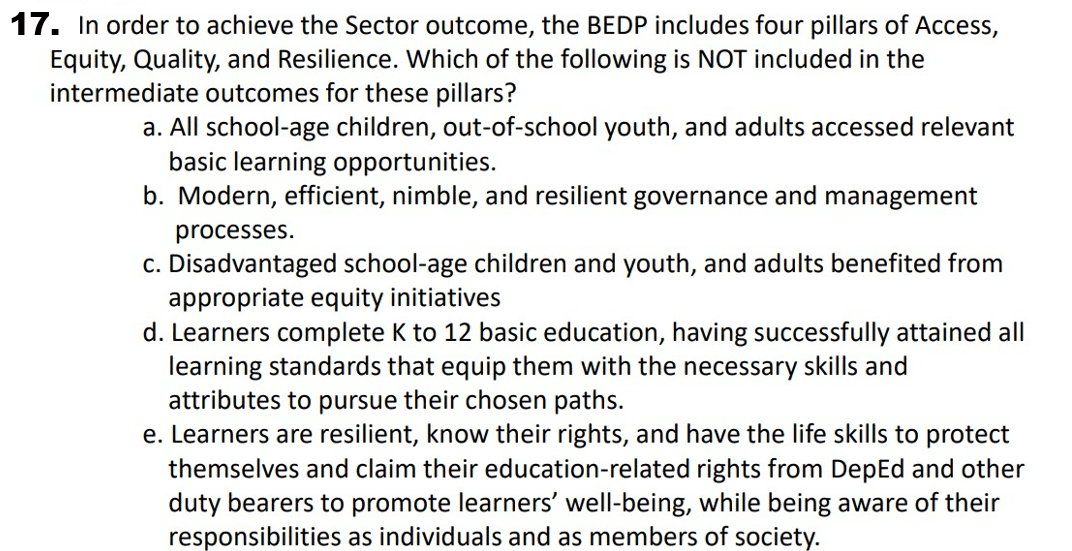
What is the correct answer?

What is the correct answer?

What is the correct answer?
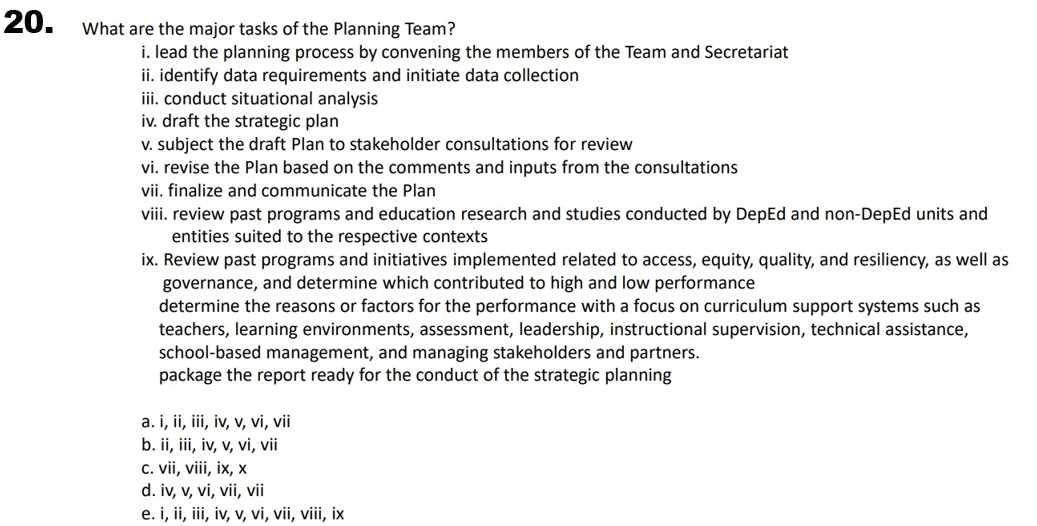
What is the correct answer?

What is the answer?
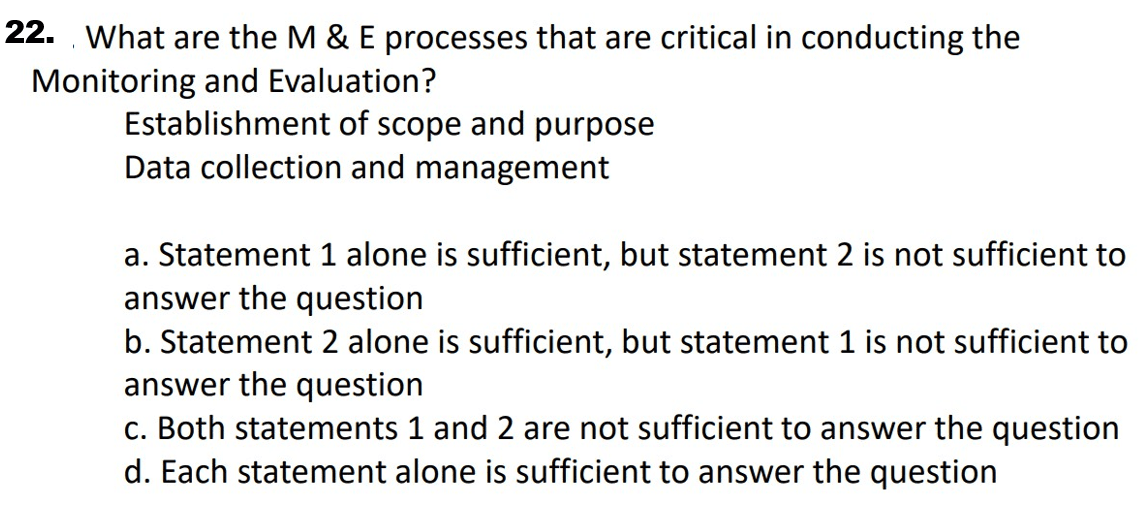
What is the answer?

What is the answer?

What is the answer?

What is the answer?
