Multiply or divide to solve word problems involving multiplicative comparison, distinguishing multiplicative comparison from additive comparison. Use drawings and equations with a symbol for the unknown number to represent the problem.
Explain why a fraction a/b is equivalent to a fraction (n x a)/(n x b) by using visual fraction models, with attention to how the number and size of the parts differ even though the two fractions themselves are the same size. Use this principle to recognize and generate equivalent fractions.
Recognize angle measure as additive. When an angle is decomposed into non-overlapping parts, the angle measure of the whole is the sum of the angle measures of the parts. Solve addition and subtraction problems to find unknown angles on a diagram in real world and mathematical problems.
Draw points, lines, line segments, rays, angles (right, acute, obtuse), and perpendicular and parallel lines. Identify these in two-dimensional figures.
Understand addition and subtraction of fractions as joining and separating parts referring to the same whole.
Use place value understanding to round multi-digit whole numbers to any place.
Solve word problems involving multiplication of a whole number by a fraction.
Find whole-number quotients and remainders with up to four-digit dividends and one-digit divisors, using strategies based on place value, the properties of operations, and/or the relationship between multiplication and division. Illustrate and explain the calculation by using equations, rectangular arrays, and/or area models.
Add and subtract mixed numbers with like denominators.
Recognize that in a multi-digit whole number, a digit in one place represents ten times what it represents in the place to its right.
Understand a multiple of a/b as a multiple of 1/b, and use this understanding to multiply a whole number by a fraction.
Identify and name all quadrilaterals with four right angles as rectangles.
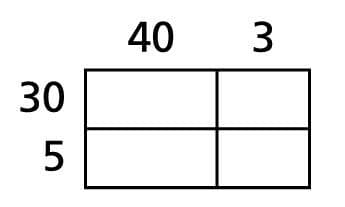
Multiply a whole number of up to four digits by a one-digit whole number, and multiply two two-digit numbers, using strategies based on place value and the properties of operations. Illustrate and explain the calculation by using equations, rectangular arrays, and/or area models.
Apply the area and perimeter formulas for rectangles in real world and mathematical problems.
Recognize a line of symmetry for a two-dimensional figure as a line across the figure such that the figure can be folded along the line into matching parts. Identify line-symmetric figures and draw lines of symmetry.
Represent these problems using equations with a letter standing for the unknown quantity. Assess the reasonableness of answers using mental computation and estimation strategies including rounding.
Compare two fractions with different numerators and different denominators. Recognize that comparisons are valid only when the two fractions refer to the same whole. Record the results of comparisons with symbols >, =, or <, and justify the conclusions.
Decompose a fraction into a sum of fractions with the same denominator in more than one way, recording each decomposition by an equation. Justify decompositions.
Track each student's skills and progress in your Mastery dashboards