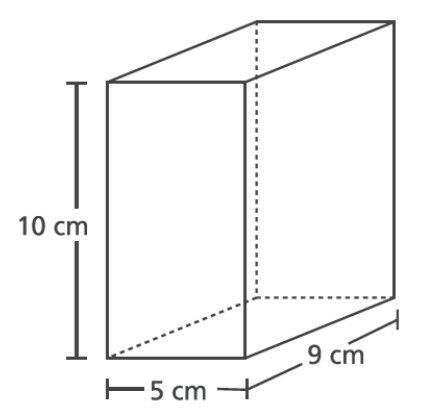
Apply the formulas V=l×w×h and V=B×h for rectangular prisms to find volumes of right rectangular prisms with whole-number edge lengths in the context of solving real world and mathematical problems.
Solve real world problems involving multiplication of fractions and mixed numbers.
Compare two decimals to thousandths based on meanings of the digits in each place, using >, =, and < symbols to record the results of comparisons.
Write simple expressions that record calculations with numbers, and interpret numerical expressions without evaluating them.
Measure volumes by counting unit cubes, using cubic cm, cubic in, cubic ft, and improvised units.
Apply the order of operations to evaluate numerical expressions.
Convert among different-sized standard measurement units within a given measurement system when the conversion factor is given. Use these conversions in solving multi-step, real world problems.
Find the area of a rectangle with fractional side lengths by tiling it with rectangles of the appropriate unit fraction side lengths, and show that the area is the same as would be found by multiplying the side lengths. Multiply fractional side lengths to find areas of rectangles, and represent fraction products as rectangular areas.
Find whole-number quotients of whole numbers with up to four-digit dividends and two-digit divisors, using strategies based on place value, the properties of operations, and/or the relationship between multiplication and division. Illustrate and explain the calculation by using equations, rectangular arrays, and/or area models.
Find the volume of a right rectangular prism with whole-number side lengths by packing it with unit cubes, and show that the volume is the same as would be found by multiplying the edge lengths, equivalently by multiplying the height by the area of the base.
Use place value understanding to round decimals to any place.
Solve real-world problems involving division of unit fractions by non-zero whole numbers and division of whole numbers by unit fractions.
Solve word problems involving addition and subtraction of fractions referring to the same whole, including cases of unlike denominators. Use benchmark fractions and number sense of fractions to estimate mentally and assess the reasonableness of answers.
Compare the size of a product to the size of one factor on the basis of the size of the other factor, without performing the indicated multiplication.
Interpret division of a unit fraction by a non-zero whole number, and compute such quotients.
Using concrete models or drawings and strategies based on place value, properties of operations, and/or the relationship between operations:
• add and subtract decimals to hundredths;
• multiply and divide decimals to hundredths.
Relate the strategy to a written method and explain the reasoning used.
Make a line plot to display a data set of measurements in fractions of a unit (1/2, 1/4, 1/8). Use operations on fractions for this grade to solve problems involving information presented in line plots.
Recognize volume as additive. Find volumes of solid figures composed of two non- overlapping right rectangular prisms by adding the volumes of the non-overlapping parts, applying this technique to solve real world problems.
Track each student's skills and progress in your Mastery dashboards