Apply properties of operations as strategies to multiply and divide rational numbers.
Solve multi-step real-life and mathematical problems posed with positive and negative rational numbers in any form (whole numbers, fractions, and decimals), using tools strategically. Apply properties of operations to calculate with numbers in any form; convert between forms as appropriate. Assess the reasonableness of answers using mental computation and estimation strategies.
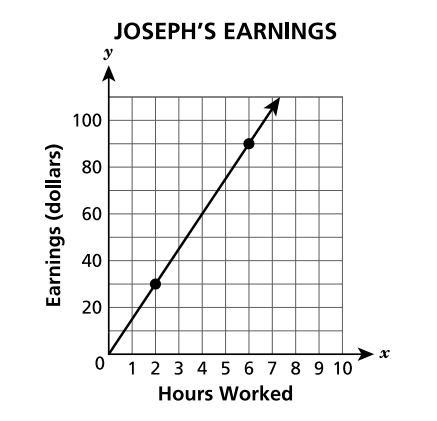
Identify the constant of proportionality (unit rate) in tables, graphs, equations, diagrams, and verbal descriptions of proportional relationships.
Apply properties of operations as strategies to add and subtract rational numbers.
Solve real-world and mathematical problems involving the four operations with rational numbers.
Decide whether two quantities are in a proportional relationship.
Use measures of center and measures of variability for quantitative data from random samples or populations to draw informal comparative inferences about the populations.
Solve word problems leading to equations of the form px + q = r and p(x + q) = r, where p, q, and r are rational numbers. Solve equations of these forms fluently. Compare an algebraic solution to an arithmetic solution, identifying the sequence of the operations used in each approach.
Understand that rewriting an expression in different forms in a problem context can shed light on the problem and how the quantities in it are related.
Use proportional relationships to solve multistep ratio and percent problems.
Represent a proportional relationship using an equation.
Compute unit rates associated with ratios of fractions.
Understand that, just as with simple events, the probability of a compound event is the fraction of outcomes in the sample space for which the compound event occurs.
Understand addition of rational numbers; p + q is the number located a distance |q| from p, in the positive or negative direction depending on whether q is positive or negative. Show that a number and its opposite have a sum of 0 (are additive inverses). Interpret sums of rational numbers by describing real-world contexts.
Solve word problems leading to inequalities of the form px+q>r, px+q≥r, px+q≤r,or px + q < r, where p, q, and r are rational numbers. Graph the solution set of the inequality on the number line and interpret it in the context of the problem.
Track each student's skills and progress in your Mastery dashboards