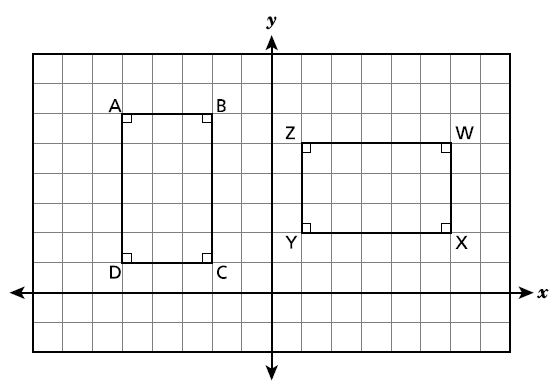
Understand that a two-dimensional figure is congruent to another if the second can be obtained from the first by a sequence of rotations, reflections, and translations; given two congruent figures, describe a sequence that exhibits the congruence between them.
Understand that a two-dimensional figure is similar to another if the second can be obtained from the first by a sequence of rotations, reflections, translations, and dilations; given two similar two-dimensional figures, describe a sequence that exhibits the similarity between them.
Use informal arguments to establish facts about the angle sum and exterior angle of triangles, about the angles created when parallel lines are cut by a transversal, and the angle-angle criterion for similarity of triangles.
Track each student's skills and progress in your Mastery dashboards
Give this quiz to my class
Q 1/6
Score 0
60
Q 2/6
Score 0
60
6 questions
Q.
1
60 sec
8.G.A.2
Q.
2
60 sec
8.G.A.3
Q.
3
60 sec
8.G.A.4
Q.
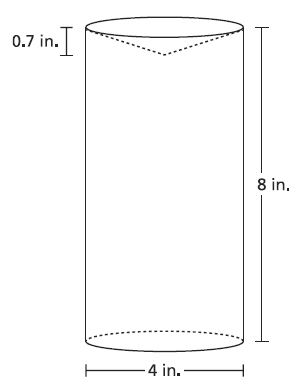
The object below is made of solid plastic. It is a cylinder with an indentation at the top in the shape of a cone.
What is the volume, to the nearest tenth of a cubic inch, of the plastic object?