Loading...


Opener 10/14 and 10/15 3i, 2d
Quiz by Darrien James
Customize this quiz to suit your class
Instantly translate to 100+ languages
Tag the questions with any skills you have. Your dashboard will track each student's mastery of each skill.
Which of the electron configurations below represents an element that is likely to bond with 1s2 2s2 2p6 3s23p6 4s1 to form a bond with a 1:1 bonding configuration?
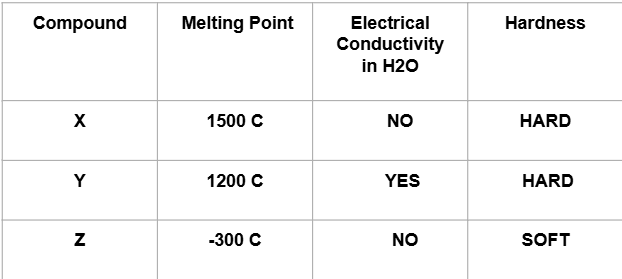
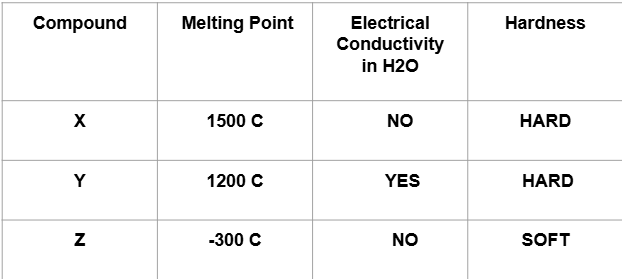
What type of bond exist in compound Y?
Which of the electron configurations below represents an element that is likely to bond with 1s2 2s2 2p6 3s23p6 4s1 to form a bond with a 1:1 bonding configuration?
1s2 2s2 2p6 3s23p5
1s2 2s2 2p3
1s2 2s2 2p4
1s2 2s2 2p6
What type of bond exist in compound Y?
nonpolar covalent bond
ionic bond
metallic bond
polar covalent bond
Give this quiz to my class
10/16 & 10/17 Naming Ionic Compounds Opener 2eMagnets Work! Did you know magnets are all around you? Magnets help you do amazing things! Keep reading! See if you think magnets have surprising uses. Magnets Pull. Look closely and you will see. Magnets can be found on a can opener. The magnet attracts, or pulls, the lid off of a soup can. A push or pull is called a force. There is also a magnet in a refrigerator. It pulls the metal in the door to make a tight seal. Do you know how? A magnet's force pulls objects made of metals called iron and steel. It will not pull other things. It will not pull a wooden pencil or a plastic toy. A magnet does not attract all items. Magnets Have Poles. You have proved, or shown, that magnets can pull some things to it. Why is this true? The two ends of a magnet are its poles. Every magnet has a north pole and a south pole. Have you ever played with trains that have magnets? Sometimes, you try to put two train cars together, but they repel. This means they push away from each other. Then you turn one of the cars around. The two cars snap together as quick as a wink. That's right! If you have played with these trains, you know it is true. When the train cars push away, two of the same poles are facing each other. However, if you put the north and south poles together, they will snap together like the train. Magnets Can Be Powerful. We know that magnets can move objects. But does the heaviness of an object matter? Can magnets move objects that have different weights? Yes, they can. Scientists are using magnets in new ways. People often wish they could travel at a faster speed than a train. There is a new train that uses powerful magnets to travel more quickly. Magnets lift the train above the track and push the train forward. The train appears to be moving as fast as lightning! Scientists have measured these train speeds. They are much faster than the trains we know. Can you imagine what magnets will help us do in the future? 10ENGLISH GROUP PROJECT: THE GLOBAL VENTURE (Thailand) Comprehensive Presentation Script & Role Outline (5-Person Distribution) 1. Strategic Role & Workload Distribution Matrix Role / Name Core Domain / Responsibility Presentation Delivery Scope Member 1Member 1 Tan Finance & Housing (Rent, cost of living, deposits, urban/rural margins)Finance & Housing (Rent, cost of living, deposits, urban/rural margins) Slide 3: Finance Lead, Slide 8: Data VisualizerSlide 3: Finance Lead, Slide 8: Data Visualizer Member 2Member 2 Huy Work Culture & Professional Etiquette (Hierarchy, industry growth, networking)Work Culture & Professional Etiquette (Hierarchy, industry growth, networking) Slide 3: Culture Lead, Slide 9: Adaptation ExpertSlide 3: Culture Lead, Slide 9: Adaptation Expert Member 3Member 3 Minh Legal, Immigration & Visa Pathways (Non-Immigrant B visas, extensions, 90-day rules)Legal, Immigration & Visa Pathways (Non-Immigrant B visas, extensions, 90-day rules) Slide 3: Legal Anchor, Slide 4: Legal FrameworkSlide 3: Legal Anchor, Slide 4: Legal Framework Member 4Member 4 THanh Healthcare Ecosystem & Public Safety (Insurance, emergency networks, local hazards)Healthcare Ecosystem & Public Safety (Insurance, emergency networks, local hazards) Slide 3: Safety Anchor, Slide 10: Matrix PresenterSlide 3: Safety Anchor, Slide 10: Matrix Presenter Member 5Member 5 Sơn(project manager),Kiên Logistics, Climate & Project Manager (Transit, weather, group synthesis)Logistics, Climate & Project Manager (Transit, weather, group synthesis) Slide 1-2: Opener, Slide 6: Email Lead, Slide 11-12: CloserSlide 1-2: Opener, Slide 6: Email Lead, Slide 11-12: Closer 3. Complete Presentation Script (Slide-by-Slide) Execution Note: During delivery, presenters should display the corresponding slide from the HTML presentation tool. Speak clearly, maintaining eye contact with the grading panel. 12-Slide Presentation Guide: Secondments in Thailand Slide 1: Title Slide Purpose: Introduce the topic clearly. Content guide: Include the presentation title, group members’ names, course/module name, and date. Speaker guide: Briefly say that the presentation explains what employees and companies should consider before sending someone on secondment to Thailand. Slide 2: Agenda / Overview Welcome everyone. Our presentation is about secondments in Thailand. We will cover the main areas that a company and employee should prepare for before relocation. These include finance and housing, work culture, legal and visa requirements, healthcare and safety, and daily logistics such as transport and climate. By the end of the presentation, we hope to show that a successful secondment depends not only on the job itself, but also on good planning before and after arrival in Thailand. Slide 3: What Is a Secondment? A secondment is a temporary work assignment where an employee is transferred to another country, branch, client site, or partner organization while usually remaining connected to the original employer. Secondments require coordination between the employee, home employer, host organization, and local authorities. Slide 4: Finance & Housing — Cost of Living Finance and housing are one of the first things a secondee should plan before moving to Thailand. The cost of living can vary a lot depending on whether the employee is based in Bangkok, another major city, or a regional area. Urban areas usually have higher rent, but they also offer better access to transport, hospitals, offices, and international services. In smaller cities or rural areas, rent may be lower, but transport and convenience can become bigger concerns. So, the key point is that secondees should not only compare prices, but also consider location, commute, and what support the employer provides. Slide 6: Work Culture — Hierarchy & Etiquette Purpose: Help secondees understand workplace expectations. Content guide: Cover respect for seniority, polite communication, indirect feedback, saving face, punctuality, proper greetings, and professional dress. Speaker guide: Explain that foreign employees should avoid being too blunt in meetings and should observe how local colleagues communicate with managers or senior staff. Suggested visual: “Do and Don’t” etiquette list. Slide 7: Work Culture — Industry Growth & Networking Purpose: Connect secondments to career and business opportunities. Content guide: Mention sectors where Thailand often attracts foreign professionals, such as manufacturing, tourism, logistics, finance, technology, and regional business operations. Discuss relationship-building and networking. Speaker guide: Emphasize that trust and long-term relationships are important in Thai professional settings. Networking can happen through industry events, chambers of commerce, company introductions, and informal business meals. Suggested visual: Thailand industry opportunity map or sector icons. Slide 8: Legal & Immigration — Visa Pathways Purpose: Explain the main legal entry pathway for work-related secondments. Content guide: Introduce the Non-Immigrant B visa as a common work/business visa category. Mention that supporting documents may include passport, application forms, employment or company letters, and other evidence requested by Thai authorities. Speaker guide: Make clear that a visa alone may not be enough to legally work; seconded employees normally need the correct visa and work authorization. The exact process depends on the employer, role, nationality, and assignment structure. Suggested visual: Simple flowchart: Home employer → Host company → Visa application → Arrival → Work permit/compliance. Slide 9: Legal & Immigration — Compliance Rules Purpose: Explain ongoing responsibilities after arrival. Content guide: Cover visa extensions, work permit validity, re-entry permits, address reporting, and 90-day reporting for eligible long-stay foreigners. Speaker guide: Stress that compliance is not a one-time task. Employees and HR teams should track deadlines carefully because missing reporting or renewal dates can cause fines, delays, or legal issues. Suggested visual: Compliance checklist or timeline. Slide 10: Healthcare & Public Safety Purpose: Explain how secondees should prepare for health and safety risks. Content guide: Cover international health insurance, access to private hospitals, emergency numbers, vaccinations or health checks if required, and common local hazards such as road safety, flooding, heat, food hygiene, and mosquito-borne illnesses. Speaker guide: Explain that Thailand has strong healthcare options in major cities, but employees should confirm insurance coverage before arrival. They should also know what to do in an emergency and save important contact numbers. Suggested visual: Emergency preparation checklist. Slide 11: Logistics & Climate Purpose: Explain practical relocation and daily-life planning. Content guide: Cover public transit, taxis, ride-hailing, domestic travel, airport access, SIM cards, banking, weather, rainy season, heat, and packing needs. Speaker guide: Mention that weather affects commuting, clothing, housing choice, and travel planning. Employees should plan around heat, rain, and possible flooding, especially during the rainy season. Suggested visual: Seasonal calendar showing hot, rainy, and cool periods. Slide 12: Project Manager / Group Synthesis Purpose: Bring the presentation together and end with key recommendations. Content guide: Summarize the main risks and preparation steps: budget early, secure compliant visa/work permit arrangements, understand workplace culture, arrange insurance, and prepare for climate/logistics. Speaker guide: Conclude by saying that a successful secondment in Thailand depends on both professional readiness and personal relocation planning. End with 3–5 recommendations for companies and employees. Suggested visual: Final checklist: “Before departure,” “Upon arrival,” and “During secondment.” A simple way to divide the work is: Member 1: Slides 1–3 introduction. Member 2: Slides 4–5 finance and housing. Member 3: Slides 6–7 work culture. Member 4: Slides 8–9 legal and immigration. Member 5: Slides 10–12 healthcare, logistics, and conclusion. One of the phenomena which had peculiarly attracted my attention was the structure of the human frame1, and, indeed, any animal endued with2 life. Whence3, I often asked myself, did the principle of life proceed? It was a bold question, and one which has ever been considered as a mystery; yet with how 5 many things are we upon the brink of4 becoming acquainted, if cowardice or carelessness did not restrain our inquiries. I revolved5 these circumstances in my mind, and determined thenceforth to apply myself more particularly to those branches of natural philosophy which relate to physiology. Unless I had been animated by an almost supernatural enthusiasm, my application to this study 10 would have been irksome, and almost intolerable. To examine the causes of life, we must first have recourse to death. I became acquainted with the science of anatomy: but this was not sufficient; I must also observe the natural decay and corruption of the human body. In my education my father had taken the greatest precautions that my mind should be impressed with no supernatural horrors. 15 I do not ever remember to have trembled at a tale of superstition, or to have feared the apparition of a spirit. Darkness had no effect upon my fancy; and a churchyard was to me merely the receptacle of bodies deprived of life, which, from being the seat of beauty and strength, had become food for the worm. Now I was led to examine the cause and progress of this decay, and forced to spend 20 days and nights in vaults and charnel-houses6. My attention was fixed upon every object the most insupportable to the delicacy of the human feelings. I saw how the fine form of man was degraded and wasted; I beheld the corruption of death succeed to the blooming cheek of life; I saw how the worm inherited the wonders of the eye and brain. I paused, examining and analysing all the minutiae 25 of causation, as exemplified in the change from life to death, and death to life, until from the midst of this darkness a sudden light broke in upon me – a light so brilliant and wondrous, yet so simple, that while I became dizzy with the immensity of the prospect which it illustrated, I was surprised that among so many men of genius who had directed their inquiries towards the same science, 30 that I alone should be reserved to discover so astonishing a secret. Remember, I am not recording the vision of a madman. The sun does not more certainly shine in the heavens, than that which I now affirm is true. Some miracle might have produced it, yet the stages of the discovery were distinct and probable. After days and nights of incredible labour and fatigue, I succeeded in 35 discovering the cause of generation and life; nay7, more I became myself capable of bestowing8 animation upon lifeless matter. The astonishment which I had at first experienced on this discovery soon gave place to delight and rapture. After so much time spent in painful labour, to arrive at once at the summit of my desires was the most gratifying 40 consummation of my toils9. But this discovery was so great and overwhelming10 that all the steps by which I had been progressively led to it were obliterated, and I beheld only the result. What had been the study and desire of the wisest men since the creation of the world was now within my grasp. Not that, like a magic scene, it all opened upon me at once: the information I had obtained was of a 45 nature rather to direct my endeavours11 so soon as I should point them towards the object of my search, than to exhibit that object already accomplished. I was like the Arabian who had been buried with the dead, and found a passage to life, aided only by one glimmering, and seemingly ineffectual12, light.Got it ✅ — you want all the topics (States of Matter → Temperature → Thermal Energy → Pressure → Gas Laws, etc.) written in the same structured style (definitions, everyday examples, non-examples, short story, daily life connections, MCQs, SAQs). Here’s a full structured lesson flow, starting with States of Matter as you requested: --- 🧊 States of Matter Definition Matter exists in three main states: Solid: Definite shape & volume, particles tightly packed, vibrate in place. Liquid: Definite volume but takes the shape of its container, particles slide past one another. Gas: No definite shape or volume, particles move freely and spread out. Everyday Examples Solid: Ice cubes, table, book. Liquid: Water, milk, juice. Gas: Air in a balloon, perfume spreading, steam. Non-Examples Honey is not a solid → it flows → liquid. A rock is not a liquid → it’s rigid → solid. Water in a closed bottle is not a gas → it stays liquid. Short Story You buy a soda on a hot day: Ice cubes (solid) keep it cold. They melt into liquid water. Bubbles rise as gas carbon dioxide escapes. Everyday Life Connections Freezing water into ice. Boiling soup on the stove. Smell of perfume spreading across a room. MCQs 1. Which state has particles vibrating in place? a) Solid ✅ b) Liquid c) Gas d) Plasma 2. Soda fizzing when opened is: a) Liquid diffusion b) Gas release ✅ c) Solid melting d) Condensation SAQ (Multi-step) You leave an ice cream outside: a) What state does it start in? b) What happens as it melts? c) If left longer, what phase change might occur? d) Which type of energy increases? --- 🌡 Temperature Definition Indicates average kinetic energy of particles. Measured with a thermometer. Heat flows between objects of different temperature. Everyday Examples Fever check with a thermometer. Ice cube cooling a drink. Why metal feels colder than wood at room temperature. Short Story A hot pizza slice cools when left on the table: heat flows from pizza (high T) to air (low T). MCQ Which is true about temperature? a) It measures total energy b) It measures average kinetic energy ✅ c) It is the same as heat d) It doesn’t affect particle motion --- 🔥 Thermal Energy Definition Total of all kinetic and potential energy of atoms in an object. Everyday Examples Large pot of warm soup has more thermal energy than a small hot cup. Heating water → particles move faster. Ice pack absorbs thermal energy from skin. Short Story In winter, sitting near a heater warms you up because air molecules gain kinetic energy and transfer it. MCQ At absolute zero: a) Particles vibrate slowly b) Particles move randomly c) Particles have no movement ✅ d) Particles expand --- ⚡ Kinetic vs Potential Energy Definition Kinetic energy: energy of motion (vibrating, flowing, diffusing). Potential energy: stored in positions/forces (attractions between particles). Everyday Examples Steam in cooker: high kinetic energy. Rubber band stretched: potential energy. Short Story A bouncing ball → kinetic while moving, potential at the top of its bounce. --- 💨 Pressure Definition Force per unit area on a surface. Everyday Examples Drinking with a straw. Bicycle tires feel hard due to air pressure. Bed of nails → force spread out, less pressure. Short Story When you open a soda bottle, pressure is released → fizzing sound and bubbles. --- 🔄 Gas Laws (Thermal Expansion & Charles’ Law) Definition At constant pressure, gas volume ∝ absolute temperature. Everyday Examples Balloon expands in sunlight. Hot air balloon rises. Tires inflate slightly after driving. Short Story A sealed chips bag puffs up on an airplane as air pressure outside decreases. MCQ According to Charles’ Law: a) Volume decreases as temperature increases b) Volume increases as temperature increases ✅ c) Volume is independent of temperature d) Volume and temperature are unrelated --- ✅ This flow covers all your slides in the same Prezi-style (definitions, examples, non-examples, story, life connections, questions). Do you want me to now add full sets of practice (10 True/False, 10 Matching, 10 Write the Term, etc.) for each section, so you’ll have a complete question bank along with the lesson flow?Opener 2/5Opener 3/11Opener 2/6