Loading...


Other Presidential Powers
Quiz by Carter
Customize this quiz to suit your class
Instantly translate to 100+ languages
Tag the questions with any skills you have. Your dashboard will track each student's mastery of each skill.
Give this quiz to my class



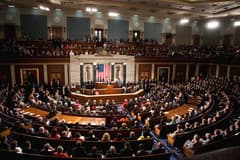
 Legislative Structure: Congress -- two houses: Senate (2 senators from each state, 6 year terms, must be at least 30 years old and have been a citizen for at least nine years) -- Constitution originally allowed state legislatures to choose the two senators but now elected by popular vote House of Representatives (number based on population of state, determined every ten years in a census -- number now set at 435; 2 year terms, must be at least 25 years old and have been a citizen for 7 years) Legislative Powers: Makes the laws -- any senator or representative can propose a bill -- if majority in one house favors it, bill goes to other house for debate -- if approved by both -- goes to the president to be signed into law -- President can veto any proposed law but can then be overruled if there is a two thirds majority in both houses favoring the law Elastic Clause -- can make all laws “necessary and proper” to carry out its other powers Only the House of Representatives can propose new taxes Only Congress can decide on how to spend the money raised through taxes Power to raise (pay for) an army and navy To declare war Approves treaties and executive appointments -- Senate How was the debate over how the president should be chosen resolved? The Electoral College System -- made up of electors who cast votes to elect the president and vice-president every four years Each state has as many electors in the Electoral College as the number of senators and reps it sends to Congress. The votes cast by electors are called electoral votes. Delegates left the method of choosing electors up to each state. Before 1820, state legislatures chose electors in most states. Today, people choose their state’s electors when they vote in presidential elections. The electors then cast their ballots for president and vice-president on a date chosen by Congress. Today must win at least 270 of the 538 total electoral votesShe went by the name of Belisa Crepusculario, not because she had been baptized with that name or given it by her mother, but because she herself had searched until she found the poetry of "beauty" and "twilight" and cloaked herself in it. She made her living selling words. She journeyed through the country from the high cold mountains to the burning coasts, stopping at fairs and in markets where she set up four poles covered by a canvas awning under which she took refuge from the sun and rain to minister to her customers. She did not have to peddle her merchandise because from having wandered far and near, everyone knew who she was. Some people waited for her from one year to the next, and when she appeared in the village with her bundle beneath her arm, they would form a line in front of her stall. Her prices were fair. For five centavos she delivered verses from memory, for seven she improved the quality of dreams, for nine she wrote love letters, for twelve she invented insults for irreconcilable enemies. She also sold stories, not fantasies but long, true stories she recited at one telling, never skipping a word. This is how she carried news from one town to another. People paid her to add a line or two: our son was born, so-and-so died, our children got married, the crops burned in the field. Wherever she went a small crowd gathered around to listen as she began to speak, and that was how they learned about each others' doings, about distant relatives, about what was going on in the civil war. To anyone who paid her fifty centavos in trade, she gave the gift of a secret word to drive away melancholy. It was not the same word for everyone, naturally, because that would have been collective dece it. Each person received his or her own word, with the assurance that no one else would use it that way in this universe or the Beyond. Belisa Crepusculario had been born into a family so poor they did not even have names to give their children. She came into the world and grew up in an inhospitable land where some years the rains became avalanches of water that bore everything away before them and others when not a drop fell from the sky and the sun swelled to fill the horizon and the world became a desert. Until she was twelve, Belisa had no occupation or virtue other than having withstood hunger and the exhaustion of centuries. During one interminable drought, it fell to her to bury four younger brothers and sisters, when she realized that her turn was next, she decided to set out across the 2 plains in the direction of the sea, in hopes that she might trick death along the way. The land was eroded, split with deep cracks, strewn with rocks, fossils of trees and thorny bushes, and skeletons of animals bleached by the sun. From time to time she ran into families who, like her, were heading south, following the mirage of water. Some had begun the march carrying their belongings on their back or in small carts, but they could barely move their own bones, and after a while they had to abandon their possessions. They dragged themselves along painfully, their skin turned to lizard hide and their eyes burned by the reverberating glare. Belisa greeted them with a wave as she passed, but she did not stop, because she had no strength to waste in acts of compassion. Many people fell by the wayside, but she was so stubborn that she survived to cross through that hell and at long last reach the first trickles of water, fine, almost invisible threads that fed spindly vegetation and farther down widened into small streams and marshes. Belisa Crepusculario saved her life and in the process accidentally discovered writing. In a village near the coast, the wind blew a page of newspaper at her feet. She picked up the brittle yellow paper and stood a long while looking at it, unable to determine its purpose, until curiosity overcame her shyness. She walked over to a man who was washing his horse in the muddy pool where she had quenched her thirst. "What is this?" she asked. "The sports page of the newspaper," the man replied, concealing his surprise at her ignorance. The answer astounded the girl, but she did not want to seem rude, so she merely inquired about the significance of the fly tracks scattered across the page. "Those are words, child. Here it says that Fulgencio Barba knocked out El Negro Tiznao in the third round." That was the day Belisa Crepusculario found out that words make their way in the world without a master, and that anyone with a little cleverness can appropriate them and do business with them. She made a quick assessment of her situation and concluded that aside from becoming a prostitute or working as a servant in the kitchens of the rich there were few occupations she was qualified for. It seemed to her that selling words would be an honorable alternative. From that moment on, she worked at that profession, and was never tempted by any other. At the beginning, she offered her merchandise unaware that words could be written outside of newspapers. When she learned otherwise, she calculated the infinite possibilities of her trade and with her savings paid a priest twenty pesos to teach her to read and write, with her three 3 remaining coins she bought a dictionary. She poured over it from A to Z and then threw it into the sea, because it was not her intention to defraud her customers with packaged words. One August morning several years later, Belisa Crepusculario was sitting in her tent in the middle of a plaza, surrounded by the uproar of market day, selling legal arguments to an old man who had been trying for sixteen years to get his pension. Suddenly she heard yelling and thudding hoofbeats. She looked up from her writing and saw, first, a cloud of dust, and then a band of horsemen come galloping into the plaza. They were the Colonel's men, sent under orders of El Mulato, a giant known throughout the land for the speed of his knife and his loyalty to his chief. Both the Colonel and El Mulato had spent their lives fighting in the civil war, and their names were ineradicably linked to devastation and calamity. The rebels swept into town like a stampeding herd, wrapped in noise, bathed in sweat, and leaving a hurricane of fear in their trail. Chickens took wing, dogs ran for their lives, women and children scurried out of sight, until the only living soul left in the market was Belisa Crepusculario. She had never seen El Mulato and was surprised to see him walking toward her. "I'm looking for you," he shouted, pointing his coiled whip at her, even before the words were out, two men rushed her -- knocking over her canopy and shattering her inkwell -- bound her hand and foot, and threw her like a sea bag across the rump of El Mulato's mount. Then they thundered off toward the hills. Hours later, just as Belisa Crepusculario was near death, her heart ground to sand by the pounding of the horse, they stopped, and four strong hands set her down. She tried to stand on her feet and hold her head high, but her strength failed her and she slumped to the ground, sinking into a confused dream. She awakened several hours later to the murmur of night in the camp, but before she had time to sort out the sounds, she opened her eyes and found herself staring into the impatient glare of El Mulato, kneeling beside her. "Well, woman, at last you've come to," he said. To speed her to her senses, he tipped his canteen and offered her a sip of liquor laced with gunpowder. She demanded to know the reason for such rough treatment, and El Mulato explained that the Colonel needed her services. He allowed her to splash water on her face, and then led her to the far end of the camp where the most feared man in all the land was lazing in a hammock strung between two trees. She could not see his face, because he lay in the deceptive shadow of the leaves and the indelible shadow of all his years as a bandit, but she imagined from the way his 4 gigantic aide addressed him with such humility that he must have a very menacing expression. She was surprised by the Colonel's voice, as soft and well-modulated as a professor's. "Are you the woman who sells words?" he asked. "At your service," she stammered, peering into the dark and trying to see him better. The Colonel stood up, and turned straight toward her. She saw dark skin and the eyes of a ferocious puma, and she knew immediately that she was standing before the loneliest man in the world. "I want to be President," he announced. The Colonel was weary of riding across that godforsaken land, waging useless wars and suffering defeats that no subterfuge could transform into victories. For years he had been sleeping in the open air, bitten by mosquitoes, eating iguanas and snake soup, but those minor inconveniences were not why he wanted to change his destiny. What truly troubled him was the terror he saw in people's eyes. He longed to ride into a town beneath a triumphal arch with bright flags and flowers everywhere, he wanted to be cheered, and be given newly laid eggs and freshly baked bread. Men fled at the sight of him, children trembled, and women miscarried from fright, he had had enough, and so he had decided to become President. El Mulato had suggested that they ride to the capital, gallop up to the Palace, and take over the government, the way they had taken so many other things without anyone's permission. The Colonel, however, did not want to be just another tyrant, there had been enough of those before him and, besides, if he did that, he would never win people's hearts. It was his aspiration to win the popular vote in the December elections. "To do that, I have to talk like a candidate. Can you sell me the words for a speech?" the Colonel asked Belisa Crepusculario. She had accepted many assignments, but none like this. She did not dare refuse, fearing that El Mulato would shoot her between the eyes, or worse still, that the Colonel would burst into tears. There was more to it than that, however, she felt the urge to help him because she felt a throbbing warmth beneath her skin, a powerful desire to touch that man, to fondle him, to clasp him in her arms. All night and a good part of the following day, Belisa Crepusculario searched her repertory for words adequate for a presidential speech, closely watched by El Mulato, who could not take his eyes from her firm wanderer's legs and virginal breasts. She discarded harsh, cold words, words 5 that were too flowery, words worn from abuse, words that offered improbable promises, untruthful and confusing words, until all she had left were words sure to touch the minds of men and women's intuition. Calling upon the knowledge she had purchased from the priest for twenty pesos, she wrote the speech on a sheet of paper and then signaled El Mulato to untie the rope that bound her ankles to a tree. He led her once more to the Colonel, and again she felt the throbbing anxiety that had seized her when she first saw him. She handed him the paper and waited while he looked at it, holding it gingerly between thumbs and fingertips. "What the shit does this say," he asked finally. "Don't you know how to read?" "War's what I know," he replied. She read the speech aloud. She read it three times, so her client could engrave it on his memory. When she finished, she saw the emotion in the faces of the soldiers who had gathered round to listen, and saw that the Colonel's eyes glittered with enthusiasm, convinced that with those words the presidential chair would be his. "If after they've heard it three times, the boys are still standing there with their mouths hanging open, it must mean the thing's damn good, Colonel" was El Mulato's approval. "All right, woman. How much do I owe you?" the leader asked. "One peso, Colonel." "That's not much," he said, opening the pouch he wore at his belt, heavy with proceeds from the last foray. "The peso entitles you to a bonus. I'm going to give you two secret words," said Belisa Crepusculario. "What for?" She explained that for every fifty centavos a client paid, she gave him the gift of a word for his exclusive use. The Colonel shrugged. He had no interest at all in her offer, but he did not want to be impolite to someone who had served him so well. She walked slowly to the leather stool where he was sitting, and bent down to give him her gift. The man smelled the scent of a mountain cat issuing from the woman, a fiery heat radiating from her hips, he heard the terrible whisper of her hair, and a breath of sweetmint murmured into his ear the two secret words that were his alone. "They are yours, Colonel," she said as she stepped back. "You may use them as much as you 6 please." El Mulato accompanied Belisa to the roadside, his eyes as entreating as a stray dog's, but when he reached out to touch her, he was stopped by an avalanche of words he had never heard before; believing them to be an irrevocable curse, the flame of his desire was extinguished. During the months of September, October, and November the Colonel delivered his speech so many times that had it not been crafted from glowing and durable words it would have turned to ash as he spoke. He travelled up and down and across the country, riding into cities with a triumphal air, stopping in even the most forgotten villages where only the dump heap betrayed a human presence, to convince his fellow citizens to vote for him. While he spoke from a platform erected in the middle of the plaza, El Mulato and his men handed out sweets and painted his name on all the walls in gold frost. No one paid the least attention to those advertising ploys; they were dazzled by the clarity of the Colonel's proposals and the poetic lucidity of his arguments, infected by his powerful wish to right the wrongs of history, happy for the first time in their lives. When the Candidate had finished his speech, his soldiers would fire their pistols into the air and set off firecrackers, and when finally they rode off, they left behind a wake of hope that lingered for days on the air, like the splendid memory of a comet's tail. Soon the Colonel was the favorite. No one had ever witnessed such a phenomenon: a man who surfaced from the civil war, covered with scars and speaking like a professor, a man whose fame spread to every corner of the land and captured the nation's heart. The press focused their attention on him. Newspapermen came from far away to interview him and repeat his phrases, and the number of his followers and enemies continued to grow. "We're doing great, Colonel," said El Mulato, after twelve successful weeks of campaigning. But the Candidate did not hear. He was repeating his secret words, as he did more and more obsessively. He said them when he was mellow with nostalgia; he murmured them in his sleep; he carried them with him on horseback; he thought them before delivering his famous speech; and he caught himself savoring them in his leisure time. And every time he thought of those two words, he thought of Belisa Crepusculario, and his senses were inflamed with the memory of her feral scent, her fiery heat, the whisper of her hair, and her sweetmint breath in his ear, until he began to go around like a sleepwalker, and his men realized that he might die before he ever sat in the presidential chair. "What's got hold of you, Colonel," El Mulato asked so often that finally one day his chief broke 7 down and told him the source of his befuddlement: those two words that were buried like two daggers in his gut. "Tell me what they are and maybe they'll lose their magic," his faithful aide suggested. "I can't tell them, they're for me alone," the Colonel replied. Saddened by watching his chief decline like a man with a death sentence on his head, El Mulato slung his rifle over his shoulder and set out to find Belisa Crepusculario. He followed her trail through all that vast country, until he found her in a village in the far south, sitting under her tent reciting her rosary of news. He planted himself, spraddle-legged, before her, weapon in hand. "You! You're coming with me," he ordered. She had been waiting. She picked up her inkwell, folded the canvas of her small stall, arranged her shawl around her shoulders, and without a word took her place behind El Mulato's saddle. They did not exchange so much as a word in all the trip; El Mulato's desire for her had turned into rage, and only his fear of her tongue prevented his cutting her to shreds with his whip. Nor was he inclined to tell her that the Colonel was in a fog, and that a spell whispered into his ear had done what years of battle had not been able to do. Three days later they arrived at the encampment, and immediately, in view of all the troops, El Mulato led his prisoner before the Candidate. "I brought this witch here so you can give her back her words, Colonel," El Mulato said, pointing the barrel of his rifle at the woman's head. "And then she can give you back your manhood." The Colonel and Belisa Crepusculario stared at each other, measuring one another from a distance. The men knew then that their leader would never undo the witchcraft of those accursed words, because the whole world could see the voracious-puma eyes soften as the woman walked to him and took his hand in hers. Copyright © 1989 by Isabel Allende From The Stories of Eva Luna, Translated by Margaret Sayers PedenHistory of policing Pre-confederation Mostly informal policing by community residents First police officers Quebec city, mid 17th century Upper Canada, early 19th century Mandate Police conflicts between ethinc groups and employes/labours Maintain moral standards (drunkenness, alcoholism) Apprehend criminals Provincal Police Force Response to disorder resulting form gold strikes in 19th century Replaced by RCMP during 20th century Currently, Ontario,Quebec and parts of Newfoundland have their own provincal police force History of RCMP North-Wesr Mounted Police Founded in 1873 Maintain law and order Ensure orderly settlement in prairies Many problems: desertion, resignation and improper conduct Replaced by Royal Canadain Mounted Police Police Today About 70,000 police officers across Canada 199 police officers per 100,000 population Lower than Scotland (337), England(244), U.S (238) NUmber increased over past decade NUmber of female officers increased 1 out of 5 officers is a women Contemporary Policing Structure of policing Four levels Federal, Provincial, municipal, and First nations Also public transportation police (railway, airport, and transit) Some municipalities have own forces E.g, Peel, Toronoto Others use provincial force detachments or RCMP detachments Royal Candanin Mounted Police Governed by Royal Canadian Mounted Pollcei Act (1985) Broad Range of policing activities, including federal policing and international peacekeppiong Contract Policing Provincial, territorial and municipal level Concerns about local oversight and accountability In but not of communities-difficult to ensure that RCMp detachments are responsive to communities Provincial Police Three forces Ontario Provincial Police Surete du Quebec (SQ) Royal Newfoundland Constabulary (RNC) Other provinces contractually use the RCMP Responsibilities Police rural areas and areas outside municipalities Enforce provincial laws and Criminal Code Regional Police Amalgamated Forces E.g Peel region police and Halton Regional Police Force Provide Police Services to over Half of Ontarians Advantages Cheaper, more servies Disadvantages To centralized, not in touch with community Municipal Police Responsibilites Enforce Criminal Code, Provincal Statues, municipal by laws, some federal statues (e.g drugs) Largest number of officers of any level My be contracted to RCMP or Provincal force Costs are paid by the municipality First Nations Type of policing is negotiated by First Nations Commnity Autonomous reserve based First Nations Officers from RCMP or OPP Responsibilites Enforce Criminal Code, federal and provicanl statues, band bylaws Accountability Reserve based police commission or band council Private Security Services Two main types 1. Private Security Firms 2. Company based, in house security officers No more legal authority than ordinary citizens But can arrest and detain people who commit crimes on private property In Canada, Private security officers outnumber police officer by four to one Parapolice Extension of activities Lack of systems of oversight like transitional police Police Work POlicing The activities of any indivual or organization acting legally on behalf of public or private organizations or persons to maintain security or social order Pluralization of Policing The sharing between public and private security Legislative Framework Carry out tasks within a number of legislative frameworks, define role, powers/responsibilites Canadian charter of rights and freedoms- most impactful on power/actvites of police Provincial and municipal legislation - Status such as motor vehicle administration acts, highway traffic acts, liquor acts and provincial/musincpal police acts Democracy Governance Categories of Policing Recruitment and Training of police officers Police recruitment Recruiting Visible Minorites and Aboriginal People Special initvates and programs for youth, women and visible minorities PEACE (Police Ethnic and Cultureal Exchange) OPPBound (particpate in variety of activate with officer) Toronto POlice recruitment of Somali Officers Edmonton police uniforms that include a hijab Police Training Residential/non-residential academies, centralized and decentralized Physical and academic instruction, socilization into the police occupation Operational field traiing Hands-on application of principles learned in the academy Mentoship form senior officer Working Personality of Police officers Challenges of Police Work Work Enviroment Long hours and shift work Exposure to stressors, especially in high demand environments PTSD and burnout Work Organiztion Harassment of female officers Cumbersome of system of internal redress Summary A number of misconceptions arounds police work, including th emotion that most police work involves crime control A variety of influences on the roles and activities of the police Four levels of policing: federal, provincial, mnicipal and First Nations, each with different responsibilities Cryptocurrency regulations in Africa vary significantly across the continent, reflecting different approaches by governments to balance innovation with consumer protection and financial stability. Here's an overview of the regulatory landscape in several key African countries: 1. Nigeria Central Bank Ban: In February 2021, the Central Bank of Nigeria (CBN) banned financial institutions from providing services to crypto exchanges, effectively restricting crypto transactions through traditional banking channels. eNaira: Despite the restrictive stance on cryptocurrencies, Nigeria launched its central bank digital currency (CBDC), the eNaira, in October 2021, aiming to enhance financial inclusion and support the digital economy. 2. South Africa Regulatory Framework: The Financial Sector Conduct Authority (FSCA) has proposed a regulatory framework to classify cryptocurrencies as financial products. This will subject crypto service providers to regulations similar to those governing other financial services. AML/CFT Compliance: Crypto exchanges are required to comply with Anti-Money Laundering (AML) and Combating the Financing of Terrorism (CFT) regulations. 3. Kenya Regulatory Caution: The Central Bank of Kenya (CBK) has issued warnings about the risks associated with cryptocurrencies but has not imposed an outright ban. Cryptocurrencies are not considered legal tender. Innovation Support: Kenya is known for its innovative financial services sector, including mobile money, which creates a fertile ground for crypto and blockchain adoption despite the cautious regulatory stance. 4. Ghana Regulatory Research: The Bank of Ghana is conducting research into cryptocurrencies and blockchain technology, with a focus on understanding the potential benefits and risks. Sandbox Initiative: Ghana has introduced a regulatory sandbox to encourage innovation in fintech, including blockchain and cryptocurrencies. 5. Uganda Regulatory Oversight: The Bank of Uganda has warned the public about the risks of cryptocurrencies but has not imposed a ban. There is ongoing discussion about developing a regulatory framework. Blockchain Adoption: Uganda is exploring the use of blockchain technology in various sectors, including agriculture and healthcare. 6. Zimbabwe Ban and Reconsideration: The Reserve Bank of Zimbabwe (RBZ) initially banned banks from processing crypto transactions but has since been exploring ways to regulate the industry. Blockchain Task Force: The government has established a blockchain and digital assets task force to study the implications and potential uses of the technology. 7. Tanzania Government Support: In 2021, the Tanzanian government indicated support for adopting blockchain and cryptocurrency technologies, with the central bank working on creating a regulatory framework. Presidential Endorsement: President Samia Suluhu Hassan called on the central bank to prepare for the adoption of cryptocurrencies. Regional Initiatives and Trends Cross-Border Collaboration: Some African countries are exploring regional cooperation to harmonize crypto regulations and promote cross-border fintech solutions. Fintech Hubs: Countries like Nigeria, South Africa, and Kenya are becoming fintech hubs, attracting startups and investment in the blockchain and crypto space. Education and Awareness: Efforts are being made to educate the public and policymakers about cryptocurrencies and blockchain technology to promote informed decision-making. Challenges and Considerations Regulatory Uncertainty: The lack of clear and consistent regulations across the continent poses challenges for businesses and investors. Risk Management: Balancing innovation with risk management, particularly concerning AML/CFT compliance, is a key concern for regulators. Infrastructure and Accessibility: Limited internet access and technological infrastructure can hinder widespread adoption and effective regulation. The regulatory landscape for cryptocurrencies in Africa is dynamic and evolving, with a mix of cautious approaches and supportive measures aimed at harnessing the benefits of blockchain technology while managing associated risks.Marine and Coastal Processes.What are the hazards that usually occur along marine and coastal areas? Coastal processes, such as waves, tides, sea level changes, crustal movement, and storm surges will result to coastal erosion, submersion, and saltwater intrusion. Coastal Erosion. Coastal erosion is the wearing down of the coastlines by the movement of wind and water. It is not a constant process; instead, the rate of erosion depends on other events such as cyclones. When cyclones occur along coastal areas, the winds and waves carry the sediment away from the shoreline. Shorelines play an important role to society. They are used in transportation, fishing, and tourism. Therefore, preventing coastal erosion is of utmost priority. There are three main classifications of stabilizing the shoreline: hard stabilization, soft stabilization, and retreat. 1. Hard stabilization is done by building structures that will slow down the erosion on areas that are prone to erosion. Examples of hard stabilization structures are jetties, sea walls, and breakwaters. Though they may slow down the erosion in one area, it may hasten the erosion in other areas. 2. Soft stabilization includes the process of beach nourishment, wherein sand from an offshore location is brought to an area with a receding shoreline. It does not make use of structures like the ones used in hard stabilization. 3. Retreat is the option taken by residents near areas where coastal erosion is already severe. At this point, the authorities no longer attempt to save the shoreline but rather limit the amount of human interference in the area. Submersion. Coastal erosion happens because of the interaction of the winds and waves on the shoreline. Submersion, on the other hand, happens because of the changes in the sea level, specifically, when it rises dangerously above the normal level. This is all due to the increase in the global temperature, which, in turn, melts the glacial deposits and increases the overall sea level. Another factor that may cause submersion is the vertical movement of the plates. Landmasses can be uplifted, which can also cause changes in the sea level. It can also be caused by tsunamis and storm surges. Submersion will most likely occur in reclaimed lands. These are the areas that were originally part of oceans, riverbeds, or lakebeds. They are low-lying flatlands, so even a small rise in sea level can cause great damage on the land. To prevent this from happening not only in reclaimed lands but also in coastal areas, a hard stabilization technique is used. Sea walls are built along the coastline to protect the land from being easily flooded. Aside from sea walls, dikes can also help prevent flooding. The government can also upgrade the infrastructures built in coastal areas, regenerate mangroves, or relocate the people. There are also other proposed strategies to mitigate coastal submersion, such as imposing of setback policies and construction regulations and creating adaptive plans for coastal management. Saltwater Intrusion. In coastal areas where there is an interaction between saltwater and fresh water, saltwater intrusion is one of the hazards that are evident in that area. Saltwater intrusion is the movement of saltwater into the freshwater aquifer. The natural flow is that the fresh water, which is less dense, moves towards the denser saltwater. But if the fresh water is being withdrawn faster than it is being replenished, then there will be a change in pressure and saltwater intrusion will occur.There are a few ways of preventing saltwater intrusion. One is to stop using the well where fresh water has been depleted and let the groundwater replenish naturally via the water cycle. The other method is to build two wells: a pumping well-built farther inland and an injection well-built closer to the coast. Using the injection well, fresh water is pumped into the aquifer to prevent the saltwater from intruding. The different marine and coastal hazards often occur in the Philippines, being an archipelago with the longest coastline. Manila Bay is one of the coastal areas of the Philippines that is facing various threats from both natural and anthropological causes. Saltwater intrusion occurs due to uncontrolled withdrawal of groundwater to be used by residential, commercial, and industrial areas built around the bay. It is also frequently flooded due to poor drainage systems and improper disposal of waste. Since Manila Bay is shared by four coastal provinces, four noncoastal provinces, and the National Capital Region, each local government unit and national agencies need to collaborate in planning, developing, and managing its marine and coastal resources. And it is not only Manila Bay but other parts as well, for as long as they are in coastal areas, hazards will mostly likely occur if not immediately addressed.THE STRATEGIC PLAN OF RICHARD BLAND COLLEGE OF WILLIAM & MARY 2020-2025 “The dogmas of the quiet past are inadequate to the stormy present. The occasion is piled high with difficulty, and we must rise with the occasion. As our case is new, so we must think anew and act anew.” – Abraham Lincoln What is the role of a selective, two-year, residential, liberal arts transfer institution within the higher education landscape of the Commonwealth of Virginia? This is a key question that must be answered to ensure the success of Richard Bland College (RBC) and the constituency that the College serves. The 2020 RBC strategic plan’s primary objective is to answer that very question so that the College, the community and the Commonwealth can engage successfully within this identity and purpose to the benefit of all. RBC has long been identified as the hidden gem of higher education in Virginia. The hidden adjective is based both on its relative obscurity—few are aware of RBC outside the Tri-Cities region—and its rural setting featuring 750+ acres of wetlands, bucolic forest, and the state’s oldest and largest pecan grove. Additionally, on average, a student of Richard Bland College travels a mere 36 miles to campus. This keeps the knowledge of RBC in a tightly focused radius. The gem moniker refers both to the College’s reputation for excellence and the undeniable sensation that the campus often elicits in its students, visitors, faculty and staff, the feeling of a warm and palpable embrace of care, compassion and support. That sensation is where we start. According the State Council of Higher Education for Virginia (SCHEV), 99% of the 11.5 million new jobs created since the great recession require workers to have more than a high-school education. Students with a bachelor’s degree have an earning potential almost double that of people with only a high school education, and yet only 17% of residents in the Petersburg area have a bachelor’s degree, 15% below the national average. The obstacles in the way of education have been exhaustively researched and include financial challenges, academic under-preparedness, low self-esteem, slow college assimilation and immature levels of self-efficacy. To combat this growing problem, Richard Bland College initiated a pilot program to determine the viability of a data-driven approach to improve retention and graduation rates. The program ultimately effected a cultural, organizational and operational shift at RBC, resulting in a personalized model of student support, the Exceptional Student Experience (ESE@RBC). Originally many of the practices that RBC used as the basis of ESE@RBC were adapted from the four key principles found in the American Association of Community Colleges (AACC) Pathways Project: 1) map pathways to student end goals; 2) help students choose and enter a program pathway; 3) keep students on path; and 4) ensure that students are learning. Unfortunately, limited resources made it necessary to skip some primary elements of guided pathways and instead to focus on a specific, high-priority project that was immediately available for implementation, dedicated student support. This strategic framework reimagines the way that RBC serves students, faculty and staff within the context of our existing culture, the principles of guided pathways and a hybrid work-college experience. Rather than thinking of a two-year college as a pipeline to a four-year university, this vision describes a more expansive menu of well-defined pathways to high-demand fields, all radiating from a curriculum constructed around the development of soft skills that define the liberal arts experience: critical thinking, written communication, analytical reasoning, civic engagement and oral communication. Furthermore, the impact of meaningful work is a resonating theme, providing avenues to participate in career-focused internships and jobs that develop important life & work skills, confidence, and character. Richard Bland has tested its entrepreneurial mettle and its capacity for transformation in recent years. The College was among a select few Competency-Based Education sites established by the U.S. Department of Education. We were ahead of the curve using predictive analytics to improve student retention and success rates, and online enrollment now makes up nearly 20 percent of course offerings. It may be counter-intuitive, but these and other deep-level institutional changes still to come will ensure that Richard Bland College remains true to its original mission. We prepare our students for a lifetime of endless potential.OtherOther, another