Loading...


P.6 - Final 64
Quiz by ศุภวัทน์ อิหม่ําเหม
Customize this quiz to suit your class
Instantly translate to 100+ languages
Tag the questions with any skills you have. Your dashboard will track each student's mastery of each skill.
Give this quiz to my class
What does this sign mean?
Keep the room clean.
Don't litter.
Don't make a loud noise.
Take off your shoes.
Son : Mom, I'm very thirsty. Can I have some ______, please?
Mom : Yes. Here you are.
iced water
sticky rice
noodles
pizza
What does this sign mean?
Son : Mom, I'm very thirsty. Can I have some ______, please?
Mom : Yes. Here you are.
Irfan : What club do you like to join?
Romang : ___________. Because I like playing the guitar.
Armanee has got a toothache. What should you say to her?
Suhaimee : Give me your pencil, please.
Mareeya : Yes. ____________.
Suhaimee : Thanks.
Katesuda : What's your telephone number?
Piyatida : It's _____________.
What should the man say to the woman?
Zoree : ________________________?
Kamal : I was born on July 17, 2015.
Complete the conversation.
Tanawut : ________________________
Hawana : It's sunny and hot.
Sarah won the first prize of the athlete. How did you feel about her?
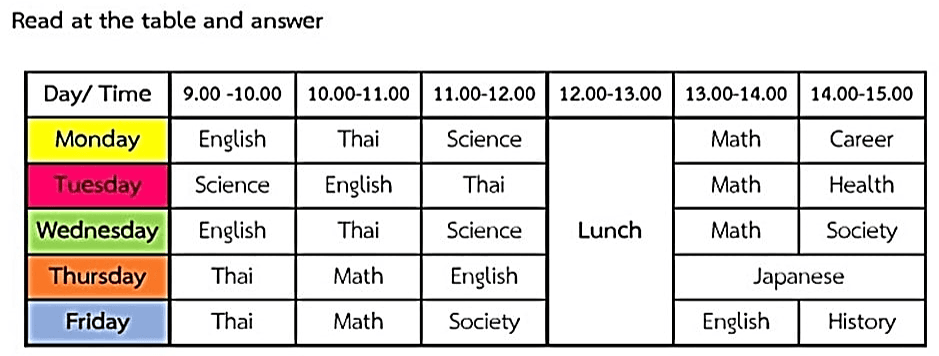
How many subjects do they study?
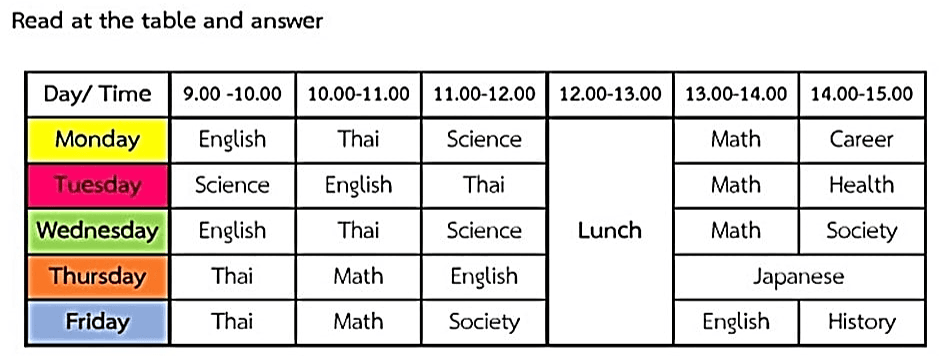
What time do they study Japanese?
Bukoree always helps his teacher clean the classroom every day. He also helps his friends with homework. Bukoree is a _____ boy.
Zoree : What do you think about my picture?
Koree : ____________________
When do you dress like them?

People around the world exchange cards, _______, chocolate and gifts between lovers on Valentine's day.
Bob and Kim are decorating with the pumpkins and dressing like ghosts.
Mee : Let me introduce myself. I'm Suhaimee.
Kate : Hi, Suhaimee. I'm Katesuda.
Mee : _______________________.
Buree : Let's go to the movie.
Ibmang : ___________. I'll go with you.
 MYTH The British helped the Jews displace the native Arab population of Palestine. FACT Herbert Samuel, a British Jew who served as the first High Commissioner of Palestine, placed restrictions on Jewish immigration “in the ‘interests of the present population’ and the ‘absorptive capacity’ of the country.”1 The influx of Jewish settlers was said to force the Arab fellahin (native peasants) from their land. This was when less than a million people lived in an area that now supports more than nine million. The British limited the absorptive capacity of Palestine when, in 1921, Colonial Secretary Winston Churchill severed nearly four-fifths of Palestine—some thirty-five thousand square miles—to create a new Arab entity, Transjordan. As a consolation prize for the Hejaz and Arabia (which are both now Saudi Arabia) going to the Saud family, Churchill rewarded Sharif Hussein’s son Abdullah for his contribution to the war against Turkey by installing him as Transjordan’s emir. The British went further and placed restrictions on Jewish land purchases in what remained of Palestine. By 1949, the British had allotted 87,500 acres of the 187,500 acres of cultivable land to Arabs and only 4,250 acres to Jews. This contradicted Article 6 of the Mandate which stated that “the Administration of Palestine…shall encourage, in cooperation with the Jewish Agency…close settlement by Jews on the land, including State lands and waste lands not acquired for public purposes.”2 Ultimately, the British admitted that the argument about the country’s absorptive capacity was specious. The Peel Commission said, “The heavy immigration in the years 1933–36 would seem to show that the Jews have been able to enlarge the absorptive capacity of the country for Jews.”3 MYTH The British allowed Jews to flood Palestine while Arab immigration was tightly controlled. FACT The British response to Jewish immigration set a precedent of appeasing the Arabs, which was followed for the duration of the Mandate. The British restricted Jewish immigration while allowing Arabs to enter the country freely. Apparently, London did not feel that a flood of Arab immigrants would affect the country’s “absorptive capacity.” During World War I, the Jewish population in Palestine declined because of the war, famine, disease, and expulsion by the Turks. In 1915, approximately 83,000 Jews lived in Palestine among 590,000 Muslim and Christian Arabs. According to the 1922 census, the Jewish population was 83,000, while the Arabs numbered 643,000.4 Thus, the Arab population grew exponentially while that of the Jews stagnated. In the mid-1920s, Jewish immigration to Palestine increased primarily because of anti-Jewish economic legislation in Poland and Washington’s imposition of restrictive quotas.5 The record number of immigrants in 1935 (see table) was a response to the growing persecution of Jews in Nazi Germany. The British administration considered this number too large, however, so the Jewish Agency was informed that less than one-third of the quota it asked for would be approved in 1936.6 The British gave in further to Arab demands by announcing in the 1939 White Paper that an independent Arab state would be created within ten years and that Jewish immigration was to be limited to 75,000 for the next five years, after which it was to cease altogether. It also forbade land sales to Jews in 95% of the territory of Palestine. The Arabs, nevertheless, rejected the proposal. Jewish Immigration to Palestine7 1919 1,806 1931 4,075 1920 8,223 1932 12,533 1921 8,294 1933 37,337 1922 8,685 1934 45,267 1923 8,175 1935 66,472 1924 13,892 1936 29,595 1925 34,386 1937 10,629 1926 13,855 1938 14,675 1927 3,034 1939 31,195 1928 2,178 1940 10,643 1929 5,249 1941 4,592 1930 4,944 By contrast, throughout the Mandatory period, Arab immigration was unrestricted. In 1930, the Hope Simpson Commission, sent from London to investigate the 1929 Arab riots, said the British practice of ignoring the uncontrolled illegal Arab immigration from Egypt, Transjordan, and Syria had the effect of displacing the prospective Jewish immigrants.8 The British governor of the Sinai from 1922 to 1936 observed, “This illegal immigration was not only going on from the Sinai, but also from Transjordan and Syria, and it is very difficult to make a case out for the misery of the Arabs if at the same time their compatriots from adjoining states could not be kept from going in to share that misery.”9 The Peel Commission reported in 1937 that the “shortfall of land is…due less to the amount of land acquired by Jews than to the increase in the Arab population.”10 MYTH The British changed their policy to allow Holocaust survivors to settle in Palestine. FACT The gates of Palestine remained closed for the duration of the war, stranding hundreds of thousands of Jews in Europe, many of whom became victims of Hitler’s “Final Solution.” After the war, the British refused to allow the survivors of the Nazi nightmare to find sanctuary in Palestine. On June 6, 1946, President Truman urged the British government to relieve the suffering of the Jews confined to displaced persons camps in Europe by immediately accepting 100,000 Jewish immigrants. Britain’s foreign minister Ernest Bevin replied sarcastically that the United States wanted displaced Jews to immigrate to Palestine “because they did not want too many of them in New York.”11 Some Jews reached Palestine, many smuggled in on dilapidated ships organized by the Haganah. Between August 1945 and the establishment of the State of Israel in May 1948, sixty-five “illegal” immigrant ships, carrying 69,878 people, arrived from European shores. In August 1946, however, the British began to intern those they caught in camps on Cyprus. Approximately 50,000 people were detained in the camps, and 28,000 remained imprisoned when Israel declared independence.12 MYTH As the Jewish population grew, the plight of the Palestinian Arabs worsened. FACT In July 1921, Hasan Shukri, the mayor of Haifa and president of the Muslim National Associations, sent a telegram to the British government in reaction to a delegation of Palestinians that went to London to try to stop the implementation of the Balfour Declaration. Shukri wrote: We are certain that without Jewish immigration and financial assistance there will be no future development of our country as may be judged from the fact that the towns inhabited in part by Jews such as Jerusalem, Jaffa, Haifa, and Tiberias are making steady progress while Nablus, Acre, and Nazareth where no Jews reside are steadily declining.13 The Jewish population increased by 470,000 between World War I and World War II, while the non-Jewish population rose by 588,000.14 The permanent Arab population increased by 120% between 1922 and 1947.15 This rapid growth of the Arab population was a result of several factors. One was immigration from neighboring states—constituting 37% of the total immigration to pre-state Israel—by Arabs who wanted to take advantage of the higher standard of living the Jews had made possible.16 The Arab population also grew because of the improved living conditions created by the Jews as they drained malarial swamps and brought improved sanitation and health care to the region. Thus, for example, the Muslim infant mortality rate fell from 201 per thousand in 1925 to 94 per thousand in 1945, and life expectancy rose from 37 years in 1926 to 49 in 1943.17 The Arab population increased the most in cities where large Jewish populations had created new economic opportunities. From 1922–1947, the non-Jewish population increased by 290% in Haifa, 131% in Jerusalem, and 158% in Jaffa. The growth in Arab towns was more modest: 42% in Nablus, 78% in Jenin, and 37% in Bethlehem.18 MYTH Jews stole Arab land. FACT Despite the growth in their population, the Arabs continued to assert they were being displaced. From the beginning of World War I, however, part of Palestine’s land was owned by absentee landlords who lived in Cairo, Damascus, and Beirut. About 80% of the Palestinian Arabs were debt-ridden peasants, semi-nomads, and Bedouins.19 Jews went out of their way to avoid purchasing land in areas where Arabs might be displaced. They sought land that was largely uncultivated, swampy, cheap, and—most important—without tenants. In 1920, Labor Zionist leader David Ben-Gurion expressed his concern about the Arab fellahin, whom he viewed as “the most important asset of the native population.” He insisted that “under no circumstances must we touch land belonging to fellahs or worked by them.” Instead, he advocated helping liberate them from their oppressors. “Only if a fellah leaves his place of settlement,” Ben-Gurion added, “should we offer to buy his land, at an appropriate price.”20 Jews only began to purchase cultivated land after buying all the uncultivated territory. Many Arabs were willing to sell because of the migration to coastal towns and because they needed money to invest in the citrus industry.21 When John Hope Simpson arrived in Palestine in May 1930, he observed, “They [the Jews] paid high prices for the land and, in addition, they paid to certain of the occupants of those lands a considerable amount of money which they were not legally bound to pay.”22 In 1931, Lewis French conducted a survey of landlessness for the British government and offered new plots to any Arabs who had been “dispossessed.” British officials received more than 3,000 applications, of which 80% were ruled invalid by the government’s legal adviser because the applicants were not landless Arabs. This left only about 600 landless Arabs, 100 of whom accepted the government land offer.23 In April 1936, a new outbreak of Arab attacks on Jews was instigated by local Palestinian leaders who were later joined by Arab volunteers led by a Syrian guerrilla named Fawzi al-Qawuqji, the commander of the Arab Liberation Army. By November, when the British finally sent a new commission headed by Lord Peel to investigate, 89 Jews had been killed and more than 300 wounded.24 The Peel Commission’s report found that Arab complaints about Jewish land acquisition were baseless. It pointed out that “much of the land now carrying orange groves was sand dunes or swamp and uncultivated when it was purchased…There was at the time of the earlier sales little evidence that the owners possessed either the resources or training needed to develop the land.”25 Moreover, the Commission found the shortage was “due less to the amount of land acquired by Jews than to the increase in the Arab population.” The report concluded that the presence of Jews in Palestine, along with the work of the British administration, had resulted in higher wages, an improved standard of living, and ample employment opportunities.26 It is made quite clear to all, both by the map drawn up by the Simpson Commission and by another compiled by the Peel Commission, that the Arabs are as prodigal in selling their land as they are in useless wailing and weeping (emphasis in the original). —Transjordan’s king Abdullah27 Even at the height of the Arab revolt in 1938 (which began in April 1936 with the murder of two Jews by Arabs and the subsequent murder of two Arab workers by members of the Jewish underground28), the British high commissioner to Palestine believed the Arab landowners were complaining about sales to Jews to drive up prices for lands they wished to sell. Many Arab landowners had been so terrorized by Arab rebels they decided to leave Palestine and sell their property to the Jews.29 The Jews paid exorbitant prices to wealthy landowners for small tracts of arid land. “In 1944, Jews paid between $1,000 and $1,100 per acre in Palestine, mostly for arid or semiarid land; in the same year, rich black soil in Iowa was selling for about $110 per acre.”30 By 1947, Jewish holdings in Palestine amounted to about 463,000 acres. Approximately 45,000 were acquired from the mandatory government, 30,000 were bought from various churches, and 387,500 were purchased from Arabs. Analyses of land purchases from 1880 to 1948 show that 73% of Jewish plots were purchased from large landowners, not poor fellahin.31 Many leaders of the Arab nationalist movement, including members of the Muslim Supreme Council, and the mayors of Gaza, Jerusalem, and s sold land to the Jews. As’ad el-Shuqeiri, a Muslim religious scholar and father of Palestine Liberation Organization chairman Ahmed Shuqeiri, took Jewish money for his land. Even King Abdullah leased land to the Jews.32 MYTH The British helped the Palestinians to live peacefully with the Jews. FACT In 1921, Haj Amin el-Husseini first began to organize fedayeen (“one who sacrifices himself”) to terrorize Jews. El-Husseini hoped to duplicate the success of Kemal Atatürk in Turkey by driving the Jews out of Palestine just as Kemal had driven the invading Greeks from his country.33 Arab radicals gained influence because the British administration was unwilling to take effective action against them until they began a revolt against British rule. Colonel Richard Meinertzhagen, former head of British military intelligence in Cairo, and later chief political officer for Palestine and Syria, wrote in his diary that British officials “incline towards the exclusion of Zionism in Palestine.” The British encouraged the Palestinians to attack the Jews. According to Meinertzhagen, Col. Bertie Harry Waters-Taylor (financial adviser to the military administration in Palestine 1919–23) met with el-Husseini in 1920, a few days before Easter, and told him that “he had a great opportunity at Easter to show the world…that Zionism was unpopular not only with the Palestine administration but in Whitehall.” He added that “if disturbances of sufficient violence occurred in Jerusalem at Easter, both General [Louis] Bols [chief administrator in Palestine, 1919–20] and General [Edmund] Allenby [commander of the Egyptian force, 1917–19, then high commissioner of Egypt] would advocate the abandonment of the Jewish Home. Waters-Taylor explained that freedom could only be attained through violence.”34 El-Husseini took the colonel’s advice and instigated a riot. The British withdrew their troops and the Jewish police from Jerusalem, allowing the Arab mob to attack Jews and loot their shops. Because of el-Husseini’s overt role in instigating the pogrom, the British decided to arrest him. He escaped, however, and was sentenced to ten years in absentia. A year later, some British Arabists convinced High Commissioner Herbert Samuel to pardon el-Husseini and to appoint him Mufti (a cleric in charge of Jerusalem’s Islamic holy places). By contrast, Vladimir Jabotinsky and several followers, who had formed a Jewish defense organization during the unrest, were sentenced to 15 years. They were released a few months later.35 Samuel met with el-Husseini on April 11, 1921, and was assured “that the influences of his family and himself would be devoted to tranquility.” Three weeks later, riots in Jaffa and elsewhere left forty-three Jews dead.36 El-Husseini consolidated his power and took control of all Muslim religious funds in Palestine. He used his authority to gain control over the mosques, the schools, and the courts. No Arab could reach an influential position without being loyal to the Mufti. His power was so absolute that “no Muslim in Palestine could be born or die without being beholden to Haj Amin.”37 The Mufti’s henchmen also ensured he would have no opposition by systematically killing Palestinians who discussed cooperation with the Jews from rival clans. As the spokesman for Palestinian Arabs, el-Husseini did not ask that Britain grant them independence. On the contrary, in a letter to Churchill in 1921, he demanded that Palestine be reunited with Syria and Transjordan.38 The Arabs found rioting an effective political tool because of the lax British response toward violence against Jews. In handling each riot, the British prevented Jews from protecting themselves but made little effort to prevent the Arabs from attacking them. After each outbreak, a British commission of inquiry would try to establish the cause of the violence. The conclusion was always the same: The Arabs feared being displaced by the Jews. To stop the rioting, the commissions would recommend that restrictions be placed on Jewish immigration. Thus, the Arabs learned they could always stop the influx of Jews by staging riots. This cycle began after a series of riots in May 1921. After failing to protect the Jewish community from Arab mobs, the British appointed the Haycraft Commission to investigate the cause of the violence. Although the panel concluded the Arabs had been the aggressors, it rationalized the cause of the attack: “The fundamental cause of the riots was a feeling among the Arabs of discontent with, and hostility to, the Jews, due to political and economic causes, and connected with Jewish immigration, and with their conception of Zionist policy.”39 One consequence of the violence was the institution of a temporary ban on Jewish immigration. The Arab fear of being “displaced” or “dominated” was an excuse for their attacks on Jewish settlers. Note, too, that these riots were not inspired by nationalistic fervor—nationalists would have rebelled against their British overlords—they were motivated by economics, the radical Islamic views of the Mufti, and misunderstanding. In 1929, Arab provocateurs convinced the masses that the Jews had designs on the Temple Mount (a tactic still used today to incite violence). A Jewish religious observance at the Western Wall, which forms a part of the Temple Mount, served as a pretext for rioting by Arabs against Jews, which spilled out of Jerusalem into other villages and towns, including Safed and Hebron. Again, the British administration made no effort to prevent the violence, and, after it began, the British did nothing to protect the Jewish population. After six days of mayhem, the British finally brought troops in to quell the disturbance. By this time, most of Hebron’s Jews had fled or been killed. In all, 133 Jews were killed and 399 wounded in the pogroms.40 After the riots, the British ordered an investigation, resulting in the Passfield White Paper. It said the “immigration, land purchase and settlement policies of the Zionist Organization were already or were likely to become, prejudicial to Arab interests. It understood the mandatory government’s obligation to the non-Jewish community to mean that Palestine’s resources must be primarily reserved for the growing Arab economy.”41 This meant it was necessary to restrict Jewish immigration and land purchases. MYTH The Mufti was not a Nazi collaborator. FACT In 1941, Haj Amin al-Husseini, the Mufti of Jerusalem, fled to Germany and met with Adolf Hitler, Heinrich Himmler, Joachim Von Ribbentrop, and other Nazi leaders. He wanted to persuade them to extend the Nazis’ anti-Jewish program to the Arab world. The Mufti sent Hitler fifteen drafts of declarations he wanted Germany and Italy to make concerning the Middle East. One called on the two countries to declare the illegality of the Jewish home in Palestine. He also asked the Axis powers to “accord to Palestine and to other Arab countries the right to solve the problem of the Jewish elements in Palestine and other Arab countries in accordance with the interest of the Arabs, and by the same method that the question is now being settled in the Axis countries.”42 In November 1941, the Mufti met with Hitler, who told him the Jews were his foremost enemy. The Nazi dictator rebuffed the Mufti’s requests for a declaration in support of the Arabs, however, telling him the time was not right. The Mufti offered Hitler his “thanks for the sympathy which he had always shown for the Arab and especially Palestinian cause, and to which he had given clear expression in his public speeches.” He added, “The Arabs were Germany’s natural friends because they had the same enemies as had Germany, namely…the Jews.” Hitler told the Mufti he opposed the creation of a Jewish state and that Germany’s objective was destroying the Jewish element in the Arab sphere.43 In 1945, Yugoslavia sought to indict the Mufti as a war criminal for his role in recruiting twenty thousand Muslim volunteers for the SS, who participated in the killing of Jews in Croatia and Hungary. He escaped French detention in 1946, however, and continued his fight against the Jews from Cairo and later Beirut where he died in 1974. MYTH The bombing of the King David Hotel was part of a deliberate terror campaign against civilians. FACT British troops seized the Jewish Agency compound on June 29, 1946, and confiscated large quantities of documents. At about the same time, more than 2,500 Jews from all over Palestine were arrested. A week later, news of a massacre of 40 Jews in a pogrom in Poland reminded the Jews of Palestine how Britain’s restrictive immigration policy had condemned thousands to death. In response to the British provocations, and a desire to demonstrate that the Jews’ spirit could not be broken, the United Resistance Movement planned to bomb the King David Hotel, which housed the British military command and the Criminal Investigation Division in addition to hotel guests. The Haganah pulled out of the plot and left it up to the Irgun. Irgun leader Menachem Begin stressed his desire to avoid civilian casualties and the plan was to warn the British so they would evacuate the building before it was blown up. Three telephone calls were placed on July 22, 1946, one to the hotel, another to the French Consulate, and a third to the Palestine Post warning that explosives in the King David Hotel would soon be detonated. The call to the hotel was received and ignored. Begin quotes one British official who supposedly refused to evacuate the building, saying, “We don’t take orders from the Jews.”44 As a result, when the bombs exploded, the casualty toll was high: 91 killed and 45 injured. Among the casualties were 15 Jews. Few people in the main part of the hotel were injured.45 For decades, the British denied they had been warned. In 1979, however, a member of the British Parliament provided the testimony of a British officer who heard other officers in the King David Hotel bar joking about a Zionist threat to the headquarters. The officer who overheard the conversation immediately left the hotel and survived.46 In contrast to Arab attacks against Jews, which Arab leaders hailed as heroic actions, the Jewish National Council denounced the bombing of the King David.47 1 Aharon Cohen, Israel and the Arab World, (NY: Funk and Wagnalls, 1970), p. 172LESSON 4. Cellular Respiration • Define cellular respiration • Identify the stages of clan respiration You have just learned how the energy from the sun is captured, processed, and stored in the form of glucose. Cellular respiration, another important life process, is the means by which cells release the stored energy in glucose to make adenosine triphosphate (ATP). The primary goal of this life process is to convert stored energy into usable form, such as ATP, for the cells to carry out their functions. Cellular respiration involves several chemical reactions. The reactions can be summed up in the following equation: C6 H12 O6 + 602 ----- 6 CO₂ +6H₂O + ATP Glucose oxygen carbon dioxide water energy Aerobic respiration reactions, or cellular respiration that takes place in the presence of oxygen, can be grouped into three stages glycolysis, Krebs cycle, and electron transport chain (ETC). Stage 1: Glycolysis Glycolysis is the process that breaks down one molecule of 6-C glucose into 3-C pyruvates or pyruvic acids. It also releases four molecules of ATP. This process occurs in the cytoplasm of the cell. The following is the step-by-step process of glycolysis. Take note that several enzymes are involved in this process. 1. The first step of glycolysis requires energy. It can only proceed when the two ATP molecules donate energy to the glucose by transferring a phosphate group with the help of an enzyme, producing glucose 6-phosphate 2. Then, a specific enzyme promotes the rearrangement of the atoms, producing the fructose 6-phosphate. 3. The action of the enzyme in step 2 promotes the transfer of a phosphate group from another ATP molecule, forming fructose 1,6-bisphosphate. 4. The resulting fructose 1,6-bisphosphate molecules, with the help of another enzyme, splits into two molecules, each with three carbon backbones. These two sugars are dihydroxyacetone phosphate and glyceraldehyde 3-phosphate. 5. Another important enzyme then rapidly interconverts the molecules of dihydro-xyacetone phosphate and glyceraldehyde 3-phosphate. This produces two molecules of glyceraldehyde 3-phosphate or 3-phosphoglyceraldehyde (PGAL) 6. The succeeding step involves another enzyme-mediated action. The hydrogen (H) from PGAL is transferred to the oxidizing agent, nicotinamide adenine dinucleotide (NAD), which forms NADH. A phosphate (P) is also added from the cytosol of the cell to oxidize the two molecules of PGAL, forming two 1.3-bisphosphoglycerate. 7. A phosphate (P) from 1,3-biphosphoglycerate is transferred to ADP to form ATP. This happens for each of the two 1,3-bisphosphoglycerate. resulting to a yield of two ATP and two 3-phosphoglycerate molecules. 8. A phosphate is transferred from 3-phosphoglycerate molecules from the third carbon to the second carbon, forming 2-phosphoglycerate molecules A hydrogen atom and a hydroxyl ((OH) group is released, which then combines to form water (H2O). The removal of H2O from 2-phosphoglycerate results in the formation of 2- phosphoglycerate molecules. 9. A hydrogen atom and a hydroxyl ((OH) group is released, which then combines to form water (H2O). The removal of H2O from 2-phosphoglycerate results in the formation of two phosphoenolpyruvic acid (PEP) 10. Phosphate (P) from PEP is transferred to ADP (and forms ATP) and the final product, pyruvic acid. This reaction yields two molecules of pyruvic acid and two ATP molecules In summary, a single glucose molecule that undergoes the process of glycolysis produces two molecules of pyruvic acid, four molecules of ATP, two molecules of NADEL and two molecules of H.O. However, only two molecules of ATP are counted as net products since two molecules of ATP are spent throughout the process. Stage II: Krebs Cycle The Krebs cycle, named after its proponent Sir Hans Adolf Krebs, is a cyclical series of enzyme-controlled reactions. This stage of cellular respiration occurs in the matrix of the mitochondria. It is sometimes. called the citric acid cycle (CAC) since it produces citric acid. Citric acid contains three carboxyl (COOH) groups; hence, it is also called the tricarboxylic acid cycle (TCA). This requires the pyruvic acids produced during glycolysis. The main function of this cycle is to produce high-energy-yielding molecules, namely, NADH and flavin adenine dinucleotide (FADH) that will later on be used in the electron transport chain reaction. Figure 6-7. Summary of glycolysis and corresponding products in each reaction presented (See Appendix F on page 285 for an enlarged and complete version of the image.) An initial process is needed for the Krebs cycle to begin. As a pyruvate molecule from glycolysis enters the mitochondrion, it undergoes an important preliminary ate to form acetyl-CoA reaction. Coenzyme-A (COA) combines with pyruvate help of an enzymatic complex. This conversion also produces CO, and NADH. The Krebs cycle is summarized as follows. Take note that several enzymes are involved in this process. 1. The Krebs cycle technically begins when the acetyl-CoA combines with oxaloacetic acid (OAA), a 4-C molecule, to produce citric acid, a 6-C molecule. 2. With the aid of an enzyme, the citric acid now goes through a series of reactions that releases energy. Water molecule is removed from the citric acid and is returned in a different location. The-OH group is repositioned, forming the molecule isocitrate. 3. Isocitrate is then oxidized, forming the a-ketoglutarate, a 5-C molecule. The byproducts of this reaction are NADH and CO, 4 The a-ketoglutarate loses its CO, and a coenzyme-A is added in its place. The decarboxylation occurs with the help of NAD, which then becomes NADH. The resulting molecule is called succinyl-CoA. 5. Succinyl-CoA is converted into succinate. Also in this reaction, a molecule of guanosine triphosphate (GTP) is synthesized. The GTP molecule has similar structure and energy properties to that of ATP and is used by cells the same way. The free phosphate group attacks the succinyl-CoA molecule, which detaches the COA. Then, phosphate is attached to GDP to come up with GTP, similar to the process that occur in ATP synthesis (from ADP to ATP). 6. Two hydrogens are removed from succinate, A molecule of flavin adenine dinucleotide (FAD), a coenzyme similar to NAD, is reduced to FADH, as it takes the hydrogens from the succinate. This reaction produces the fumarate. 7. Fumarate is then converted into malate as the addition of a water molecule is catalyzed. The final reaction is the regeneration of oxaloacetate. The resulting byproduct of this regeneration is NADH Recall that two pyruvate molecules were produced during glycolysis, causing the Krebs cycle to turn twice. Each tuts produces three molecules of NADH, single ATH one FADIH, and the by-product CO, which is exhaled. Stage III: Electron Transport Chain The electron transport chain (ETC) is a series of photon pumps on the inner membrane of the mitochondrion. Electron transport is the last stage of the cellular respiration. In this stage, the energy from NADH and FADH, from the Krebs cycle is transferred to ADP to produce ATP. This process is generally known as oxidative phosphorylation. This energy coupling mechanism in the cell was revealed by the work of Peter stored energy in the form of proton (1) gradient to phosphorylate (add phosphate) ADP and produce ATP. The pumping of hydrogen sons across the inner membrane creates higher concentration ions in the inner membrane than on the outside of the membrane. This chemiosmotic gradient causes the ions to flow back across the membrane where the concentration of ions is lower. ATP synthase lined in the matrix serve as a channel protein, helping the ions to move across the membrane. The chemiosmotic gradient powers the phosphorylation of ADP to ATP, which also occurs in the ATP synthase. After passing through the ETC, the oxygen, being the final hydrogen acceptor, combines with two electrons and two protons, forming a water molecule. Water is a by-product of cellular respiration and is excreted. MINI TEST 6-3 1. Which energy-releasing pathway yields the most ATF in each glucose molecule? 2. Briefly describe the two stages of aerobic respiration that follow glycolysis: (a) Krebs cycle (b) Electron transport chain Anaerobic Respiration Most cells carry out arrobic respiration when oxygen is present. Aerobic respiration is an efficient process that yields a lot of ATP. However, many organisms thrive in mud, marshes, animal gut, canned goods, sewage treatment pond, and deep oceans where oxygen is scarce. Organisms that can live without oxygen are called anaerobes. Cellular respiration that proceeds without the presence of oxygen is called anaerobic respiration. In the event that the oxygen supply becomes low, aerobic cells also perform fermentation and lactic acid fermentation anaerobic pathways. There are two common anaerobic pathways in these cells, alcoholic fermentation and lactic acid fermentation. In alcoholic fermentation, ethyl alcohol and carbon dioxide are produced by some cells using the pyruvate from glycolysis. Each pyruvate molecule is rearranged into acetaldehyde and carbon dioxide, which is eventually released. NADII gives up electrons to acetaldehyde to form ethanol Fermentation is widely used in the industry. Yeast, a fungus used in making bread. can undergo anaerobic respiration. Bakers aux sugar, flour, water, and yeast to form the bread dough. The dough rises due to the carbon dioxide and alcohol released by the yeast cells trapped in air bubbles. Beer and wine manufacturers, we yeast to ferment the sugars in wheat and grape juice, forming alcoholic beverages such as beer and wine. In some cells, glycolysis produces two pyruvates, two NADH molecules, and two ATP molecules. Pyruvate itself becomes the final acceptor of the electrons from the NADH that produces the final product: lactate. Oftentimes, this product is called lactic acid. Human skeletal muscles can carry out fermentation when the blood cannot supply the cells with adequate oxygen during strenuous activities. When lactic acid builds up in the muscles, fatigue, burning sensation, and cramps result. Lactic acid will continue to build up until there is adequate supply of oxygen. Lactic acid is then converted back into pyruvate in the liver. Muscles also restore normal functions. Have you ever wondered why milk or cream turns sour after some time? Bacterial cells that undergo fermentation are responsible in producing lactate that turns the milk sour. These bacteria are used in manufacturing yogurt and sour milk products. Fermentation pathways do not breakdown and utilize the glucose completely. ATP is no longer produced beyond the process of glycolysis. Thus, energy produced is just enough for some single-celled organisms, or the energy can only be used by multicellular organisms for a short period.La classificazione dei beni di consumo La scelta della strategia migliore per un dato prodotto dipende dalle caratteristiche del prodotto stesso e dall'obiettivo perseguito dall'impresa nell'ambiente competitivo in cui opera, si stabilisce una distinzione fra 4 sottogruppi: 1) I prodotti d'acquisto corrente (convenience good) sono i beni che il consumatore acquista con il minimo sforzo possibile, di frequente e in piccole quantità, adottando un comportamento d'acquisto abitudinario. Questa categoria può essere suddivisa in: prodotti di prima necessità: sono acquistati regolarmente e includono la maggior parte dei prodotti alimentari, l'acquisto è facilitato dalla fedeltà alla marca e dalla pubblicità ripetitiva. prodotti d'impulso: vengono acquistati senza alcuna premeditazione (patatine);devono essere disponibili in più negozi; la confezione e gli espositori sono importanti per la loro vendita. prodotti d'urgenza: vengono acquistati per soddisfare un bisogno inaspettato e urgente, vanno acquistati nel momento del bisogno quindi devono essere disponibili in diversi tipi di punti vendita (cerotti, disinfettanti ecc.); per questi prodotti, l'impresa non ha scelta: è necessaria la massima copertura del mercato perché, se il cliente non trova il prodotto o la marca desiderata nel momento e nel luogo in cui vuole acquistarla, sceglierà un'altra marca. 2) I prodotti di acquisto ragionato (shopping good) sono prodotti per i qualí si percepisce un livello elevato di rischio, per cui i consumatori investono tempo e impegno per confrontare le caratteristiche di prodotti alternativi, in base a criteri come la qualità, il prezzo, lo stile ecc. es. mobili, abiti... prodotti a prezzo elevato e a bassa frequenza d'acquisto. In questi casi, i clienti potenziali si recano in vari punti vendita prima di decidere l'acquisto e il personale di vendita esercita un'influenza notevole sulla decisione finale. Per questi prodotti è indicata la distribuzione selettiva, in quanto serve la collaborazione del dettagliante e l'ubicazione adeguata del punto vendita. 3) I prodotti esclusivi (specialty good) sono prodotti con caratteristiche uniche; all'acquisto di tali beni il consumatore è pronto a dedicare molti sforzi, si tratta di marche di prodotti di lusso es. auto, alta moda ecc. Per questi prodotti, i clienti non procedono a confronti tra le marche: cercano il punto vendita dove è disponibile il prodotto o la marca desiderata. Il fattore determinante è la fedeltà al prodotto o alla marca, per il produttore di un bene specifico, la distribuzione esclusiva rappresenta la migliore soluzione. 4) I prodotti non ricercati sono quelli che i clienti non conoscono, o quelli che sono noti ma non c'è interesse spontaneo, rientrano, per esempio, apparecchiature per il controllo della temperatura o assicurazioni sulla vita. Questi prodotti non ricercati richiedono sforzi di vendita notevoli e la collaborazione dell'intermediario è indispensabile. 16.6 Le politiche di comunicazione nella rete distributiva Per conseguire gli obiettivi di marketing dell'impresa, è necessaria la collaborazione dei distributori. Per ottenere tale impegno da parte degli intermediari, l'impresa può scegliere 2 politichecomunicative: Le politiche push Consiste nel concentrare gli sforzi di comunicazione e di promozione sugli intermediari, in modo da stimolarli a collaborare con l'azienda, inserire il prodotto nei loro assortimenti, immagazzinarlo in quantità consistenti e garantirgli lo spazio di vendita adeguato. L'obiettivo è quello di sollecitare la collaborazione volontaria del distributore che, a seconda degli incentivi e delle condizioni di vendita che gli vengono proposti (margini elevati, sconti sulle quantità, pubblicità nel punto vendita, budget promozionali, distribuzioni gratuite), tenderà a privilegiare il nostro prodotto, quindi è indispensabile un programma di incentivi. Il rischio di questa strategia è che potrebbe rendere l'impresa dipendente dall'intermediario, che ne controlla l'accesso al mercato. Le politiche pull Consiste nel tagliare fuori gli intermediari e cercare di costruire la domanda dell'impresa rivolgendosi direttamente ai potenziali consumatori nel segmento target. L'obiettivo comunicativo è quello di creare una forte domanda da parte del consumatore finale e di sviluppare la fedeltà alla marca in modo che il distributore sia costretto a inserirla nel proprio assortimento, per soddisfare le richieste del consumatore. Sono necessarie spese sulla comunicazione in pubblicità sui media, promozioni ai consumatori e altri mezzi di mkt diretto, se si ha successo, il produttore avrà il potere d'influenzare i partecipanti al canale distributivo e di indurli a prendere in carico la marca.. Procter & Gamble adotta una politica pull per lanciare i nuovi prodotti. Però questa politica richiede ingenti risorse finanziarie per coprire i costi delle campagne pubblicitarie, si tratta di costi fissi mentre adottando una politica push, i costi sono proporzionali ai volumi di vendita e diventano più sostenibili, in particolare per le piccole imprese. Una politica pull va considerata un investimento a lungo termine: l'obiettivo dell'impresa è quello di creare un capitale di reputazione, il cosiddetto "brand equity". In pratica le due politiche di comunicazione sono utilizzate insieme. 16.7 L'analisi dei costi di distribuzione I costi di distribuzione sono misurati dalla differenza tra il prezzo unitario di vendita pagato dal consumatore finale e il prezzo pagato al produttore dal primo acquirente. Il margine di distribuzione s'identifica dunque con il concetto di valore aggiunto del canale distributivo. Laddove più intermediari intervengono nel processo distributivo, il margine di distribuzione è costituito dalla somma dei margini del diversi Intermediari. I margini di distribuzione Si esprime in termini percentuali, si calcola sia in rapporto al costo d'acquisto (C), sia in rapporto al prezzo di vendita (P). Si parla di margine di distribuzione (D) come di mark-up (o "ricarico") e di"sconto". Abbiamo diverse formule di calcolo: Costi di distribuzione (CD) ➨ CD = Pcf - Ppa Pcf = prezzo pagato dal consumatore finale Ppa = prezzo pagato al produttore dal primo acquirente Margine di distribuzione (MD) = volume d’affari del canale (VA) MD = ∑ md n md = Pv - Pa n = margini dei diversi intermediari In un sistema di distribuzione indiretto, il margine di distribuzione è uguale alla somma dei margini dei distributori IL MARGINE DEL DISTRIBUTORE (D) = prezzo di vendita - costo d'acquisto = D = P - C IL MARGINE DI DISTRIBUZIONE IN PERCENTUALE sul prezzo di vendita (sconto): D* = P-C / P sul costo di acquisto (mark-up): D° = P-C / C REGOLE DI EQUIVALENZA D*= D° /1 + D° D° = D* /1 - D* Calcolo del prezzo di vendita al cliente Costo di acquisto = 90€; Sconto = 25% Prezzo di vendita al dettaglio = 90€/ (1 - 0,25) = 90€/0,75 = 120€ I margini di distribuzione sono espressi in relazione al prezzo di vendita, ma la prassi può variare fra un settore e l'altro e fra un'impresa e l'altra, inoltre dipende dalla posizione occupata dall'intermediario nella rete e remunera la funzione o le funzioni esercitate. In alcuni casi, l'intermediario beneficia di più margini. Confronto tra prezzo di listino, di fattura e finale I margini di distribuzione costituiscono solo una parte del margine totale, bisogna distinguere tra; ➤prezzo di listino è il prezzo ufficiale, pubblicato nel tariffario o nel listino dell'azienda. ➤prezzo di fattura è il prezzo di listino al netto delle deduzioni "in fattura" che andrebbero conteggiate in aggiunta allo sconto standard per il distributore, per esempio, di sconti speciali al distributore, sconti all'utente finale e promozioni in fattura. ➤prezzo finale è il prezzo di fattura senza le deduzioni "aggiunte fuori fattura", come lo sconto per i pagamenti in contanti, i costi del conto clienti, le indennità, i rimborsi, i programmi promozionali fuori fattura e le spese di spedizione, inoltre confezioni speciali o supporto tecnico.. sottraendo dal prezzo finale il costo di questi servizi si ottiene il margine finale, ossia la misura della redditività del prodotto. Confronto fra costi di distribuzione Il margine di distribuzione remunera le funzioni e i compiti della distribuzione assunti dagli intermediari. Nel canale indiretto lungo, la maggior parte dei compiti fisici di distribuzione (stoccaggio e trasporto) sono svolti dai grossisti e i costi sono proporzionali al volume d'affari del fabbricante e coperti dal margine del grossista e del distributore. Il produttore deve mantenere un servizio commerciale minimo, con spese fisse a suo carico ridotte però l'impresa esercita un controllo scarso sull'organizzazione di vendita. Nel canale indiretto breve, la quota di spese fisse diventa preponderante rispetto al costo totale di distribuzione; il fabbricante deve sostenere le spese della distribuzione fisica, organizzare una rete di magazzini e un'amministrazione delle vendite, sugli oneri finanziari prodotti dalla gestione delle scorte e del conto vendita della clientela, come pure la funzione di vendita. L'adozione di questo canale implica per il fabbricante, un rischio finanziario maggiore, però l'impresa è in grado di esercitare un miglior controllo sulla propria organizzazione commerciale, essendo in contatto diretto con la domanda finale. L'indice di redditività di ciascuno di essi si calcolerà nel modo seguente: R = volume d'affari - costi di distribuzione /costi di distribuzione dove R rappresenta una valutazione dell'indice di redditività previsto, tenendo conto dell'insieme dei costi che ogni canale comporta. 16.8 L'impatto di internet sulle decisioni di distribuzione Internet sta migliorando l'efficienza dei mercati, creando situazioni prossime alla concorrenza pura o perfetta, l'impresa che controlla l'accesso dei prodotti sul mercato possiede un importante vantaggio competitivo. Nell'e-business, invece di vendere ciò che produce, l'impresa virtuale vende ciò che può offrire, non importa chi provvederà al processo di fabbricazione dei prodotti. La tentazione di disintermediazione Internet potrebbe consentire alle imprese di trattare direttamente con il cliente finale, scavalcando le reti di distribuzione esistenti e riducendo i costi di transazione, si definisce disintermediazione. Prima di considerare la disintermediazione, è utile verificare se ciascuna applicazione online "completa" o "sostituisce" le operazioni offline, in molti casi, la soluzione migliore è data da una combinazione delle due, promuovendo in tal modo la complementarietà. Andare contemporaneamente online e offline? Offrendo gli stessi prodotti agli stessi clienti, con la stessa marca contemporaneamente online e offline, si possono generare dei forti conflitti di canale, possono essere: Conflitti interni ⟹ quelli tra due o più canali di commercializzazione impiegati dall'impresa; esistono 4 tipi di conflitti interni: 1. Cannibalizzazione tra canali: la creazione di un nuovo canale di vendita può determinare una ridistribuzione del volume complessivo di vendite tra i canali, che si traduce in una cannibalizzazione dei canali esistenti, a favore di quelli nuovi. 2. Sottoutilizzazione delle infrastrutture fisiche: i canali di vendita al dettaglio necessitano di Investimenti in beni materiali come negozi, uffici... L'ottimizzazione del numero, delle dimensioni e dell'utilizzazione di queste risorse è importante, se volumi consistenti di vendite vengono spostati online, l'equilibrio potrebbe saltare, con un impatto negativo sui costi totali. 3. Discriminazione di prezzo tra I canali: l'impresa che utilizza anche un canale di distribuzione online si troverà a competere con imprese che operano esclusivamente su Web e che hanno costi e prezzi più bassi, ciò la spingerà a ridurre i prezzi online, causando possibili problemi con i propri clienti tradizionali, i quali potrebbero ritenere di pagare troppo offline. 4. Desincronizzazione dei canali: i clienti non distinguono tra i canali di vendita per la stessa marca, ma selezionano semplicemente il canale più conveniente, aspettandosi un certo grado di integrazione tra l'online e l'offline. Conflitti esterni ⟹ quando operatori terzi indipendenti sono coinvolti nella rete distributiva. 1. Eliminare i dettaglianti tradizionali: nel momento in cui i canali online tolgono volume d'affari ai canali tradizionali, questi ultimi possono ritirare il loro supporto ai prodotti dell'azienda e passare alla concorrenza. 2. Perdere Il controllo del canale: I produttori cercano di controllare i canali che utilizzano, impostando delle quote di vendita per area o per regione e fornendo linee guida rigorose in materia di presentazione e promozione del prodotto, è difficile mantenere lo stesso controllo sul canali online. 3. Spostamento del valore a monte: la fornitura di servizi e di informazioni direttamente da parte dei produttori riduce il ruolo e il valore aggiunto dei rivenditori, le cui funzioni sono limitate alle attività di distribuzione fisica, che sono peraltro le più costose. Esistono delle opzioni per conciliare i canali online e non, che riducono i potenziali conflitti: • inserire sul sito web dell'impresa una presentazione e un catalogo di prodotti senza listino prezzi, in modo, tale che i distributori percepiscono il sito come supporto promozionale; • usare nel sito web lo stesso prezzo di mercato, ma aggiungere le spese di consegna, mantenendo attraente l'offerta del distributore tradizionale; • vendere sul sito web, ma riconoscendo una provvigione ai distributori situati nella zona geografica in cui il prodotto è venduto; • adottare la stessa politica di prezzo dei distributori.Il produttore che decide di usare degli intermediari per organizzare la distribuzione dei suoi prodotti, deve decidere quanti usarne per ciascun livello, Esistono 3 possibili strategie di copertura: La distribuzione intensiva ➠ l'impresa cerca il maggior numero possibile di punti vendita per il proprio prodotto e tende a moltiplicare i centri di stoccaggio per assicurare la massima copertura dell'area di vendita e la massima esposizione per la marca; si adatta ai prodotti di acquisto corrente e ai servizi di facile esecuzione. es. i Pocket Coffee che sono venduti ovunque sia possibile. Vantaggi: massimizza la disponibilità del prodotto e consente di generare una quota di mercato consistente grazie all'elevata esposizione della marca ai potenziali clienti. Rischi: il volume d'affari può differire da un distributore all'altro, mentre il costo di contatto è identico per ogni intermediario, l'aumento del costo di distribuzione può compromettere la redditività. Quando il prodotto è distribuito in larga misura in punti vendita molteplici e differenziati, l'impresa rischia di: perdere il controllo della sua strategia di marketing, non riuscire a prevenire la concorrenza sleale in fatto di prezzi, una riduzione della qualità del servizio e la mancanza di collaborazione. Infine questa distribuzione è spesso incompatibile con la salvaguardia di un'immagine di marca coerente e di un posizionamento preciso nel mercato. La distribuzione selettiva ➠ Il produttore ricorre, in una determinata area geografica, a un numero di intermediari inferiore rispetto al numero di intermediari disponibili; è indicata per i prodotti il cui acquisto è ponderato e non frequente (shopping good), e per I quali il cliente procede a un confronto tra i vari prezzi e tra le varie caratteristiche delle offerte presenti sul mercato.es. Burberry distribuisce i suoi prodotti di abbigliamento in negozi specializzati, accuratamente selezionati. Questa distribuzione può scaturire dal rifiuto di una parte di dettaglianti di accettare il prodotto nel proprio assortimento, perché si abbia distribuzione selettiva voluta dal produttore, deve essere quest'ultimo a selezionare i propri intermediari; esistono diversi possibili criteri di scelta: La dimensione del distributore, misurata dal suo volume d'affari, costituisce il criterio più usato. La qualità del servizio offerto; alcuni distributori sono in grado di svolgere alcune funzioni in modo più efficace di altri. La competenza tecnica e l'attrezzatura aggiornata del distributore sono criteri importanti soprattutto nel caso dei prodotti complessi, per i quali la qualità dell'assistenza post vendita è fondamentale. Optando per questa distribuzione si accetta di limitare la disponibilità della propria offerta, onde ridurre i costi di distribuzione e ottenere una migliore collaborazione da parte degli intermediari, questa collaborazione ha diverse forme: la partecipazione alle spese di pubblicità e di promozione; l'inserimento di prodotti nuovi o non richiesti, il mantenimento di un livello minimo di scorte ecc.. Rischi: non garantire una copertura sufficiente del mercato, il produttore deve assicurarsi che il cliente finale sia in grado di identificare facilmente il distributore, altrimenti la ridotta disponibilità conduce a perdite di opportunità di vendita; l'impresa è praticamente obbligata a scegliere un canale di tipo indiretto breve. La distribuzione esclusiva e I sisterni di franchising ➠ in una zona predeterminata, un solo distributore ottiene il diritto esclusivo di vendere la marca e s'impegna a non vendere marche concorrenti della stessa categoria di prodotti.es. Louis Vuitton distribuisce i suoi prodotti in negozi esclusivi: a ogni punto vendita viene assegnata una zona in cui nessun altro è autorizzato a rappresentare la marca. Vantaggi: differenzia il proprio prodotto con una politica di alta qualità, di prestigio, la collaborazione con distributori esclusivi facilita la realizzazione dei programmi di servizio al cliente del produttore. Vantaggi e inconvenienti sono gli stessi della distribuzione selettiva, ma accentuati. Una forma particolare è il franchising ➠forma di marketing verticale contrattuale integrato che fa riferimento a un sistema completo di distribuzione dei beni e dei servizi. Esso implica una relazione contrattuale continua in cui l'impresa affiliante (franchisor) dà ai suoi affiliati (franchisee) il privilegio di vendere il proprio prodotto o servizio che è molto conosciuto. Il franchisee accetta di pagare una quota iniziale e/o royalties calcolate sulle vendite e di ricevere assistenza e servizi dal franchisor;Il franchisee acquista il diritto di utilizzare una formula di successo e beneficia del supporto e delle conoscenze del franchisor. Caratteristiche di un franchising efficace: si commercializza un prodotto o servizio di alta qualità,la domanda del prodotto o servizio è universale,viene offerto servizio ed assistenza iniziale e continuativi, vengono specificati il canone iniziale e le royalty, coinvolge il franchisee nella gestione e sviluppo del sistema, specifica procedure di rinnovo, annullamento e proroga del contratto. La classificazione dei beni di consumo La scelta della strategia migliore per un dato prodotto dipende dalle caratteristiche del prodotto stesso e dall'obiettivo perseguito dall'impresa nell'ambiente competitivo in cui opera, si stabilisce una distinzione fra 4 sottogruppi: 1) I prodotti d'acquisto corrente (convenience good) sono i beni che il consumatore acquista con il minimo sforzo possibile, di frequente e in piccole quantità, adottando un comportamento d'acquisto abitudinario. Questa categoria può essere suddivisa in: prodotti di prima necessità: sono acquistati regolarmente e includono la maggior parte dei prodotti alimentari, l'acquisto è facilitato dalla fedeltà alla marca e dalla pubblicità ripetitiva. prodotti d'impulso: vengono acquistati senza alcuna premeditazione (patatine);devono essere disponibili in più negozi; la confezione e gli espositori sono importanti per la loro vendita. prodotti d'urgenza: vengono acquistati per soddisfare un bisogno inaspettato e urgente, vanno acquistati nel momento del bisogno quindi devono essere disponibili in diversi tipi di punti vendita (cerotti, disinfettanti ecc.); per questi prodotti, l'impresa non ha scelta: è necessaria la massima copertura del mercato perché, se il cliente non trova il prodotto o la marca desiderata nel momento e nel luogo in cui vuole acquistarla, sceglierà un'altra marca. 2) I prodotti di acquisto ragionato (shopping good) sono prodotti per i qualí si percepisce un livello elevato di rischio, per cui i consumatori investono tempo e impegno per confrontare le caratteristiche di prodotti alternativi, in base a criteri come la qualità, il prezzo, lo stile ecc. es. mobili, abiti... prodotti a prezzo elevato e a bassa frequenza d'acquisto. In questi casi, i clienti potenziali si recano in vari punti vendita prima di decidere l'acquisto e il personale di vendita esercita un'influenza notevole sulla decisione finale. Per questi prodotti è indicata la distribuzione selettiva, in quanto serve la collaborazione del dettagliante e l'ubicazione adeguata del punto vendita. 3) I prodotti esclusivi (specialty good) sono prodotti con caratteristiche uniche; all'acquisto di tali beni il consumatore è pronto a dedicare molti sforzi, si tratta di marche di prodotti di lusso es. auto, alta moda ecc. Per questi prodotti, i clienti non procedono a confronti tra le marche: cercano il punto vendita dove è disponibile il prodotto o la marca desiderata. Il fattore determinante è la fedeltà al prodotto o alla marca, per il produttore di un bene specifico, la distribuzione esclusiva rappresenta la migliore soluzione. 4) I prodotti non ricercati sono quelli che i clienti non conoscono, o quelli che sono noti ma non c'è interesse spontaneo, rientrano, per esempio, apparecchiature per il controllo della temperatura o assicurazioni sulla vita. Questi prodotti non ricercati richiedono sforzi di vendita notevoli e la collaborazione dell'intermediario è indispensabile. 16.6 Le politiche di comunicazione nella rete distributiva Per conseguire gli obiettivi di marketing dell'impresa, è necessaria la collaborazione dei distributori. Per ottenere tale impegno da parte degli intermediari, l'impresa può scegliere 2 politichecomunicative: Le politiche push Consiste nel concentrare gli sforzi di comunicazione e di promozione sugli intermediari, in modo da stimolarli a collaborare con l'azienda, inserire il prodotto nei loro assortimenti, immagazzinarlo in quantità consistenti e garantirgli lo spazio di vendita adeguato. L'obiettivo è quello di sollecitare la collaborazione volontaria del distributore che, a seconda degli incentivi e delle condizioni di vendita che gli vengono proposti (margini elevati, sconti sulle quantità, pubblicità nel punto vendita, budget promozionali, distribuzioni gratuite), tenderà a privilegiare il nostro prodotto, quindi è indispensabile un programma di incentivi. Il rischio di questa strategia è che potrebbe rendere l'impresa dipendente dall'intermediario, che ne controlla l'accesso al mercato. Le politiche pull Consiste nel tagliare fuori gli intermediari e cercare di costruire la domanda dell'impresa rivolgendosi direttamente ai potenziali consumatori nel segmento target. L'obiettivo comunicativo è quello di creare una forte domanda da parte del consumatore finale e di sviluppare la fedeltà alla marca in modo che il distributore sia costretto a inserirla nel proprio assortimento, per soddisfare le richieste del consumatore. Sono necessarie spese sulla comunicazione in pubblicità sui media, promozioni ai consumatori e altri mezzi di mkt diretto, se si ha successo, il produttore avrà il potere d'influenzare i partecipanti al canale distributivo e di indurli a prendere in carico la marca.. Procter & Gamble adotta una politica pull per lanciare i nuovi prodotti. Però questa politica richiede ingenti risorse finanziarie per coprire i costi delle campagne pubblicitarie, si tratta di costi fissi mentre adottando una politica push, i costi sono proporzionali ai volumi di vendita e diventano più sostenibili, in particolare per le piccole imprese. Una politica pull va considerata un investimento a lungo termine: l'obiettivo dell'impresa è quello di creare un capitale di reputazione, il cosiddetto "brand equity". In pratica le due politiche di comunicazione sono utilizzate insieme. 16.7 L'analisi dei costi di distribuzione I costi di distribuzione sono misurati dalla differenza tra il prezzo unitario di vendita pagato dal consumatore finale e il prezzo pagato al produttore dal primo acquirente. Il margine di distribuzione s'identifica dunque con il concetto di valore aggiunto del canale distributivo. Laddove più intermediari intervengono nel processo distributivo, il margine di distribuzione è costituito dalla somma dei margini del diversi Intermediari. I margini di distribuzione Si esprime in termini percentuali, si calcola sia in rapporto al costo d'acquisto (C), sia in rapporto al prezzo di vendita (P). Si parla di margine di distribuzione (D) come di mark-up (o "ricarico") e di"sconto". Abbiamo diverse formule di calcolo: Costi di distribuzione (CD) ➨ CD = Pcf - Ppa Pcf = prezzo pagato dal consumatore finale Ppa = prezzo pagato al produttore dal primo acquirente Margine di distribuzione (MD) = volume d’affari del canale (VA) MD = ∑ md n md = Pv - Pa n = margini dei diversi intermediari In un sistema di distribuzione indiretto, il margine di distribuzione è uguale alla somma dei margini dei distributori IL MARGINE DEL DISTRIBUTORE (D) = prezzo di vendita - costo d'acquisto = D = P - C IL MARGINE DI DISTRIBUZIONE IN PERCENTUALE sul prezzo di vendita (sconto): D* = P-C / P sul costo di acquisto (mark-up): D° = P-C / C REGOLE DI EQUIVALENZA D*= D° /1 + D° D° = D* /1 - D* Calcolo del prezzo di vendita al cliente Costo di acquisto = 90€; Sconto = 25% Prezzo di vendita al dettaglio = 90€/ (1 - 0,25) = 90€/0,75 = 120€ I margini di distribuzione sono espressi in relazione al prezzo di vendita, ma la prassi può variare fra un settore e l'altro e fra un'impresa e l'altra, inoltre dipende dalla posizione occupata dall'intermediario nella rete e remunera la funzione o le funzioni esercitate. In alcuni casi, l'intermediario beneficia di più margini. Confronto tra prezzo di listino, di fattura e finale I margini di distribuzione costituiscono solo una parte del margine totale, bisogna distinguere tra; ➤prezzo di listino è il prezzo ufficiale, pubblicato nel tariffario o nel listino dell'azienda. ➤prezzo di fattura è il prezzo di listino al netto delle deduzioni "in fattura" che andrebbero conteggiate in aggiunta allo sconto standard per il distributore, per esempio, di sconti speciali al distributore, sconti all'utente finale e promozioni in fattura. ➤prezzo finale è il prezzo di fattura senza le deduzioni "aggiunte fuori fattura", come lo sconto per i pagamenti in contanti, i costi del conto clienti, le indennità, i rimborsi, i programmi promozionali fuori fattura e le spese di spedizione, inoltre confezioni speciali o supporto tecnico.. sottraendo dal prezzo finale il costo di questi servizi si ottiene il margine finale, ossia la misura della redditività del prodotto. Confronto fra costi di distribuzione Il margine di distribuzione remunera le funzioni e i compiti della distribuzione assunti dagli intermediari. Nel canale indiretto lungo, la maggior parte dei compiti fisici di distribuzione (stoccaggio e trasporto) sono svolti dai grossisti e i costi sono proporzionali al volume d'affari del fabbricante e coperti dal margine del grossista e del distributore. Il produttore deve mantenere un servizio commerciale minimo, con spese fisse a suo carico ridotte però l'impresa esercita un controllo scarso sull'organizzazione di vendita. Nel canale indiretto breve, la quota di spese fisse diventa preponderante rispetto al costo totale di distribuzione; il fabbricante deve sostenere le spese della distribuzione fisica, organizzare una rete di magazzini e un'amministrazione delle vendite, sugli oneri finanziari prodotti dalla gestione delle scorte e del conto vendita della clientela, come pure la funzione di vendita. L'adozione di questo canale implica per il fabbricante, un rischio finanziario maggiore, però l'impresa è in grado di esercitare un miglior controllo sulla propria organizzazione commerciale, essendo in contatto diretto con la domanda finale. L'indice di redditività di ciascuno di essi si calcolerà nel modo seguente: R = volume d'affari - costi di distribuzione /costi di distribuzione dove R rappresenta una valutazione dell'indice di redditività previsto, tenendo conto dell'insieme dei costi che ogni canale comporta.P.6 WP P.15p.6-11P.6 2nd Term RevisionP.6 容量及體積