Loading...

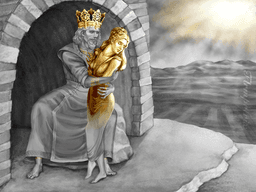
Past Tense (from King Midas and the Golden Touch)
Quiz by Shannon Du
Customize this quiz to suit your class
Instantly translate to 100+ languages
Tag the questions with any skills you have. Your dashboard will track each student's mastery of each skill.
Give this quiz to my class
One day, King Midas _____ a magician and offered him a place to stay.
met
mete
meeted
The magician ________ to Midas and said, "I will give you anything you wish."
spoke
speak
spook
One day, King Midas _____ a magician and offered him a place to stay.
The magician ________ to Midas and said, "I will give you anything you wish."
Breathless with excitement, King Midas ______ down on his chair.
King Midas _____ so excited that he began to dance around.
After a while he became hungry, so he _____ downstairs to eat some grapes.
To his horror, he realized that everything he ____ and drank turned to gold.
To his horror, he realized that everything he ate and ______ turned to gold.
Suddenly his daughter ______ into the room to give her father a hug.
The king was so sad that he _____ into tears and began to cry.
He _____ the price for his greed.
He had _____ the one thing he loved more than gold.
Midas ________, "I wish everything I touched turned to gold."
So the magician ______ the king's wish.
The next day, Midas _____ up and noticed that his bed had turned to gold.
When he _____ the grapes, they turned into pure gold!
He ____ to stop his daughter, but it was too late!
For many days, the king ______.
The king was so grateful that he _____ his wealth with everyone.
After that, he was ______ the kindest king in the country.
 Can you convert a sentence from the present to the past tense?Create 20 mcq with fill in the blanks and 4 choices of answers for these irregular verbs: are, has, choose, do, get, catch, keep, feel, build, buy, pay, ride, find, sell, fly, drive, sleep, sit, grow, make. Give 4 choices of answers to choose from. in simple past tense Create a comprehension quiz for the following vocabulary; To be getting on in age: Growing older; advancing in years. Pet peeve: Something that annoys or bothers someone significantly. Pinhead: A small-minded or foolish person. Nit-pick: To find fault with small or trivial details. Whilst/while: During the time that; at the same time as. On a dig: Engaged in archaeological excavation. Mad vs crazy: "Mad" typically refers to anger or insanity, while "crazy" can denote insanity or extreme enthusiasm. Twitch: A sudden, quick movement or spasm. Dreamt/dreamed: Past tense forms of the verb "to dream." Eaves: The part of a roof that overhangs the walls. Burly man: A strong, muscular man. She’s a looker: A woman who is attractive or visually appealing. Breech birth: A birth in which the baby is delivered feet first instead of head first. Being too forward: Acting too boldly or presumptuously. Gooey: Soft and sticky, often used to describe certain textures or emotional situations. Spare tire: Excess fat around the waistline; a protruding belly. Twists and turns of fate: Unexpected changes or developments in life. Pompous: Self-important or arrogant. Play a prank on someone: To carry out a mischievous trick or joke on someone. Scamps: Mischievous or playful individuals, often used affectionately. To tend one's resignation: To formally submit one's resignation from a job. A sound judgment: A wise or rational decision. To set someone up with someone else: To arrange a meeting or date between two people. Loon: A colloquial term for a crazy or eccentric person. Duvet: A type of blanket filled with feathers, down, or synthetic fibers, used as a bed covering. Don't Meddle: Do not interfere or intervene. Croquet mallet: A hammer-like instrument used to strike croquet balls. Cut it out: Stop doing something annoying or inappropriate. Pop over: Visit briefly or unexpectedly. It was a riot: It was extremely funny or enjoyable. Spit Tspat spat: Sounds indicating a quick, spat-out expulsion of saliva. A hoot: Something that is amusing or enjoyable. Overhear: To unintentionally hear what others are saying without their knowledge. You're quite a package: You possess many appealing qualities or attributes. I'm quite a catch: I am an attractive or desirable partner. Limper: A person who walks with a limp. A hanky: A handkerchief, a small piece of cloth carried for personal hygiene or used as a fashion accessory.Got you now 👍 — you don’t want a code, you want ready-made quiz content you can paste into Quizalize so a teacher/class can use it. I’ll generate a proper SSS1 quiz bank (Maths, English, Basic Science) in a clean format. You can copy this into Quizalize “Create Quiz”. 📘 SSS1 QUIZ (READY FOR QUIZALIZE) 🧠 MATHS (10 QUESTIONS) What is 9 × 8? A. 72 B. 64 C. 81 D. 74 Answer: A Solve: 3x = 15 A. 3 B. 5 C. 6 D. 9 Answer: B What is 12²? A. 124 B. 144 C. 132 D. 122 Answer: B Simplify: 18 ÷ 3 A. 3 B. 5 C. 6 D. 9 Answer: C What is the square root of 49? A. 5 B. 6 C. 7 D. 8 Answer: C Find x: x + 7 = 20 A. 11 B. 12 C. 13 D. 14 Answer: C 5 × 5 × 5 = ? A. 125 B. 100 C. 150 D. 75 Answer: A What is 100 ÷ 4? A. 20 B. 25 C. 30 D. 40 Answer: B What is 15 + 17? A. 31 B. 32 C. 33 D. 34 Answer: B What is 10% of 200? A. 10 B. 20 C. 30 D. 40 Answer: B 📘 ENGLISH (10 QUESTIONS) Choose correct spelling A. Recieve B. Receive C. Receve D. Recive Answer: B Opposite of “fast” A. Quick B. Slow C. Sharp D. Rapid Answer: B Synonym of “happy” A. Sad B. Angry C. Joyful D. Tired Answer: C A noun is a name of a… A. Action B. Place/Person/Thing C. Verb D. Adverb Answer: B He ___ to school every day A. go B. going C. goes D. gone Answer: C Plural of child A. Childs B. Childes C. Children D. Childer Answer: C Antonym of “big” A. Large B. Huge C. Small D. Wide Answer: C A verb is a word that shows A. Name B. Action C. Place D. Thing Answer: B She is ___ honest girl A. a B. an C. the D. no article Answer: A Past tense of go A. Goed B. Gone C. Went D. Going Answer: C 🔬 BASIC SCIENCE (10 QUESTIONS) Plants absorb carbon dioxide during A. Respiration B. Photosynthesis C. Digestion D. Movement Answer: B Human breathing organ A. Heart B. Liver C. Lungs D. Kidney Answer: C Water boils at A. 0°C B. 50°C C. 100°C D. 150°C Answer: C Which is a metal? A. Rubber B. Copper C. Wood D. Plastic Answer: B The sun is a A. Planet B. Star C. Moon D. Comet Answer: B Force is measured in A. Joule B. Newton C. Watt D. Kelvin Answer: B Solid → Liquid is called A. Freezing B. Melting C. Evaporation D. Condensation Answer: B Earth revolves around A. Moon B. Mars C. Sun D. Jupiter Answer: C Human blood is pumped by A. Brain B. Heart C. Lungs D. Kidney Answer: B Energy from the sun is called A. Nuclear B. Solar C. Chemical D. Sound Answer: B ⚡ HOW TO USE IN QUIZALIZE Go to Quizalize Click Create Quiz Choose Manual Input Copy each question Paste with options + correct answer Set timer per question (5–10 sec for pressure mode) 🔥 IF YOU WANT NEXT LEVEL I can also: �Turn this into 100-question exam paper �Add hard WAEC/JAMB-level traps Or �simulate inter-house elimination rounds Just say: “upgrade me” 😈Complete the sentences with the words from the brackets using the Past Simple tense.Make me a question contains 10 points easch has 4 options to from to complete the gap in the givin sentence . the question is about choosing the coreect verb to coplete a sentence in the past sipmle tenseJAKARTA, Indonesia (AP) — Indonesia’s highest volcano on its most densely populated island released searing gas clouds and rivers of lava Sunday in its latest eruption. Monsoon rains eroded and finally collapsed the lava dome atop 3,676-meter (12,060-foot) Mount Semeru, causing the eruption, according to National Disaster Management Agency spokesperson Abdul Muhari. Several villages were blanketed with falling ash, blocking out the sun, but no casualties have been reported. Several hundred residents, their faces smeared with volcanic dust and rain, fled to temporary shelters or left for other safe areas. Thick columns of ash were blasted more than 1,500 meters (nearly 5,000 feet) into the sky while searing gas and lava flowed down Semeru’s slopes toward a nearby river. Increased activities of the volcano on Sunday afternoon prompted authorities to widen the danger zone to 8 kilometers (5 miles) from the crater, said Hendra Gunawan, who heads the Volcanology and Geological Hazard Mitigation Center. He said scientists raised the volcano’s alert level to the highest and people were advised to keep off the southeastern sector along the Besuk Kobokan River, which is in the path of the lava flow. Semeru’s last major eruption was in December last year, when it blew up with fury that left 51 people dead in villages that were buried in layers of mud. Several hundred others suffered serious burns and the eruption forced the evacuation of more than 10,000 people. The government moved about 2,970 houses out of the danger zone. Semeru, also known as Mahameru, has erupted numerous times in the past 200 years. Still, as is the case with many of the 129 active volcanoes in Indonesia, tens of thousands of people continue to live on its fertile slopes. Indonesia, an archipelago of more than 270 million people, sits along the Pacific “Ring of Fire,” a horseshoe-shaped series of fault lines, and is prone to earthquakes and volcanic activity.Make a multiple choice quiz for my year 8 science students based on the science in this transcript from a video: 3°C 0:04 It can be the difference between snow and sleet 0:08 Wearing a jacket or not 0:11 In your day-to-day life, it may not seem significant 0:15 But 3°C of global warming would be catastrophic 0:20 Heatwaves, droughts, extreme precipitation, even fire 0:25 3°C of warming is really disastrous 0:28 The scary thing is, the world is well on its way there 0:32 Since the industrial revolution, the Earth has warmed between 1.1°C and 1.3°C 0:40 This is a problem that babies you pass in the street will have to live with 0:46 Children born today... 0:47 ...are up to seven times more likely to face extreme weather than their grandparents 0:52 If global temperatures do rise by 3°C... 0:55 ...what would their world look like? Climate change is already having devastating effects 1:03 Rising sea levels 1:05 Desertification 1:07 Hollywood has always enjoyed imagining the end of the world 1:11 While blockbusters like this are clearly fiction... 1:14 ...this film will show the scenario we all face... 1:17 ...unless more drastic measures are taken to stop burning fossil fuels 1:30 In some parts of the world the effects of inaction are already clear 1:35 The slums of Bangladesh’s capital are filling up with climate migrants 1:41 Minara comes from Bhola District, an area in southern Bangladesh 1:46 There, like many other parts of the country... 1:49 ...rivers swollen by heavier rain and melting Himalayan glaciers... 1:53 ...are washing away people’s homes 1:56 Many, like her, have lost everything 2:00 Our home in Bhola had endless amounts of land 2:03 There was lots of space for farming, we had a spacious house 2:08 There were different types of fruits, vegetation and trees growing at home 2:12 We used to eat the fruit from our own trees 2:18 I can’t eat them now because they don't exist anymore 2:21 Since the river flooded for the third time, I had to flee to Dhaka 2:26 Life was much better back home 2:29 It was unbearable to live through, truly intolerable 2:33 We didn’t have the time to save anything at all 2:38 1.1°C to 1.3°C of global warming has already transformed Minara’s life 2:45 It’s one of the reasons why so many migrants like her... 2:47 ...are moving to the city each year... 2:50 ...nearly 400,000 according to the last estimate 2:53 And climate models show there could be much worse to come How climate modelling works 3:02 Climate scientist Joeri Rogelj... 3:04 ...has spent the last ten years modelling future climate scenarios... 3:08 ...for the United Nations 3:10 The models we use to carry out this exercise... 3:13 ...really represent the state of the art... 3:15 ...of our current knowledge of climate change and where we are heading 3:19 Joeri’s projections use data collected by hundreds of scientists around the world 3:26 Here this is the 3°C level... 3:28 ...and so there is at least a one-in-four chance that under current policies... 3:32 ...we would hit 3°C by the end of the century 3:36 This is just one of the scenarios Joeri looks at 3:40 Another one imagines that all policy promises are kept 3:44 The most optimistic assumes that all promises have been kept... 3:47 ...and net-zero targets are met 3:50 Where our best estimate ends up around 2°C at the end of the century... 3:54 ...there is still a one-in-20 chance that we end up with 3°C instead 3:59 One would not be entering a plane if there is a one-in-20 chance... 4:03 ...that the plane will crash Nowhere is safe from global warming 4:07 A rise of 3°C would affect everyone 4:10 Even wealthy cities in rich countries wouldn’t be immune to the consequences 4:15 European capitals like Paris and Berlin... 4:18 ...would bake under more extreme heatwaves 4:22 Frequent storm-surges in New York could turn parts of the city desolate 4:27 In many ways, cities magnify, intensify climate events 4:33 Cities are hotter than the places around them... 4:36 ...they tend to be more vulnerable to flooding 4:39 And you can get a really bad event in a city in a way that you can’t in the countryside 4:46 And because of their denser populations... 4:49 ...disasters in a city affect far more people 4:52 Some cities might be badly prepared for the changes coming 4:56 But they have the means to adapt 4:59 Cities tend to be wealthier than surrounding places 5:03 They have a lot of amenities 5:05 A city that has taken seriously the risks of a 3°C world... 5:08 …wouldn’t necessarily be a worse place to be in a 3°C world 5:12 But a city that hasn’t prepared for these sort of eventualities... 5:16 ...that might be a really nasty place The impact of prolonged droughts 5:20 So far, many developed cities have got off lightly... 5:24 ...but some rural parts of the world are suffering disproportionately 5:29 Smallholders—small-scale farmers—are particularly vulnerable to climate change 5:35 And there are over 600 million around the world 5:38 Smallholders with farms under two hectares... 5:40 ...produce around a third of the global food supply 5:46 Central America’s “Dry Corridor”... 5:48 ...supports a mix of smallholdings and medium-sized farms 5:53 Sandwiched between the Pacific Ocean and the Caribbean Sea... 5:56 ...the area is prone to droughts 6:08 Israel Ramírez Rivera is a smallholder in Guatemala 6:12 Here, climate change is making the dry seasons longer, and more severe 6:18 This is the biggest ear of maize that this plot could deliver 6:23 He depends on his crops of corn and beans 6:26 But they’re getting harder to grow 6:30 The surrounding mountains... 6:32 ...used to provide us with native food... 6:38 ...and now that isn’t an option anymore... 6:41 ...due to climate change and its effects 6:46 Nearly two-thirds of the smallholders in the Dry Corridor now live in poverty 6:52 The impact of all of this for us... 6:59 ...malnutrition among children 7:03 We’ve lost a few 7:07 For my crops especially, the midsummer heat is harder than before 7:16 The plant dries up and can’t provide us... 7:19 ...with the necessary food provision 7:24 Severe droughts in Central America... 7:26 ...are now four times more likely than they were last century 7:30 Many families from here have gone to the States 7:37 The economic despair and debts... 7:44 ...have pushed many people from this community to do this journey 7:53 Migration from Guatemala to the United States has quadrupled since 1990 7:59 Not all of this has been due to climate change 8:02 But longer droughts would force even more to move 8:05 In a 3°C world, annual rainfall in this region... 8:09 ...could drop by up to 14% 8:12 At 3°C, over a quarter of the world’s population... 8:16 ...could endure extreme droughts for at least a month of the year 8:19 Northern Africa could see droughts that last for years at a time Rising sea levels, storm surges and flooding 8:24 But for some, too much water will be the problem 8:29 10% of the world’s population lives on a coastline... 8:32 ...that’s less than 10 metres above sea level 8:35 For these coastal inhabitants, a 3°C world would spell disaster 8:40 By 2100, global sea levels could have climbed by half a metre from 2005 levels 8:46 Low-lying cities like Lagos would be especially vulnerable... 8:49 ...with up to up to a third of the population displaced 8:54 And in Fiji, rising waters are already upending lives 9:04 You can see the graveyard there, it’s all under water now... 9:08 ...due to this rising sea level and climate change 9:15 The village of Togoru in Fiji is being swallowed by the sea 9:19 Barney Dunn, the village headman, has seen over half the village disappear 9:24 Relatives’ houses have been abandoned, and family graves are now under water 9:29 We have been asked by the government to relocate... 9:32 ...but no one wants to relocate... 9:34 ...because we have our great-great-grandparents down there in the sea 9:39 This is the place we’ve been brought up in 9:41 ...it’s not easy to leave 9:44 Past attempts to build a seawall haven’t worked 9:48 But Barney sees building a new one as the village’s only hope 9:52 If they do that, maybe we can save whatever is left 9:56 But if we don’t have the seawall, then it will be keep eroding and time will come... 10:01 ...maybe in ten,15 years, Togoru will be all eroded 10:05 Rising seas also mean storms cause more floods 10:11 And many more countries could suffer 10:14 The Philippines and Myanmar are just two countries... 10:17 ...that will also see an increase in storm surges in a 3°C world 10:21 To escape, many will move… 10:24 …often, to urban areas Extreme heat and wet-bulb temperatures 10:27 Half the world’s population already lives in cities... 10:31 ...almost a third in slums 10:36 For them, a 3°C world could be deadly 10:40 Minara has moved to Dhaka to escape the impact of climate change 10:44 But life could get even worse for her 10:47 I’m struggling a lot nowadays 10:49 The heat during the day is unbearable 10:52 Even late at night it doesn’t cool down 10:57 The heat is getting more intense every day 10:59 I mean, it’s going to get much worse 11:03 I can barely survive it now, how will I live through it in the future? 11:08 Dhaka is getting hotter 11:11 In the last 20 years the average daytime temperature... 11:13 ...has crept up by nearly half a degree 11:17 Days that approach 40°C are now being reported 11:20 And high so-called wet-bulb temperatures are on the rise 11:26 A wet-bulb temperature is a measure of heat and humidity 11:30 Humans cool themselves by sweating… 11:32 But in these conditions, when relative humidity is near 100%... 11:36 ...sweat doesn’t evaporate well 11:38 So people can’t cool down… 11:41 ...even if given unlimited shade and water 11:45 At a high wet-bulb temperature, the body can’t lose heat... 11:49 ...and so it gets hotter and hotter... 11:51 ...and the body is designed to work at a given temperature 11:53 And if it gets too hot inside, you will die 11:58 The human limit for wet-bulb temperatures is 35°C... 12:02 ...around skin temperature 12:04 Dhaka will have a much higher chance... 12:05 ...of reaching dangerous wet-bulb temperatures... 12:07 ...if global warming reaches 3°C 12:12 You can’t really adapt to that 12:14 You have to get out. If the temperature is so high that you can’t work... 12:20 ...can’t do hard manual labour outside for significant parts of the year... 12:25 ...then many places will become functionally no longer part of the economy 12:33 Jacobabad in Pakistan, and Ras al Khaimah, in the United Arab Emirates... 12:37 ...have already recorded deadly wet-bulb temperatures 12:40 More of the tropics and the Persian Gulf... 12:43 ...as well as parts of Mexico and the south-eastern United States... 12:47 ...could all get to this threshold by the end of the century 12:50 Climate modelling might show us the weather Increased migration and conflict 12:52 But it doesn’t show us its other effects on society 12:56 Established migration patterns could change 12:59 Climate disasters may exacerbate reasons people cross borders 13:03 Within countries, more people will move to cities 13:07 In a 3°C world, tens of millions of people a year... 13:10 ...could be displaced by disasters made worse by climate change 13:15 When people are displaced by climate... 13:18 …they may well go to cities... 13:19 ...because cities are the places that attract people from the countryside already 13:25 A lot of people who can get to the developed world... 13:28 ...not least because the developed world tends to be less hot, will give that a go 13:35 As migration around the world increases... 13:38 ...there could be more competition for fewer resources 13:42 Water—already a highly contested resource—will be a focal point 13:47 Turkey’s new Ilisu dam has reduced the flow of water into Iraq 13:53 China lays claim to rivers vital to India and Pakistan 13:57 The prospect of a water-conflict makes people very uneasy 14:03 How national tensions would exacerbate those sorts of reactions... 14:08 ...in a 3°C world... 14:09 ...is the sort of thing that no one should really want to find out 14:14 I think you’d have to be incredibly sanguine... 14:16 ...not to think that the sort of climate extremes that we talk about... 14:19 ...in a 3°C world wouldn’t lead some places... 14:22 ...to the brink of societal collapse 14:25 Those lucky enough to escape unrest... Adaptation and mitigation are crucial 14:28 ...would still have to adapt to a radically different world 14:32 People can adapt to climate change in all sorts of ways, one of the most obvious ones... 14:37 ...is air conditioning 14:39 But other ways to adapt at a local or regional level... 14:42 ...I mean, one of the most obvious is diversifying agriculture 14:47 There are physical things you can do, like seawalls 14:52 The fact that people can adapt and that adaptation will reduce suffering... 14:57 ...doesn’t mean that it will eliminate suffering 15:00 Suffering is built into this whole process of heating up the planet 15:06 Adaptation will only get the world so far 15:09 The best way to deal with a 3°C world... 15:12 ...is not to go to a 3°C world 15:14 And that’s why increasing efforts on mitigation are important 15:17 It’s why working towards negative emissions... 15:20 ...that could bring down the temperature after it peaks are important 15:25 Once you get to a 3°C world, you are in real bad global trouble 15:33 The scale of change needed... 15:35 ...and the slow progress of governments so far... 15:38 ...means 3°C of warming is uncomfortably likely unless more is done 15:44 Despite existing pledges, greenhouse-gas emissions... 15:48 ...are still set to rise by 16% from 2010 levels by 2030 15:54 The need to act has never been clearer 15:57 There’s still time to reduce emissions, so that a 3°C world remains fiction... 16:02 ...rather than becoming fact