Loading...


PHYSICS CLASS XI (JEE/NEET) OPTICS
Quiz by Janiya Malhotra
Tag the questions with any skills you have. Your dashboard will track each student's mastery of each skill.
1.
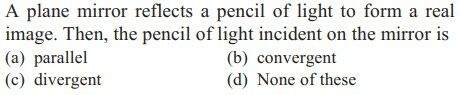
a
d
b
c
1
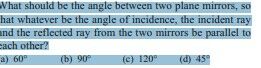
c
d
a
b
1.

1
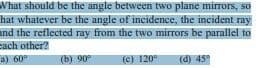
A man is 180 cm tall and his eyes are 10 cm below the top of his head. In order to see this entire height right from top to head, he uses a plane mirror kept at a distance of 1m from him. The minimum length of the plane mirror is
A ray of light is incident on a plane mirror at an angle of 30°. The deviation produced in the ray is
To get three images of a single object, one should have two plane mirrors at an angle of
Two mirrors are kept at 60° to each other and a body is placed at the middle. The total number of images formed is
8

When a plane mirror is placed horizontally on level ground at a distance of 60 m from the foot of a tower, the top of the tower and its image in the mirror subtend an angle of 90° at the corner of the mirror nearer to the foot of tower. The height of the tower is
A watch shows the time as 3 : 25. What will be the time that appears when seen through a plane mirror?
1

The focal length of a concave mirror is 50 cm. Where an object be placed, so that its image is two times and inverted
An object of size 7.5 cm is placed in front of a convex mirror of radius of curvature 25 cm at a distance of 40 cm.The size of the image should be
The image formed by a convex mirror of focal length 30 cm is a quarter of the size of the object. The distance of the object from the mirror is
An object is placed 40 cm from a concave mirror of focal length 20 cm. The image formed is
A concave mirror gives an image three times as large as the object placed at a distance of 20 cm from it. For the image to be real, the focal length should be
1

A point object is placed at a distance of 30 cm from a convex mirror of focal length 30 cm. The image will form at
Convergence of concave mirror can be decreased by dipping in
A point object is placed at a distance of 10 cm and its real image is formed at a distance of 20 cm from a concave mirror. If the object is moved by 0.1 cm towards the mirror, the image will shift by about
An object is placed at a distance of 30 cm from a concave mirror and its real image is formed at a distance of 30 cm from the mirror. The focal length of the mirror is (a) 15 cm (b) 45 cm (c) 30 cm (d) 20 cm
A boy 2 m tall stands 40 cm in front of a mirror. He sees an erect image, 1 m high. The mirror is (a) concave (b) convex (c) plane (d) either convex or concave
An object is 20 cm away from a concave mirror with focal length 15 cm. If the object moves with a speed of 5 m/s along the axis, then the speed of the image will be (a) 45 m/s (b) 27 m/s (c) 9 m/s (d) 10 m/s
The refractive index of a certain glass is 1.5 for light whose wavelength in vacuum is 6000 Å. The wavelength of this light when it passes through glass is (a) 4000 Å (b) 6000 Å (c) 9000 Å (d) 15000 Å
1

1

1

2

1
1
A green light is incident from the water to the air-water interface at the critical angle ( ) θ . Select the correct statement. [IIT Main]
The apparent flattening of the sun at sunset and sunrise is due to [Kerala CEE]
1
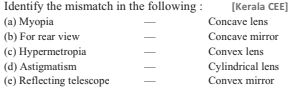
A microscope is having objective focal lengths 1 cm and eye piece of focal length 6 cm. If tube length is 30 cm and image is formed at the least distance of distinct vision, what is the magnification produced by the microscope. (take, D = 25cm) [Karnataka CET]
1
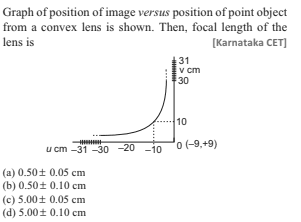
A focal length of a lens is 10 cm. What is power of a lens in dioptre? [Karnataka CET]
An object is placed at 20 cm in front of a concave mirror produces three times magnified real image. What is the focal length of the concave mirror? [Karnataka CET]
1
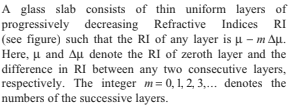
1

13. A luminous object is separated from a screen by distance d. A convex lens is placed between the object and the screen such that it forms a distinct image on the screen. The maximum possible focal length of this convex lens is [WB JEE]
1
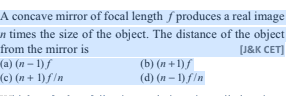
1
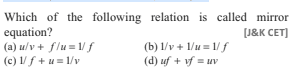
Light form a point source in air falls on a spherical glass surface (n = 1.67 and radius of curvature = 25 cm). The distance of the light source from the glass surface is 95 cm. At what position, the image is formed? [J&K CET]
The angle of a prism is 42° and refractive index of its material is 3/2. Then, angle of minimum deviation for this prism is [J&K CET]
18. A compound microscope has a magnification of 30. The focal length of the eye-piece is 5 cm. If the final image is formed at the least distance of distinct vision (25 cm) the magnification produced by the objective is [J&K CET]
1
1
1
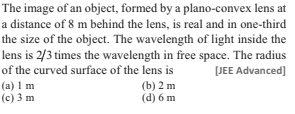
Diameter of a plano-convex lens is 6 cm and thickness at the centre is 3 cm. If speed of light in material of lens is 2 108 × m/s, the focal length of the lens is [JEE Main]
1
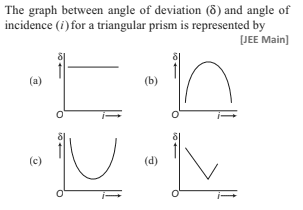
1
