Loading...


PISA - GRAND CANYON
Quiz by Evelyn Grace Labasan
Tag the questions with any skills you have. Your dashboard will track each student's mastery of each skill.
The temperature in the Grand Canyon ranges from below 0 oC to over 40 oC. Although it is a desert area, cracks in the rocks sometimes contain water. How do these temperature changes and the water in rock cracks help to speed up the breakdown of rocks?
A. Freezing water dissolves warm rocks
B. Water cements rocks together.
C. Ice smoothes the surface of rocks.
D. Freezing water expands in the rock cracks.
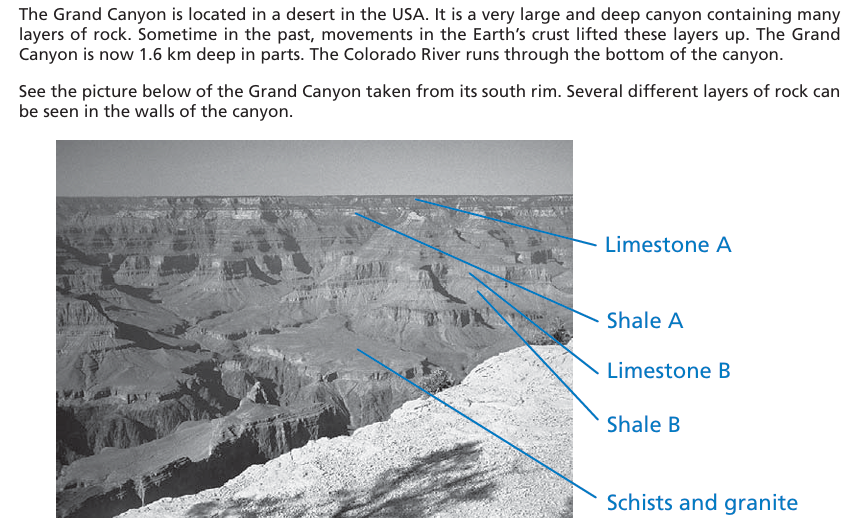
A. Freezing water dissolves warm rocks
C. Ice smoothes the surface of rocks.
D. Freezing water expands in the rock cracks.
B. Water cements rocks together.
The temperature in the Grand Canyon ranges from below 0 oC to over 40 oC. Although it is a desert area, cracks in the rocks sometimes contain water. How do these temperature changes and the water in rock cracks help to speed up the breakdown of rocks?
A. Freezing water dissolves warm rocks
B. Water cements rocks together.
C. Ice smoothes the surface of rocks.
D. Freezing water expands in the rock cracks.
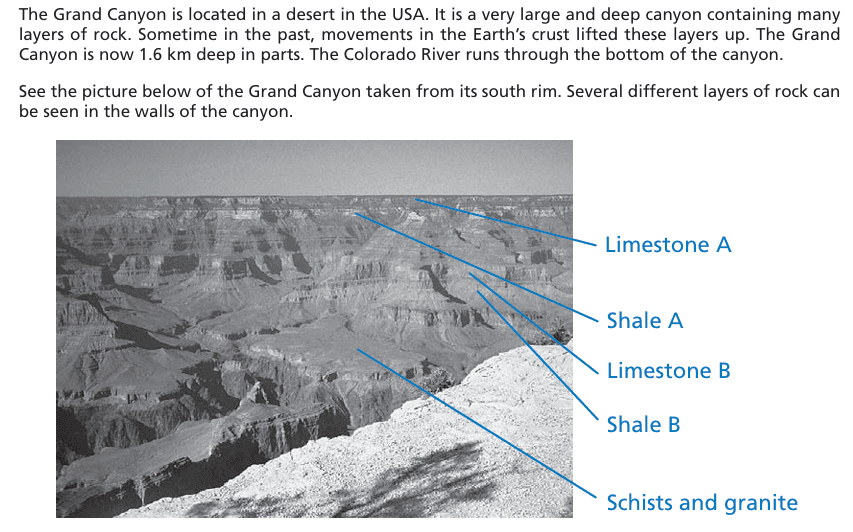
There are many fossils of marine animals, such as clams, fish and corals, in the Limestone A layer of the Grand Canyon. What happened millions of years ago that explains why such fossils are found there?
A In ancient times, people brought seafood to the area from the ocean.
B Oceans were once much rougher and sea life washed inland on giant waves.
C An ocean covered this area at that time and then receded later.
D Some sea animals once lived on land before migrating to the sea
About five million people visit the Grand Canyon national park every year. There is concern about the damage that is being caused to the park by so many visitors. Can the following questions be answered by scientific investigation? Circle “Yes” or “No” for each question

The Grand Canyon, located in Arizona, USA, is a massive canyon carved by the Colorado River over millions of years. It is about 277 miles (446 km) long, up to 18 miles (29 km) wide, and attains a depth of over a mile (6,093 feet or 1,857 meters). The canyon is known for its layered bands of red rock, revealing millions of years of geological history. It is also home to diverse ecosystems and a popular destination for tourists, geologists, and scientists.
The Grand Canyon is often described as a "window to Earth's past" due to the way it reveals layers of rock that span over a billion years of geological history.
The layers of the Grand Canyon are significant because:
A They show that the canyon was formed rapidly by a single event.
B They provide evidence of the slow and continuous processes that shaped Earth’s surface over time.
C They were created by the construction of dams and human interventions.
D They suggest that the Grand Canyon formed in the last 10,000 years.
Describe two ways scientists might use the Grand Canyon to understand Earth's past climate.
If erosion by the Colorado River were to continue at the same rate, how might the Grand Canyon look in another 10 million years?
A The canyon would become much narrower and deeper, with new rock layers exposed.
B The canyon would fill up with sediment, eventually becoming flat.
C The canyon would completely disappear as erosion levels it with the surrounding land.
D The Colorado River would stop flowing, and the canyon would remain the same as today.
The Grand Canyon is often studied by geologists to understand the Earth's tectonic history. The layers of rock in the canyon show shifts and faults that occurred over millions of years. Some of these shifts are evidence of tectonic plate movements.
Which of the following statements best explains how tectonic activity contributed to the formation of the Grand Canyon?
A Tectonic plates collided, causing a deep valley to form suddenly.
B The shifting tectonic plates elevated the Colorado Plateau, allowing the Colorado River to cut through the rock over millions of years.
C Volcanic eruptions created the canyon by removing large sections of rock.
D Tectonic activity had no role in the formation of the Grand Canyon, as it was formed solely by water erosion.
Over time, the Colorado River has eroded rock layers of the Grand Canyon, revealing fossils from different periods. Some fossils found in the deeper layers belong to marine animals like trilobites, which lived hundreds of millions of years ago.
What does the presence of marine fossils deep within the Grand Canyon's rock layers suggest about the region's past?
A The Grand Canyon was once an ocean floor.
B The Grand Canyon has always been above sea level.
C Marine animals once lived in the Colorado River.
D The Grand Canyon formed due to volcanic activity in the ocean.
The Grand Canyon is known for its steep cliffs and deep valleys, making it a popular destination for hiking and exploration. However, visitors are often warned about flash floods caused by sudden rainstorms, even if the rain falls miles away.
Why are flash floods a serious risk in the Grand Canyon?
A The canyon’s steep sides funnel water rapidly into the Colorado River, leading to sudden flooding.
B The river absorbs all the rainfall, leaving the canyon dry during storms.
C The Colorado River frequently overflows its banks, causing floods.
D Rainwater in the region evaporates quickly, preventing any flood risk.
The Grand Canyon is not only a geological wonder but also a place of cultural and historical importance. Several Native American tribes, including the Havasupai and Hopi, consider the Grand Canyon sacred and have lived in or near the area for centuries.
Explain two ways in which the Grand Canyon is significant to Native American cultures, beyond its physical landscape.